
BAR-230 · Lesson 10 of 12 · 19 min
New Hampshire Rules of Professional Conduct
▶ Video coming soon A video version of this lesson is on the way.
Ezra's MPRE was more than a year behind him when, in November, a call came into Caswell and Thayer that sent him straight back to the ethics rules. A man who had been a client of the firm two years earlier, in the purchase of a house, called to ask whether Margaret Caswell could represent him in a dispute with his new neighbor about a boundary. The neighbor, it turned out, had consulted Joan Thayer the month before about the same boundary, though she had not hired the firm. Caswell asked Ezra to pull the New Hampshire rules on prospective clients and conflicts and to write her a short memo by the end of the day.
'This is where the MPRE and real practice part ways a little,' Marchetti told him at their next session. 'The MPRE tests the ABA Model Rules. You practice under the New Hampshire Rules of Professional Conduct. They are built on the Model Rules, so most of what you learned still applies, but New Hampshire has its own text in places, its own comments and its own rules with no Model Rule counterpart. When a question matters, you read the New Hampshire version.' This lesson explains the structure of the New Hampshire rules, the attorney discipline system, several New Hampshire features that a new lawyer should know and the practical rules on client funds.
The rules and their structure
The New Hampshire Supreme Court adopts the Rules of Professional Conduct, which are published on the judicial branch website alongside the other court rules. New Hampshire's current rules were adopted in a comprehensive overhaul that took effect in 2008 and that reorganized the state's rules to follow the numbering and much of the text of the ABA Model Rules. Since then the court has amended individual rules from time to time, often after recommendations from the Bar Association's Ethics Committee and the court's advisory committee on rules.
Two features of the format are worth knowing. First, the rules follow the Model Rules' numbering, so a lawyer who knows that Rule 1.7 governs current-client conflicts and Rule 1.9 governs former-client conflicts can find the New Hampshire version immediately. Second, the published rules include commentary that explains New Hampshire's approach. Some comments track the ABA's, and some are New Hampshire comments explaining where and why the state departs from the Model Rules. The comments help with interpretation, but the text of the rule controls.
Rules with no Model Rule counterpart
New Hampshire's rules include provisions that a lawyer trained only on the Model Rules will not recognize. Two examples appear in the published rules. Rule 1.19, titled Disclosure of Information to the Client, imposes disclosure duties on lawyers beyond those in the Model Rules, including disclosure to clients when a lawyer in private practice does not maintain professional liability insurance at the levels the rule specifies. Rule 4.5, titled Subpoenas, addresses lawyers' use of subpoenas, which New Hampshire lawyers can issue in many proceedings, and sets standards to prevent their misuse.
Neither rule appears on the MPRE. Both appear in New Hampshire practice. A new lawyer opening a solo practice must decide whether to carry malpractice insurance and, if not, comply with Rule 1.19's disclosure requirement. A litigator who issues a records subpoena must follow Rule 4.5 and the procedural rules on notice to other parties.
| Topic | MPRE (ABA Model Rules) | New Hampshire practice |
|---|---|---|
| Numbering and core duties | Model Rules 1.1 to 8.5 | Same numbering; most duties substantially similar |
| Commentary | ABA comments | Published comments including New Hampshire comments on departures |
| Disclosure to clients | No general rule on insurance disclosure | Rule 1.19 requires specified disclosures, including lack of malpractice insurance |
| Subpoenas | No specific rule | Rule 4.5 governs lawyers' use of subpoenas |
| Client trust accounts | Rule 1.15 | Rule 1.15 plus Supreme Court Rule 50 and related rules on trust account procedures |
| Discipline system | Not tested by structure | Supreme Court Rule 37: Attorney Discipline Office and committees |
Prospective clients and conflicts
Ezra's memo began with the conflict rules, which in New Hampshire follow the Model Rule structure. Rule 1.18 protects prospective clients: a person who consults a lawyer about the possibility of forming a client-lawyer relationship. Even if no relationship results, the lawyer may not use or reveal information learned in the consultation, except as the rules permit for former clients, and may not represent a client with interests materially adverse to the prospective client in the same or a substantially related matter if the lawyer received information that could be significantly harmful to the prospective client. If the lawyer who received the information is disqualified, the rule allows other lawyers in the firm to proceed if the disqualified lawyer is timely screened and written notice is given to the prospective client, or if both the prospective client and the affected client give informed consent confirmed in writing.
Rule 1.9 governs duties to former clients. The man calling the firm was a former client, but in an unrelated matter, a house purchase. The question for the new matter was not whether he could be represented against his own interests, but whether the firm could take him on as a current client against the neighbor, who had been a prospective client of Joan Thayer.
Worked problem
Ezra's conflict memo
The neighbor consulted Joan Thayer last month about the boundary and did not hire the firm. Now the neighbor's adversary, a former client of Margaret Caswell, asks Caswell to represent him in the same boundary dispute.
Show solution
- Identify the relationship: the neighbor is a prospective client of the firm under Rule 1.18 because she consulted Thayer about forming a relationship.
- Same matter, adverse interests: the new client's interests are materially adverse to hers in the same matter.
- Harmful information: the memo asks what Thayer learned. If she received information that could be significantly harmful to the neighbor, such as her plans or weaknesses in her title, Thayer is disqualified.
- Imputation and screening: the firm may proceed only if Thayer is timely screened and the neighbor receives prompt written notice, or if both the neighbor and the new client give informed consent confirmed in writing.
- Practical recommendation: in a three-lawyer firm where everyone shares files and conversations, a reliable screen is hard to build. Unless both give informed consent, decline the matter.
Answer: The firm should decline unless both parties give informed written consent, because an effective screen is unrealistic in a firm of three lawyers who share space.
Caswell agreed with the recommendation and declined the matter, referring the caller to two other firms. She told Ezra the memo's best line was the practical one: rules permit screening, but a screen has to work in the real office.
Fees and engagement letters
New Hampshire's fee rule follows the Model Rule's structure: fees must be reasonable, considering factors such as the time and labor required, the customary fee and the results obtained; contingent fees must be in a writing signed by the client that states the method of calculation; and contingent fees are prohibited in criminal cases and in most domestic relations matters. On the communication of fees to a new client, several states are stricter than the Model Rule's suggestion that the basis of the fee be communicated preferably in writing. A New Hampshire lawyer should read the New Hampshire text of Rule 1.5 and should, as a matter of good practice, use a written engagement letter in every new matter.
At Caswell and Thayer, every new client receives an engagement letter that describes the scope of the representation, the fee arrangement, the responsibilities of lawyer and client, and how the representation will end. In limited-scope matters, which are common in family law, the letter describes exactly what the lawyer will and will not do, because the rules on limited representation require the limitation to be reasonable and the client to give informed consent.
Client funds: Rule 1.15 and Supreme Court Rule 50
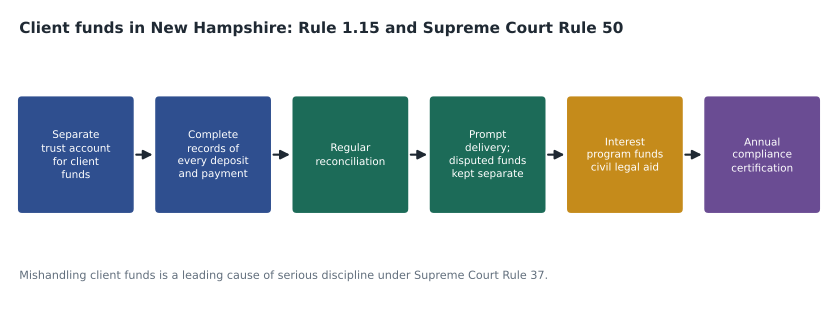
The most common source of serious discipline for lawyers anywhere is mishandling client funds, and New Hampshire treats trust accounting with particular care. Rule 1.15 requires a lawyer to hold client and third-party funds separately from the lawyer's own funds, to keep complete records, to promptly deliver funds that a client or third party is entitled to receive and to keep disputed funds separate until the dispute is resolved. The Supreme Court's Rule 50 and related rules set detailed procedures for trust accounts, including record-keeping, reconciliation and the participation of trust accounts in the state's interest on lawyers' trust accounts program, whose interest funds civil legal services through the New Hampshire Bar Foundation.
Lawyers certify their compliance with the trust account rules as part of their annual obligations to the court, and the court's attorney discipline system can audit trust accounts. A new lawyer who opens a solo practice should set up the trust account correctly from the first day and learn the reconciliation procedures before receiving the first retainer.
The attorney discipline system
Lawyer discipline in New Hampshire is administered under Supreme Court Rule 37, which establishes the attorney discipline system. Complaints go to the Attorney Discipline Office, which screens and investigates them. A complaint screening committee reviews matters at an early stage, hearings committees hear contested cases, and the Professional Conduct Committee decides many matters and recommends serious sanctions to the Supreme Court. Only the Supreme Court can suspend or disbar a lawyer.
For a new lawyer, the most important features of the system are practical. Lawyers must cooperate with disciplinary investigations. A lawyer who receives a grievance should respond promptly and candidly, and should consider consulting a lawyer experienced in discipline matters. And many grievances can be prevented by the basic habits the rules require: communicating with clients, returning calls, explaining fees in writing and keeping client funds separate.
The Ethics Committee and ethics opinions
The New Hampshire Bar Association's Ethics Committee issues advisory opinions on questions of professional conduct, publishes articles on recurring problems and answers inquiries from lawyers through an ethics guidance service. Its opinions are not binding on the court, but they are widely followed and are often the first place a New Hampshire lawyer looks when the rules do not clearly answer a question. When Ezra drafted his conflict memo, he searched the committee's opinions for guidance on prospective clients and screening before finishing his recommendation.
Admission duties that continue after the oath
Some obligations come from Rule 42 rather than the Rules of Professional Conduct. Admitted lawyers must promptly notify the Bar Association in writing of changes to their residence or office address. They must complete the Practical Skills Course within two years, as Lesson 6 explained. They must complete continuing legal education each year, as Lesson 11 explains. And they must pay the combined Bar Association dues and Supreme Court fees, billed together on a single invoice for the license year running from June 1 to May 31.
Keeping the two sets of rules apart
For the MPRE, Ezra learned the Model Rules. For practice, he now uses the New Hampshire rules. The two overlap so much that the risk of confusion is small, but the differences matter when they apply. Marchetti suggested that he keep a short list of New Hampshire provisions with no Model Rule counterpart, such as Rules 1.19 and 4.5, and of New Hampshire text that differs from the Model Rules on topics he encounters often, such as fees and limited representation. When a question arises, he checks the list first, then reads the current rule on the judicial branch website, then looks for an Ethics Committee opinion.
Common mistakes
MistakeThe New Hampshire rules are identical to the ABA Model Rules.
InsteadThey follow the Model Rules' structure but include New Hampshire text, New Hampshire comments and rules such as 1.19 and 4.5 with no Model Rule counterpart.
MistakeA prospective client who never hired the firm creates no conflict.
InsteadRule 1.18 can disqualify the lawyer and, absent screening and notice or consent, the firm.
MistakeA screen is always enough to cure a conflict.
InsteadScreening must be timely and effective; in a very small firm it may not be realistic.
MistakeTrust account rules are only in Rule 1.15.
InsteadSupreme Court Rule 50 and related rules set detailed trust account procedures.
MistakeThe Bar Association disciplines lawyers.
InsteadDiscipline runs through the court's attorney discipline system under Supreme Court Rule 37.
Summary and key terms
- New Hampshire's Rules of Professional Conduct follow the Model Rules' numbering, with New Hampshire text and comments where the state departs.
- Rules 1.19 (disclosure to clients) and 4.5 (subpoenas) have no Model Rule counterpart.
- Rule 1.18 protects prospective clients; screening and notice or informed consent may allow the firm to proceed.
- Client funds are governed by Rule 1.15 and Supreme Court Rule 50, with annual compliance certification.
- Discipline is administered under Supreme Court Rule 37 through the Attorney Discipline Office and its committees.
- The Bar Association's Ethics Committee issues advisory opinions that are widely followed.
- 0
- Rules of Professional Conduct
- 1
- Rule 1.19
- 2
- Rule 4.5
- 3
- prospective client
- 4
- screening
- 5
- trust account
- 6
- Attorney Discipline Office
- 7
- Ethics Committee
Practice problems
Work each problem on paper first, then reveal the answer to check.
Which New Hampshire rule addresses disclosure to clients when a lawyer lacks malpractice insurance?
Show answer
Rule 1.19, Disclosure of Information to the Client.
Under what supreme court rule is New Hampshire's attorney discipline system established?
Show answer
Supreme Court Rule 37.
Can a three-lawyer firm take a matter adverse to a prospective client who consulted one of its lawyers?
Show answer
Only if the consulted lawyer is timely screened and the prospective client receives written notice, or both clients give informed written consent, and the screen must actually work.
Does the MPRE test New Hampshire Rule 4.5?
Show answer
No. The MPRE tests the ABA Model Rules; Rule 4.5 is a New Hampshire rule.
Lesson quiz · 5 questions
Score 60% or more to complete this lesson.
Create a free account to save your progress, take quizzes and earn a certificate.