
BAR-230 · Lesson 6 of 12 · 19 min
No state component: what the exam tests and how New Hampshire law appears
▶ Video coming soon A video version of this lesson is on the way.
Ezra came to his mid-November session with a problem he had not expected. 'I spent three hours this week reading superior court orders on apportionment for a case at work,' he said, 'and then I sat down to do an MEE torts question and wrote the New Hampshire rule. My practice grader marked it down. The model answer used the general multistate rule. Now I'm worried I'm going to mix the two up on the real exam.' Marchetti had heard this before, mostly from candidates who clerk while they study. 'That is the central challenge for a New Hampshire candidate,' she said. 'You have to learn to keep two sets of rules in separate drawers: the general principles the exam tests, and the New Hampshire rules you will use on Monday morning after you are sworn in.'
This lesson explains what it means for New Hampshire to have no state-specific component, how the UBE treats state law, why the line between general and local rules matters for a candidate who works in a New Hampshire office, and how the state builds local knowledge after admission through the Practical Skills Course. It ends with a method for studying the two sets of rules without confusing them.
No jurisdiction-specific requirement
Several UBE jurisdictions add something of their own to the exam: a short online course with a test on state law, a separate state essay, or a state-specific module that must be completed before admission. New Hampshire does none of these. NCBE's chart for New Hampshire lists no jurisdiction-specific component for the legacy UBE, for NextGen, for admission by transferred UBE score or for admission on motion. The court's bar examination page confirms that the MEE answers are graded on general legal principles and not on New Hampshire law.
For a candidate, the consequence is simple. Nothing on the February 2027 exam requires knowledge of New Hampshire statutes, New Hampshire cases or the New Hampshire Rules of Professional Conduct. A perfect knowledge of RSA 507:7-d will not earn a single point, and a candidate who writes the New Hampshire rule where the general rule is called for risks losing points, as Ezra found.
How the UBE treats state law
Every UBE question is written to be answered under generally accepted principles, not under the law of any particular state. On the MBE, the instructions direct candidates to apply generally accepted rules unless a question says otherwise; questions on contracts involving the sale of goods apply Article 2 of the Uniform Commercial Code; and questions on evidence apply the Federal Rules of Evidence. On the MEE, the questions are graded according to NCBE's analyses, which identify the majority or most widely accepted rule and sometimes note a significant minority rule. When the analysis notes a split, a candidate who identifies both rules and applies them shows command of the issue.
On the MPT, the problem is different. The library supplies the law, which may be the law of a fictional jurisdiction called Franklin, of a real state, or of the federal courts. The candidate must use the authorities in the library and nothing else. A New Hampshire candidate who knows a New Hampshire rule on the subject of an MPT task must set that knowledge aside and work from the file and library.
| Part of the exam | Source of law tested | What a New Hampshire candidate should do |
|---|---|---|
| MBE | Generally accepted principles; UCC Article 2 for sales; Federal Rules of Evidence | Apply the general rule even when New Hampshire differs |
| MEE | Majority rules as identified in NCBE analyses; occasionally a noted minority rule | State the general rule; mention a well-known split only if it matters |
| MPT | Only the law in the library | Ignore outside knowledge, including New Hampshire law |
| MPRE | ABA Model Rules and general principles | Apply the Model Rules even where New Hampshire's rules differ |
Where New Hampshire law differs from the general rule
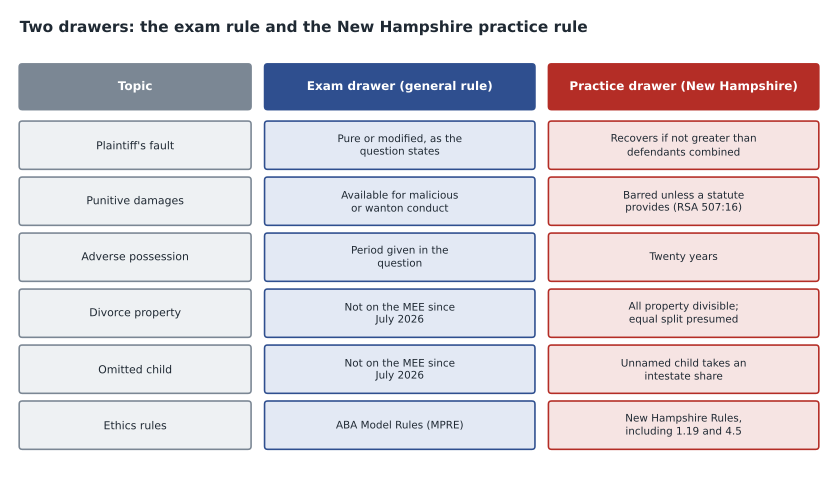
Because Ezra works in a New Hampshire firm, the risk of mixing rules is real. The useful defense is to know, in advance, where the New Hampshire rule departs from the general rule the exam tests. A short list covers most of the danger in the subjects he works on every day.
In torts, the MBE tests comparative negligence by distinguishing pure comparative negligence, which lets a plaintiff recover reduced damages however great the plaintiff's own share, from modified comparative negligence, which bars recovery once the plaintiff's share passes a threshold. New Hampshire follows a modified form under RSA 507:7-d, in which a plaintiff whose fault is not greater than the defendant's, or the defendants' combined, may recover reduced damages. An MBE question will tell the candidate which system applies, or ask about the general concepts, and the answer must follow the question, not New Hampshire. Similarly, punitive damages are a standard remedy on the MBE for malicious or wanton torts, but RSA 507:16 bars them in New Hampshire unless a statute provides otherwise.
In property, many states use a ten- or fifteen-year period for adverse possession, and MBE questions usually state the period. New Hampshire's period under its limitations statute for real actions is twenty years. In family law and trusts and estates, which no longer appear on the MEE but may appear on the MPT with the law supplied, New Hampshire has distinctive rules on property division at divorce and on children omitted from wills. Lessons 8 and 9 cover these New Hampshire rules in depth.
Worked problem
Answering an MEE torts question
An MEE question describes a pedestrian struck by a car in an unnamed state. The pedestrian was 40 percent at fault and the driver 60 percent. The call asks what the pedestrian can recover.
Show solution
- Identify the issue: comparative negligence and its effect on recovery.
- State the general framework: under pure comparative negligence, the plaintiff recovers damages reduced by her share of fault; under modified comparative negligence, she recovers reduced damages unless her share reaches the jurisdiction's bar, usually 50 or 51 percent.
- Apply: at 40 percent, she recovers 60 percent of her damages under either system.
- Do not cite RSA 507:7-d. The question is set in an unnamed state and graded on general principles.
Answer: The pedestrian recovers 60 percent of her damages under either form of comparative negligence; New Hampshire law is irrelevant to the grade.
Why New Hampshire chose this design
New Hampshire's choice to give the UBE without a state component reflects a judgment about what a licensing exam can do. An exam can test whether a candidate knows general legal principles and can analyze and write under time pressure. It cannot easily test whether a candidate knows how to file a petition in the circuit court's family division, what a superior court judge expects in a structuring conference, or how to record a deed in a county registry. Those are things learned in practice, from mentors and from training designed for new lawyers.
So New Hampshire places its local training after admission, where it can be practical. The design also makes the exam portable. A candidate who passes in New Hampshire with a score of 270 or more holds a score that other UBE jurisdictions can accept, and lawyers who passed elsewhere can transfer their scores into New Hampshire without sitting a local test.
The Practical Skills Course
Rule 42 requires every newly admitted New Hampshire lawyer to attend a practical skills course presented by the New Hampshire Bar Association within two years of admission. The requirement applies to lawyers admitted on any route, including experienced lawyers admitted on motion and those who transfer UBE scores. Attendance at all sessions is required, the lawyer signs an affidavit of attendance, and there is no test. A lawyer may seek an exemption only by written application to the court showing exceptional circumstances, and lawyers in military or government service can have the deadline extended.
The consequences of skipping the course are serious. A lawyer who does not complete it within the time allowed is suspended from practice. Reinstatement requires completing the course and filing a petition with a fee, and if the petition is filed more than a year after the suspension, the lawyer must also show continuing competence and moral character.
The Bar Association offers the course in person, as a two-day program. The December 2025 course was held at a conference center in Concord. It opened with a plenary session and then offered breakout workshops in practice areas such as family practice, wills and trusts, debtor and creditor law, real estate, civil litigation, criminal practice, discovery, business organizations, employment law and solo and small firm management. Participants received a New Hampshire practice and procedure handbook. Attending both days earns substantial continuing legal education credit, including ethics and professionalism minutes, which count toward the lawyer's annual requirement but do not fully satisfy it.
Learning New Hampshire law before admission
A candidate who works in a New Hampshire office during bar study, as Ezra does, is already learning local law. The question is how to keep that learning from interfering with exam preparation. Marchetti's approach is to keep a separate notebook, which she calls the practice drawer. Every time Ezra meets a New Hampshire rule at work that differs from what he is studying, he writes it in the practice notebook with a short note on the general rule it departs from. He does not review the practice notebook during study blocks. After the exam, it becomes the core of his first-year reference file.
The same idea works in reverse. When Ezra studies a general rule that he knows New Hampshire does not follow, he flags it in his outline with a small mark that means exam rule. The mark reminds him, when he writes practice essays, that the exam wants the general principle.
Using the MPT as a bridge
The MPT is where the habits of practice help most. Each task asks for the kind of work a new associate does: a memorandum to a supervising partner, a persuasive brief, a client letter, a closing argument outline, a set of interrogatories. A clerk who drafts documents for real lawyers already knows how to read a file for facts, how to organize authorities and how to write for a specific reader. The skills transfer even though the law does not.
What does not transfer is outside knowledge. MPT libraries sometimes deal with subjects Ezra knows from work, such as landlord and tenant disputes, probate, family matters or professional responsibility. When that happens, he must use only the library's authorities. Graders reward candidates who use the library thoroughly and accurately, and they do not reward knowledge brought from outside.
A study plan without a state component
Without a state component, New Hampshire candidates can devote their entire study period to the UBE. That is an advantage, but it also means there is no easy local section to lean on. The weights in Lesson 4 should guide the allocation: about half the effort on the MBE, about a third on the MEE and the rest on the MPT. For the MEE, the July 2026 subject change narrows the field to business associations and the seven MBE subjects, which means MBE study does double duty. For the MPT, the most effective preparation is timed practice with released tasks and careful comparison with the point sheets NCBE publishes.
Marchetti's final advice was about the weeks after the exam. 'The day after you finish, open the practice drawer,' she told Ezra. 'You will be sworn in, you will start taking calls at Caswell and Thayer, and within two years you will sit in the Practical Skills Course. The New Hampshire law you learned at work this winter will finally be what you are graded on.'
Common mistakes
MistakeNew Hampshire tests its own law on the MEE.
InsteadMEE answers are graded on general principles; there is no New Hampshire component.
MistakeCiting the New Hampshire statute shows extra knowledge and earns points.
InsteadThe exam rewards the general rule; citing a local rule where the general rule is called for can cost points.
MistakeOn the MPT, I can supplement the library with what I know from practice.
InsteadUse only the library's authorities.
MistakeThe Practical Skills Course is optional for lawyers admitted on motion.
InsteadRule 42 requires it of new admittees on every route within two years.
MistakeMissing the Practical Skills Course means a late fee.
InsteadFailure to complete the course leads to suspension.
Summary and key terms
- New Hampshire has no jurisdiction-specific component for the UBE, transferred scores or admission on motion.
- MBE and MEE questions are answered under general principles; MPT tasks use only the library.
- Candidates who work in New Hampshire offices should know where local law departs from the general rule, such as comparative fault, punitive damages and adverse possession.
- New Hampshire places local training after admission through the mandatory Practical Skills Course.
- The course must be attended in person within two years of admission; failure leads to suspension.
- Keeping separate exam and practice notes prevents confusion between general and New Hampshire rules.
- 0
- jurisdiction-specific component
- 1
- generally accepted principles
- 2
- NCBE analysis
- 3
- MPT library
- 4
- Practical Skills Course
- 5
- affidavit of attendance
- 6
- suspension
Practice problems
Work each problem on paper first, then reveal the answer to check.
Does New Hampshire require a state-law test for applicants who transfer a UBE score?
Show answer
No. NCBE lists no jurisdiction-specific requirement for transferred scores.
On an MBE question about punitive damages, should a candidate apply RSA 507:16?
Show answer
No. The MBE tests general principles, under which punitive damages are available for malicious or wanton conduct.
When must a new admittee attend the Practical Skills Course?
Show answer
Within two years of admission, in person, attending all sessions.
What happens to a lawyer who does not complete the Practical Skills Course on time?
Show answer
The lawyer is suspended and must petition for reinstatement after completing the course.
Lesson quiz · 5 questions
Score 60% or more to complete this lesson.
Create a free account to save your progress, take quizzes and earn a certificate.