
BAR-230 · Lesson 1 of 12 · 23 min
Becoming a lawyer in New Hampshire
▶ Video coming soon A video version of this lesson is on the way.
Ezra Prescott grew up in Laconia, in Belknap County, where his father runs a small marine repair shop on the shore of Lake Winnipesaukee. Every summer of his childhood ran on the same rhythm: boats in the water by Memorial Day, outboard motors stacked three deep in the shop by July, and the long slide toward shrink-wrapping hulls in October. Ezra finished law school in Concord in May 2026. He had planned to sit for the July 2026 bar exam, but in April his father tore a shoulder tendon lifting an engine block, and Ezra spent the summer running the shop's front counter and scheduling the two mechanics. In September 2026 he started as a law clerk at Caswell and Thayer, a three-lawyer firm a few blocks from the State House in Concord that handles residential closings, estates and trusts, divorces in the circuit court and a steady stream of car-accident and premises cases in the superior court. In October he filed his application for the February 2027 New Hampshire bar examination, and he joined Hollis Marchetti's online study group.
At their first one-on-one video session, Ezra explained what was bothering him. 'Half my class never sat for a bar exam at all,' he said. 'A friend of mine, Wyatt Fiske, was a Daniel Webster Scholar. He was sworn in the day before graduation. I didn't apply to that program, so I'm on the regular track. People keep telling me New Hampshire is a UBE state, so there is nothing local to learn, but Ms. Caswell says the first year of practice here is full of New Hampshire rules nobody tests. And somebody in the library told me the exam is changing. I need a clear map: which exam I'm taking in February, what it covers and what else I have to finish before and after I'm sworn in.'
Marchetti smiled. 'New Hampshire is a good state to learn this in, because it has more ways in than almost anywhere. You are taking the Uniform Bar Examination in February 2027, the same exam given in most UBE states, and you need 270 on the 400-point scale. There is no New Hampshire law test attached to it. The court has announced that the NextGen bar exam replaces the current exam beginning in July 2028, so your exam is the current format. You also need a character and fitness clearance and an MPRE scaled score of 79. After you are admitted, New Hampshire adds something most states do not: a two-day Practical Skills Course you must attend within two years. This course keeps all of those tracks in view, and then it spends real time on the New Hampshire law you will meet at Caswell and Thayer.'
This lesson maps the whole system: who controls admission in New Hampshire, the bodies that do the work, the four routes into practice and the usual order of events for a first-time candidate. Later lessons take each step in detail and then turn to the distinctive New Hampshire law a new lawyer meets in Concord, Manchester, Nashua, Portsmouth, Keene or the North Country.
The New Hampshire Supreme Court controls admission
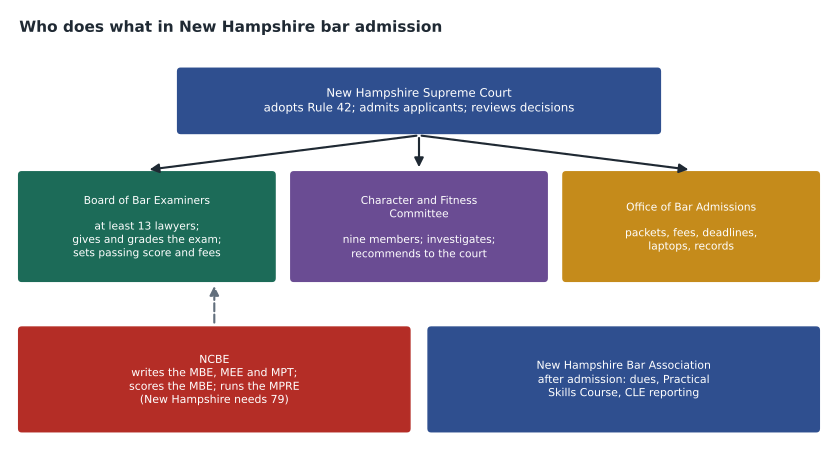
Admission to the bar in New Hampshire is a judicial function. The New Hampshire Supreme Court adopts the rule that governs admission, Supreme Court Rule 42, and it alone admits applicants. Every requirement a candidate meets, from the education standards to the oath, comes from Rule 42 and the related rules on character and fitness. When the court changes the exam, as it did when it announced in July 2025 that the NextGen bar examination would replace the current Uniform Bar Examination beginning in July 2028, it acts through its rules and orders, and the Board of Bar Examiners and the Office of Bar Admissions carry out the change.
That structure matters in practice. A candidate who wants an exception to a deadline, who disagrees with an eligibility decision or who receives an adverse character and fitness recommendation deals first with the Board or the Character and Fitness Committee under Rule 42. If the matter goes further, it goes to the Supreme Court itself, and Rule 42 gives a short window, twenty days from notice of a final decision, to petition the court for review. Classmates' advice, bar review summaries and older lawyers' memories are useful background, but Rule 42 and the Office of Bar Admissions' current instructions are the only authority. Ezra keeps a folder with the current rule, the packet completion checklist for the February 2027 exam and every email the Office of Bar Admissions has sent him.
The Board of Bar Examiners, the Character and Fitness Committee and the Office of Bar Admissions
Rule 42 sets up three working parts. The Board of Bar Examiners is a group of New Hampshire lawyers appointed by the court for three-year terms. The rule requires at least thirteen members, and the court designates the chair and vice chair. The Board decides eligibility questions, administers the bar examination, grades the written parts and, with the court's approval, sets the passing score and the fees. Board members themselves read and score the Multistate Performance Test and Multistate Essay Examination answers.
The Character and Fitness Committee reviews each applicant's background. It has nine members: seven members of the New Hampshire Bar, including a member of the Board of Bar Examiners, a member of the Professional Conduct Committee, the Attorney General or a designee and the clerk of the Supreme Court or a designee, plus two members who are not lawyers. The Committee investigates, may interview the applicant and makes a recommendation to the court.
The Office of Bar Admissions is the administrative division that handles the paper. It receives the Petition and Questionnaire for Admission and the exam application, collects fees, answers questions, posts forms and checklists, runs laptop registration and keeps exam papers for a year after each administration. When Ezra has a practical question, such as whether his law school has sent his final transcript or how to request testing accommodations, the Office is where he starts.
The New Hampshire Bar Association after admission
The New Hampshire Bar Association is the organization every lawyer practicing in the state belongs to after admission. A candidate has little to do with it before the oath, but from the first month after admission it sends a single invoice that combines bar dues and the Supreme Court's annual fees, prorated for new admittees. The Bar Association presents the Practical Skills Course that Rule 42 requires of new admittees, runs the reporting system lawyers use to record their continuing legal education, and keeps the membership records that the court relies on. Rule 42 requires admitted lawyers to tell the Bar Association promptly, in writing, when their residence or office address changes, because court notices go to the address on file.
Lawyer discipline is handled through the Supreme Court's own attorney discipline system rather than by the Bar Association as such. The court's Professional Conduct Committee and the Attorney Discipline Office investigate and prosecute complaints under the New Hampshire Rules of Professional Conduct, which Lesson 10 covers.
NCBE's part
The National Conference of Bar Examiners writes the three parts of the Uniform Bar Examination: the Multistate Bar Examination, the Multistate Essay Examination and the Multistate Performance Test. It also writes and administers the Multistate Professional Responsibility Examination, on which New Hampshire requires a scaled score of 79. NCBE scores the MBE and maintains the score services that let a UBE score earned in one state be transferred to another.
NCBE does not decide who is admitted. New Hampshire decides who may sit, how the written answers are graded, what passing score applies, whether to accept scores from elsewhere and whether an applicant has the character and fitness to practice. NCBE's jurisdiction pages are a convenient summary, and this course cites them often, but when they and the Office of Bar Admissions differ, the Office and Rule 42 control. That point is not academic. NCBE's 2026 chart lists one exam fee and the court's own bar examination page lists a different, lower figure; Lesson 2 explains how to handle a discrepancy like that.
Four routes into practice
New Hampshire recognizes four ways to be admitted, and Rule 42 lists them side by side. The first is admission by examination: passing the New Hampshire administration of the bar exam. This is the route for most new graduates, including Ezra. The second is admission by transferred UBE score, for an applicant who earned a passing UBE score in another state within the time limits in Rule 42. The third is admission by motion without examination, for experienced lawyers who meet the practice and reciprocity requirements, with special provisions for lawyers from Vermont and Maine. The fourth is the Daniel Webster Scholar Honors Program, a competency-based pathway for selected students at the state's law school in Concord, who are evaluated by bar examiners throughout their last two years and admitted without sitting the conventional exam after graduation.
Every route shares the same core: the applicant must meet the education requirements, establish good character and fitness, pass the MPRE and be at least eighteen years old. What differs is how the applicant shows minimum competence in law. The Daniel Webster program is the reason New Hampshire is so often described as a leader in licensing reform. The court approved it in 2005, the first cohort began in January 2006 and graduated in May 2008, and the New Hampshire Bar Association reported in 2025 that more than 350 lawyers had been admitted through it. Lesson 11 covers each route in detail.
| Route | Who uses it | Key requirement |
|---|---|---|
| Examination | New graduates and anyone who does not qualify another way | UBE total of 270 or more, taken in New Hampshire |
| Transferred UBE score | Applicants who passed the UBE elsewhere | Score of 270 or more within three years, or three to five years with two years of practice |
| Motion without examination | Experienced lawyers admitted by exam elsewhere | Active practice for five of the last seven years, with reciprocity; three years for Vermont and Maine lawyers plus New Hampshire CLE |
| Daniel Webster Scholar Honors Program | Selected students at the law school in Concord | Two-year competency-based program assessed by bar examiners |
The usual order of events on the examination route
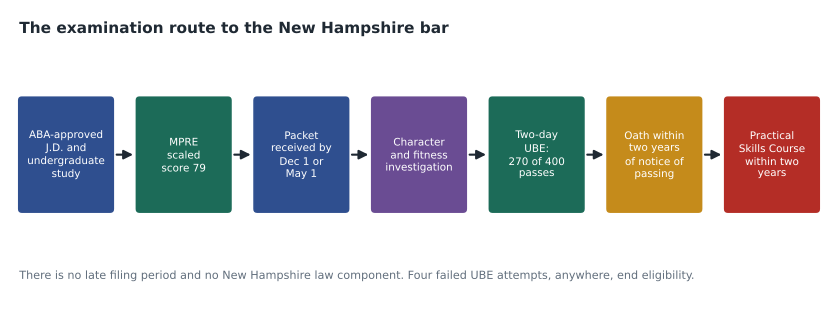
Most candidates on the examination route follow the same rhythm. During law school they take the MPRE, usually in the second or third year. In the final semester or soon after graduation they assemble the admission packet: the Petition and Questionnaire for Admission, which is the character and fitness filing made under oath, and the application for the bar examination, along with the documents the packet checklist requires. The packet must reach the Office of Bar Admissions by May 1 for the July exam or by December 1 for the February exam. Rule 42 sets no late filing period, so a packet that arrives on December 2 is too late for February.
While the candidate studies, the Character and Fitness Committee investigates. The exam itself is given over two days, on the last Wednesday of February or July and the Tuesday before it. Results are announced by the Board's chair and a list of successful applicants is posted on the court's website. Once the Board certifies that every requirement is met, including the character and fitness clearance and a passing MPRE score, the applicant is admitted and takes the oath. Rule 42 gives an admitted applicant two years from the notice of passing to complete the remaining requirements and take the oath. Within two years after being sworn in, the new lawyer must attend the Practical Skills Course.
Ezra's own path shows the order in miniature. He took the MPRE in August 2025, after his second year, and scored 88, comfortably above New Hampshire's 79. He mailed his packet on October 14, 2026, well before the December 1 deadline, after Ms. Caswell and a former professor signed the certificate of character that the petition requires. His exam dates are Tuesday, February 23, and Wednesday, February 24, 2027.
Why New Hampshire's exam has no local component
Some UBE states add a separate test or course on their own law, such as a state-law module taken online before admission. New Hampshire does not. NCBE's chart lists no jurisdiction-specific requirement for the UBE, for transferred UBE scores or for admission on motion. The exam you sit in Concord is graded on general principles, and the Multistate Essay Examination answers are measured against those general principles rather than against New Hampshire statutes.
New Hampshire puts its local training after admission instead. The Practical Skills Course, presented in person by the New Hampshire Bar Association, teaches new lawyers how practice actually works in the state's courts and offices, with sessions on family practice, wills and trusts, real estate, civil litigation, criminal practice and running a small firm. Rule 42 makes attendance mandatory within two years of admission, and a lawyer who fails to attend faces suspension. Lesson 6 explains how to study for an exam with no state component, and Lessons 7 through 10 teach the New Hampshire law that fills a new lawyer's first year.
Worked problem
Sorting out who to ask
In November 2026 Ezra has three questions: whether his August 2025 MPRE score will still count, whether he must tell anyone about his new apartment in Concord, and whether he needs to join the New Hampshire Bar Association before the exam.
Show solution
- The MPRE question is answered by Rule 42 and the Board: New Hampshire requires a scaled score of 79, and NCBE lists no time limit on when the score must be earned. His 88 counts, as long as he designated New Hampshire to receive it or requests a transfer.
- Applicants must keep the information in their application current in writing throughout the process. The address change goes to the Office of Bar Admissions now.
- Bar Association membership follows admission. The first dues invoice arrives the month after he is sworn in.
Answer: His MPRE counts, the address update goes to the Office of Bar Admissions, and Bar Association membership comes after the oath.
Building a study winter around the process
Marchetti asked Ezra to sketch the next three months on one page. At the top he wrote the exam dates. Beneath that he listed his open administrative items: confirm that his law school sent the final transcript, check for any request from the Character and Fitness Committee, watch for laptop registration in January and confirm that NCBE has reported his MPRE score to New Hampshire. The rest of the page went to study: the seven MBE subjects, the six-question MEE and the two MPT tasks.
'The paperwork should take an hour a month if you stay on top of it,' Marchetti said. 'Where candidates get hurt is letting a Committee letter sit for three weeks because they are deep in evidence outlines. Answer everything the week it arrives.'
Ezra also asked how much of his clerk work would help. Marchetti's answer was practical. Reading a superior court order on apportionment of fault or drafting a will with a pretermitted heir clause teaches him New Hampshire practice, which he will need in March. But the February exam rewards organized analysis of general principles under time pressure, and that comes only from timed practice. He agreed to keep his clerk hours at thirty a week through mid-December and to drop to twelve in January.
What this course covers
Lessons 2 and 3 cover eligibility, education, deadlines, fees, character and fitness and the MPRE. Lesson 4 explains the exam's format, scoring and the 270 passing score. Lesson 5 explains the transition to NextGen in July 2028 and what it means for candidates who may need to retake. Lesson 6 covers studying for an exam with no state component. Lessons 7 through 10 teach New Hampshire courts and procedure, torts and claims against government, family law and estates, and the New Hampshire Rules of Professional Conduct. Lesson 11 covers score transfer, admission on motion, the Daniel Webster program and the duties of a new lawyer, and Lesson 12 is a capstone with original practice questions and an exam-day plan.
Common mistakes
MistakeNew Hampshire is a UBE state, so there is nothing New Hampshire-specific to learn.
InsteadThe exam has no state component, but admission brings a mandatory Practical Skills Course and a first year of practice full of New Hampshire statutes and rules.
MistakeThe New Hampshire Bar Association runs the bar exam.
InsteadThe Board of Bar Examiners, the Character and Fitness Committee and the Office of Bar Admissions, all under the Supreme Court and Rule 42, handle admission. The Bar Association matters after the oath.
MistakeNextGen arrives in New Hampshire in 2027.
InsteadThe court announced that NextGen begins in July 2028. The February 2027 exam is the current UBE.
MistakeIf the packet is a few days late, I can pay a late fee.
InsteadRule 42 and the Office list a single filing deadline, May 1 for July and December 1 for February, with no late period.
Summary and key terms
- The New Hampshire Supreme Court adopts Rule 42 and admits applicants.
- The Board of Bar Examiners administers and grades the exam; the Character and Fitness Committee reviews each applicant; the Office of Bar Admissions handles filings.
- New Hampshire gives the Uniform Bar Examination and requires 270 on the 400-point scale; there is no state-law component.
- An MPRE scaled score of 79 is required.
- The four routes are examination, transferred UBE score, motion without examination and the Daniel Webster Scholar Honors Program.
- New admittees must attend the Bar Association's Practical Skills Course in person within two years of admission.
- 0
- Rule 42
- 1
- Board of Bar Examiners
- 2
- Character and Fitness Committee
- 3
- Office of Bar Admissions
- 4
- Petition and Questionnaire for Admission
- 5
- Daniel Webster Scholar Honors Program
- 6
- Practical Skills Course
- 7
- New Hampshire Bar Association
Practice problems
Work each problem on paper first, then reveal the answer to check.
Which body adopts the rule that governs admission to the New Hampshire bar?
Show answer
The New Hampshire Supreme Court, through Supreme Court Rule 42. The court also admits applicants.
Who grades the MPT and MEE answers on the New Hampshire exam?
Show answer
Members of the Board of Bar Examiners. NCBE scores the MBE.
Does New Hampshire require a test on New Hampshire law before admission?
Show answer
No. There is no jurisdiction-specific component, but new admittees must attend the Practical Skills Course within two years.
Name the four routes to admission.
Show answer
Examination, transferred UBE score, motion without examination, and the Daniel Webster Scholar Honors Program.
Lesson quiz · 5 questions
Score 60% or more to complete this lesson.
Create a free account to save your progress, take quizzes and earn a certificate.