
BAR-230 · Lesson 2 of 12 · 20 min
Eligibility, education, deadlines and fees
▶ Video coming soon A video version of this lesson is on the way.
On a Tuesday evening in late October, Hollis Marchetti opened the group's video session with a slide that had only two dates on it: May 1 and December 1. 'For New Hampshire candidates,' she said, 'these are the only filing deadlines you get. There is no late period. Ezra already mailed his packet, so tonight he gets to relax while we walk through what was in it.' Ezra laughed and held up a thick manila envelope's worth of photocopies. 'This is my copy of everything I sent,' he said. 'I kept one of each page, because Ms. Caswell told me the first rule of practice is to keep a copy of what you file.'
This lesson covers who is eligible to sit for the New Hampshire exam, the education requirements in Rule 42, the filing deadlines and the fees. It also explains the rules on withdrawing and transferring to the next administration, the limit on the number of attempts and the timing for testing accommodations. The theme throughout is that New Hampshire's process is simple to describe but unforgiving of missed details.
General eligibility under Rule 42
Rule 42 lists the general requirements that apply to every applicant, whatever route they use. The applicant must satisfy all the rule's requirements and respond to the Board's and Committee's requests for information. The applicant must qualify by one of the four routes: passing the New Hampshire bar examination, a transferred UBE score, motion without examination, or completion of the Daniel Webster Scholar Honors Program. The applicant must pass the MPRE, must be at least eighteen years old, must meet the education requirements and must establish good moral character and fitness.
Two features of the general rule are worth noticing. First, the MPRE requirement applies to everyone, including Daniel Webster Scholars and experienced lawyers seeking admission on motion. Second, the rule puts the burden on the applicant. An applicant who fails to answer a question or produce a document can be found not to have carried the burden of showing eligibility or character, even if nothing bad is ever proved.
The undergraduate requirement
New Hampshire's undergraduate rule is phrased differently from many states' rules. Rule 42 requires that, before beginning the study of law, the applicant completed at least three years of work toward a bachelor's degree at an accredited college or university, or received an equivalent education. Most applicants have a full bachelor's degree, so the difference rarely matters. It matters for the occasional applicant who entered law school after three years of college under a combined program. That applicant satisfies the New Hampshire rule without the degree itself. An applicant whose education does not fit the standard pattern carries the burden of proving equivalence to the Board.
The law degree requirement
For graduates of American law schools, the rule is straightforward. The applicant must hold a law degree from a law school approved by the American Bar Association. A full-time program must run at least three academic years, and a part-time program at least four academic years with equivalent total hours. An applicant who studied at two schools qualifies only if both meet the requirements. New Hampshire does not admit graduates of unaccredited or state-accredited-only American schools through the education rule.
| Applicant | Education rule | Result |
|---|---|---|
| J.D. from an ABA-approved school, three years full time | Meets Rule 42 directly | Eligible |
| J.D. from an ABA-approved part-time program, four years | Meets Rule 42 directly | Eligible |
| Three years of college, then an ABA-approved J.D. | Three years of bachelor's work suffices | Eligible |
| Graduate of a non-ABA American school | No ABA approval | Not eligible under the education rule |
| Law graduate from a common-law country with 24 qualifying U.S. credits | Foreign-education provision | Eligible if every element is shown |
| Law graduate from a civil-law country | Jurisprudence must be based on English common law | Not eligible under the foreign-education provision |
Graduates of foreign law schools
Rule 42 allows some graduates of foreign law schools to qualify, but the test is demanding and every element must be shown. The applicant must have studied at a law school recognized by the accrediting agency of its own country, and distance, correspondence and online programs do not count. The country's jurisprudence must be based on the principles of English common law. And the applicant's education must be substantially equivalent to an ABA-accredited legal education.
Substantial equivalence has a concrete meaning in the rule. The applicant must complete at least twenty-four semester credit hours at an ABA-accredited law school in subjects of American law, including constitutional law and professional responsibility. At least sixteen of those hours must come from at least five subjects on a list in the rule, which includes subjects such as evidence, civil procedure, criminal procedure, contracts, torts and taxation. If the applicant meets the first two elements but not the credit-hour element, the Board may still find the education sufficient after considering factors listed in the rule. The applicant supports the request with an affidavit made under oath.
In practice, a lawyer trained in England, Ireland, Canada's common-law provinces, India, Nigeria or Australia who completes an American LL.M. built around those credits can often qualify. A lawyer trained in a civil-law country, such as France, Brazil or Japan, does not qualify under this provision however many American credits they earn, because the second element is not met.
Worked problem
Applying the foreign-education rule
Ngozi Adeyemi, a member of the study group who qualified in Nigeria and completed an LL.M. in the United States, asks whether she could sit in New Hampshire instead of New York. Her LL.M. included constitutional law, professional responsibility, evidence, civil procedure, contracts and torts, for a total of twenty-six credits.
Show solution
- Recognized law school: her Nigerian law school is recognized by Nigeria's accrediting authority and she studied in person, so the first element is met.
- Common-law jurisprudence: Nigerian law is based on English common law, so the second element is met.
- Substantial equivalence: twenty-six credits at an ABA-accredited school, including constitutional law and professional responsibility, with at least sixteen credits drawn from five listed subjects (evidence, civil procedure, contracts, torts and one more), meets the twenty-four-credit test.
- She must still file an affidavit and the Board decides; she would also need the MPRE and character and fitness.
Answer: On these facts Ngozi appears to satisfy the New Hampshire foreign-education provision, subject to the Board's review of her documents.
The admission packet
A candidate on the examination route files two main documents with the Office of Bar Admissions. The first is the Petition and Questionnaire for Admission to the New Hampshire Bar, the long character and fitness filing that every applicant on every route submits. It is made under oath and includes a certificate signed by two people who vouch for the applicant's character. The second is the Application for the New Hampshire Bar Examination. The Office's packet completion checklist lists the supporting documents, such as transcripts and authorizations. The candidate also needs an NCBE number, which NCBE issues through its online account system and which links the candidate's MPRE and UBE records.
Testing accommodation requests go in with the application. Rule 42 requires the request to be made on the Board's forms, with the supporting medical or professional documentation, by the application deadline. The rule does not accept late accommodation requests, so a candidate who might need accommodations should gather the documentation in the fall, not after mailing the packet.
Filing deadlines: May 1 and December 1
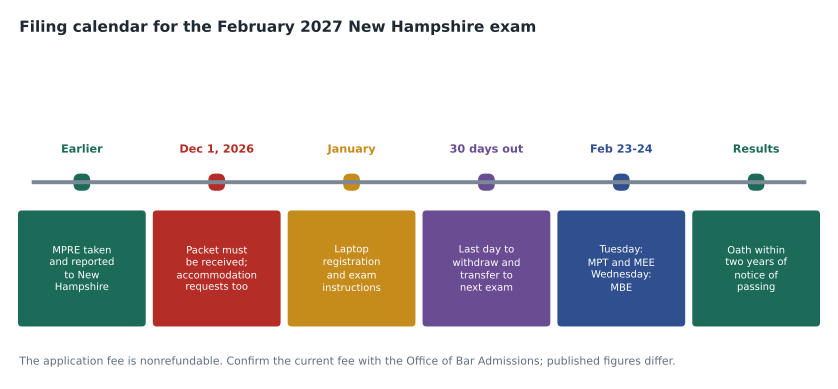
The packet must reach the Office of Bar Admissions by May 1 for the July exam and by December 1 for the February exam. The word that matters is reach. The court's page says the application must be received by the deadline, so a packet postmarked on November 30 that arrives on December 2 is late. NCBE's chart lists no late filing deadline for New Hampshire, and the court's page describes none.
The single-deadline system is easier to remember than the tiered systems some states use, but it has a cost. In a state with a late period, a candidate who misses the regular deadline pays more and still sits. In New Hampshire, a candidate who misses December 1 waits until July. Marchetti's advice to the group was blunt: aim to mail by November 1, use a delivery method with tracking, and keep a full copy.
Fees and how to handle a discrepancy
The Board sets fees with the court's approval, and the application fee is nonrefundable. Here candidates meet a practical problem: the published sources do not agree. NCBE's 2026 jurisdiction chart lists the New Hampshire bar exam fee as 995 dollars for first-time takers, attorneys and repeaters, with a laptop fee of 52.50 dollars, and lists 995 dollars for admission by transferred UBE score and 2,500 dollars for admission on motion. The court's own bar examination page and its transferred UBE page list a fee of 725 dollars, payable to the State of New Hampshire.
A careful candidate does not guess. The right move is to check the fee printed on the current packet checklist and application form for the specific administration and, if the sources still conflict, to call or email the Office of Bar Admissions and keep a note of the answer. Ezra did exactly that in early October. The Office confirmed the amount for his packet, and he paid by a single check payable to the State of New Hampshire, as the instructions required. This course gives both figures so that candidates know a discrepancy exists, but the Office's answer for the administration you are entering is the only one that counts.
| Item | NCBE 2026 chart | Court web page |
|---|---|---|
| Bar exam application | 995 dollars | 725 dollars |
| Laptop fee | 52.50 dollars | Not stated on the exam page |
| Transferred UBE score | 995 dollars | 725 dollars |
| Motion without examination | 2,500 dollars | Not stated on the exam page |
| MBE score transfer out of New Hampshire | Not listed | 25 dollars, requested before the exam |
Withdrawing and transferring to the next exam
Life intervenes, as Ezra's summer showed. Rule 42 lets an applicant who withdraws at least thirty days before the exam transfer to the next administration. The applicant pays an administrative fee set by the Board but does not pay a new application fee. A candidate who withdraws later than thirty days before the exam, or who simply does not appear, loses that option and must file a new application with a new fee.
The transfer rule has a planning consequence. A candidate who is unsure whether a family or health situation will allow them to sit in February should decide by late January. A decision made on the Friday before the exam is a decision to pay again.
The four-attempt limit
Rule 42 limits the number of times an applicant may fail. After four failed attempts, the applicant may not sit again. Importantly, attempts in any UBE jurisdiction count toward the limit, not just attempts in New Hampshire. The same four-attempt limit appears in the transferred UBE rule: an applicant seeking admission by transferred score must have reached the minimum score in no more than four attempts.
For most candidates the limit never matters. But it changes the advice for someone who has failed elsewhere. Sofia Reyes, the group member who missed the California exam by a small margin, asked whether her California attempt would count if she ever applied in New Hampshire. Marchetti explained that California does not give the UBE, so a California attempt is not a UBE attempt. The limit counts failed attempts in UBE jurisdictions.
The two-year window to complete admission
Passing the exam does not end the process. Rule 42 requires the applicant to complete every remaining requirement and take the oath within two years of the notice of passing, or of the notice that a motion or transferred-score request was granted. An applicant who misses the window must retake the exam or refile, unless the Board extends the time for good cause, and must establish character and fitness again. The rule protects the public by keeping character findings current.
Most candidates are sworn in within a few months of their results, so the window rarely becomes a problem. It matters for a candidate who passes the exam but has an unresolved character and fitness issue, or who passes and then delays the MPRE. Ezra's MPRE was already done, so for him the window is a background rule, but he wrote the two-year date in his planner anyway.
Common mistakes
MistakeI can mail the packet on December 1.
InsteadThe packet must be received by December 1. Mail it early with tracking.
MistakeThere is a late filing period if I pay extra.
InsteadNew Hampshire lists no late filing deadline. Missing the deadline means waiting for the next exam.
MistakeAccommodation requests can follow after I see the exam schedule.
InsteadRequests and documentation are due with the application by the filing deadline; late requests are not accepted.
MistakeOnly New Hampshire failures count toward the attempt limit.
InsteadFailed attempts in any UBE jurisdiction count toward the four-attempt limit.
MistakeAny law degree qualifies if I add an LL.M.
InsteadAmerican graduates need an ABA-approved J.D.; foreign graduates must come from a common-law country and meet the credit-hour test.
Summary and key terms
- Every applicant must meet Rule 42's general requirements: a qualifying route, the MPRE, age eighteen, education, and character and fitness.
- Undergraduate study must include at least three years of bachelor's-degree work; American law graduates need an ABA-approved degree.
- Foreign graduates must show a recognized school, common-law jurisprudence and substantial equivalence, usually twenty-four ABA-school credits.
- The packet must be received by May 1 for July or December 1 for February, with no late period.
- Fees are set by the Board with court approval and are nonrefundable; published figures differ, so confirm with the Office.
- Withdrawal at least thirty days before the exam allows transfer to the next exam; four failed UBE attempts end eligibility.
- 0
- general eligibility
- 1
- substantial equivalence
- 2
- admission packet
- 3
- filing deadline
- 4
- withdrawal and transfer
- 5
- four-attempt limit
- 6
- two-year completion window
- 7
- NCBE number
Practice problems
Work each problem on paper first, then reveal the answer to check.
What is the filing deadline for the February exam, and what does it require?
Show answer
December 1 of the prior year; the packet must be received by the Office of Bar Admissions by that date.
Can a graduate of a civil-law country qualify under New Hampshire's foreign-education rule?
Show answer
No. The country's jurisprudence must be based on English common law.
What happens if an applicant withdraws 45 days before the exam?
Show answer
The applicant may transfer to the next administration by paying the Board's administrative fee, without a new application fee.
How long does a successful candidate have to take the oath?
Show answer
Two years from the notice of passing, unless the Board extends the time for good cause.
Lesson quiz · 5 questions
Score 60% or more to complete this lesson.
Create a free account to save your progress, take quizzes and earn a certificate.