
BAR-230 · Lesson 12 of 12 · 21 min
Capstone: New Hampshire practice questions and an exam-day plan
▶ Video coming soon A video version of this lesson is on the way.
On a Saturday in mid-November, a little more than three months before the exam, Marchetti held a long session with Ezra. 'Two parts today,' she said. 'First, a practice set that mixes what you will see in February with what you will see in March. The February part is general law under time. The March part is New Hampshire law, because you will be sworn in soon and I want you to see how far you have come. Second, we build your exam-day plan, hour by hour, including what you do if it snows.' Ezra had cleared his calendar at Caswell and Thayer for the day. He had a legal pad, a timer and a pot of coffee.
This lesson gives original practice material in four parts: multiple-choice questions written in the style of the MBE, an essay in the style of the MEE with a model answer outline, a short performance-test planning exercise, and a New Hampshire practice problem drawn from the earlier lessons. None of these are released bar exam questions; all are written for this course. The lesson ends with a study plan for the final weeks and an exam-day plan for February 23 and 24, 2027.
Part one: MBE-style questions
Marchetti gave Ezra six questions and nine minutes per three questions, a little more than the MBE's average of about 1.8 minutes per question, so that he could think aloud afterward. The questions are answered under generally accepted principles, not New Hampshire law, and each is followed by the answer and a short explanation.
Question 1. A homeowner hired a painter to paint her house for 6,000 dollars, payment due on completion. After painting three sides, the painter quit to take a better-paying job. The homeowner hired another painter to finish for 3,000 dollars. The first painter sues for the value of the work done. What is the most likely result? Answer: the first painter may recover in restitution the reasonable value of the benefit conferred, reduced by the homeowner's damages from the breach. A party in material breach cannot sue on the contract, but most courts allow a breaching party restitution for the net benefit conferred, so the painter's recovery is limited by the homeowner's extra cost and other losses.
Question 2. A police officer, without a warrant, used a drone equipped with a thermal camera to look into the windows of a suspect's home at night, then obtained a warrant based on what he saw. The suspect moves to suppress under the Fourth Amendment. What is the strongest argument for suppression? Answer: using technology not in general public use to obtain information about the interior of a home that could not otherwise be obtained without physical intrusion is a search, under the reasoning of the Supreme Court's thermal imaging case, Kyllo v. United States, and the warrant based on it is tainted.
Question 3. In a negligence action, the plaintiff offers evidence that, after the accident, the defendant store installed a handrail on the stairs where the plaintiff fell. The plaintiff offers it to prove that the store was negligent. Is it admissible? Answer: no. Under Federal Rule of Evidence 407, evidence of subsequent remedial measures is not admissible to prove negligence or culpable conduct, though it may be admitted for other purposes, such as ownership or control or feasibility of precautions, if disputed.
Question 4. A landowner conveyed land to her nephew by a deed that was never recorded. A month later she conveyed the same land to a buyer who paid fair value, had no notice of the first deed, and recorded promptly. The jurisdiction's statute provides that no conveyance is good against a subsequent purchaser for value without notice unless it is recorded. Who owns the land? Answer: the buyer. This is a notice statute, under which a subsequent bona fide purchaser for value without notice prevails over an earlier unrecorded conveyance, whether or not the later purchaser records first.
Question 5. A pedestrian was injured when a delivery truck backed into her. The jury found the pedestrian 30 percent at fault and the driver 70 percent at fault, with damages of 100,000 dollars. The jurisdiction follows pure comparative negligence. How much does the pedestrian recover? Answer: 70,000 dollars. Under pure comparative negligence, damages are reduced by the plaintiff's share of fault.
Question 6. A plaintiff from Vermont sues a corporation incorporated in Delaware with its principal place of business in New Hampshire, in federal court, claiming 80,000 dollars in damages for breach of contract. Does the court have subject matter jurisdiction? Answer: yes. There is complete diversity, because the plaintiff is a citizen of Vermont and the corporation is a citizen of Delaware and New Hampshire, and the amount in controversy exceeds 75,000 dollars.
Ezra got five of six. He missed the first, choosing the answer that the painter recovers nothing because he breached. Marchetti pointed out that the question asked what was most likely, and that the modern rule allows restitution to a breaching party for the net benefit. 'When an answer feels harsh, check whether the law has softened it,' she said.
Part two: an MEE-style essay
The essay is in business associations, one of the subjects that remained on the MEE after July 2026. Ezra had thirty minutes.
Facts: Three friends, Ada, Ben and Cole, agreed orally to run a bicycle repair shop together and to share profits equally. They did not file any documents with the state. Ada contributed 20,000 dollars, Ben contributed tools, and Cole agreed to work in the shop full time. Ben, without consulting the others, signed a one-year lease for a second shop location in the business's name at 2,000 dollars a month. Ada and Cole object to the lease. Six months later the business cannot pay a supplier 30,000 dollars for parts. Questions: (1) What kind of business organization exists? (2) Is the business bound by the lease? (3) Who is personally liable for the supplier's claim?
Model answer outline. (1) A general partnership. Under the Revised Uniform Partnership Act, the association of two or more persons to carry on as co-owners a business for profit forms a partnership, whether or not the persons intend to form one. No filing is required. Sharing profits creates a presumption of partnership. Ada, Ben and Cole are partners.
(2) The lease likely binds the partnership. Each partner is an agent of the partnership for the purpose of its business, and an act of a partner apparently carrying on in the ordinary course the partnership business, or business of the kind carried on by the partnership, binds the partnership unless the partner had no authority and the third party knew or had notice of that. Leasing a location is arguably in the ordinary course for a repair shop. The landlord had no notice of a limitation. Within the partnership, a matter outside the ordinary course requires the consent of all partners, and Ben may be liable to his partners for breaching his duties if the lease was outside the ordinary course or violated an agreement among them, but that does not affect the landlord's rights.
(3) All partners are jointly and severally liable for partnership obligations. Under the Act, a judgment creditor generally must first exhaust partnership assets before levying on a partner's personal assets, unless an exception applies. The supplier can sue the partnership and the partners and, after exhausting partnership assets, collect from any of them. The partners then share losses according to their agreement, which here, in the absence of a different loss-sharing term, follows their equal profit-sharing.
Ezra's answer identified the partnership and the personal liability, but he spent too long on the lease and did not mention the exhaustion requirement. Marchetti graded it a 4 on the six-point scale and told him that a clear headed structure for each call, with the rule stated before the analysis, would move it to a 5.
Part three: planning a performance test
For the MPT, Marchetti did not ask Ezra to write a full answer. She gave him a ten-minute planning exercise. The task: a supervising partner asks for an objective memorandum on whether a client can terminate a commercial lease early under a clause in the lease and two cases in the library. Ezra's plan had to identify the format, the reader, the issues, the sources and the time budget.
His plan: format, an objective memorandum with a short statement of the question, a brief answer and a discussion organized by issue; reader, the supervising partner, who wants a balanced assessment; issues, first whether the termination clause's conditions were met and second whether the client gave proper notice; sources, the lease clause and the two library cases, one of which strictly construes notice provisions and one of which applies substantial compliance; time, thirty-five minutes reading and outlining, fifty-five minutes writing. Marchetti approved, with one note: read the task memo twice before opening the file, because it tells you what the partner wants, and MPT graders follow it closely.
Part four: a New Hampshire practice problem
The last practice item is not for the exam. It is the kind of question a new associate at Caswell and Thayer receives, and it uses the New Hampshire law from Lessons 7 through 11.
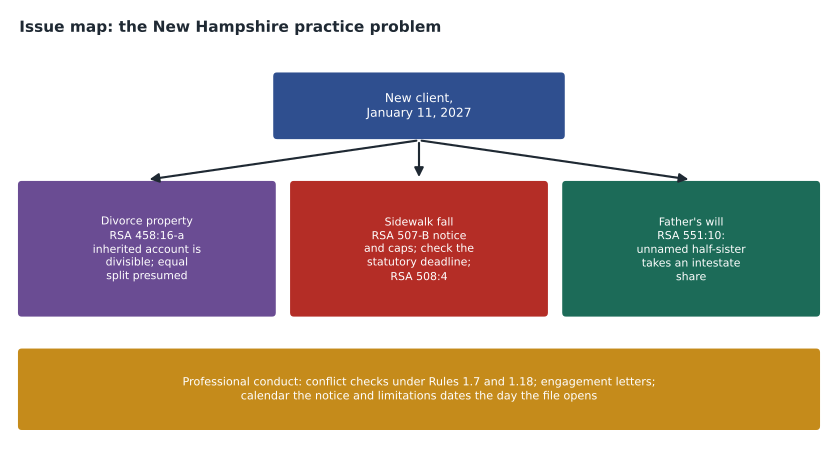
Facts: A client comes in on January 11, 2027. Her husband of nine years has filed for divorce in the Family Division in Concord. Their property includes a house in Concord in joint names, a brokerage account she inherited from her father during the marriage and kept in her own name, and his business. Separately, last March she slipped on an icy sidewalk outside the town hall in a nearby town and broke her ankle. She has not told the town. She also says her father's will, signed in 2010, left everything to her and her brother and did not mention her younger half-sister, who was born in 2005. Her father died in December 2026. What are the key New Hampshire issues?
Analysis outline. Divorce property: under RSA 458:16-a, all property of either spouse is subject to division, including her inherited brokerage account. Equal division is presumed equitable; she can argue that the account's source as an inheritance kept separate justifies awarding it to her, but she bears the burden of showing that an unequal division is equitable. Parenting is not at issue if there are no minor children; alimony would follow the RSA 458:19 framework if either spouse seeks it.
Sidewalk injury: a claim against a town falls under RSA 507-B, which limits municipal liability to claims arising from motor vehicles and premises, caps damages and requires timely written notice. The first step is to check the notice deadline in the statute and send notice immediately if it has not passed; the second is to analyze whether a sidewalk claim fits within the statute's premises category and whether any snow and ice provisions apply. The three-year limitations period under RSA 508:4 would otherwise run from the March 2026 fall.
Father's will: the half-sister was alive when the will was signed but was not named or referred to in it. Under RSA 551:10, a child not named or referred to in the will who takes nothing under it is entitled to an intestate share. The half-sister likely has a pretermitted heir claim against the estate in the Probate Division, which would reduce the client's and her brother's shares. The firm should also consider whether it has a conflict in advising the client on an estate in which she and her half-sister have adverse interests, and should not advise the half-sister.
Professional conduct: the firm must check conflicts under Rules 1.7 and 1.18 before taking any of these matters, send an engagement letter defining the scope of each, and calendar the RSA 507-B notice deadline and the limitations dates the day the file is opened.
The final three weeks
Marchetti and Ezra built his last three weeks around three principles: timed practice, review of mistakes and protection of sleep. Each weekday he would do one block of thirty-three MBE questions under time, review every miss and every lucky guess, write one MEE essay under time and compare it with the analysis, and every other day complete one full MPT under time. He would stop new substantive reading ten days before the exam and shift to reviewing his own outlines and error log. He would stop clerking entirely on February 8.
Two full simulated exam days, on the Tuesday and Wednesday two weeks before the real exam, would test the plan: two MPTs and six MEEs on the first day, two hundred MBE questions on the second, at the actual times. He would review the results on the following Thursday and Friday, then rest for part of the weekend.
The exam-day plan
For February 23 and 24, Ezra wrote a plan with times. The night before each day: pack the items the Office of Bar Admissions' instructions allow, including identification and the admission materials, a charged laptop if he types, and approved snacks if permitted; lay out warm clothing in layers; set two alarms; check the weather forecast and the Office's page for any notice about weather. Morning: breakfast he has eaten before, not something new; leave early enough to arrive before the 8:15 a.m. time the court's FAQs give, allowing extra time for snow; park and walk in without hurrying.
During the written day: read each MPT task memo twice; budget ninety minutes per task and stop at ninety; on the MEE, spend about thirty minutes per question, outlining briefly and stating each rule before applying it; if one essay goes badly, let it go, because no single essay must be passed. During the MBE: pace at about forty-five minutes per twenty-five questions; mark and move on from any question that takes more than three minutes; fill in every answer, because there is no penalty for guessing. Lunch both days: eat, walk, and do not discuss questions with other candidates.
The snow plan: if a storm is forecast, check the Office of Bar Admissions' instructions and email, plan an earlier departure, and consider staying near the test site the night before. Ezra booked a refundable room in case the forecast turned bad.
| Time | Tuesday, February 23, 2027 | Wednesday, February 24, 2027 |
|---|---|---|
| Before 8:15 a.m. | Arrive; registration opens at 8:00 | Arrive; registration opens at 8:00 |
| Morning session | Two MPT tasks, 90 minutes each | MBE, 100 questions, 3 hours |
| Lunch | Eat, walk, do not discuss questions | Eat, walk, do not discuss questions |
| Afternoon session | Six MEE questions, about 30 minutes each | MBE, 100 questions, 3 hours |
| Evening | Light review of MBE weak spots; early bed | Rest |
After the exam
The plan continued past Wednesday afternoon. Results would come in the spring. If he passed, he would watch for the swearing-in information, confirm that his MPRE score was on file, take the oath, pay his first combined dues invoice within thirty days, register for the December 2027 Practical Skills Course and set up his CLE tracking for the year starting June 1, 2027. If he did not pass, he would wait for the score breakdown, review his essays at the Office of Bar Admissions and plan for July 2027, still on the legacy UBE.
'And on Thursday morning,' Marchetti said, 'you open the practice drawer.' Ezra laughed. Margaret Caswell had already put three new files on his desk for the week after the exam: a closing in Bow, a will for a client with four children, every one of whom would be named, and a slip-and-fall with a notice letter to send.
Common mistakes
MistakeA breaching party can never recover anything.
InsteadMost courts allow restitution for the net benefit conferred, reduced by the other party's damages.
MistakeOn the MEE, writing everything I know earns the most points.
InsteadAnswer each call with a clear rule statement and application; organization matters as much as content.
MistakeOn the MPT, start writing immediately to save time.
InsteadRead the task memo twice and plan before writing; the memo defines what graders reward.
MistakeSkipping a hard MBE question means leaving it blank.
InsteadMark it, move on and fill in an answer; there is no guessing penalty.
MistakeIf it snows, the exam will automatically be postponed.
InsteadCheck the Office of Bar Admissions' instructions and plan to arrive early in winter weather.
Summary and key terms
- MBE questions are answered under general principles; pacing is about 1.8 minutes per question.
- MEE answers should state the rule for each call before applying it; business associations remains a core MEE subject.
- MPT success starts with reading the task memo twice and budgeting the ninety minutes.
- New Hampshire practice problems combine RSA 458:16-a, RSA 507-B, RSA 508:4 and RSA 551:10 with conflict checks.
- The final weeks should focus on timed practice, error review and two simulated exam days.
- The exam-day plan covers arrival before 8:15 a.m., pacing, lunch, weather and the steps after results.
- 0
- general partnership
- 1
- apparent authority of a partner
- 2
- exhaustion rule
- 3
- notice recording statute
- 4
- subsequent remedial measures
- 5
- MPT task memo
- 6
- pacing
- 7
- error log
Practice problems
Work each problem on paper first, then reveal the answer to check.
Under RUPA, is a filing needed to form a general partnership?
Show answer
No. Co-owners carrying on a business for profit form a partnership whether or not they intend to or file anything.
What is the purpose of reading the MPT task memo twice?
Show answer
It defines the assignment, the audience and the format, which graders follow closely.
In the New Hampshire practice problem, what is the first step on the sidewalk claim?
Show answer
Check the RSA 507-B notice deadline and send written notice to the town immediately if it has not passed.
Why does the half-sister have a claim against the father's estate?
Show answer
She was not named or referred to in the will and took nothing, so RSA 551:10 gives her an intestate share.
Lesson quiz · 5 questions
Score 60% or more to complete this lesson.
Create a free account to save your progress, take quizzes and earn a certificate.