
BAR-227 · Lesson 8 of 12 · 19 min
Montana torts and insurance: comparative negligence, damages caps and bad faith
▶ Video coming soon A video version of this lesson is on the way.
In August 2026, a Fergus County gravel truck crossed the center line on a county road north of Lewistown and sideswiped a pickup driven by a retired schoolteacher who became a client of Thorsen & Kittle. She had a broken wrist and a damaged truck, and the county's adjuster had already called her twice. Garrett Thorsen handed Brynn the file with three questions written on a sticky note: 'How does fault work if she was a little over the line too? What is the most we can recover from the county? And what do we do about her own insurer, who has not paid her medical bills?'
Marchetti, reviewing the file with Brynn, said the three questions covered most of what makes Montana tort practice distinctive. 'Montana has its own comparative negligence rule, its own limits on joint and several liability, special caps for governmental entities and for medical malpractice, and a strong body of law on insurance claim handling. A first-year lawyer who knows those five things is ahead of most.'
This lesson covers modified comparative negligence, joint and several liability and the allocation of fault, punitive damages, the governmental liability limits, the medical malpractice noneconomic damages cap, and Montana's insurance claim handling law, including the Unfair Trade Practices Act and the duty to advance medical payments.
Modified comparative negligence
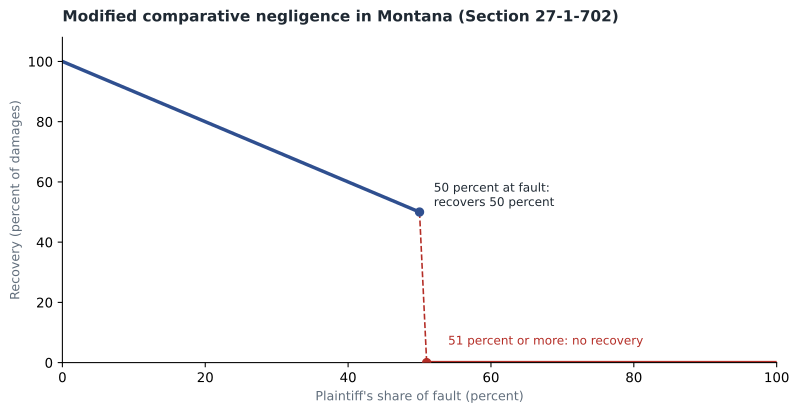
Montana abolished contributory negligence as a complete bar decades ago. Under Section 27-1-702 of the Montana Code Annotated, a plaintiff's contributory negligence does not bar recovery if it was not greater than the negligence of the person, or the combined negligence of all persons, against whom recovery is sought. Any damages allowed are reduced in proportion to the plaintiff's share of negligence.
The words 'not greater than' make Montana a 51 percent bar state. A plaintiff who is 50 percent at fault recovers half of the damages. A plaintiff who is 51 percent at fault recovers nothing. The comparison is with the combined negligence of the defendants from whom recovery is sought, so a plaintiff who is 40 percent at fault can recover against two defendants who are each 30 percent at fault.
Joint and several liability and the allocation of fault
Section 27-1-703 limits joint and several liability. A defendant whose negligence is more than 50 percent of the combined negligence of all persons whose fault is considered is jointly and severally liable for the whole of the damages. A defendant whose share is 50 percent or less is liable only for his or her own percentage. A defendant who pays more than its share may seek contribution from the others.
The statute also addresses who can be on the verdict form. In 1996 the Montana Supreme Court, in Plumb v. Fourth Judicial District Court, held unconstitutional a provision that let defendants allocate fault to nonparties who were not before the court and had no chance to defend themselves. The Legislature then amended the statute in 1997. Under the current approach, the fact finder may consider the negligence of persons who have settled with or been released by the claimant, subject to notice requirements, but Montana does not allow a general empty-chair allocation to anyone a defendant can blame. Allocation questions are technical, and a lawyer should read the current text of the statute in each case.
| Defendant's share of fault | Liability under Section 27-1-703 |
|---|---|
| More than 50 percent | Jointly and severally liable for all damages, with a right of contribution |
| 50 percent or less | Severally liable only for its own percentage |
| Settled or released person | Fault may be considered under the statute's notice rules; the claimant's recovery is reduced accordingly |
Worked problem
Allocating a Whitefish crash
Hypothetical: Dalton Rusk is injured in a three-car collision near Whitefish. His damages are 200,000 dollars. The jury finds Dalton 20 percent at fault, Driver A 55 percent and Driver B 25 percent. Driver B has no insurance and no assets. What can Dalton collect, and from whom?
Show solution
- Comparative negligence: Dalton's 20 percent is not greater than the combined 80 percent of the defendants, so he recovers, reduced by 20 percent: 160,000 dollars.
- Driver A's 55 percent is more than 50 percent, so A is jointly and severally liable for the full 160,000 dollars.
- Driver B's 25 percent is 50 percent or less, so B is severally liable for 50,000 dollars (25 percent of 200,000).
- Because A is jointly and severally liable, Dalton may collect all 160,000 dollars from A; A may seek contribution from B for B's share.
Answer: Dalton can collect 160,000 dollars from Driver A. If A had been 45 percent at fault and B 35 percent, A would owe only 90,000 dollars and Dalton would bear the risk of B's insolvency.
Punitive damages
Under Section 27-1-221, punitive damages may be awarded only when the defendant has been found guilty of actual fraud or actual malice, and each element must be proven by clear and convincing evidence. The statute defines both terms narrowly. Section 27-1-220 caps punitive damages at the lesser of 10 million dollars or 3 percent of the defendant's net worth, with exceptions for certain class actions. Punitive damages are not available against governmental entities.
The governmental liability limits
Article II, Section 18 of the Montana Constitution waives the state's sovereign immunity: the state, counties, cities and other local governments are subject to suit for injury to a person or property, except as the Legislature provides by a two-thirds vote of each house. Using that power, the Legislature has set limits on governmental liability. Under Section 2-9-108, a governmental entity is not liable in tort for more than 750,000 dollars for each claim and 1.5 million dollars for each occurrence. Governmental entities are also immune from punitive damages.
Procedural rules matter as much as the caps. Claims against the state must first be presented in writing to the Department of Administration before suit, and claims against counties and cities are presented under the applicable statutes and the entity's procedures. In Daniels v. Gallatin County (2022), the Montana Supreme Court held that the statutory cap did not limit recovery where the county's insurance policy listed higher limits. A lawyer should therefore ask about the entity's coverage early.
Applied to the firm's file, the teacher's claim against Fergus County is subject to the 750,000-dollar per-claim limit, which is unlikely to matter for a broken wrist and a damaged truck, but punitive damages are unavailable and the claim must be presented properly. If she was slightly over the center line herself, her share of fault reduces her recovery under Section 27-1-702 but does not bar it unless it exceeds the county driver's.
The medical malpractice noneconomic damages cap
Montana has capped noneconomic damages in medical malpractice cases since 1995. Section 25-9-411 limits all claims for noneconomic loss arising from injuries to a patient in a single incident of malpractice, against one or more health care providers. Noneconomic loss means subjective, nonmonetary loss such as pain and suffering, emotional distress, inconvenience, loss of companionship and humiliation. Economic damages, such as medical expenses and lost earnings, are not capped.
For decades the cap was 250,000 dollars. The 2025 Legislature amended the statute. As currently published in the Montana Code Annotated, the cap is 300,000 dollars effective March 27, 2025, rising to 350,000 dollars in 2026, 400,000 dollars in 2027, 450,000 dollars in 2028 and 500,000 dollars in 2029, and increasing by 2 percent a year after that. The code publishes the section in two versions, one temporary and one effective on the occurrence of a contingency, so a lawyer must confirm which version governs a given claim. The jury is not told the cap; the court reduces an award above it, reducing future noneconomic damages first, and future noneconomic damages are not discounted to present value.
| Calendar year | Noneconomic damages limit (dollars) |
|---|---|
| Before the 2025 amendment | 250,000 |
| 2025 (from March 27) | 300,000 |
| 2026 | 350,000 |
| 2027 | 400,000 |
| 2028 | 450,000 |
| 2029 | 500,000 |
| 2030 and after | Increases 2 percent a year |
Medical malpractice claims also carry procedural requirements before suit, including Montana's Medical Legal Panel process, and a three-year limitations period with a five-year outside limit. A new lawyer should not accept a malpractice case without reading the current statutes on prerequisites to filing.
Insurance claim handling and bad faith
Montana has one of the most developed bodies of insurance claim-handling law in the country. Its center is the Unfair Trade Practices Act. Section 33-18-201 lists unfair claim settlement practices, including misrepresenting policy provisions, failing to acknowledge and act reasonably promptly on claims, refusing to pay without a reasonable investigation and neglecting to attempt in good faith to effectuate prompt, fair and equitable settlements of claims in which liability has become reasonably clear. Section 33-18-242 gives both insureds and third-party claimants an independent cause of action against an insurer for certain of those violations. A third-party claimant generally may not file that action until the underlying claim has been settled or reduced to judgment.
Montana courts have also recognized duties that go beyond the statute's text. In Ridley v. Guaranty National Insurance Co. (1997), the Montana Supreme Court held that when liability is reasonably clear, a liability insurer must pay an injured third party's medical expenses as they are incurred, in advance of a final settlement, if they are reasonably related to the accident. Later cases extended the principle to lost wages. The made-whole doctrine, recognized in Montana since Skauge v. Mountain States Telephone and Telegraph Co. (1977), generally prevents an insurer from exercising subrogation rights until its insured has been fully compensated.
Back to the file: the schoolteacher has two insurance relationships. The county's insurer may owe Ridley payments of her medical expenses if the county's liability is reasonably clear. Her own insurer, if her policy includes medical payments coverage, owes her the benefits her contract promises, handled under the Unfair Trade Practices Act. And if her own insurer pays and then seeks reimbursement from her recovery against the county, the made-whole doctrine may limit its claim until she is fully compensated.
Constitutional backdrop
Article II, Section 16 of the Montana Constitution guarantees that courts are open to every person and that speedy remedy is afforded for every injury of person, property or character. Plaintiffs have relied on it, and on the right to trial by jury, in challenges to damages caps and other limits on tort recovery. The outcomes have varied, and the arguments recur whenever the Legislature changes tort law, as it did in 2025. A lawyer litigating a capped claim should check for pending challenges.
Common mistakes
MistakeMontana uses pure comparative negligence.
InsteadMontana uses modified comparative negligence: recovery is barred if the plaintiff's negligence is greater than the defendants' combined negligence.
MistakeEvery defendant in Montana is jointly and severally liable.
InsteadOnly a defendant more than 50 percent at fault is jointly and severally liable.
MistakeThe medical malpractice cap is still 250,000 dollars.
InsteadThe 2025 amendments raised it on a schedule; confirm the version in force.
MistakeA third-party claimant can sue the other driver's insurer under the UTPA at any time.
InsteadA third-party claimant generally must wait until the underlying claim is settled or reduced to judgment.
An intake checklist for a Montana injury case
Marchetti and Brynn turned the lesson into a checklist for new injury files. Identify every potential defendant, including governmental entities, and the date of injury for limitations purposes. If a governmental entity is involved, identify the correct office for presenting the claim, present it in writing as the statute requires and ask about the entity's liability coverage. Estimate the client's own share of fault and each defendant's share, because the 51 percent bar and the 50 percent threshold for joint and several liability shape both settlement value and the choice of defendants.
Next, identify every insurance policy: the defendants' liability coverage, the client's own medical payments, uninsured and underinsured motorist coverage and any health insurer with subrogation or reimbursement claims. Ask the liability insurer for Ridley payments if liability is reasonably clear, document unreasonable claim handling, and keep the made-whole doctrine in mind when a health or auto insurer seeks reimbursement. If the claim involves a health care provider, stop and review the malpractice prerequisites and the current cap before doing anything else.
Finally, confirm the version of every statute in force on the date of the injury. Montana's Legislature meets in odd-numbered years, and tort statutes change often enough that a rule learned in law school may not govern a new file.
Summary and key terms
- Section 27-1-702: recovery is allowed if the plaintiff's negligence is not greater than the defendants' combined negligence, reduced by the plaintiff's share.
- Section 27-1-703: joint and several liability only for a defendant more than 50 percent at fault; settled and released persons may be considered under notice rules.
- Punitive damages require actual fraud or actual malice by clear and convincing evidence and are capped at the lesser of 10 million dollars or 3 percent of net worth.
- Governmental liability is limited to 750,000 dollars per claim and 1.5 million dollars per occurrence, with no punitive damages.
- The Unfair Trade Practices Act, Ridley payments and the made-whole doctrine shape insurance claim handling.
- 0
- modified comparative negligence
- 1
- joint and several liability
- 2
- contribution
- 3
- actual malice
- 4
- governmental liability limits
- 5
- noneconomic loss
- 6
- Unfair Trade Practices Act
- 7
- Ridley payments
Practice problems
Work each problem on paper first, then reveal the answer to check.
A plaintiff is 50 percent at fault and the sole defendant 50 percent. Does the plaintiff recover in Montana?
Show answer
Yes. The plaintiff's negligence is not greater than the defendant's, so the plaintiff recovers half of the damages.
What are the governmental liability limits under Section 2-9-108?
Show answer
750,000 dollars for each claim and 1.5 million dollars for each occurrence.
What did Ridley v. Guaranty National require?
Show answer
When liability is reasonably clear, the liability insurer must pay the injured party's reasonably related medical expenses as incurred, before final settlement.
What standard of proof applies to punitive damages in Montana?
Show answer
Clear and convincing evidence of actual fraud or actual malice.
Lesson quiz · 5 questions
Score 60% or more to complete this lesson.
Create a free account to save your progress, take quizzes and earn a certificate.