
BAR-227 · Lesson 6 of 12 · 20 min
The Montana Law Seminar and how Montana law appears
▶ Video coming soon A video version of this lesson is on the way.
Garrett Thorsen took the Montana bar exam in the 1990s, when Montana still wrote its own essay questions. 'We had a question on Montana water rights and another on the Montana Constitution,' he told Brynn one morning. 'Now you take the national exam and then sit through a seminar. I am not sure which is harder.' Brynn passed the story along to Marchetti and asked the question that had been building for weeks: if the exam does not test Montana law, where does Montana law come in, and does she need to know any of it before February?
Marchetti's answer had two parts. 'Montana law comes in through the Montana Law Seminar, which you must complete before you can be admitted. And on the exam itself, Montana law matters in an unexpected way: it is a trap. Several Montana rules differ from the general rules the UBE tests. If you write the Montana rule on an MEE torts question, you may lose points.'
This lesson covers the Montana Law Seminar under Rule VIII of the Rules for Admission, how the seminar was delivered for February 2027, why Montana uses a seminar instead of a test, and how to keep Montana rules and UBE rules in separate boxes on exam day.
The requirement
Rule VIII makes completion of the Montana Law Seminar a prerequisite for admission to the State Bar of Montana. The only exception is for a lawyer appearing pro hac vice in a single case, who is not being admitted at all. Every other route requires it: examination, UBE score transfer and admission on motion. An applicant needs to complete the seminar only once, so a candidate who must retake the exam does not repeat the seminar.
The Rules give applicants a window. A candidate applying by examination or by transferred UBE score may complete the seminar at either of the two administrations before taking the UBE or at either of the first two administrations after. A motion applicant may complete it at either of the first two administrations after applying. The window keeps the seminar close in time to admission, so that what it teaches is fresh when the new lawyer starts to practice.
The Board of Bar Examiners sets the date and location of the seminar and develops its content and method of delivery, and the Supreme Court approves the program. The Rules allow the Board to offer a two-track afternoon, one for litigation and one for commercial and transactional practice, so that new lawyers can choose the track closer to the work they expect to do.
How the seminar is delivered
The Rules describe the seminar as something completed in person, with only limited portions delivered by video, recording or live video link. For the February 2027 administration, however, the Board's exam notice states that the seminar will be offered online only. It will be distributed on Thursday, February 25, 2027, the day after the MBE, and applicants must finish viewing it by Friday, March 5, 2027. Viewing must be confirmed before an applicant can be admitted. The State Bar's admissions page likewise lists having viewed the Montana Law Seminar among the requirements.
The difference between the text of the Rules and the February 2027 notice is a good example of why candidates must read the Board's notice for their own administration. Delivery can change from session to session, the State Bar's admissions page warns that the Court has recently adopted new rules, and the notice reflects the Board's current practice. A candidate who assumes the seminar is an in-person event the day after the exam, or who assumes it can be watched at any time, could miss the window.
The notice also makes three practical points. The seminar is a requirement set by the Supreme Court and is not continuing legal education, so it does not earn CLE credit. Its fee, 155 dollars for February 2027, is paid with the exam fee by February 1. And re-examinees do not retake it or pay for it again.
| Question | Answer for February 2027 | Source |
|---|---|---|
| Who must complete it? | Every applicant for admission except pro hac vice | Rule VIII |
| How often? | Once | Rule VIII |
| Format | Online only | Board notice |
| When? | Distributed February 25; viewing completed by March 5, 2027 | Board notice |
| Fee | 155 dollars, paid by February 1 | Board notice |
| CLE credit? | No; it is a Court requirement, not CLE | Board notice |
| Retakers | Do not repeat it or pay again | Board notice |
Why a seminar instead of a test
Montana's approach reflects a choice many UBE jurisdictions have faced. Adopting the UBE gives candidates a portable score and lets the state rely on a nationally developed, statistically equated exam. But a new lawyer also needs to know where the state's law differs from the national rules. Some states answer that need with a short multiple-choice or online test on state law. Montana answers it with a required seminar, which teaches rather than tests.
This course cannot reproduce the seminar's agenda, which the Board sets for each administration. What it can do is introduce the areas where Montana law is most distinctive for a new lawyer, which is what Lessons 7 to 10 cover: Montana's court system and civil procedure, including tribal court jurisdiction; Montana tort and insurance law; the rights in the Montana Constitution; and Montana water law and the Wrongful Discharge from Employment Act. A candidate who works through those lessons after the exam will recognize much of what the seminar and early practice bring.
How Montana law appears on the UBE: it does not
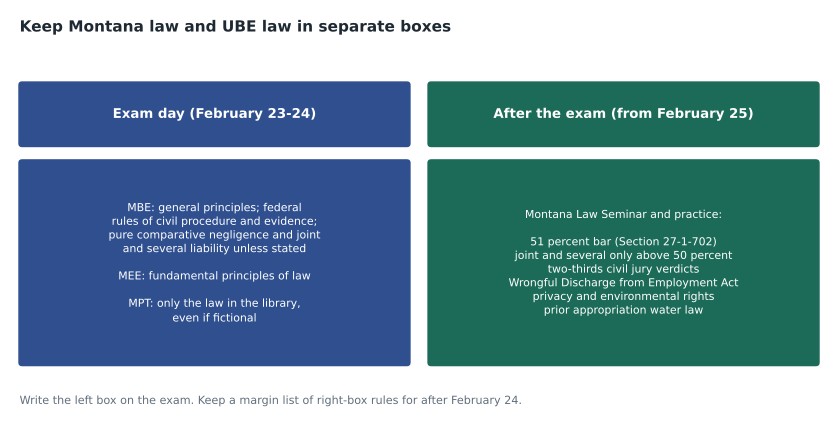
On the exam itself, Montana law is not tested. The MBE tests generally accepted principles and, for civil procedure, the Federal Rules of Civil Procedure; for evidence, the Federal Rules of Evidence. The MEE asks candidates to apply fundamental legal principles, not the law of any one state, unless a question supplies specific law. The MPT supplies its own law in the library, which may come from a fictional jurisdiction, and candidates must use that law even if Montana would decide the question differently.
That makes Montana rules dangerous on exam day. A candidate who has absorbed Montana law in a clinic, a clerkship or a summer job may reach for it without noticing. The safe rule is simple: on the UBE, write the general rule unless the question tells you otherwise.
Montana rules that differ from what the UBE tests
A few comparisons show the trap. Each Montana rule below is covered in a later lesson; here the point is only that the exam expects something else.
| Topic | What the UBE generally expects | Montana rule (for practice) |
|---|---|---|
| Comparative negligence | Pure comparative negligence on the MBE unless a question says otherwise | Modified comparative negligence: the plaintiff recovers only if his or her negligence is not greater than the defendants' (Section 27-1-702) |
| Joint and several liability | Traditional joint and several liability unless the question says otherwise | Joint and several only for a defendant more than 50 percent at fault (Section 27-1-703) |
| Employment termination | At-will employment as the default rule | Wrongful Discharge from Employment Act: good cause required after the probationary period |
| Civil jury verdicts | Unanimity under the Federal Rules unless the parties stipulate otherwise | Two-thirds of the jury may render a civil verdict (Montana Constitution, Article II, Section 26) |
| Water rights | Rarely tested; riparian and prior appropriation described generally | Prior appropriation; post-1973 permits under the Montana Water Use Act |
| Search and seizure | Fourth Amendment doctrine | Article II, Sections 10 and 11 give broader protection in some settings |
Two Montana sets of rules, by contrast, line up closely with what the exam tests. The Montana Rules of Civil Procedure were comprehensively revised in 2011 to track the federal rules, and the Montana Rules of Evidence are modeled on the Federal Rules of Evidence. That overlap is a gift: the time a candidate spends on federal civil procedure and evidence for the MBE also builds the foundation for Montana practice. The differences that do exist, such as Montana's two-thirds civil jury verdict, are ones to learn after the exam.
Worked problem
Exam answer or practice answer?
An MEE torts question: a driver who was 40 percent at fault sues a driver who was 60 percent at fault. The question says nothing about which jurisdiction's law applies. How should Brynn answer, and how would a Montana court decide the same case?
Show solution
- On the MEE: the question asks for generally accepted principles. Explain the forms of comparative negligence and apply them: under pure comparative negligence, the plaintiff recovers 60 percent of damages; under a modified system, the result depends on whether the bar is set at 50 or 51 percent, and the plaintiff recovers 60 percent either way because 40 percent is below both thresholds.
- A strong answer notes that most states use some form of comparative negligence and that the result here is the same under each common version.
- In Montana practice: under Section 27-1-702, the plaintiff's 40 percent is not greater than the defendant's 60 percent, so the plaintiff recovers, with damages reduced by 40 percent.
- The two answers happen to match on these facts, but the MEE answer must be written in general terms.
Answer: Write the general rule on the exam. Save Montana sections for the seminar and for practice.
A study plan that keeps the boxes separate
Marchetti's advice to Brynn was to put Montana law aside until after the MBE. 'You will learn more Montana law in your first month at the firm than in any outline. For the next twelve weeks, every rule you write should be one an examiner in any state would recognize.' She suggested one exception: if a practice question triggers a Montana rule in Brynn's mind, write it in a margin list labeled 'after February.' That list becomes a starting point for the seminar and for the second half of this course.
Brynn's margin list grew quickly. It included the 51 percent bar on comparative negligence, the two-thirds jury verdict, the good-cause rule for firing employees and Montana's constitutional right of privacy. 'I already knew most of these from the clinic and the firm,' she said. 'That is exactly why I needed to write them down somewhere other than my exam answers.'
Common mistakes
MistakeThe Montana Law Seminar earns CLE credit.
InsteadIt is a Supreme Court requirement for admission, not CLE.
MistakeThe seminar is always held in person the day after the exam.
InsteadDelivery is set by the Board; for February 2027 it was online only, viewed from February 25 to March 5.
MistakeMontana rules should be used on MEE answers by Montana candidates.
InsteadThe MEE tests fundamental principles; Montana-specific rules can cost points.
MistakeA retaker must repeat the seminar.
InsteadThe seminar need only be completed once.
Getting the most from the seminar
Because the seminar comes immediately after the exam, many new lawyers watch it tired and distracted. Marchetti suggests a different approach: treat it as the first week of practice. Watch it in sessions of an hour or two, take notes in the same margin list started during bar study and mark each topic with the kind of work it will matter for, such as litigation, transactions, family law or water. Keep the notes; they become a reading list for the first year.
A new lawyer should also write down questions the seminar raises and take them to a supervising lawyer. A rule that sounds simple in a presentation often has local practice attached to it, such as how a particular district judge handles scheduling or how the Department handles a type of water application. Those are the details that make a new lawyer useful quickly.
Writing general principles well
Writing general principles on the MEE is a skill in its own right. A good answer states the majority rule and, where an important minority rule exists, names it briefly and explains whether the result would change. That approach earns credit without depending on any one state's law. For example, on a negligence question, a candidate can state the elements, describe the main forms of comparative negligence and apply them, noting that the result is the same under each if the plaintiff's share is small.
For civil procedure and evidence, the MBE and MEE use the federal rules. A candidate who knows the Montana versions from a clerkship should still write the federal rule. Since Montana's rules largely track the federal ones, the risk is small, but the habit of writing the tested rule protects against the cases where they differ.
When a question supplies law
Occasionally an MEE question tells candidates that a particular statute or rule applies, or that the jurisdiction follows a specific approach. When it does, that instruction controls. The MPT always supplies its law. In both cases, the task is to apply what is given, not to substitute what the candidate knows from Montana or anywhere else.
Summary and key terms
- Rule VIII makes the Montana Law Seminar a prerequisite for admission by every route except pro hac vice; it is completed once.
- Exam and transfer applicants may complete it at either of the two administrations before or the first two after the UBE; motion applicants at either of the first two after applying.
- For February 2027 the seminar was online only, distributed February 25 and viewed by March 5, with a 155-dollar fee.
- The UBE does not test Montana law; the MBE and MEE use general principles and the MPT uses its own library.
- Montana's modified comparative negligence, limited joint and several liability, two-thirds civil verdicts and good-cause discharge rule differ from what the exam expects.
- 0
- Montana Law Seminar
- 1
- Rule VIII
- 2
- two-track afternoon
- 3
- generally accepted principles
- 4
- MPT library
- 5
- Montana Rules of Civil Procedure
- 6
- Montana Rules of Evidence
- 7
- modified comparative negligence
Practice problems
Work each problem on paper first, then reveal the answer to check.
Which applicants are exempt from the Montana Law Seminar?
Show answer
Only lawyers appearing pro hac vice; all applicants for admission must complete it.
For February 2027, when did the seminar have to be viewed?
Show answer
Between its distribution on February 25 and March 5, 2027.
Should a Montana candidate apply Section 27-1-702 on an MEE torts question?
Show answer
No. The MEE tests generally accepted principles; the candidate should explain comparative negligence in general terms.
Why does federal civil procedure study help a Montana lawyer?
Show answer
Because the Montana Rules of Civil Procedure were revised in 2011 to track the federal rules.
Lesson quiz · 5 questions
Score 60% or more to complete this lesson.
Create a free account to save your progress, take quizzes and earn a certificate.