
BAR-227 · Lesson 1 of 12 · 20 min
Becoming a lawyer in Montana
▶ Video coming soon A video version of this lesson is on the way.
Brynn Haugen grew up on her family's cattle ranch outside Lewistown, in Fergus County, where the first serious argument she ever heard was about water. Her father and a neighbor disagreed about whose turn it was to take water from a creek in a dry August, and the answer turned on which homesteader had first put the creek to use in the 1890s. She finished law school in Missoula in May 2026, worked in a water law clinic in her third year and took a clerkship that summer instead of sitting for the July exam. By the fall she was clerking at Thorsen & Kittle, a three-lawyer firm in Lewistown, and had filed her application for the February 2027 Montana bar exam.
At her first one-on-one session with Hollis Marchetti, the study group's coach, Brynn laid out what she knew and what she did not. 'Montana is a UBE state, so I know the exam is the same one my classmates are taking in Idaho and Washington,' she said. 'But Garrett Thorsen keeps telling me about a Montana Law Seminar, a friend says Montana is switching to NextGen, and somebody at the courthouse told me Montana does not let you transfer just an MBE score. I want one map of the whole thing.'
Marchetti nodded. 'Montana is a good state to start with because the exam itself is simple: it is the Uniform Bar Examination, and you need a 266. What makes Montana Montana is everything around the exam. There is a Montana Law Seminar you must complete before you are admitted. There is an MPRE score of 80, which is higher than many states. There are rules on how old a transferred score may be and how many tries it can take. And Montana has set its date for NextGen. Once you see how the pieces fit, the rest is study.'
This lesson maps the whole process: who controls admission in Montana, the bodies that do the work, the three routes into practice and the usual order of events for a first-time candidate. Later lessons take each step in detail and then turn to the Montana law that a new lawyer meets in Lewistown, Billings, Missoula, Great Falls, Helena, Bozeman or Kalispell.
The Montana Supreme Court controls admission
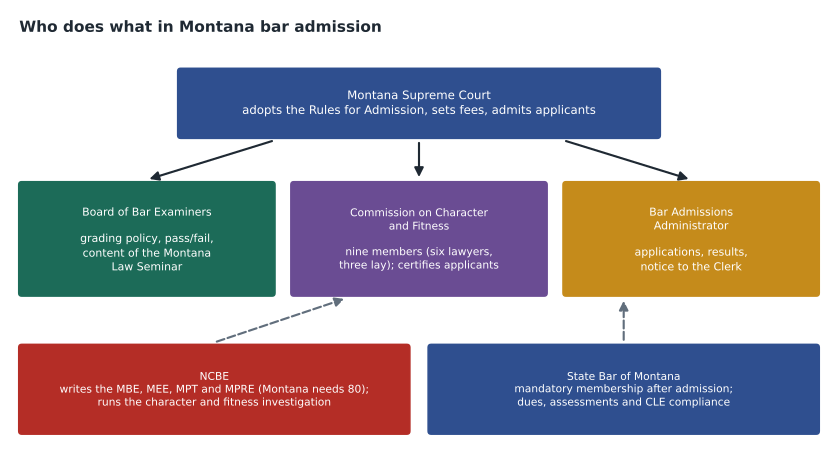
Admission to practice law in Montana is a judicial function. The Montana Supreme Court adopts the Rules for Admission to the Bar of Montana, sets the fees and alone admits applicants. Changes to the exam come by order of the Court. When the Board of Bar Examiners and the State Bar of Montana asked the Court to adopt the NextGen bar exam, the Court first published the petition for comment by an order of March 16, 2026, and then approved the change. The Court also decides appeals from the Commission on Character and Fitness and petitions from applicants who have used up their attempts.
Because the Court controls admission, the Rules are the first source a candidate should read. They are short and readable, and they answer most practical questions: who may sit, when to file, what score passes, how long a score lasts and what must happen before the oath. The State Bar's admissions page warns that the Court has recently adopted new rules with significant changes and that the Rules control if any summary differs. That warning applies to this course as well. Every number here should be checked against the current Rules and the Board's notice for your administration.
The bodies that do the work
Montana spreads the work of admission across several bodies, most of them housed at the State Bar of Montana in Helena.
The Board of Bar Examiners writes the policies for the exam, oversees grading of the written components and decides pass and fail. It also develops the content of the Montana Law Seminar, which the Supreme Court approves. Its decisions on whether an applicant passed are final and not subject to substantive review under the Rules.
The Commission on Character and Fitness reviews every applicant's character and fitness. It has nine members: six Montana lawyers and three members of the public. It must certify, or conditionally certify, each applicant before the applicant may sit for the exam or be admitted by transfer or motion. It also handles pro hac vice applications.
The Bar Admissions Administrator, a State Bar employee, runs the office day to day: receiving applications, answering questions, sending results and notifying the Clerk of the Supreme Court when an applicant is ready to be admitted. Candidates deal with the Administrator far more than with the Board or the Commission.
The State Bar of Montana is the mandatory bar association. After admission every lawyer must be a member and pay dues and assessments. Before the oath, an applicant pays the state license tax, State Bar fees and the assessments for the Office of Disciplinary Counsel and the Lawyers' Fund for Client Protection. The State Bar also runs continuing legal education compliance under the Court's rules.
NCBE's part
The National Conference of Bar Examiners writes every exam component Montana uses: the Multistate Bar Examination, the Multistate Essay Examination, the Multistate Performance Test and the Multistate Professional Responsibility Examination. Montana applicants also file their application online through NCBE, and NCBE conducts the character and fitness investigation for Montana, producing an investigative summary for the Commission. That investigation takes time: the Board's February 2027 notice says the Commission cannot certify an applicant until it receives NCBE's summary, which takes at least 100 days from submission.
Three routes into practice
The State Bar describes three routes into Montana practice. The first is to take the bar exam in Montana. That is the route for recent graduates and for anyone who does not qualify for the other two. The second is to transfer a Uniform Bar Examination score earned in another jurisdiction, as long as it meets Montana's passing score of 266, is no more than three years old and was earned within no more than three attempts. The third is admission on motion for lawyers who were admitted by examination elsewhere and have actively practiced for at least five of the last seven years.
Every route shares the same core requirements: a J.D. from an ABA-accredited law school, certification by the Commission on Character and Fitness, an MPRE scaled score of at least 80, completion of the Montana Law Seminar and payment of the license tax and State Bar dues. The routes differ only in how the applicant proves competence: a new exam, a transferred score or a record of practice.
| Route | Who uses it | Key Montana requirements |
|---|---|---|
| Examination in Montana | Recent graduates and others who do not qualify for transfer or motion | ABA J.D. in hand at the time of the exam; UBE score of 266; MPRE 80; Montana Law Seminar |
| UBE score transfer | Applicants who passed the UBE elsewhere | Score of 266 or more, no more than three years old, earned in no more than three attempts; MPRE 80; seminar |
| Admission on motion | Lawyers admitted by exam elsewhere with five of the last seven years in active practice | At least 1,000 hours of practice a year; good standing everywhere; MPRE; seminar; no Montana UBE failure within five years |
The usual order of events
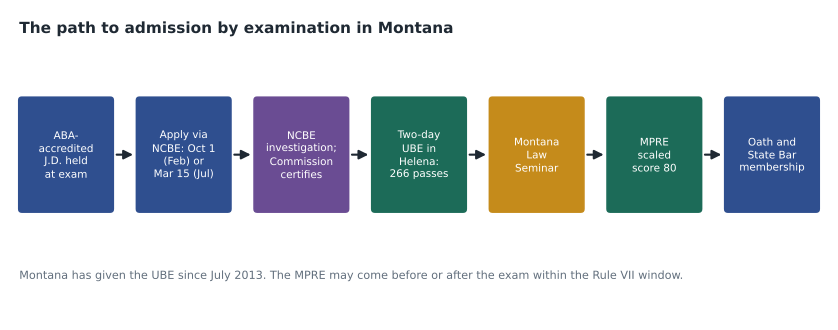
For a first-time candidate like Brynn, the steps run in a predictable order. She earns a bachelor's degree and a J.D. from an ABA-accredited law school. She applies online through NCBE and mails the signed application, the Montana cover sheet and the required documents to the Administrator by the deadline: October 1 for the February exam, March 15 for the July exam. NCBE investigates; the Commission reviews and certifies. She pays the exam and seminar fees by the Board's date, sits for the two-day UBE in Helena, completes the Montana Law Seminar, certifies a passing MPRE score and, once all of that is done, takes the oath at a ceremony set by the Supreme Court.
Two points in that list surprise many candidates. First, Montana does not let a law student sit for the exam before graduation: the J.D. must be held when the applicant takes the exam. Second, the MPRE can come before or after the bar exam, but it has its own time window, discussed in Lesson 3, and the applicant is responsible for getting the score certified to the Administrator.
Why Montana's process looks the way it does
Montana adopted the Uniform Bar Examination in July 2013, one of the early states to do so. Before that, Montana wrote and graded its own essay questions on Montana law. When the state moved to the UBE, it kept a Montana-specific requirement in another form: the Montana Law Seminar. Rather than testing Montana law on the exam, Montana requires every new lawyer to complete a seminar on Montana law and practice before admission. The idea is that a portable national exam measures general competence, and the seminar introduces the local rules a Montana lawyer needs on the first day.
That design has a practical consequence for study. A Montana candidate does not need to memorize Montana law for the exam. The essays and performance tests on the UBE test general principles and the law in the materials provided, never Montana law as such. What a candidate needs from Montana law comes later, in the seminar and in practice, which is why the second half of this course is written for the first year of practice rather than for exam day.
Worked problem
Sorting out who to ask
Brynn has four questions: (1) Whether her 2021 minor-in-possession citation must be disclosed; (2) whether she may handwrite the essays; (3) whether her MPRE score from August 2025 is still good; (4) how many CLE hours she must earn in her first year. Whom should she ask, and where does the answer come from?
Show solution
- Disclosure: the application itself and the Commission on Character and Fitness; the rule is candor, and the question calls for disclosure.
- Handwriting: the Board's exam notice for February 2027, which makes laptops optional and provides blue books.
- MPRE timing: Rule VII of the Rules for Admission, administered by the Administrator; a score earned within three years before the exam works.
- CLE: the Court's Rules for Continuing Legal Education, administered through the State Bar; new members are exempt for the rest of the reporting year in which they are admitted.
Answer: Each question has a home. Going to the right source first saves time and avoids relying on what classmates in other states remember.
Building a study year around the process
Marchetti ended the session by turning the map into a calendar. The application was filed, so the next items were administrative: watch for the Commission's certification letter, which usually arrives about 30 days before the exam; pay the exam and seminar fees through the State Bar's online store by February 1; book a room in Helena early; and decide whether to register a laptop. Everything else was study, and because Montana gives the plain UBE, the study plan could follow a standard national schedule built around the MBE, the MEE and the MPT.
Brynn's one worry was the seminar. 'If I have to learn Montana law anyway, should I be studying it now?' she asked. Marchetti's answer was no. 'Learn it for practice after the exam. On the exam, a Montana rule that differs from the general rule will cost you points if you use it instead of what the MEE tests. Keep the two in separate boxes until February 25.'
What this course covers
Lessons 2 to 5 cover eligibility and deadlines, character and fitness and the MPRE, the exam format and scoring, and the NextGen change planned for February 2028. Lesson 6 covers the Montana Law Seminar and how Montana law relates to what the UBE tests. Lessons 7 to 10 introduce the Montana law that a new lawyer meets early: the courts and civil procedure, including tribal jurisdiction; torts and insurance; the Montana Constitution's distinctive rights; and water law and the Wrongful Discharge from Employment Act. Lesson 11 covers score transfer, admission on motion and practice after admission. Lesson 12 is a capstone with original practice questions and an exam-day plan.
Common mistakes
MistakeMontana tests Montana law on the bar exam.
InsteadMontana gives the UBE; Montana law comes in through the required Montana Law Seminar, not the exam.
MistakeA third-year student can sit for the Montana exam in February before graduating in May.
InsteadThe J.D. must be held when the applicant takes the exam.
MistakeThe State Bar decides who is admitted.
InsteadThe Montana Supreme Court admits; the Board and the Commission evaluate; the State Bar houses the office and takes over after admission.
MistakeAny MBE score from another state can be carried into Montana.
InsteadMontana does not accept a transferred MBE score by itself; it accepts transferred UBE scores that meet its rules.
Summary and key terms
- The Montana Supreme Court adopts the Rules for Admission, sets fees and admits applicants.
- The Board of Bar Examiners decides pass and fail; the nine-member Commission on Character and Fitness certifies applicants; the Administrator runs the office.
- NCBE supplies the MBE, MEE, MPT and MPRE and conducts the character and fitness investigation.
- The three routes are examination, UBE score transfer and admission on motion; all require an ABA J.D., Commission certification, an MPRE score of 80 and the Montana Law Seminar.
- Montana has given the UBE since July 2013; the passing score is 266.
- 0
- Rules for Admission
- 1
- Board of Bar Examiners
- 2
- Commission on Character and Fitness
- 3
- Bar Admissions Administrator
- 4
- State Bar of Montana
- 5
- Montana Law Seminar
- 6
- Uniform Bar Examination
- 7
- admission on motion
Practice problems
Work each problem on paper first, then reveal the answer to check.
Which body admits applicants to the Montana bar?
Show answer
The Montana Supreme Court.
What are the three routes into Montana practice?
Show answer
Examination in Montana, transfer of a qualifying UBE score and admission on motion.
Who conducts the character and fitness investigation for Montana applicants?
Show answer
NCBE conducts the investigation; the Commission on Character and Fitness reviews it and decides certification.
When did Montana first give the UBE?
Show answer
July 2013.
Lesson quiz · 5 questions
Score 60% or more to complete this lesson.
Create a free account to save your progress, take quizzes and earn a certificate.