
BAR-227 · Lesson 3 of 12 · 22 min
Character and fitness and the MPRE
▶ Video coming soon A video version of this lesson is on the way.
Brynn had answered every question on her application, but two answers had kept her up at night. In her freshman year of college she had been cited for minor in possession of alcohol at a party in Bozeman; she paid the fine and completed a class. And in 2024, during her second year of law school, a credit card balance went to collections for two months after she moved and missed the statements; she paid it as soon as she found out. 'I disclosed both,' she told Marchetti. 'But I keep wondering whether I explained them well enough, and whether the collections account will hurt me more than the citation.'
Marchetti's answer was the one she gives every candidate. 'You did the most important thing, which was to tell the truth on the application. Commissions see youthful mistakes and financial stumbles all the time. What worries them is a pattern, or an applicant who hides things. A single citation with a completed class, and a debt you paid as soon as you found it, are the kinds of events that usually lead to a few questions at most. Now let us talk about how the process works, and then about your MPRE score, because Montana's number is higher than you might expect.'
This lesson covers Montana's character and fitness process: who decides, what the investigation involves, what kinds of conduct draw attention, how certification and review work, and the MPRE requirement, including Montana's score of 80 and its timing rules.
Why character and fitness matters
The purpose of character and fitness review is to protect clients, courts and the public. A lawyer handles other people's money, keeps their secrets and makes representations to courts that must be true. The review asks whether an applicant's past conduct suggests that he or she will meet those obligations. It is not a test of whether an applicant has ever made a mistake. It is a test of honesty, responsibility and respect for the law, judged by what the applicant has done and how the applicant has dealt with it.
The Commission and its process
In Montana the Commission on Character and Fitness makes the decision. Its nine members are six Montana lawyers and three members of the public. It processes each application under its own Rules of Procedure, adopted by the Supreme Court, and it decides whether to certify each applicant. No applicant may sit for the exam, or be admitted by transfer or motion, without the Commission's certification or conditional certification.
The investigation itself is done by NCBE. Montana applicants complete NCBE's character and fitness application, which asks about education, employment, residences, criminal history, civil litigation, financial matters, discipline in school or in other professions and conduct that may bear on fitness. NCBE verifies the answers, contacts references and employers, checks records and prepares an investigative summary for the Commission. The Board's February 2027 notice says this takes at least 100 days from submission and that the Commission cannot certify an applicant until the summary arrives.
When the summary raises a question, the Commission may ask the applicant for more information, documents or an explanation. In more serious cases it may hold an interview or a hearing under its procedures. It may certify the applicant, certify the applicant conditionally, or decline to certify. An applicant aggrieved by an action of the Administrator may ask the Commission or the Board to review it, and the Commission's decisions may be appealed to the Montana Supreme Court.
Candor comes first
The single most important rule is candor. An applicant must answer every question fully and truthfully and must update the application if anything changes before admission, such as a new address, a new job, a citation or a lawsuit. Failing to disclose is often treated as more serious than the underlying conduct, because it is current dishonesty directed at the body deciding whether the applicant can be trusted. A minor-in-possession citation from years ago is unlikely to stop anyone; hiding it is a different matter.
The duty of candor also applies to the way an applicant explains events. An explanation should be accurate and complete, should not minimize or blame others, and should show what the applicant learned and did afterward. Documents help: a court disposition showing the fine paid, a certificate from a class, a letter from a creditor showing an account paid in full.
Conduct that draws attention
Some kinds of conduct commonly lead to further inquiry. None is automatically disqualifying in every case, and each is weighed with the rest of the record.
| Area | Examples | What helps |
|---|---|---|
| Criminal conduct | Arrests, citations, convictions, diversion programs | Full disclosure, court records, completion of sentence, time since the event |
| Financial responsibility | Collections, defaults, judgments, bankruptcy, unpaid taxes | Proof of payment or a payment plan, an explanation of circumstances |
| Academic and professional discipline | Honor code findings, discipline in another licensed profession | The school's or agency's records, evidence of later conduct |
| Candor problems | Inconsistent answers on law school and bar applications | Amending the law school application, a full explanation |
| Conduct bearing on fitness | Conduct showing a current inability to practice competently and ethically | Evidence of treatment, monitoring or stability where relevant |
Questions about mental health have changed in recent years. National guidance and many states have moved away from asking about diagnoses or treatment as such and toward asking about conduct, recognizing that seeking help should not count against an applicant. What matters is whether an applicant can currently meet the duties of a lawyer, judged by behavior.
A recurring problem is inconsistency between the law school application and the bar application. If an applicant failed to disclose something to the law school, such as a citation, the applicant should amend the law school application before applying to the bar, so that the two records match. The Commission will compare them.
Worked problem
Evaluating Brynn's disclosures
Brynn disclosed a 2021 minor-in-possession citation (fine paid, class completed) and a 2024 credit card account sent to collections for two months and paid in full. How is the Commission likely to view them?
Show solution
- The citation: a single event, at age 18 or 19, disclosed, with the sentence completed and no repetition. Commissions routinely treat such events as minor.
- The collections account: a short delinquency caused by a move, paid promptly once discovered, with no pattern of debt problems. Proof of payment answers the question.
- Candor: both were disclosed on the bar application and, if asked, on the law school application.
- Supporting documents: the court disposition, the class certificate and a creditor letter showing the account paid.
Answer: Neither event is likely to prevent certification. The likely worst case is a request for documents or a short letter of explanation.
The MPRE in Montana
Every Montana applicant must also pass the Multistate Professional Responsibility Examination. Rule VII of the Rules for Admission requires a scaled score of 80 or higher. That is one of the higher MPRE requirements in the country; many states require 75 or 85, and a few accept lower scores. A candidate who has a score from another state's planning, such as a 77, needs to know that it will not work in Montana.
The MPRE is a two-hour, 60-question multiple-choice test written by NCBE and given three times a year at testing centers. Scores are reported on a scale from 50 to 150. It tests the ABA Model Rules of Professional Conduct and the ABA Model Code of Judicial Conduct, along with generally accepted principles of the law governing lawyers, such as malpractice and the attorney-client privilege. It does not test the Montana Rules of Professional Conduct as such, though Montana's rules follow the Model Rules closely in most respects.
Montana's MPRE timing rules
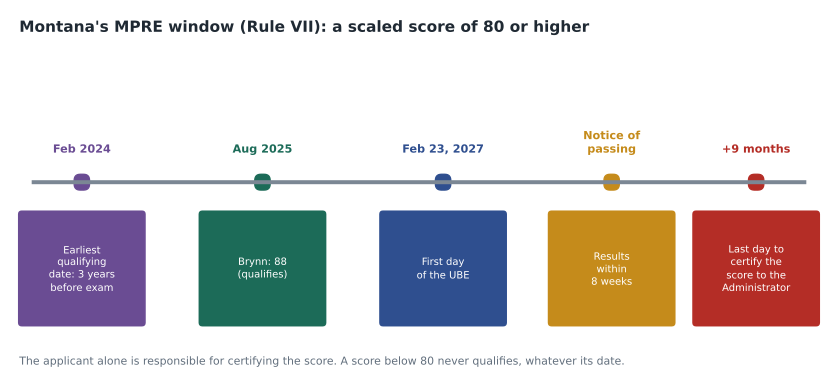
Montana sets a time window around the score. Under Rule VII, the score must be earned no earlier than three years before the first day of the UBE administration the applicant takes, or, for a motion applicant, three years before the motion application. The Board's February 2027 notice describes the same rule from the applicant's side: a score of 80 or higher earned within three years before applying, or no later than nine months after notice that the applicant passed the bar exam.
The applicant must have the score certified to the Bar Admissions Administrator. The Rules make this the applicant's sole responsibility, and the certification must arrive within nine months after notice that the applicant passed the UBE or became eligible for motion. An applicant who passes the bar exam but lets that window close without a qualifying MPRE score on file cannot be admitted on that result.
Worked problem
Checking an MPRE score
Brynn earned an MPRE scaled score of 88 in August 2025. Her friend Wyatt earned 79 in November 2023 and plans to sit for the February 2027 Montana exam. Do their scores work?
Show solution
- Brynn: 88 is at least 80, and August 2025 is within three years before February 23, 2027. Her score works; she must make sure it is certified to the Administrator.
- Wyatt: 79 is below 80, so the score fails regardless of date. In any event, November 2023 is more than three years before February 2027.
- Wyatt's fix: retake the MPRE and earn 80 or more; under the Board's notice he may do so after the bar exam, as long as the score is certified within nine months of notice of passing.
Answer: Brynn is set; Wyatt needs a new MPRE score of at least 80.
Preparing for the MPRE
Most candidates prepare for the MPRE in two to four weeks of focused study, using NCBE's subject matter outline and practice questions. The heaviest areas are conflicts of interest, client confidentiality, the client-lawyer relationship and the lawyer's duties to the court and third parties. Because Montana requires 80, Marchetti tells candidates to aim for comfortable margins in practice: a candidate who scores in the low 80s on practice tests should keep studying, since test-day performance usually falls a little below practice.
Brynn already had her 88. Her remaining task was paperwork: confirm that NCBE would send the score to Montana, and check with the Administrator that it was on file. 'The day you pass is not the day to discover your MPRE was never certified,' Marchetti said.
Common mistakes
MistakeA minor citation that was resolved need not be disclosed.
InsteadDisclose everything the application asks about; nondisclosure is treated more seriously than the event.
MistakeMontana accepts an MPRE score of 75.
InsteadMontana requires a scaled score of 80 or higher.
MistakeNCBE automatically completes Montana's MPRE paperwork.
InsteadThe applicant is solely responsible for having the score certified to the Administrator.
MistakeThe MPRE tests the Montana Rules of Professional Conduct.
InsteadIt tests the ABA Model Rules, the Model Code of Judicial Conduct and general principles of the law governing lawyers.
Writing an explanation the Commission can use
When an application asks for an explanation, a short, factual statement works best. Marchetti suggests four parts. First, what happened, in plain words, with the date and place. Second, how it was resolved, with a reference to the attached document that proves it. Third, what the applicant learned or changed. Fourth, what has happened since, such as years without a repeat. An explanation that runs more than a page, argues with the police report or blames friends invites more questions than it answers.
Brynn's explanation of the citation was five sentences long: she was cited at a party in her freshman year, she pleaded and paid the fine, she completed the required class, she has had no further citations, and the disposition and class certificate were attached. Her explanation of the collections account was four: she moved in 2024, missed two statements sent to the old address, paid the balance in full when she learned of it, and attached the creditor's letter confirming payment.
Updating the application
The duty of candor continues until admission. If something happens after the application is filed, such as a new citation, a lawsuit, a change of address or employment, or a new debt problem, the applicant should update the application promptly. An event that would have been minor if reported can become serious if the Commission learns of it from someone else.
If the Commission has questions
A letter from the Commission asking for more information is not a denial. It usually means the investigative summary raised a point the Commission wants to understand. The right response is prompt, complete and documented. An applicant facing a serious question, such as a recent criminal matter, a pattern of financial problems or a candor issue, may want advice from a lawyer experienced in admissions matters before responding, and should take any interview or hearing as seriously as a court appearance.
Studying the MPRE efficiently
The MPRE rewards precise knowledge of a limited set of rules. Candidates usually do best by reading the Model Rules on conflicts of interest, confidentiality, fees, communication with clients and represented persons, candor to the tribunal and advertising closely, because questions turn on fine distinctions such as whether informed consent must be confirmed in writing or whether a disclosure is permitted or required. Practice questions help candidates learn how the exam phrases those distinctions.
A second habit that helps is reading every answer choice. MPRE questions often present several plausible courses of action, and the best answer is the one the rules require or permit, not the one that seems most cautious or most ethical in a general sense. A candidate who chooses the most conservative option by instinct will miss questions where the rules allow more.
Summary and key terms
- The nine-member Commission on Character and Fitness decides certification; NCBE investigates; the process takes at least 100 days.
- Candor is the central requirement; failure to disclose is often worse than the conduct.
- Commission decisions may be appealed to the Montana Supreme Court.
- Montana requires an MPRE scaled score of 80, earned no earlier than three years before the first day of the exam (or the motion application).
- The applicant must have the score certified within nine months after notice of passing or of motion eligibility.
- 0
- character and fitness
- 1
- candor
- 2
- certification
- 3
- conditional certification
- 4
- investigative summary
- 5
- MPRE
- 6
- scaled score
- 7
- rehabilitation
Practice problems
Work each problem on paper first, then reveal the answer to check.
What MPRE scaled score does Montana require?
Show answer
80 or higher.
How early may a qualifying MPRE score have been earned for a February 2027 Montana applicant?
Show answer
No earlier than three years before the first day of the exam, so from late February 2024.
Who is responsible for certifying the MPRE score to the Administrator?
Show answer
The applicant alone.
Why should an applicant amend a law school application before applying to the bar?
Show answer
So the two records match; the Commission compares them, and inconsistency raises candor concerns.
Lesson quiz · 5 questions
Score 60% or more to complete this lesson.
Create a free account to save your progress, take quizzes and earn a certificate.