
BAR-227 · Lesson 11 of 12 · 23 min
Score transfer, admission on motion and practice after admission
▶ Video coming soon A video version of this lesson is on the way.
In mid-November, Garrett Thorsen asked Brynn to help with a hiring question. The firm wanted a second associate, and two candidates had applied. One was a lawyer who had practiced for six years in North Dakota after passing that state's exam. The other had sat for the UBE in Idaho in July 2026 and passed with a 271, but had not yet been admitted anywhere. 'Which of them can we put to work in Montana, and how soon?' he asked. At the same session, Brynn wanted to know what would happen after her own admission: dues, continuing education and the professional conduct rules she would live under.
Marchetti said the two questions were really one. 'Montana gives three doors into practice, and you already know the exam door. The other two are score transfer and admission on motion. Once anyone is through a door, the same rules apply: State Bar membership, CLE and the Montana Rules of Professional Conduct.'
This lesson covers transferring a UBE score into Montana, admission on motion, temporary appearances pro hac vice and, for every new lawyer, the oath, State Bar membership, continuing legal education and a distinctive Montana rule on insurance defense practice.
Transferring a UBE score into Montana
Rule IV of the Rules for Admission lets an applicant who sat for the UBE in another jurisdiction use that score in Montana. The score must be at least 266. It remains valid for three years from the first day of the administration in which it was earned. And it must have been earned in no more than three UBE administrations taken within the three years before the application. The score is used as a whole: components may not be combined from different administrations.
A transfer applicant must meet the other requirements as well: a J.D. from an ABA-accredited law school, an MPRE scaled score of at least 80 within the Rule VII window, good standing in every jurisdiction where the applicant is admitted, disclosure of any pending complaints, certification by the Commission on Character and Fitness and completion of the Montana Law Seminar. NCBE's summary of Montana's rules lists transfer fees of 155 or 410 dollars plus NCBE's character and fitness fee, without stating which applies when, so an applicant should confirm the amount with the Administrator. Montana also permits a concurrent application, so a candidate sitting for the UBE elsewhere can apply for Montana admission by transferred score at the same time.
Montana does not accept a transferred MBE score alone. A candidate with an MBE score from a jurisdiction that does not give the UBE must take the full exam in Montana. For NextGen scores, NCBE's summary lists Montana as accepting transfers starting July 2026 with a minimum of 616.
Worked problem
The Idaho candidate
The second applicant sat for the UBE in Idaho in July 2026 and scored 271 on her first attempt. She has an MPRE score of 84 from March 2026 and an ABA-accredited J.D. Can she transfer the score to Montana?
Show solution
- Score: 271 is at least 266.
- Age: the score is valid for three years from the first day of the July 2026 administration, so she must apply and complete the process well before July 2029.
- Attempts: one attempt, well within the limit of three in three years.
- MPRE: 84 is at least 80 and was earned within three years.
- Remaining steps: NCBE character and fitness investigation, Commission certification, the Montana Law Seminar at one of the permitted administrations, and the oath.
Answer: She qualifies by transfer. The longest step is likely the character and fitness investigation, which takes at least 100 days.
Using a Montana score elsewhere
The same portability works in the other direction. A candidate who passes in Montana may transfer the score to another UBE jurisdiction, subject to that jurisdiction's minimum score, time limit and other requirements. Because UBE cut scores range from 260 to 270, a Montana score of 266 to 269 will transfer to many jurisdictions but not to those requiring 270. A Montana lawyer near the Idaho, Wyoming, North Dakota or Washington border may want to seek admission in a neighboring state while the score is fresh.
Admission on motion
Rule V provides for admission on motion for experienced lawyers. The core requirement is that the applicant was admitted by bar examination in another state, territory or the District of Columbia and has been engaged in the active practice of law for at least five of the seven years immediately before applying. Each of the five years must include at least 1,000 hours of practice.
Active practice is defined broadly. It includes representing clients in private practice; service as a lawyer for a government entity, including military service; teaching at an ABA-accredited law school; service as a judge; judicial clerkships after admission; work as in-house counsel after admission; and practice in Montana under a temporary admission.
The Rules also set exclusions. An applicant may not use the motion route if he or she has been denied admission on character and fitness grounds, has failed the Montana UBE within the past five years, was previously admitted in Montana (except a lawyer who resigned in good standing), has been denied admission on motion before, has engaged in the unauthorized practice of law, or is not in good standing everywhere admitted. The applicant must also have a passing MPRE score, Commission approval and completion of the Montana Law Seminar. The motion fee is 2,500 dollars, covering the attorney application fee, the seminar and first-year dues and assessments.
| Requirement | Admission on motion in Montana (Rule V) |
|---|---|
| Prior admission | By bar examination in another United States jurisdiction |
| Practice | Active practice for at least five of the past seven years, at least 1,000 hours a year |
| Education | J.D. from an ABA-accredited law school |
| Barriers | No Montana UBE failure within five years; no prior character and fitness denial or unauthorized practice; good standing everywhere |
| Other | MPRE score of 80; Commission certification; Montana Law Seminar within the first two administrations after applying |
| Fee | 2,500 dollars, including seminar and first-year dues |
Worked problem
The North Dakota lawyer
The first applicant passed the North Dakota exam in 2020 and has practiced full time at a Bismarck firm since then, about 1,900 hours a year. He has never sat for the Montana exam. His MPRE score is 92 from 2019. Can he be admitted on motion?
Show solution
- Prior admission by examination: yes, North Dakota.
- Five of seven years: practice from 2020 to 2026 gives six years of full-time practice, each above 1,000 hours.
- Barriers: no Montana UBE failure, no denials and good standing, assuming his record is clean.
- MPRE: the Rules require an MPRE score of at least 80 within three years before the motion application. A 2019 score is outside that window, so he must confirm with the Administrator whether a new MPRE is required.
- Other steps: Commission certification, the Montana Law Seminar within the first two administrations after applying, the 2,500-dollar fee.
Answer: He likely qualifies on motion, but he should resolve the MPRE timing question first. Until he is admitted, he may not practice Montana law.
Appearing pro hac vice
A lawyer licensed elsewhere who needs to appear in a single Montana case may ask the court for permission to appear pro hac vice under Rule VI. The lawyer must be admitted to practice before the highest court of another state and must associate with a Montana lawyer of record. A lawyer who lives in Montana or regularly practices here may not use pro hac vice unless an application for admission is pending. Beyond a second appearance, further appearances require good cause, which the Rules say should not be routinely granted. The fee equals annual active dues, with a one-time fee for pro bono matters. The Rules exempt certain Indian Child Welfare Act cases and federal government lawyers appearing in Water Court matters from parts of these requirements.
After admission: the oath, membership and fees
A successful applicant is admitted at a ceremony set by the Supreme Court, signs the roll of attorneys and the ethics oath and recites the oath prescribed by the Court. Before admission the applicant pays the state license tax, State Bar fees and the assessments for the Office of Disciplinary Counsel and the Lawyers' Fund for Client Protection. An applicant must be admitted within one year after meeting all requirements. Membership in the State Bar of Montana is mandatory for every practicing lawyer.
Continuing legal education
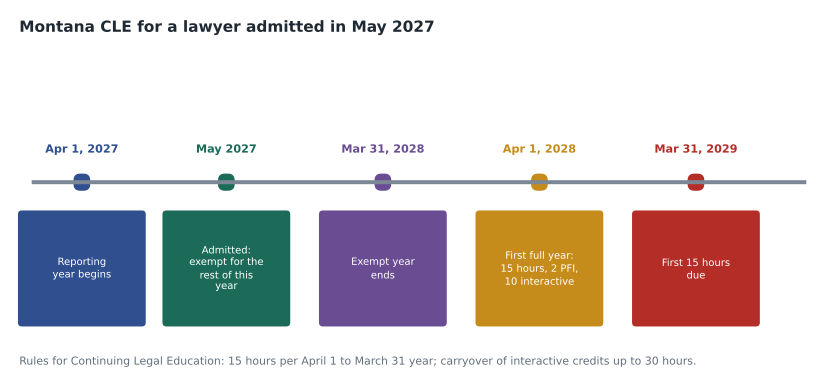
The Supreme Court's Rules for Continuing Legal Education require every active member to earn at least 15 credit hours of approved CLE each reporting year, which runs from April 1 through March 31. At least 2 of the 15 hours must be Professional Fitness and Integrity credits, which may cover professional responsibility and ethics, fitness to practice, including substance use, stress and mental health, and the elimination of bias. At least 10 hours must come from interactive programs, and no more than 5 from other methods such as self-study. Excess interactive credits may be carried forward into one or both of the next two reporting years, up to 30 hours.
New lawyers get a grace period: an active member is exempt for the balance of the reporting year in which he or she is admitted. Compliance is reported through the State Bar. Members who fail to comply receive notices in the spring, owe a late fee if they are found noncompliant after May 15, and are transferred to inactive status if not corrected by July 1.
Worked problem
Brynn's first CLE deadline
If Brynn passes in February 2027 and is admitted at the early May 2027 ceremony, when must she first meet the 15-hour requirement?
Show solution
- The reporting year runs April 1 to March 31, so May 2027 falls in the year from April 1, 2027 to March 31, 2028.
- A new member is exempt for the balance of the reporting year of admission.
- Her first full reporting year is April 1, 2028 to March 31, 2029.
- Interactive hours she earns in her exempt year may help later only if the carryover rules allow; she should ask the State Bar how credits earned during the exempt year are treated.
Answer: Her first 15 hours, including 2 Professional Fitness and Integrity hours, are due for the year ending March 31, 2029.
A Montana rule for insurance defense lawyers
The Montana Rules of Professional Conduct are based on the ABA Model Rules, and most differences are small. One Montana decision has an outsized effect on practice. In In re the Rules of Professional Conduct and Insurer Imposed Billing Rules and Procedures, 2000 MT 110, the Montana Supreme Court held that a lawyer defending an insured at an insurer's expense represents the insured as the sole client. The insurer is not a co-client. The Court held that defense counsel may not follow insurer billing and litigation guidelines that require prior approval before taking steps in the defense, in a way that interferes with counsel's independent professional judgment, and that counsel may not send detailed billing information to an outside auditor without the insured's informed consent.
For a firm like Thorsen & Kittle, which defends insured ranchers and businesses in car wrecks and property disputes, the decision means that the client is the person being sued, not the company paying the bill. Garrett Thorsen keeps a copy of the opinion in the front of the firm's insurance defense manual.
Common mistakes
MistakeMontana accepts any UBE score from any year.
InsteadA transferred score must be at least 266, no more than three years old and earned within three attempts.
MistakeAdmission on motion requires five consecutive years of practice.
InsteadThe Rules require five of the past seven years, with at least 1,000 hours in each year counted.
MistakeNew Montana lawyers must earn 15 CLE hours in their first partial year.
InsteadThey are exempt for the balance of the reporting year in which they are admitted.
MistakeAn insurer is a co-client of the defense lawyer it hires.
InsteadUnder 2000 MT 110, the insured is the sole client.
Choosing a route
For a lawyer or graduate thinking about Montana, the choice of route usually follows from three facts: whether the person has a recent UBE score of at least 266, whether the person has five of the past seven years in active practice after admission by examination, and whether the person is willing to sit for the exam again. A recent graduate with a passing UBE score from another state should transfer. An experienced lawyer admitted by examination should consider motion. Everyone else sits for the exam in Montana. In every case the MPRE, character and fitness and the seminar come along.
Summary and key terms
- UBE transfer into Montana: 266 or more, no more than three years old, earned within three attempts, plus the MPRE, Commission certification and the seminar.
- Admission on motion: admitted by exam elsewhere and in active practice for five of the past seven years, at least 1,000 hours a year; fee 2,500 dollars.
- Pro hac vice requires association with Montana counsel; appearances beyond the second require good cause.
- CLE: 15 hours each April 1 to March 31 reporting year, including 2 Professional Fitness and Integrity hours and at least 10 interactive hours; new members are exempt for the year of admission.
- In 2000 MT 110, the Montana Supreme Court held that the insured is the sole client of insurance defense counsel.
- 0
- score transfer
- 1
- concurrent application
- 2
- admission on motion
- 3
- active practice
- 4
- pro hac vice
- 5
- reporting year
- 6
- Professional Fitness and Integrity credits
- 7
- sole client
Practice problems
Work each problem on paper first, then reveal the answer to check.
How old may a UBE score be when transferred into Montana?
Show answer
No more than three years from the first day of the administration in which it was earned.
How many hours a year of practice count toward admission on motion?
Show answer
At least 1,000 hours in each of the five years.
When does the Montana CLE reporting year run?
Show answer
From April 1 through March 31.
Who is the client when an insurer hires a lawyer to defend its insured in Montana?
Show answer
The insured, as the sole client, under 2000 MT 110.
Lesson quiz · 5 questions
Score 60% or more to complete this lesson.
Create a free account to save your progress, take quizzes and earn a certificate.