
BAR-227 · Lesson 2 of 12 · 20 min
Eligibility, education, deadlines and fees
▶ Video coming soon A video version of this lesson is on the way.
Brynn came to her second session with a folder of receipts and a question from a classmate. 'Wyatt is finishing his J.D. in December at a school in Oregon,' she said. 'He asked whether he can sit for the February exam in Montana if his degree is conferred in January. And another friend, who went to law school in Canada, wants to know whether Montana would let her sit at all.' She also wanted to know whether she had paid everything she owed or whether more fees were coming.
Marchetti opened the Rules for Admission on her screen. 'Eligibility questions in Montana are short, because the Rules are strict. There is one educational path for an exam applicant, the deadlines are fixed dates, and the fees are set by the Supreme Court. Let us go through them in the order an applicant meets them.'
This lesson covers who may sit for the Montana exam, the education requirement, the filing deadlines and how to meet them, the fees and when they are due, and what happens when an applicant needs to defer, retake or ask for more time.
Who may apply
The Rules divide applicants into categories. A student applicant is someone who has never been licensed to practice law anywhere. An attorney applicant is someone already admitted in another United States state, territory or the District of Columbia. A resigned applicant is a former Montana lawyer seeking to return, who proceeds by petition to the Supreme Court and generally does not sit for the exam unless the Court orders otherwise.
Every exam applicant, student or attorney, must hold a Juris Doctor from a law school accredited by the American Bar Association. Montana takes the requirement literally in two ways. First, the J.D. must be held at the time the applicant takes the exam. Montana has no provision allowing a student to sit in the last semester of law school, as a few states do. Second, a Master of Laws degree does not substitute for the J.D. A foreign-trained lawyer with an American LL.M., who may qualify to sit in some states, does not qualify in Montana on that basis. NCBE's summary of Montana's rules lists foreign law graduates as ineligible.
So Brynn's two friends get two different answers. Wyatt can sit in February if his J.D. is conferred before the exam begins, as long as he files on time and his school confirms the degree. Brynn should tell him to make sure the school can send the final transcript showing the conferred degree by the Board's transcript date. Her friend with a Canadian law degree cannot sit for the Montana exam on that degree; she would need an ABA-accredited J.D., or admission elsewhere followed by years of practice that might in time support admission on motion, which also requires an ABA-accredited J.D.
| Applicant | Eligible to sit in Montana? | Why |
|---|---|---|
| J.D. conferred in May from an ABA-accredited school | Yes | Meets the education rule |
| Third-year student who will graduate after the exam | No | The J.D. must be held when the applicant takes the exam |
| J.D. conferred in January before a February exam | Yes, if the degree is conferred and documented in time | Degree held at the time of the exam |
| Foreign-trained lawyer with an American LL.M. | No | An LL.M. does not substitute for the J.D.; foreign graduates are not eligible |
| Lawyer admitted in another state with an ABA J.D. | Yes, as an attorney applicant | May also consider transfer or motion if eligible |
How to apply
Montana uses NCBE's online application. The applicant completes it online, prints it, and mails a signed original to the Bar Admissions Administrator along with the Montana Application Cover Sheet, the documents listed on Montana's application checklist and the Montana application fee. NCBE's character and fitness fee is paid separately to NCBE. An applicant who wants a certified copy of the application later can order one from the State Bar.
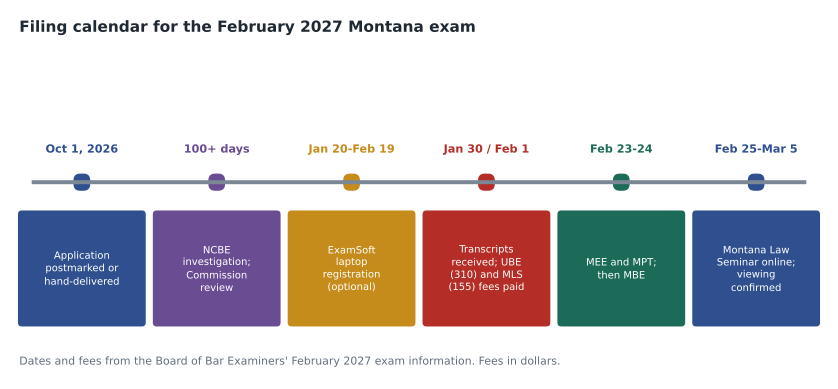
The checklist is where many delays begin. It typically calls for documents such as a copy of a government photo identification, which must match the identification the applicant brings to the exam, and transcripts sent directly by the law school. The Board's February 2027 notice set January 30 as the deadline for receipt of transcripts and reminded applicants that requesting them is their own responsibility.
The filing deadlines
The Rules set two deadlines. Applications for the July exam must be filed by March 15 before that exam. Applications for the February exam must be filed by October 1 before that exam. A filing is timely if it is postmarked or hand-delivered by the deadline. NCBE's summary lists no late filing period for Montana, and the Rules say that a late application may be accepted only with leave of the Supreme Court and with an added late fee. In practice, a candidate should treat the deadline as fixed.
The early deadlines are tied to the character and fitness process. NCBE's investigation takes at least 100 days, and the Commission cannot certify an applicant until it has the investigative summary. Certification letters usually go out about 30 days before the exam. An applicant who files on the last day has no margin if references are slow, records are missing or an issue needs a closer look.
The fees
The Supreme Court sets all Montana admission fees, and the Montana application fee is nonrefundable. Fees fall into several groups, and a candidate should expect to pay more than once.
The application fee is paid with the application. NCBE's summary of Montana's fees lists 620 dollars for first-time takers who are not lawyers, 875 dollars for attorney applicants and 310 dollars for repeaters, each with NCBE's character and fitness fee on top. The Board's notice for each administration then sets the payments due before the exam. For February 2027, the notice lists a 310-dollar UBE fee and a 155-dollar Montana Law Seminar fee, both payable through the State Bar's online store by February 1, with a 3 percent processing surcharge on online payments. Re-examinees pay the UBE fee each time but not the seminar fee again. A deferral to the next exam costs 20 dollars.
Laptop users pay ExamSoft directly. The February 2027 notice lists a 125-dollar charge for the SofTest software, with registration open from January 20 to February 19. Laptops are optional: essays may be handwritten in blue books provided by the Board.
Admission on motion carries a single larger fee. Under the Rules, a motion applicant pays 2,500 dollars, which covers the attorney application fee, registration for the Montana Law Seminar and the first year's dues and assessments. The attorney application fee is waived for lawyers employed by an Access to Justice organization, full-time faculty at Montana's law school and applicants for emeritus status, though they still pay for the seminar, dues and assessments.
Finally, before taking the oath, every new lawyer pays the state license tax, State Bar fees and the assessments for the Office of Disciplinary Counsel and the Lawyers' Fund for Client Protection.
| Fee | Amount (dollars) | Paid to and when |
|---|---|---|
| Application, first-time non-attorney (NCBE summary) | 620 plus NCBE character and fitness fee | With the application |
| Application, attorney applicant (NCBE summary) | 875 plus NCBE character and fitness fee | With the application |
| UBE fee (February 2027 notice) | 310 | State Bar online store by February 1 |
| Montana Law Seminar (February 2027 notice) | 155 | State Bar online store by February 1; not repeated on retake |
| ExamSoft laptop software | 125 | ExamSoft, if using a laptop |
| Deferral to the next exam | 20 | With the written deferral request |
| Admission on motion | 2,500 | With the motion application; covers seminar and first-year dues |
Worked problem
Budgeting the February exam
Brynn applied as a first-time, non-attorney applicant, handwrites her essays and pays online. Using the figures above, what will she pay to Montana bodies between filing and the exam, leaving aside NCBE's investigation fee and later license and dues payments?
Show solution
- Application fee as listed by NCBE for first-time non-attorney takers: 620 dollars.
- The Board's February notice lists the UBE fee (310) and seminar fee (155) due February 1; confirm with the Administrator whether the 620 figure already includes the UBE fee, because NCBE's figure equals two UBE fees.
- Online payments add a 3 percent surcharge on the store payment: 3 percent of 465 is about 14 dollars.
- No laptop fee because she handwrites.
Answer: The safest course is to read the fee schedule the Administrator sends and to ask about anything that looks duplicated. Fees are nonrefundable, so paying the wrong item is a real cost.
Deferral, reexamination and the attempt limit
Plans change, and the Rules address what happens when they do. An applicant who cannot sit as planned must request a deferral in writing and file an addendum no later than twenty days before the exam, unless an emergency arises. An applicant who fails to appear without a written deferral, or who misses an addendum deadline, is dismissed and must file a new application with a new fee.
An applicant who does not pass may sit again by filing a reexamination addendum no later than twenty days before the next exam and paying the regular exam fees. After three deferrals or reexaminations, a new application and fee are required. After three unsuccessful attempts, the applicant must petition the Supreme Court for permission to sit again, and the petition must include a study plan. Unsuccessful applicants may review their own results to prepare for reexamination, but the review must be scheduled within sixty days of the mailed notice.
Accommodations and medical needs
An applicant with a disability may request testing accommodations through the application process. Those with approved accommodations receive an individual schedule rather than the standard one. Separately, the Board asks any applicant with a medical condition that could matter on exam day to submit a Notice of Medical Alert form before the exam. Food is not allowed in the exam room unless cleared in advance, so an applicant who needs to eat during a session for medical reasons should raise it early.
Brynn closed her folder. 'So I owe the February 1 payments, I need to make sure my transcript shows the degree conferred, and I need to watch for the certification letter in January.' Marchetti added one more item: 'And keep copies of everything you mailed. If something is lost, a copy with a postmark date is how you show you filed on time.'
Common mistakes
MistakeMontana lets students sit in their final semester.
InsteadThe J.D. must be held at the time of the exam.
MistakeA foreign law degree plus an American LL.M. qualifies an applicant to sit.
InsteadMontana requires an ABA-accredited J.D.; an LL.M. does not substitute.
MistakeMontana has a routine late filing window.
InsteadA late application needs leave of the Supreme Court and a late fee; NCBE lists no late deadline.
MistakeA retaker pays the seminar fee again.
InsteadRe-examinees pay the UBE fee each time but not the seminar fee.
Planning backward from the exam
Montana's fixed dates make it easy to plan backward. Marchetti has every candidate write the exam date at the bottom of a page and work up. For the February 2027 exam, the bottom line is February 23. Above it go the seminar viewing deadline after the exam (March 5), the fee payment date (February 1), the transcript receipt date (January 30), the laptop registration window (January 20 to February 19) if needed, the expected certification letter (about 30 days before the exam) and, at the top, the filing deadline of October 1, 2026. For the July exam the same list starts from March 15.
The value of the exercise is that it exposes dependencies. A transcript showing a conferred degree cannot be sent until the degree is conferred, so a December graduate must confirm with the school that it can send the final transcript in time. A certification letter cannot arrive until NCBE finishes its investigation, so a slow employer reference in November becomes a problem in January. A candidate who sees those links in October can fix them; one who sees them in February cannot.
Common filing mistakes
Most filing problems are avoidable. The ones that come up most often are an unsigned or incomplete application; an identification document that does not match the identification the candidate later brings to the exam; transcripts sent by the candidate rather than directly by the school; missing documents from the checklist; and a fee paid for the wrong item or not paid at all by the Board's date. Each can delay certification, and some can lead to dismissal of the application if a deadline passes.
A second group of mistakes involves changes after filing. Candidates move, change jobs, get traffic citations or become parties to lawsuits between October and February. The application is a continuing statement, and changes that bear on the questions it asks should be reported promptly. A candidate who is unsure whether a change matters should ask the Administrator rather than guess.
Keeping a file
Every candidate should keep a complete copy of everything sent: the application as printed and signed, the cover sheet, each document on the checklist, proof of mailing with the postmark date, receipts for every payment and copies of every email with the Administrator. The State Bar can provide a certified copy of an application on request for a fee, but a candidate's own file is faster and includes proof of when things were sent. Applications are kept by the State Bar for five years.
Summary and key terms
- Every exam applicant needs a J.D. from an ABA-accredited law school, held when the applicant takes the exam; an LL.M. does not substitute.
- Apply through NCBE online, then mail the signed application, cover sheet, checklist documents and fee to the Administrator.
- Deadlines: October 1 for February and March 15 for July, postmarked or hand-delivered; late filing needs Supreme Court leave.
- Fees are set by the Court and nonrefundable; the February 2027 notice lists a 310-dollar UBE fee and a 155-dollar seminar fee due February 1.
- Deferral and reexamination addenda are due twenty days before the exam; after three unsuccessful attempts, a petition with a study plan is required.
- 0
- student applicant
- 1
- attorney applicant
- 2
- ABA-accredited J.D.
- 3
- filing deadline
- 4
- addendum
- 5
- deferral
- 6
- reexamination
- 7
- study plan petition
Practice problems
Work each problem on paper first, then reveal the answer to check.
What is the deadline to apply for the February Montana exam?
Show answer
October 1 before the exam, postmarked or hand-delivered.
Can an applicant with a Canadian law degree and an American LL.M. sit for the Montana exam?
Show answer
No. Montana requires an ABA-accredited J.D., and an LL.M. does not substitute.
What must an applicant do after three unsuccessful attempts?
Show answer
Petition the Montana Supreme Court for permission to sit again, including a study plan.
What does the 2,500-dollar motion fee cover?
Show answer
The attorney application fee, Montana Law Seminar registration and first-year dues and assessments.
Lesson quiz · 5 questions
Score 60% or more to complete this lesson.
Create a free account to save your progress, take quizzes and earn a certificate.