
BAR-221 · Lesson 9 of 12 · 20 min
Maryland family law and property: the 2023 divorce reform and tenancy by the entirety
▶ Video coming soon A video version of this lesson is on the way.
Half of Helen Szabo's caseload is family law, and much of the rest involves houses. Bridget's second week at the firm had included a consultation with a couple from Essex who had separated in March 2026 and wanted to divorce, and a phone call from a creditor's lawyer asking whether the firm's client and his wife owned their Perry Hall house as tenants by the entirety. 'Those are two different fields of law,' Bridget said to Hollis at the ninth session, 'but they kept running into each other.'
'They always do,' Hollis said. 'In Maryland, the house is often the biggest asset in a divorce, and how a married couple holds title decides what a creditor can reach. Let us take them in order.'
This lesson covers Maryland's 2023 divorce reform, the basic structure of property division, alimony and child support, and the Maryland rules on tenancy by the entirety. Family law and trusts and estates appear in the Maryland Law Component outlines, and they are among the subjects most likely to come up early in a general practice.
Divorce before October 1, 2023
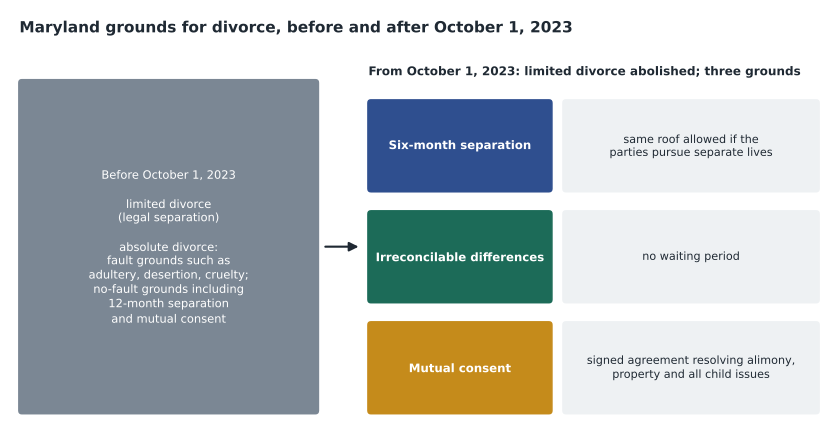
Until October 1, 2023, Maryland had two kinds of divorce. A limited divorce was a legal separation that did not end the marriage. An absolute divorce ended it. Grounds for absolute divorce included fault grounds, such as adultery, desertion, cruelty and excessively vicious conduct, and no-fault grounds, including a twelve-month separation and mutual consent. Many couples went through a long and expensive process, and the fault grounds encouraged litigation about who was to blame.
The 2023 reform
In 2023 the General Assembly passed matching bills, Senate Bill 36 and House Bill 14, enacted as Chapters 645 and 646 of the Laws of Maryland 2023. The reform took effect on October 1, 2023. It abolished limited divorce and replaced the old list of grounds with three grounds for absolute divorce.
The first ground is a six-month separation. The parties must have lived separate and apart for six months before the complaint is filed. The reform allows the parties to live under the same roof during the separation, as long as they are pursuing separate lives.
The second ground is irreconcilable differences. This ground has no waiting period. A spouse can file on the basis that the marriage has broken down beyond repair.
The third ground is mutual consent. The parties must submit a written settlement agreement, signed by both, that resolves all issues relating to alimony, the distribution of property and the care, custody, access, maintenance and support of any minor children.
Fault grounds no longer exist as grounds for divorce. Fault has not vanished from family law entirely, however. When a court decides alimony or a monetary award, the statutory factors include the circumstances that contributed to the estrangement of the parties, so conduct during the marriage can still matter to the financial outcome.
The couple from Essex had separated in March 2026. By the time they consulted Helen in September they had passed six months of separation, and they could file on that ground. They could also file on the ground of irreconcilable differences without waiting. If they could agree on everything, a mutual consent divorce with a signed settlement agreement would likely be the fastest and least expensive.
Property division
Maryland is not a community property state. It divides property through a process set out in Title 8 of the Family Law Article. The court first decides which property is marital property. Marital property is property acquired by either or both spouses during the marriage, however titled, except property acquired by inheritance or gift from a third party, property excluded by valid agreement and property directly traceable to those sources. The court then values the marital property.
Traditionally, a Maryland court does not simply reassign ownership of every asset. Instead, it may grant a monetary award to adjust the parties' equities and rights in the marital property, and it may order the transfer of certain kinds of property, such as interests in retirement plans and some jointly owned property. The court considers statutory factors, including each party's contributions, monetary and nonmonetary, to the family's well-being, the value of each party's property, the economic circumstances of each party, the duration of the marriage, the age and health of each party and the circumstances that contributed to the estrangement.
The family home receives special attention. A court can grant one spouse the use and possession of the family home, often the parent with custody of minor children, for a period after the divorce.
Alimony and child support
Maryland recognizes two main kinds of alimony. Rehabilitative alimony, which is the more common, supports a spouse for a limited period while he or she becomes self-supporting. Indefinite alimony may be awarded when a spouse cannot reasonably be expected to make substantial progress toward self-support because of age, illness or disability, or when, even after the other spouse makes as much progress as can be expected, the respective standards of living would be unconscionably disparate. The court considers a list of statutory factors.
Child support is calculated under the Maryland Child Support Guidelines, which use an income shares model: the child is entitled to the share of parental income the child would have received if the parents lived together, divided between the parents in proportion to their incomes. A court may depart from the guidelines when applying them would be unjust or inappropriate, but it must explain why.
Custody decisions turn on the best interests of the child. Maryland distinguishes legal custody, the right to make long-range decisions about education, religion and health care, from physical custody, which concerns where the child lives.
Worked problem
Choosing a ground
Hypothetical: Dominic and Celeste married in 2015 and have two children. On August 1, 2026, Dominic moved into the guest room; since then they have kept separate finances and schedules and do not share meals or a bedroom. Celeste wants to file for divorce in December 2026. They disagree about custody. What grounds are available?
Show solution
- The 2023 reform allows separation under the same roof if the parties pursue separate lives.
- Six months from August 1, 2026 is February 1, 2027, so the separation ground is not yet available in December.
- Irreconcilable differences has no waiting period and is available now.
- Mutual consent requires a signed agreement resolving all issues, including custody, which they do not have.
Answer: Celeste can file in December on the ground of irreconcilable differences. She could wait until February 2027 for the six-month separation ground. Mutual consent is not available unless they settle custody and everything else.
Tenancy by the entirety
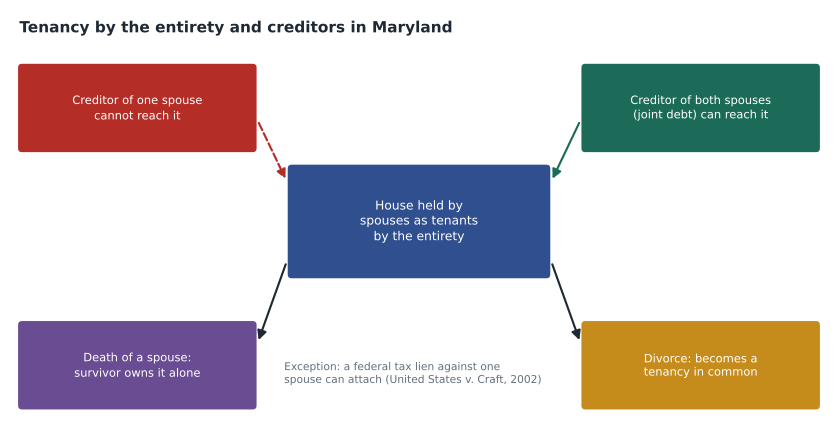
Tenancy by the entirety is a form of co-ownership available only to married couples. Maryland, unlike many states, retains it with its traditional features. Each spouse is treated as owning the whole property, not a share. On the death of one spouse, the survivor owns the property alone by right of survivorship. Neither spouse acting alone can sell, mortgage or otherwise transfer the property or his or her interest in it. A deed to a married couple as co-owners is generally treated as creating a tenancy by the entirety unless it says otherwise.
The feature that matters most in practice is protection from creditors. Property held by the entireties cannot be reached by a creditor of only one spouse. If a creditor has a judgment against the husband alone, it cannot levy on the house he owns with his wife by the entireties. A creditor of both spouses, on a joint debt or a judgment against both, can reach the property.
That protection is why the creditor's lawyer called Helen's office. The firm's client had a judgment against him personally from a business that failed. If the Perry Hall house was held by the entireties with his wife, and she was not liable on the debt, the creditor could not reach it.
There are limits. The protection ends if the marriage ends. A divorce converts a tenancy by the entirety into a tenancy in common, in which each former spouse owns a share that can be sold or reached by that spouse's creditors. Death of the non-debtor spouse leaves the debtor owning the property alone, and the debtor's creditors can then reach it. And federal law is different for federal tax liens: in United States v. Craft, 535 U.S. 274 (2002), the Supreme Court of the United States held that a federal tax lien against one spouse can attach to that spouse's interest in entireties property. A transfer into the entireties to defeat existing creditors may also be challenged as a fraudulent conveyance.
Estates and the elective share
Maryland estates are administered through the Orphans' Courts and the Registers of Wills, described in Lesson 7. A surviving spouse who is unhappy with the will may elect to take a statutory share instead: one third of the net estate if the decedent left surviving issue, or one half if there are no surviving issue. Property held by the entireties passes outside the estate to the surviving spouse by survivorship.
Ground rents
One property feature is especially Maryland: ground rents. Many older homes in Baltimore City and Baltimore County were sold subject to a ground rent, under which the homeowner holds a long lease of the land, typically for 99 years and renewable forever, and pays a small annual rent to the ground rent owner. Reforms in 2007 removed the ground rent owner's old power to eject a homeowner for unpaid rent and created a registry of ground rents with the State Department of Assessments and Taxation. A title search in Baltimore should always check for one.
Common mistakes
MistakeA Maryland couple can still file for limited divorce.
InsteadLimited divorce was abolished on October 1, 2023.
MistakeSeparation must last twelve months and the parties must live apart.
InsteadSix months, and the parties may live under the same roof if they pursue separate lives.
MistakeMutual consent is available even if custody is disputed.
InsteadIt requires a signed agreement resolving all issues, including custody and support.
MistakeMaryland is a community property state.
InsteadMaryland identifies marital property and may grant a monetary award; it is not a community property state.
MistakeA creditor of one spouse can force sale of entireties property.
InsteadEntireties property is protected from creditors of only one spouse, though not from federal tax liens.
Practice problems
Work each problem on paper first, then reveal the answer to check.
When did the divorce reform take effect, and through which chapters?
Show answer
October 1, 2023, through Chapters 645 and 646 of the Laws of Maryland 2023 (Senate Bill 36 and House Bill 14).
Name the three current grounds for absolute divorce.
Show answer
Six-month separation, irreconcilable differences and mutual consent.
What must a mutual consent divorce include?
Show answer
A written settlement agreement signed by both parties resolving alimony, property and all issues about minor children.
What happens to tenancy by the entirety at divorce?
Show answer
It becomes a tenancy in common.
What is the elective share when the decedent leaves surviving issue?
Show answer
One third of the net estate.
Custody terms
Maryland custody orders use specific vocabulary. Legal custody may be sole or joint; joint legal custody means the parents share major decisions. Physical custody may also be sole or shared. Where one parent has primary physical custody, the other usually has visitation, often described in a parenting schedule. Courts look to the best interests of the child and consider factors such as each parent's fitness, the child's relationships and the parents' ability to communicate. Many Maryland courts require or encourage mediation in custody disputes where it is safe and appropriate.
Use and possession and retirement benefits
Two property tools come up often in practice. A use and possession order lets one spouse, often the parent with custody of minor children, live in the family home and use family property for a period after the divorce, regardless of title. And retirement benefits earned during the marriage are commonly marital property in part; the court can divide them through an order directed to the retirement plan, so the share earned during the marriage is split without forcing a sale of other assets.
The general law on the exam
Family law and trusts and estates are being phased into the NextGen exam, and when they appear the exam tests general principles: the common grounds for no-fault divorce, equitable distribution, the best-interests standard and the basic rules of intestacy and wills. A NextGen question will not ask about Maryland's 2023 grounds or the Maryland elective share unless the materials provide them. Bridget planned to learn the general rules for the exam and keep the Maryland rules for practice and the Maryland Law Component.
Wills and personal representatives
In Maryland, the person who administers an estate is called the personal representative, whether named in a will or appointed by the Orphans' Court. A will is usually filed with the Register of Wills, who handles the paperwork for the Orphans' Court. Bridget's work at the Register of Wills for Baltimore County had shown her how much of estate practice is careful paperwork and deadlines: inventories, accounts and notices to creditors and heirs.
Summary and key terms
- Since October 1, 2023, Maryland has abolished limited divorce and recognizes three grounds: six-month separation, irreconcilable differences and mutual consent.
- Separation may be under the same roof if the parties pursue separate lives; irreconcilable differences has no waiting period.
- Courts identify and value marital property and may grant a monetary award; Maryland is not a community property state.
- Alimony is rehabilitative or indefinite; child support follows the income shares guidelines.
- Tenancy by the entirety protects property from creditors of only one spouse and converts to a tenancy in common at divorce.
- The elective share is one third with surviving issue and one half without.
- absolute divorce
- The divorce that ends a marriage; since 2023 the only kind of divorce in Maryland.
- irreconcilable differences
- A no-fault ground for divorce added in 2023 with no waiting period.
- monetary award
- A payment a court orders to adjust the parties' equities in marital property.
- tenancy by the entirety
- Co-ownership by spouses with survivorship and protection from creditors of one spouse.
- ground rent
- A long renewable lease of land under a house, common in older Baltimore properties.
Lesson quiz · 5 questions
Score 60% or more to complete this lesson.
Create a free account to save your progress, take quizzes and earn a certificate.