
BAR-221 · Lesson 4 of 12 · 20 min
The Maryland bar exam: the NextGen UBE, scoring and the 616 passing score
▶ Video coming soon A video version of this lesson is on the way.
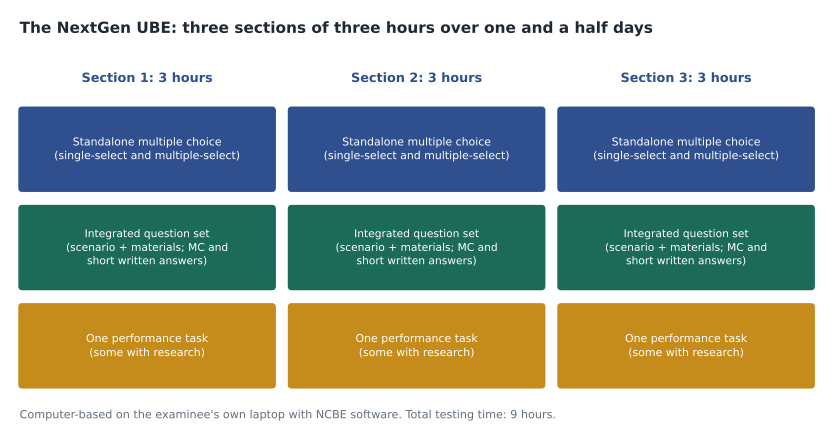
Hollis began the fourth session by sharing a page with three boxes, each labeled with a three-hour block. 'This is your exam,' she said. 'Nine hours. Three sections. Each section has the same ingredients: multiple-choice questions, an integrated question set and one performance task. If you understand one section, you understand the whole exam.' Bridget had heard the NextGen exam described as a mystery, a new test nobody had sat. 'Maryland has given it once already,' Hollis said. 'July 2026. People passed it. You will too.'
This lesson describes the NextGen Uniform Bar Examination as Maryland gives it, how it is scored, what Maryland's passing score of 616 means, and how and when results are released.
The structure
The NextGen UBE is a nine-hour exam given over one and a half days. NCBE divides it into three sections of three hours each. Every section mixes three types of item. Standalone multiple-choice questions come in two forms: single-select questions with one correct answer, and multiple-select questions that ask the examinee to choose a stated number of correct answers from a list. Integrated question sets begin with a scenario and legal materials, such as a statute, a contract or a short case excerpt, and then ask several questions about it, some multiple-choice and some short written answers. Performance tasks are shorter than the old MPT; some include a research element in which the examinee chooses which materials to consult, and some include a few multiple-choice or short-answer questions along with the main written product.
The legacy UBE took twelve hours over two full days. The NextGen exam is shorter and arranged differently. Maryland gives it on the last Wednesday of February and July and the Tuesday before. For the February 2027 exam those days are February 23 and 24. The Board's dates document sets the reporting times and the site.
Computer-based testing
The NextGen exam is computer-based. Examinees use their own laptops running NCBE's secure testing software at a site managed by the jurisdiction. For July 2026, Maryland used Halls A through C of the Baltimore Convention Center. The software presents the questions, provides a timer and records answers, including written answers typed into response boxes. Examinees need to practice in an interface that resembles the real one. NCBE publishes sample questions and a tutorial that shows how multiple-select questions and integrated sets look on screen.
What the exam tests
The NextGen exam tests two things together: foundational lawyering skills and foundational legal concepts. NCBE's skills list includes legal research, legal writing, issue spotting and analysis, investigation and evaluation, client counseling and advising, negotiation and dispute resolution, and client relationship and management. Its concepts list covers the core doctrine of civil procedure, contract law, evidence, torts, business associations, constitutional law, criminal law and constitutional protections of accused persons, and real property. NCBE's materials mark some topics for detailed knowledge and others for limited scope, and they indicate that family law and trusts and estates are being phased into the exam during the transition.
The NextGen exam tests general law, not Maryland law. A question about contributory negligence on the NextGen exam would test the general rule that most states follow, comparative negligence, not Maryland's own rule, unless the materials provided in the question supply a different rule. That is why Maryland teaches its own law through the Maryland Law Component.
Professional responsibility appears inside the skills. NCBE lists specific Model Rules tested within client counseling, negotiation and client relationship skills: Rules 1.1, 1.2(a) and (d), 1.3, 1.4, 1.6(a) and (c), 1.7, 3.3(a)(1) and (2), 4.1, 4.2 and 4.3. A performance task about advising a client might include a question about whether the lawyer may share certain information with the other side.
How the score is built
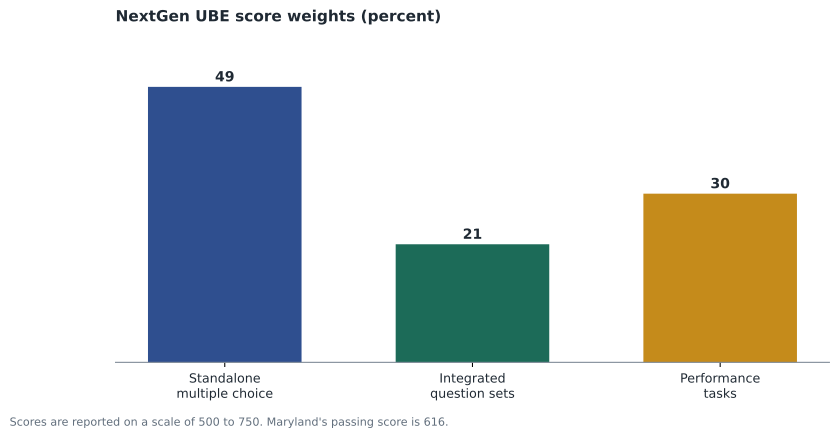
NCBE reports a single NextGen score on a scale of 500 to 750. The three item types are weighted. According to NCBE, standalone multiple-choice questions count for 49 percent of the total, integrated question sets for 21 percent and performance tasks for 30 percent.
NCBE scores the multiple-choice items. Jurisdictions grade the written components, using NCBE's grading materials, and NCBE then scales and equates the results. Equating adjusts for small differences in difficulty between exam forms, so that a score of 616 in February 2027 reflects the same level of performance as 616 in July 2026. Scaling places the written scores on the same scale as the multiple-choice scores. The final score is compensatory: strength in one part can make up for weakness in another, and Maryland does not set a separate minimum for each part.
Bridget did the arithmetic on Hollis's page. 'So the multiple choice is almost half,' she said. 'And the written parts together are the other half.' Hollis nodded. 'Which means neither can be neglected. People who prepared for the legacy UBE by drilling only MBE questions would be making a mistake here, because the integrated sets and performance tasks are more than half the score.'
Maryland's passing score of 616
Maryland's passing score on the NextGen UBE is 616. Under the legacy UBE, Maryland's passing score was 266 on the 400-point scale. The two numbers are on different scales and cannot be compared directly by subtracting or dividing. NCBE published information relating the two scales so that jurisdictions could set passing scores on the NextGen scale that reflect a comparable standard.
The score of 616 is the minimum. An applicant who scores 616 or above passes; an applicant who scores 615 does not. A score that meets 616 is also a qualifying score that can later be transferred to other NextGen jurisdictions, subject to their own passing scores and time limits.
| Exam | Scale | Maryland passing score | In Maryland |
|---|---|---|---|
| Legacy UBE | 0 to 400 | 266 | Through February 2026 |
| NextGen UBE | 500 to 750 | 616 | From July 2026 |
The first NextGen results
NCBE reported national results for the first NextGen administration in July 2026. In ten jurisdictions, 2,630 examinees sat the exam. The mean score was 640.6. Across those jurisdictions, using each jurisdiction's own passing score, 72.7 percent passed, with 85.2 percent of first-time takers and 41.0 percent of repeat takers passing. Maryland released its July 2026 results on Friday, October 9, 2026, at 4:30 pm, through eBar, with an unofficial list of passing seat numbers posted on the Board's website. NCBE's national figures are aggregate and do not give a Maryland pass rate, and this course does not state one.
Hollis drew one lesson from the national numbers. 'First-time takers did well. Repeat takers struggled. That gap is common on any exam, but it shows the new format rewards fresh, well-structured preparation more than it rewards having studied for the old test.'
When results come out
The Board's page says results are normally released on the third Friday of October after July exams and the third Friday of April after February exams. In 2026 the July results came out on October 9, which was the second Friday, so the exact date can vary; the Board announces it. Results arrive through eBar. An applicant who passes must file the Affirmation within seven days of the results notice, and must complete the Maryland Law Component before being cleared for admission. Admission ceremonies follow, usually in the late spring after February exams and in the late fall after July exams.
Strategy for each item type
Standalone multiple-choice questions reward breadth and speed. They test doctrine directly, and multiple-select questions punish partial knowledge, because an examinee must identify every correct option the question asks for. The best preparation is timed practice with careful review of each explanation.
Integrated question sets reward reading. The scenario and the materials contain the law the examinee needs, sometimes in a form that differs from the general rule. An examinee who answers from memory instead of from the provided statute will miss questions designed to test whether she reads carefully. Short written answers should be direct: state the answer, give the reason, cite the provided material.
Performance tasks reward following instructions. The task memo says what to write, for whom and in what form. Some tasks give a set of research materials and ask the examinee to decide which are relevant. The examinee should budget time: read the task memo first, skim the materials, outline, then write. A complete, organized answer that follows the instructions scores better than a brilliant partial answer.
Worked problem
Reading the weights
Bridget is stronger at writing than at multiple choice. In a practice exam she scores well on the performance tasks but poorly on standalone questions. She proposes to spend her last month only on performance tasks, since she likes them. Is that a good plan?
Show solution
- Standalone multiple-choice questions count for 49 percent of the score, the largest single share.
- Performance tasks count for 30 percent and integrated sets for 21 percent.
- The score is compensatory, so strength in performance tasks helps, but neglecting nearly half the exam is risky.
- Her weakest area offers the most room for improvement.
Answer: No. She should keep practicing performance tasks enough to maintain her strength but spend most of the month on multiple-choice practice, where the weight is largest and her gains are likely biggest.
Common mistakes
MistakeThe NextGen exam has an MBE day and a writing day.
InsteadIt has three three-hour sections, each mixing multiple choice, an integrated set and a performance task.
MistakeMaryland's passing score is 266.
InsteadThat was the legacy UBE score; on the NextGen UBE it is 616 on the 500 to 750 scale.
MistakeMaryland requires a minimum score on each part.
InsteadThe score is compensatory; only the total decides the result.
MistakeNextGen questions test Maryland law.
InsteadThey test general law; Maryland law is covered by the Maryland Law Component.
MistakeResults always come out on the third Friday.
InsteadThat is the normal pattern, but July 2026 results came out on October 9; the Board announces the date.
Practice problems
Work each problem on paper first, then reveal the answer to check.
How long is the NextGen UBE and how is it divided?
Show answer
Nine hours over one and a half days, in three sections of three hours each.
What are the three score weights?
Show answer
Standalone multiple choice 49 percent, integrated question sets 21 percent, performance tasks 30 percent.
What is the NextGen score scale and Maryland's passing score?
Show answer
A scale of 500 to 750; Maryland requires 616.
When did Maryland release its July 2026 results?
Show answer
Friday, October 9, 2026, at 4:30 pm through eBar.
Which national figures did NCBE report for July 2026?
Show answer
2,630 examinees in ten jurisdictions, a mean of 640.6 and a pass rate of 72.7 percent.
Reading a multiple-select question
Multiple-select questions are new to most candidates. The question tells the examinee how many options to choose, for example two of six. Each option must be judged on its own, as if it were a true-or-false statement about the facts. A useful method is to mark each option true, false or unsure before choosing, then select the options marked true. If the count does not match the number requested, the examinee rereads the unsure options. Guessing a pattern, such as choosing the two longest options, is a poor strategy.
Working an integrated set
Integrated question sets reward a set order of work. Read the scenario first, quickly, to learn who the parties are and what they want. Then read the questions, so you know what to look for in the materials. Then read the materials with those questions in mind. A statute in the materials may define a term differently from the general law, or a contract clause may change the default rule. The set is designed to see whether the examinee notices. A short written answer should name the rule from the materials, apply it to the key fact and state a conclusion in a few sentences.
Managing a three-hour section
Each section mixes item types, so time management is a skill in itself. Examinees often find it useful to work through the standalone questions first, at a steady pace, then the integrated set, leaving a protected block for the performance task. Others prefer to start with the performance task while fresh. Either approach can work. What matters is deciding in advance, practicing it on full sections and not changing it on exam day.
What 616 means in practice
Because the NextGen score is scaled, there is no fixed number of questions an examinee must answer correctly to reach 616. The same scaled score can reflect slightly different raw performance on different forms. Candidates should not try to compute a raw target. A better use of practice results is to track improvement by item type over several weeks and to aim comfortably above the passing standard on full simulated exams. Bridget's first full practice section in November had been weakest on multiple-select questions, which told her where to begin.
A practice-day routine
Hollis suggested a weekday routine for Bridget's study months. Begin with thirty standalone multiple-choice questions under time, then review every explanation. Work one integrated question set, writing out the short answers in full. Then spend an hour on one performance task or on outlining one. End with a short review of the day's errors written into a mistakes notebook. On weekends, sit a full three-hour section. The routine practices all three item types every day, in proportion to their weight.
Summary and key terms
- The NextGen UBE is nine hours over one and a half days in three three-hour sections.
- Each section mixes standalone multiple-choice questions, an integrated question set and a performance task.
- Weights: standalone multiple choice 49 percent, integrated sets 21 percent, performance tasks 30 percent.
- Scores run from 500 to 750, and Maryland's passing score is 616 (266 on the legacy UBE).
- The exam is computer-based on the examinee's laptop and tests general law, not Maryland law.
- Results come through eBar, normally on the third Friday of April or October; July 2026 results came on October 9, 2026.
- NextGen UBE
- NCBE's new bar exam, given in Maryland since July 2026, scored from 500 to 750.
- integrated question set
- A NextGen item with a scenario and legal materials followed by multiple-choice and short written questions.
- performance task
- A NextGen written task, shorter than the old MPT, sometimes with a research element.
- equating
- Statistical adjustment that keeps scores comparable across exam forms.
- compensatory scoring
- Scoring in which strength in one part can offset weakness in another.
Lesson quiz · 5 questions
Score 60% or more to complete this lesson.
Create a free account to save your progress, take quizzes and earn a certificate.