
BAR-221 · Lesson 10 of 12 · 20 min
The Maryland Declaration of Rights and the Maryland Attorneys' Rules of Professional Conduct
▶ Video coming soon A video version of this lesson is on the way.
Helen Szabo keeps two small books on her desk: a pocket copy of the Maryland Constitution and a spiral-bound copy of Title 19 of the Maryland Rules with her own tabs. When Bridget asked why, Helen said the first tells you what the state cannot do to your client and the second tells you what you cannot do to your client. 'Read the first part of each,' she said. 'Most lawyers never do.'
At the tenth session Hollis set Bridget the same task. 'The NextGen exam tests the federal Constitution and the Model Rules. Maryland practice adds two layers: a state Declaration of Rights that sometimes goes further than the federal Bill of Rights, and Maryland's own version of the ethics rules, with Maryland numbering and Maryland duties about money and reporting.'
This lesson introduces the Maryland Declaration of Rights and the Maryland Attorneys' Rules of Professional Conduct, with attention to the provisions most relevant to new lawyers and to the Maryland Law Component.
The Declaration of Rights
The Maryland Constitution begins with a Declaration of Rights, a list of numbered articles that predates the federal Bill of Rights in its origins. The current constitution dates from 1867, but the Declaration preserves language from Maryland's first constitution of 1776. Several articles matter regularly in practice.
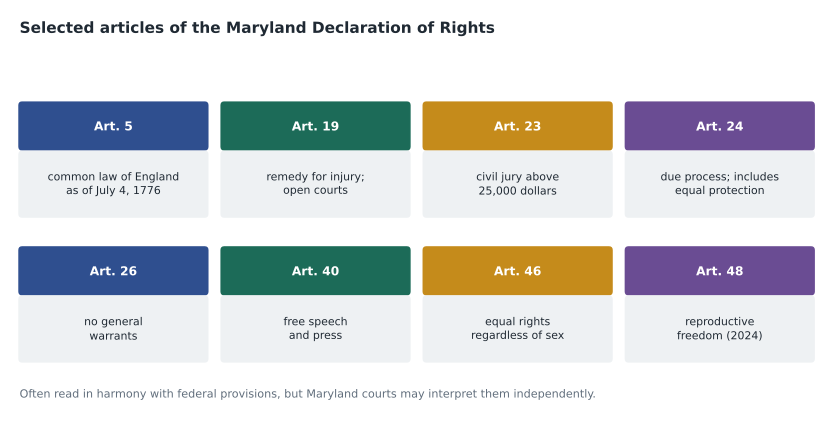
Article 5 declares that the inhabitants of Maryland are entitled to the common law of England, and to English statutes in force on July 4, 1776, as applicable, subject to later change by the legislature. It is the reason Maryland courts still speak of the common law as a living source of Maryland law and why doctrines such as contributory negligence survive until the General Assembly changes them.
Article 19 provides that every person ought to have a remedy for injury to person or property by the course of the law of the land, and that justice should be administered freely and without delay. Litigants sometimes invoke it to challenge statutes that restrict access to courts, including damages caps, though Maryland courts have generally upheld the caps.
Article 23 guarantees the right of trial by jury in civil proceedings where the amount in controversy exceeds 25,000 dollars, the threshold voters set in November 2022. Article 24 provides that no person ought to be deprived of life, liberty or property except by the judgment of peers or by the law of the land. Maryland courts read Article 24 as Maryland's due process guarantee and have held that it includes an equal protection component. Article 26 condemns general warrants. Article 40 protects freedom of speech and of the press. Article 46 provides that equality of rights under the law shall not be abridged or denied because of sex. And Article 48, added by voters in November 2024, protects a right to reproductive freedom.
How Maryland courts read the Declaration
Maryland courts often say that a Declaration of Rights provision is read in pari materia with, meaning in harmony with, its federal counterpart. Article 24 is often interpreted consistently with the Fourteenth Amendment, and Article 26 consistently with the Fourth. But harmony is not identity. Maryland's highest court has stated that the state provisions are independent and can provide broader protection, and in some areas it has given them independent meaning. A Maryland lawyer challenging state action should therefore plead both the federal and the Maryland provision and argue each.
For the exam, the federal Constitution controls the answer. In practice, a Maryland claim may succeed where a federal one fails. Hollis compared it to the contributory negligence point from Lesson 8: two sets of rules, both real, applied in different places.
The Maryland Attorneys' Rules of Professional Conduct
Maryland lawyers are governed by the Maryland Attorneys' Rules of Professional Conduct, in Title 19, Chapter 300 of the Maryland Rules. Maryland adopted them in a restyled form, renumbered to fit the Maryland Rules. Each Model Rule number becomes a Maryland number by adding 19-30 in front of the Model Rule's first digit. Model Rule 1.6 on confidentiality becomes Maryland Rule 19-301.6. Model Rule 1.15 on safekeeping property becomes Rule 19-301.15. Model Rule 8.4 on misconduct becomes Rule 19-308.4.
| Model Rule | Maryland rule | Subject |
|---|---|---|
| 1.1 | 19-301.1 | Competence |
| 1.5 | 19-301.5 | Fees |
| 1.6 | 19-301.6 | Confidentiality |
| 1.7 | 19-301.7 | Conflicts with current clients |
| 1.15 | 19-301.15 | Safekeeping property |
| 6.1 | 19-306.1 | Pro bono service |
| 8.4 | 19-308.4 | Misconduct |
The substance of most Maryland rules is close to the Model Rules, which is why the MPRE and NextGen professional responsibility questions remain good preparation. Where Maryland differs, the Maryland Law Component outlines point out the differences, and a new lawyer should read the Maryland text of any rule before relying on her memory of the Model Rule.
Trust accounts and client funds
The rules on client money are where Maryland practice is most detailed. A lawyer who holds client funds must keep them in an attorney trust account, separate from the lawyer's own money, at an approved financial institution. Title 19, Chapter 400 contains the trust account rules, including record-keeping requirements and the obligation of approved institutions to report overdrafts on trust accounts. Maryland's program of interest on lawyer trust accounts directs the interest on pooled trust accounts to fund civil legal services for people with low incomes.
Maryland treats misuse of client funds with great seriousness. In Attorney Grievance Commission v. Vanderlinde, 364 Md. 376 (2001), the Court of Appeals, now the Supreme Court, held that intentional misappropriation of entrusted funds will ordinarily result in disbarment, absent truly compelling extenuating circumstances, and that mitigating factors commonly offered, such as financial stress, will not usually suffice. New lawyers sometimes hear that commingling is a technical violation. It is not. It is the first step on a path the Court treats as among the most serious in legal ethics.
Reporting and funds
A Maryland license carries annual administrative duties. Lawyers pay an annual assessment to the Client Protection Fund, which reimburses clients who lose money because of a lawyer's dishonest conduct, and to the Disciplinary Fund, which supports the Attorney Grievance Commission. Lawyers file annual reports with the Judiciary, including a report on pro bono legal service and a report on their trust accounts. Rule 19-306.1 states an aspiration that lawyers provide pro bono service, but the reporting of pro bono hours is required. A lawyer who fails to pay assessments or file reports can be decertified from practice until the problem is fixed.
Discipline
The Attorney Grievance Commission oversees the discipline of Maryland lawyers. Its chief lawyer, Bar Counsel, receives and investigates complaints. Many complaints are dismissed. Others are resolved with a warning, a conditional diversion agreement or a reprimand. For serious matters, Bar Counsel files a petition for disciplinary or remedial action in the Supreme Court of Maryland. The Court designates a circuit court judge to hold a hearing and make findings of fact and conclusions of law. The Supreme Court then reviews the record and decides the sanction, which can range from reprimand to indefinite suspension to disbarment.
Bridget asked whether a new lawyer was likely to meet this process. Hollis said most never do, but that the most common paths into it for new lawyers are neglect, poor communication with clients and mistakes with trust accounts. All three are preventable with calendars, prompt replies and careful bookkeeping.
Worked problem
A trust account question
Hypothetical: Six months after admission, Ines receives a 5,000-dollar settlement check for a client. Her office rent is due, and her own account is short. She deposits the check into her operating account, planning to pay the client next week when another fee arrives. Analyze her conduct under the Maryland Attorneys' Rules.
Show solution
- Client funds must be held in an attorney trust account, separate from the lawyer's own funds, under Rule 19-301.15 and Title 19, Chapter 400.
- Depositing the check into her operating account is commingling.
- Using the money for rent, even temporarily, is misappropriation.
- Under Vanderlinde, intentional misappropriation ordinarily leads to disbarment; financial stress is not usually enough to avoid it.
Answer: Her plan would expose her to the most serious discipline. She must deposit the funds in her trust account and promptly deliver them to the client.
Professional conduct on the exam and in practice
The NextGen exam tests a specific list of Model Rules inside its skills questions, and the MPRE tests the law governing lawyers generally. Both use the Model Rules. In practice, the Maryland rule is the one that binds. The difference is usually only a number, but a careful lawyer cites the Maryland rule by its Maryland number in any Maryland filing or opinion letter.
Common mistakes
MistakeMaryland follows the Model Rules by their Model Rule numbers.
InsteadMaryland's rules are renumbered in Title 19, Chapter 300; Model Rule 1.6 is Rule 19-301.6.
MistakeArticle 24 of the Declaration of Rights is identical to the Fourteenth Amendment.
InsteadIt is often read in harmony with it but can be interpreted independently and more broadly.
MistakePro bono reporting is voluntary.
InsteadPro bono service is aspirational, but Maryland lawyers must report it each year.
MistakeBorrowing client funds for a week is a minor violation.
InsteadIt is misappropriation; Vanderlinde makes disbarment the ordinary sanction for intentional misappropriation.
MistakeThe Attorney Grievance Commission decides sanctions.
InsteadThe Supreme Court of Maryland decides sanctions after a designated circuit court judge hears the case.
Practice problems
Work each problem on paper first, then reveal the answer to check.
What does Article 5 of the Declaration of Rights provide?
Show answer
That Marylanders are entitled to the common law of England and applicable English statutes as of July 4, 1776, subject to legislative change.
What does Article 46 protect?
Show answer
Equality of rights under the law regardless of sex.
What is the Maryland number for Model Rule 1.15?
Show answer
Rule 19-301.15.
What did Vanderlinde hold?
Show answer
That intentional misappropriation of entrusted funds ordinarily results in disbarment absent compelling extenuating circumstances.
Who files a petition for disciplinary action?
Show answer
Bar Counsel, on behalf of the Attorney Grievance Commission, in the Supreme Court of Maryland.
Pleading the state and federal claims
Hollis gave Bridget a practical rule for constitutional claims in Maryland: plead both. A client challenging a search should invoke the Fourth Amendment and Article 26. A client challenging an unfair government classification should invoke the Equal Protection Clause and Article 24. A client challenging a restriction on speech should invoke the First Amendment and Article 40. Even when the Maryland courts read the provisions in harmony, the separate state claim preserves the argument that Maryland law gives broader protection, and it keeps the case in a posture where the Supreme Court of Maryland has the last word on the state question.
Rules a new lawyer uses every week
Some Maryland Attorneys' Rules come up constantly in a small firm. Rule 19-301.4 on communication requires keeping clients reasonably informed and responding promptly to reasonable requests for information. Rule 19-301.3 on diligence requires acting with reasonable promptness. Rule 19-301.7 on conflicts requires checking every new matter against current clients. Rule 19-301.6 on confidentiality applies to everything learned in the representation, not just secrets the client asks to keep. And Rule 19-303.3 on candor toward the tribunal forbids false statements of fact or law to a court.
Bridget noticed that the list matched the Model Rules NCBE tests inside NextGen skills questions: competence, scope, diligence, communication, confidentiality, conflicts, candor, truthfulness to others and communications with represented and unrepresented persons. Hollis said that was no accident. Those are the rules that govern daily practice everywhere, which is why both the exam and the Maryland Law Component focus on them.
The supervising lawyer
As a law clerk, Bridget works under Helen's supervision. Rule 19-305.3 makes Helen responsible for ensuring that the conduct of nonlawyer assistants is compatible with Helen's professional obligations. Once Bridget is admitted, Rule 19-305.2 will make her responsible for her own conduct even when she acts at Helen's direction, except where she acts in accordance with a supervisor's reasonable resolution of an arguable question of professional duty.
Reporting misconduct
Rule 19-308.3 requires a lawyer who knows that another lawyer has committed a violation raising a substantial question about that lawyer's honesty, trustworthiness or fitness to inform the appropriate authority, which in Maryland is Bar Counsel. The duty does not reach information protected by Rule 19-301.6. A new lawyer who discovers a serious problem at a firm should seek advice promptly, including from the ethics resources of a bar association.
Fees and client communication
Rule 19-301.5 requires that a lawyer's fees be reasonable and that the basis or rate of the fee be communicated to the client, preferably in writing, before or within a reasonable time after the representation begins. Contingent fee agreements must be in writing and signed by the client, and they must state how the fee is calculated. Bridget had already seen Helen's standard contingent fee agreement for injury cases, which explained how costs would be handled and what percentage applied at each stage of the case.
Summary and key terms
- The Maryland Declaration of Rights includes Article 5 (common law), Article 19 (remedy), Article 23 (civil jury), Article 24 (due process and equal protection), Article 26, Article 40, Article 46 and Article 48 (2024).
- Maryland courts often read the Declaration in harmony with federal law but can interpret it independently.
- The Maryland Attorneys' Rules are in Title 19, Chapter 300, numbered 19-30x.x; Model Rule 1.6 is Rule 19-301.6.
- Client funds go in a trust account at an approved institution under Rule 19-301.15 and Chapter 400.
- Vanderlinde (2001): intentional misappropriation ordinarily means disbarment.
- Bar Counsel investigates; the Supreme Court decides sanctions; annual assessments and reports are required.
- Declaration of Rights
- The opening part of the Maryland Constitution listing individual rights.
- Article 24
- The Maryland due process guarantee, read to include equal protection.
- Maryland Attorneys' Rules of Professional Conduct
- Maryland's ethics rules in Title 19, Chapter 300 of the Maryland Rules.
- Bar Counsel
- The chief lawyer of the Attorney Grievance Commission, who investigates and prosecutes misconduct.
- misappropriation
- Using client or third-party funds for an unauthorized purpose.
Lesson quiz · 5 questions
Score 60% or more to complete this lesson.
Create a free account to save your progress, take quizzes and earn a certificate.