
BAR-221 · Lesson 12 of 12 · 19 min
Capstone: Maryland practice questions and an exam-day plan
▶ Video coming soon A video version of this lesson is on the way.
The last session came in mid-November. Bridget had a list of everything she had covered and a calendar running to May 2027. Hollis wanted to use the session for two things: a full Maryland problem worked in memo form, to pull the Maryland law lessons together, and a written plan for the twelve weeks before February 23.
'Two warnings before we start,' Hollis said. 'First, everything in this problem is Maryland law, which is the law you will practice and the law of the Maryland Law Component. The NextGen exam will test general law. Second, the problem is invented. The people and events are hypothetical, but the rules are real.'
The problem
Read the facts and then the questions. Try to outline an answer to each question before reading the model answer.
Hypothetical facts. Rosalind and Theo Marchand married in 2012 and live in Catonsville, in Baltimore County. They own their house as tenants by the entirety under a deed to them as husband and wife. Theo ran a small landscaping business as a sole proprietor until it failed in 2025, and a supplier obtained a judgment of 38,000 dollars against Theo alone in the Circuit Court for Baltimore County in June 2026.
On September 12, 2026, Rosalind was cycling on a county road when she struck a large pothole that county crews had been told about three weeks earlier, and she was thrown into the path of a delivery van. The van driver was looking at a handheld phone and did not brake. Rosalind was not wearing reflective clothing, and it was dusk; there is evidence she was riding slightly outside the marked bike lane to avoid debris. Her medical expenses and lost wages total 210,000 dollars. Her lawyer believes a jury could value her pain and suffering at over 1.2 million dollars.
Since August 1, 2026, Rosalind and Theo have slept in separate rooms, kept separate finances and stopped sharing meals and social events, though both still live in the house. In November 2026 Rosalind tells her lawyer she wants a divorce as soon as possible.
Questions. First, can the supplier reach the Catonsville house to satisfy its judgment against Theo? Second, what claims does Rosalind have for her injuries, against whom, and what defenses and limits should her lawyer anticipate? Third, on what grounds can Rosalind file for divorce in November 2026, and how might the divorce affect the supplier's position?
Model answer: issue one, the house
Issue. Whether a creditor holding a judgment against one spouse can reach real property the spouses own as tenants by the entirety.
Rule. In Maryland, property held by a married couple as tenants by the entirety cannot be reached by a creditor of only one spouse. A creditor of both spouses can reach it. A deed to spouses as co-owners generally creates a tenancy by the entirety unless it says otherwise.
Application. The deed runs to Rosalind and Theo as husband and wife, and nothing suggests a different form of ownership. The supplier's judgment is against Theo alone; Rosalind was not a party to his sole proprietorship's debt. The supplier is a creditor of one spouse only.
Conclusion. While the marriage continues, the supplier cannot reach the house. The supplier may look for other assets of Theo's or investigate whether any transfer into the entireties was made to defeat creditors, but on these facts the deed dates from the marriage and the debt from 2025, so no such argument appears.
Model answer: issue two, the injury claims
Issue. Whether Rosalind can recover from the van driver and from Baltimore County, given evidence of her own negligence, and what limits apply.
Rules. Maryland retains contributory negligence: if the plaintiff's negligence was a proximate cause of her injury, she recovers nothing. The defendant bears the burden of proof, and the question is ordinarily for the jury. Under last clear chance, a negligent plaintiff may recover if the defendant had a fresh opportunity to avoid the harm after the plaintiff's negligence put her in danger. Section 11-108 of the Courts and Judicial Proceedings Article caps noneconomic damages; the cap is the one in effect when the cause of action arises, 965,000 dollars for causes arising from October 1, 2025 through September 30, 2026. Claims against a county fall under the Local Government Tort Claims Act, which limits liability to 400,000 dollars per individual claim and 800,000 dollars per occurrence and requires notice of the claim, generally within one year after the injury.
Application to the van driver. The driver was looking at a handheld phone and did not brake, which is strong evidence of negligence. The driver's insurer will argue contributory negligence: no reflective clothing at dusk and riding outside the bike lane. Rosalind's lawyer will respond that riding slightly outside the lane to avoid debris was reasonable, that lack of reflective clothing at dusk was not a proximate cause if the driver was not looking at the road at all, and, in the alternative, that the driver had the last clear chance: once Rosalind was thrown into the van's path, an attentive driver could have braked. Whether that is a fresh opportunity, as Maryland requires, will depend on timing evidence.
Application to the county. The county had notice of the pothole three weeks before the crash and did not repair it, which supports negligence. The same contributory negligence defense applies. Rosalind's lawyer must give notice of the claim within the statutory period, generally one year from September 12, 2026, and must expect the 400,000-dollar per-claim limit on the county's liability.
Damages. Rosalind's economic damages of 210,000 dollars are not capped by section 11-108. Her noneconomic damages, if a jury awards more than 965,000 dollars, will be reduced to 965,000 dollars, because her cause of action arose on September 12, 2026, before the October 1, 2026 increase. Any recovery from the county is separately limited to 400,000 dollars.
Conclusion. Rosalind has viable claims against both defendants, but the risk of a complete bar for contributory negligence is substantial and will weigh heavily in settlement. Her lawyer should send the county notice immediately, preserve the driver's phone records and gather evidence on the timing of the collision to support last clear chance.
Model answer: issue three, the divorce
Issue. On what grounds Rosalind can file for absolute divorce in November 2026, and how divorce would affect the supplier's ability to reach the house.
Rules. Since October 1, 2023, Maryland recognizes three grounds for absolute divorce: six months' separation, which may be under the same roof if the parties pursue separate lives; irreconcilable differences, with no waiting period; and mutual consent, with a written settlement agreement resolving all issues. A divorce converts a tenancy by the entirety into a tenancy in common.
Application. Rosalind and Theo began separate lives under the same roof on August 1, 2026. Six months runs to February 1, 2027, so the separation ground is not yet available in November. Irreconcilable differences is available now. Mutual consent would be available if they sign an agreement resolving alimony and property; they have no minor children mentioned, so custody issues may not arise.
Once the divorce is final, the house will be held as a tenancy in common unless the divorce court orders otherwise as part of its property decisions. Theo's share as a tenant in common will no longer have entireties protection, and the supplier can then seek to reach it. Rosalind's lawyer should consider how the property settlement deals with the house, such as a transfer of Theo's interest to Rosalind for value, and advise her about the creditor's position.
Conclusion. Rosalind can file now on the ground of irreconcilable differences. Her lawyer should advise her that divorce will end the entireties protection that currently keeps the supplier away from the house, and should plan the property settlement with that in mind.
Short practice questions
Practice problems
Work each problem on paper first, then reveal the answer to check.
A tenant owes her landlord in Frederick 31,500 dollars in back rent. Which court hears the landlord's claim?
Show answer
The District Court, which has jurisdiction over all landlord-tenant cases.
A client was injured on October 5, 2026. What noneconomic cap applies?
Show answer
980,000 dollars, because the cause of action arose after October 1, 2026.
What is the Maryland number of the rule on conflicts with current clients?
Show answer
Rule 19-301.7, which corresponds to Model Rule 1.7.
A couple separated under one roof on May 1, 2026. When is the separation ground available?
Show answer
From November 1, 2026, if they have pursued separate lives for six months.
An applicant passed the February 2027 exam. By when should she finish the Maryland Law Component to make the May ceremony?
Show answer
By mid-April 2027, the Board's recommended date.
A Virginia lawyer has practiced for four of the last five years. Can she seek admission without examination?
Show answer
Yes, she meets the three-of-five test, subject to the MPRE score of 85, character and fitness and the MLC.
The exam-day plan
Hollis turned to the calendar. The exam is on Tuesday and Wednesday, February 23 and 24, 2027. Its nine hours fall in three three-hour sections over a day and a half. The plan works backward from those days.
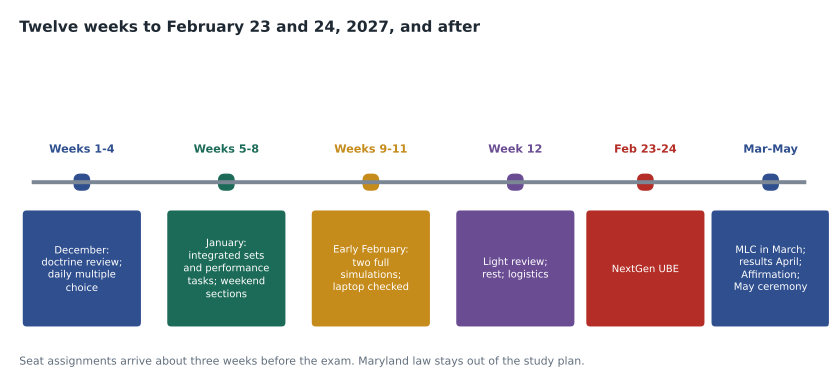
Weeks one to four, December. Review doctrine subject by subject using NCBE's concepts list, with daily sets of standalone multiple-choice questions, both single-select and multiple-select. Work one integrated question set every other day. Keep Maryland law out of the study plan entirely, except for Monday notes from the office.
Weeks five to eight, January. Shift the balance toward integrated question sets and performance tasks, because together they carry 51 percent of the score. Work at least two performance tasks a week under NextGen timing, and on each weekend sit one full three-hour section on the laptop. Review every multiple-choice explanation, especially for questions answered correctly by guessing. Bridget arranged with Helen to cut her clerkship hours from thirty a week to fifteen in January.
Weeks nine to eleven, early February. Sit two full simulated exams, each nine hours over a day and a half, on the same laptop she will use in the exam room. Confirm the laptop meets NCBE's requirements and the testing software is installed and working. Watch for the seat assignment, which the Board releases about three weeks before the exam, and check the Board's dates document for the site, reporting times and permitted items.
Week twelve. Light review only. Sleep on a schedule that matches the exam's start times. Plan the route to the site and where to park or which train to take. Pack the laptop, charger, identification and permitted items the night before.
On exam days. Arrive early. Read each task memo and each integrated set's materials before answering, because the provided law may differ from the general rule. Budget time by section, not by question. Keep moving on multiple choice: mark and return. On performance tasks, follow the instructions about format and audience exactly. Between sections, do not discuss answers with other examinees.
After the exam. Finish the Maryland Law Component in March, with a backup evening if a first attempt falls short of 40. Keep the running file of changes for the Affirmation. Watch eBar for results in April, normally on the third Friday. If she passes, file the Affirmation within seven days and look for the May admission ceremony. If she does not, file a new Notice of Intent by May 1 for July 2027.
Bridget read the plan back aloud. Hollis made one change. She moved the first full simulated exam a week earlier, to the end of January, so a bad result would leave three weeks to adjust rather than two.
Common mistakes
MistakeStudying Maryland law will help on the NextGen exam.
InsteadThe exam tests general law; Maryland law belongs to practice and the MLC.
MistakeThe noneconomic cap depends on when the case is tried.
InsteadIt depends on when the cause of action arose.
MistakeSeparation under the same roof never counts.
InsteadSince 2023 it counts if the spouses pursue separate lives for six months.
MistakeDivorce does not affect a creditor's rights in entireties property.
InsteadDivorce converts the property to a tenancy in common, exposing each share to that spouse's creditors.
MistakeSimulated exams are optional if the doctrine is strong.
InsteadFull timed simulations on the actual laptop are essential preparation for a computer-based exam.
Grading your own answer
After Bridget outlined her answers to the capstone problem, Hollis showed her how to grade them against the model. For each issue, give one point for stating the issue precisely, one for stating the correct Maryland rule, two for applying the rule to the specific facts, including the facts that cut against the client, and one for a clear conclusion. A perfect score on each issue is five. Bridget scored four on the first issue, three on the second, because she had forgotten the local government notice requirement, and five on the third. The missed point told her exactly what to review.
The last week
Hollis's final advice was about the last week. Do not learn new subjects. Review the notes made during practice, especially lists of mistakes. Confirm the logistics twice. Sleep. On the morning of February 23, eat breakfast, arrive early and read the first instruction screen slowly. Then begin.
Summary and key terms
- Work Maryland problems in IRAC form: issue, rule, application, conclusion.
- Entireties property is safe from a creditor of one spouse until the marriage ends.
- Contributory negligence, last clear chance, the section 11-108 cap and the LGTCA limits and notice rule shape injury claims.
- The 2023 divorce grounds give fast options; irreconcilable differences has no waiting period.
- Plan twelve weeks backward from February 23 and 24, 2027, with full simulations on the laptop.
- After the exam: MLC by mid-April, results in April, Affirmation within seven days, May ceremony.
- IRAC
- Issue, rule, application and conclusion, a structure for written legal analysis.
- simulated exam
- A full-length timed practice exam under realistic conditions.
- seat assignment
- The examinee's assigned place at the exam site, released about three weeks before the exam.
- dates document
- The Board's notice of filing periods, exam dates, site and logistics for each exam.
- tenancy in common
- Co-ownership in shares without survivorship; what entireties property becomes at divorce.
Lesson quiz · 5 questions
Score 60% or more to complete this lesson.
Create a free account to save your progress, take quizzes and earn a certificate.