
BAR-221 · Lesson 7 of 12 · 20 min
Maryland courts and civil procedure
▶ Video coming soon A video version of this lesson is on the way.
Bridget's first real assignment at Helen Szabo's firm had been a collections case: a small contractor in Parkville was owed 4,200 dollars for a deck he had built. Helen had asked her where to file it. Bridget, fresh from a law school civil procedure course built on the federal rules, had started looking up the amount-in-controversy requirement for diversity jurisdiction before Helen stopped her. 'This is a District Court case,' Helen said. 'Exclusive jurisdiction. You do not have a choice.'
Bridget told the story at the seventh session, a little embarrassed. Hollis was pleased. 'That is exactly the kind of Maryland fact the exam will not test and practice will test on your first day,' she said. 'Let us build the map.'
This lesson describes the structure of the Maryland courts, the jurisdiction of each court, the main sources of Maryland civil procedure and several rules that differ from the federal rules studied for the exam. These topics appear in the Maryland Law Component's civil procedure outline.
The four levels
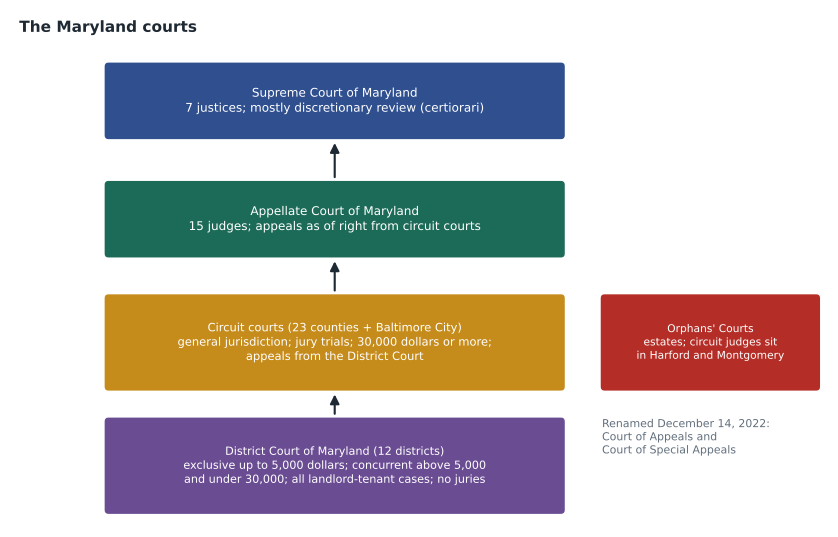
Maryland has two appellate courts and two kinds of trial court, plus the Orphans' Courts for estates.
The Supreme Court of Maryland is the highest court. It has seven justices and was called the Court of Appeals until December 14, 2022. Most of its docket is discretionary: a party asks it to review a case by petition for a writ of certiorari, and the Court decides which cases to hear. It also has original and special responsibilities, including adopting the Maryland Rules and admitting and disciplining lawyers.
The Appellate Court of Maryland is the intermediate appellate court, with fifteen judges. It was called the Court of Special Appeals until December 2022. It hears most appeals from the circuit courts as of right.
The circuit courts are Maryland's trial courts of general jurisdiction. There is one in each of Maryland's 23 counties and one in Baltimore City, organized into judicial circuits. Circuit courts hear major civil cases, serious criminal cases, family law matters including divorce and custody, and appeals from the District Court and from many administrative agencies. Jury trials in civil and criminal cases happen in the circuit courts.
The District Court of Maryland is a single statewide court of limited jurisdiction, with 33 locations in 12 districts. It hears smaller civil claims, all landlord-tenant cases, motor vehicle violations, misdemeanors and some other criminal matters, and peace and protective orders. The District Court does not hold jury trials.
Civil jurisdiction by amount
The District Court has exclusive jurisdiction over civil claims for 5,000 dollars or less. It shares jurisdiction with the circuit courts over claims above 5,000 dollars and under 30,000 dollars. Claims of 30,000 dollars or more belong to the circuit courts. Landlord-tenant cases belong to the District Court whatever the amount.
The contractor's 4,200-dollar claim therefore had to go to the District Court. A claim for 18,000 dollars could go to either court, and the choice would depend on speed, cost and whether a jury trial mattered. A claim for 45,000 dollars would go to a circuit court.
| Amount claimed | Court | Notes |
|---|---|---|
| 5,000 dollars or less | District Court only | Exclusive jurisdiction |
| Above 5,000 and under 30,000 dollars | District Court or circuit court | Concurrent jurisdiction |
| 30,000 dollars or more | Circuit court | General jurisdiction |
| Landlord-tenant, any amount | District Court | All landlord-tenant cases |
The civil jury threshold
Article 23 of the Maryland Declaration of Rights guarantees the right to a jury trial in civil cases above a set amount in controversy. Maryland voters raised that amount in the November 8, 2022 general election. Question 3 on the ballot raised the threshold from 15,000 dollars to 25,000 dollars, and it passed with about 62.5 percent of the vote.
Because the District Court does not hold jury trials, a District Court case in which the amount in controversy exceeds the jury threshold can be moved to the circuit court if a party demands a jury trial. A plaintiff who files a 28,000-dollar claim in the District Court should expect that the defendant may demand a jury and the case may move.
The Orphans' Courts
Estates in Maryland are handled by the Orphans' Courts, together with a Register of Wills in each county and Baltimore City. The Orphans' Courts supervise the administration of estates, appoint personal representatives and resolve many disputes about estates. In most counties the Orphans' Court judges are elected and need not be lawyers. In Harford County and Montgomery County, circuit court judges sit as the Orphans' Court. Helen's estate work takes Bridget to the Register of Wills for Baltimore County several times a month.
Sources of Maryland civil procedure
Maryland civil procedure comes mainly from the Maryland Rules, adopted by the Supreme Court, and from statutes in the Courts and Judicial Proceedings Article of the Maryland Code. The Rules are organized by title. Title 2 governs civil procedure in the circuit courts. Title 3 governs civil procedure in the District Court. Title 5 contains the Maryland Rules of Evidence. Title 8 governs appeals. A rule's first digit tells you its title: Rule 2-321 is a circuit court civil rule, and Rule 3-308 is a District Court civil rule.
The Maryland Rules were modeled in many places on the federal rules, but they are not identical, and the differences cause mistakes for lawyers who learned federal procedure first.
Some differences from federal practice
Time to answer. In a circuit court, a defendant generally must file an answer within 30 days after being served, not the 21 days of the federal rules. A defendant served outside the state may have longer.
Pleading. Maryland pleading rules require a clear statement of the facts necessary to constitute a cause of action. The Maryland tradition expects a complaint to set out the facts that support each element, and a lawyer should not assume that federal pleading case law simply carries over.
Preliminary motions. Rule 2-322 lists defenses that must be raised by preliminary motion or are waived, including lack of personal jurisdiction, improper venue and insufficiency of process or service. Other defenses may be raised later.
Summary judgment. Rule 2-501 allows summary judgment when there is no genuine dispute as to any material fact and the moving party is entitled to judgment as a matter of law. The standard is close to the federal one.
Electronic filing. Maryland's courts use an electronic case management and filing system called MDEC, short for Maryland Electronic Courts. Lawyers file electronically in MDEC courts, and a new lawyer should register early.
Limitations
The general limitation period for civil actions in Maryland is three years from the date the action accrues, under section 5-101 of the Courts and Judicial Proceedings Article. Maryland applies a discovery rule: in many cases a cause of action accrues when the plaintiff knew or reasonably should have known of the wrong. Special periods apply to some claims, including medical malpractice, actions against local governments, which have a notice requirement, and claims involving minors. A Maryland lawyer checks the specific period for every new matter on the day it comes in.
Personal jurisdiction and venue
Maryland's long-arm statute, section 6-103 of the Courts and Judicial Proceedings Article, lists acts that subject a nonresident to jurisdiction in Maryland, such as transacting business in the state or causing tortious injury in the state. Maryland courts have said the statute reaches as far as due process allows, but a plaintiff must still identify a basis in the statute and show that exercising jurisdiction is consistent with due process. Venue rules in Title 6 of the same Article generally place a civil action where the defendant resides, carries on a regular business or is employed.
Appeals
An appeal from a final judgment of a circuit court generally goes to the Appellate Court of Maryland. The notice of appeal must be filed within 30 days after entry of judgment. Appeals from the District Court generally go to the circuit court. The Supreme Court reviews most cases on certiorari, either after the Appellate Court decides or, in some cases, before.
Worked problem
Choosing a court
Hypothetical: Mrs. Tran was injured when a neighbor's dog knocked her down. Her medical bills are 9,000 dollars, and her lawyer values the claim at 22,000 dollars. The neighbor's insurer has signaled it wants a jury. Where should her lawyer file?
Show solution
- A 22,000-dollar claim is within the concurrent range, so either the District Court or a circuit court may hear it.
- The jury threshold under Article 23 is 25,000 dollars, so with 22,000 dollars in controversy a jury right may not attach.
- If the claim is valued above 25,000 dollars, a jury demand in the District Court would move the case to the circuit court.
- The District Court is usually faster and less expensive for a claim of this size.
Answer: At 22,000 dollars, filing in the District Court is reasonable, and the jury threshold is not met. If the claim grows above 25,000 dollars, the lawyer should expect a jury demand and consider filing in the circuit court from the start.
Common mistakes
MistakeThe Court of Special Appeals is Maryland's highest court.
InsteadIt was the intermediate court; it is now the Appellate Court of Maryland. The highest court is the Supreme Court of Maryland.
MistakeA 4,000-dollar claim may be filed in a circuit court.
InsteadThe District Court has exclusive jurisdiction of claims of 5,000 dollars or less.
MistakeA circuit court defendant has 21 days to answer.
InsteadGenerally 30 days after service under the Maryland Rules.
MistakeThe District Court holds jury trials.
InsteadIt does not; a qualifying jury demand moves the case to the circuit court.
MistakeThe civil jury threshold is 15,000 dollars.
InsteadVoters raised it to 25,000 dollars in November 2022.
Practice problems
Work each problem on paper first, then reveal the answer to check.
Which court has exclusive jurisdiction over a 3,500-dollar contract claim?
Show answer
The District Court of Maryland.
Which court hears all landlord-tenant cases?
Show answer
The District Court.
What did Question 3 in 2022 do?
Show answer
It raised the civil jury trial threshold under Article 23 from 15,000 to 25,000 dollars.
Which title of the Maryland Rules governs civil procedure in the circuit courts?
Show answer
Title 2.
What is the general limitation period for civil actions?
Show answer
Three years from accrual, under section 5-101 of the Courts and Judicial Proceedings Article.
A District Court case from start to finish
The contractor's case gave Bridget a tour of the District Court. Helen had her prepare a complaint on the District Court's civil complaint form, stating the amount claimed, the basis of the claim and the facts in plain terms, with the contract and invoices attached. The clerk set a trial date when the complaint was filed. The defendant was served, and because he wanted to contest the claim, he filed a notice of intention to defend. Without that filing, the contractor could have sought a judgment by affidavit. The trial was short and informal by circuit court standards, before a judge without a jury.
If the losing party had wanted to appeal, the appeal would have gone to the Circuit Court for Baltimore County, not to the Appellate Court. Further review by the Supreme Court of Maryland would have required a petition for certiorari. The path is different from the federal model, where every district court judgment goes to a court of appeals.
Landlord-tenant cases
Because the District Court hears all landlord-tenant cases, it is the court where most Marylanders encounter the legal system. Failure-to-pay-rent cases move quickly, and tenants often appear without lawyers. A new Maryland lawyer who volunteers with a legal services program is likely to see this docket first. The procedure is specialized, and a lawyer should read the current District Court rules and forms before taking such a case.
Reading a Maryland rule number
Hollis gave Bridget a short drill. Rule 2-501: Title 2, circuit court civil procedure, summary judgment. Rule 3-308: Title 3, District Court civil procedure. Rule 5-803: Title 5, the Maryland Rules of Evidence, a hearsay exception. Rule 8-202: Title 8, appellate procedure, the time for filing a notice of appeal. Rule 19-301.15: Title 19, attorneys, the Maryland Attorneys' Rules on safekeeping property. Once the pattern is clear, any Maryland rule can be placed in context at a glance.
Evidence
The Maryland Rules of Evidence in Title 5 track the Federal Rules of Evidence closely in structure, and many rules carry the same numbers after the title prefix, so Rule 5-803 corresponds to Federal Rule 803. There are differences in particular rules, which the Maryland Law Component outlines identify. On the NextGen exam the Federal Rules control. In a Maryland courtroom, the Maryland rule controls, and a new lawyer preparing for trial should read the Maryland text of every rule she plans to rely on.
Venue and transfer between courts
Choosing the right court is only the first step. Within the circuit courts, venue rules decide which county's court should hear a case, and a defendant who believes the plaintiff chose the wrong county can raise improper venue by preliminary motion. Within the District Court, a case may be moved to a circuit court when a party properly demands a jury trial in a case above the jury threshold. A new lawyer should check venue as carefully as subject matter jurisdiction, because a case filed in the wrong county can be dismissed or transferred, losing time and sometimes a limitation period.
Summary and key terms
- The Supreme Court of Maryland and the Appellate Court of Maryland are the two appellate courts, renamed in December 2022.
- Circuit courts in 23 counties and Baltimore City are the general trial courts and hold jury trials.
- The District Court has exclusive jurisdiction up to 5,000 dollars, concurrent jurisdiction above 5,000 and under 30,000, and all landlord-tenant cases.
- The civil jury threshold is 25,000 dollars after the 2022 amendment to Article 23.
- Title 2 governs circuit court civil procedure, Title 3 the District Court, Title 5 evidence and Title 8 appeals.
- The general limitation period is three years, with a discovery rule.
- circuit court
- Maryland's trial court of general jurisdiction, one in each county and Baltimore City.
- District Court of Maryland
- The statewide court of limited jurisdiction that hears smaller civil claims, landlord-tenant cases and minor criminal matters.
- Orphans' Court
- The Maryland court that supervises estates, working with the Register of Wills.
- Article 23
- The provision of the Declaration of Rights guaranteeing civil jury trials above 25,000 dollars.
- MDEC
- Maryland Electronic Courts, the judiciary's electronic filing and case management system.
Lesson quiz · 5 questions
Score 60% or more to complete this lesson.
Create a free account to save your progress, take quizzes and earn a certificate.