
BAR-221 · Lesson 1 of 12 · 23 min
Becoming a lawyer in Maryland
▶ Video coming soon A video version of this lesson is on the way.
Bridget Wierzbicki grew up in Dundalk, on the east side of Baltimore County, where her father worked at the port for thirty years. She finished her JD at a Maryland law school in May 2026 and planned to sit the July 2026 bar exam. In June her father had knee surgery that went less smoothly than expected, and she spent the summer driving him to physical therapy instead of working practice questions. She moved her plan to February 2027. Since September she has worked as a law clerk at Helen Szabo's four-lawyer firm in Towson, the Baltimore County seat, where the docket runs to car crashes, divorces, estates in the Orphans' Court and the occasional landlord-tenant case in the District Court.
Bridget joined Hollis Marchetti's Tuesday study group late in the fall and asked for a set of one-on-one sessions focused on Maryland. At the first one, Hollis opened a blank page on the shared screen and wrote three words across the top: who, what, when. 'Before you study a single rule of evidence,' she said, 'you should be able to explain to your grandmother who admits lawyers in Maryland, what you have to do to be admitted and when each step happens. People who cannot answer those questions are the ones who miss a deadline or forget a requirement and lose a season.'
This course follows Bridget through those questions and then through the Maryland law she will meet in practice. This first lesson maps the bodies involved, the three ways into the Maryland bar and the order in which the steps happen. Later lessons fill in each step.
The Supreme Court of Maryland admits lawyers
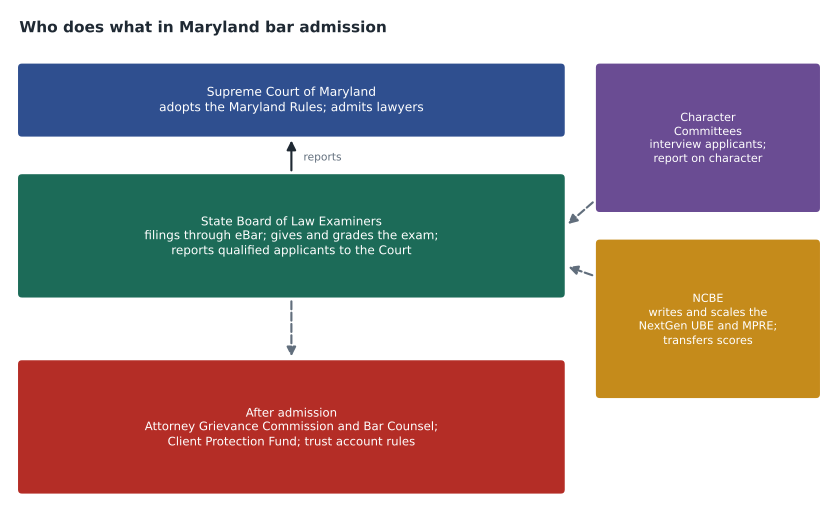
The power to admit lawyers in Maryland belongs to the state's highest court, the Supreme Court of Maryland. Until December 14, 2022, that court was called the Court of Appeals of Maryland, and the intermediate appellate court was called the Court of Special Appeals. Maryland voters approved a constitutional amendment in the November 8, 2022 general election, and the new names took effect immediately once the result was proclaimed: the Supreme Court of Maryland and the Appellate Court of Maryland. The seven judges of the high court are now called justices. The courts' jurisdiction and functions did not change. Older cases, rules and study materials use the old names, so a candidate needs to recognize both. A citation to the Court of Appeals in a 2013 opinion is a citation to the court that is now the Supreme Court.
The Supreme Court adopts the Maryland Rules, a single set of court rules organized into titles. Title 19 governs attorneys. Its Chapter 200 covers admission to the bar, its Chapter 300 contains the Maryland Attorneys' Rules of Professional Conduct, and its Chapter 400 deals with attorney trust accounts. Candidates who read official materials will see rule numbers such as Rule 19-215, which covers admission of out-of-state attorneys without examination, and Rule 19-214, which sets time limits for completing the requirements for admission. The three-digit number after the hyphen tells you the chapter: rules in the 200s are admission rules.
The Court acts through orders. Several orders since 2023 have shaped the bar exam directly. One adopted the NextGen bar exam, and two others limited the number of applications that would be processed for particular exam administrations. Those orders are signed by the justices who approve them, and a justice who does not approve an order does not sign it. In the June 2, 2025 order limiting applications for the July 2026 exam, and the October 27, 2025 order limiting applications for the February 2026 exam, one justice did not approve. That detail does not matter for the exam, but it shows a useful habit: Maryland's important admission decisions are written down in court orders posted on the Judiciary's website, and a careful candidate reads the order rather than a summary of it.
The State Board of Law Examiners
The day-to-day work of admission belongs to the State Board of Law Examiners, usually called the SBLE or simply the Board. The Board is appointed by the Supreme Court and works under the Court's rules and its own Board Rules. It receives applications, decides whether applicants are eligible to sit, administers and grades the bar exam, oversees the character and fitness process and reports to the Court which applicants are qualified for admission. The Board's office is in Annapolis, and since October 1, 2026 it has announced that it does not accept walk-in visits, so applicants deal with it through its online system and by appointment.
That online system is eBar. Every applicant creates an eBar account, and the account requires a United States Social Security number and an NCBE number. Through eBar the applicant files the Character Questionnaire and the Notice of Intent to sit the exam, pays fees once the Board approves each filing, receives notices and, after passing, receives results. Lesson 2 walks through the filings in order.
Character and fitness review in Maryland involves more than the Board's staff. The Supreme Court appoints Character Committees, made up of lawyers, and an applicant may be interviewed by a committee member who reports on the applicant's character. Lesson 3 explains how that review works and what applicants must disclose.
NCBE's role
The National Conference of Bar Examiners, NCBE, does not admit anyone. It writes the exams Maryland uses and provides several services. It prepares the NextGen Uniform Bar Examination, which Maryland began giving in July 2026, and the Multistate Professional Responsibility Examination, the MPRE. It scales and equates scores so that results mean the same thing from one administration to the next. It runs the score transfer service that lets an examinee send a Uniform Bar Examination score from one jurisdiction to another. And it conducts character investigations for some applicants, especially lawyers who apply for admission without examination. Every Maryland applicant needs an NCBE number, which is created through an NCBE account.
Three ways into the Maryland bar
Maryland offers three routes to admission. Most new graduates take the first. Lawyers who already passed elsewhere often use the second or third.
The first route is to pass the Uniform Bar Examination in Maryland. Since July 2026 that means the NextGen UBE, and Maryland's passing score on it is 616 on the 500 to 750 NextGen scale. Before July 2026, Maryland gave the legacy UBE, and its passing score was 266 on the 400-point legacy scale. Bridget is on this route for February 23 and 24, 2027.
The second route is to transfer a qualifying UBE score earned in another jurisdiction. Maryland accepts transferred legacy UBE scores and NextGen UBE scores within set time limits, and the score must meet Maryland's passing score. A candidate who sat the UBE in the District of Columbia or another UBE jurisdiction and wants to practice in Maryland too may be able to use that score instead of sitting again. Lesson 11 covers the rules.
The third route is admission without examination for lawyers admitted in other states who have practiced for a required period. Maryland Rule 19-215 governs it. Maryland requires practice for at least three of the last five years, or for more than ten years in total, along with an MPRE score of 85 and the other requirements every applicant must meet. Maryland has no separate shorter attorneys' exam. Lesson 11 covers this route as well.
| Route | Who uses it | Key requirement |
|---|---|---|
| Pass the UBE in Maryland | New graduates and anyone without a usable score | NextGen UBE score of 616 or higher (legacy UBE 266 before July 2026) |
| Transfer a UBE score | Examinees who passed in another UBE jurisdiction | Score meeting Maryland's passing score, transferred within the time limit |
| Admission without examination | Lawyers admitted elsewhere with enough practice | Three of the last five years of practice, or more than ten years in total, under Rule 19-215 |
Requirements every route shares
Whatever route an applicant takes, some requirements apply to everyone. Every applicant must establish good moral character and fitness. Every applicant must meet the MPRE requirement, a scaled score of 85 or higher. And every applicant must complete the Maryland Law Component, Maryland's own course on Maryland law, before being cleared for admission. The Maryland Law Component is a set of written outlines on Maryland law followed by an online, open-book, fifty-question multiple-choice test; Lesson 6 describes it in detail.
Hollis underlined the Maryland Law Component twice. 'This is the step people forget,' she said. 'It is not on exam day. It is not graded with the exam. You can do it after you pass. But nobody gets admitted in Maryland without it, and it is easy to finish early.'
Bridget asked whether the Maryland Law Component replaced the old Maryland essay questions. Hollis nodded. Before Maryland joined the UBE, the bar exam included Maryland-specific essays. Since joining the UBE, the exam itself tests general law, and Maryland's local rules are taught and tested separately through the Maryland Law Component.
The path in order
For an applicant sitting the exam in Maryland, the steps follow a fixed order. First, the applicant confirms eligibility: the required undergraduate study and a JD from an ABA-approved law school, or a waiver obtained before filing. Second, the applicant sits the MPRE, ideally in law school, because Maryland counts an MPRE score earned within three years before the Notice of Intent is filed for applicants not already admitted elsewhere. Third, the applicant creates an eBar account and files the Character Questionnaire, and then, with or after it, the Notice of Intent for a particular exam. For a February exam the Notice of Intent is due December 1 of the year before; for a July exam it is due May 1. Fourth, the character review runs while the applicant studies. Fifth, the applicant sits the exam. Sixth, the applicant completes the Maryland Law Component, which can be done any time after the Notice of Intent is filed. Seventh, after passing, the applicant files a final Affirmation updating the Character Questionnaire, the Board reports the applicant as qualified, and the applicant is admitted by the Supreme Court and takes the oath at an admission ceremony.
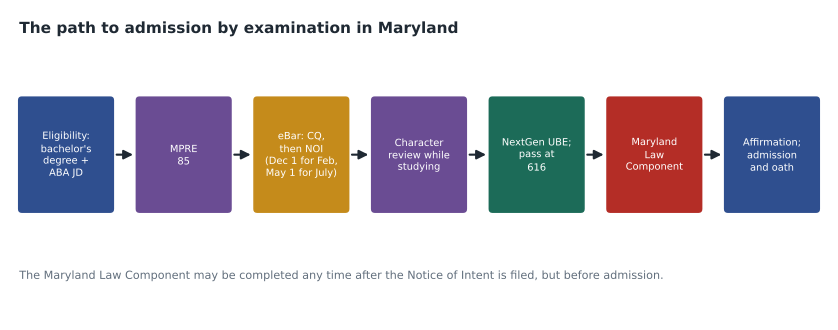
Bridget wrote her own timeline under Hollis's three words. She had sat the MPRE in March 2026 and scored 97. She had created her eBar account in October 2026 and filed her Character Questionnaire and Notice of Intent on November 3, 2026, well before the December 1 deadline. Her exam would be on Tuesday and Wednesday, February 23 and 24, 2027. Results for February exams are normally released in April. She planned to finish the Maryland Law Component in March, after the exam but before results, so nothing would hold up her admission.
After admission
Admission is not the end of the regulatory relationship. A Maryland lawyer practices under the Maryland Attorneys' Rules of Professional Conduct. The Attorney Grievance Commission investigates and prosecutes complaints of misconduct through Bar Counsel, and the Supreme Court decides discipline. Lawyers pay annual assessments to the Client Protection Fund, which reimburses clients who lose money through a lawyer's dishonest conduct, and to the Disciplinary Fund. Maryland lawyers who hold client money must follow the trust account rules in Title 19, Chapter 400, and they file annual reports on trust accounts and on pro bono service. The Maryland Law Component outlines cover these obligations, because a new lawyer must meet them from the first day.
The Maryland State Bar Association is a voluntary association. Membership is not required to practice, unlike states with a unified bar where every lawyer must belong to the state bar. Maryland also does not currently require continuing legal education. The Supreme Court has considered a mandatory program, and a 2023 workgroup proposed one, but in April 2025 the Court postponed the proposal until further notice. Lesson 11 returns to that history.
Reading official sources
Hollis ended the session with a list of places to look. The Board's pages on the Maryland Judiciary website explain admission by UBE, score transfer, admission without examination and the Maryland Law Component. The Board posts a dates document for each exam with filing periods and the exam site. Court orders about the exam are posted among the Judiciary's administrative orders. NCBE's jurisdiction page for Maryland lists the passing score, MPRE requirement, transfer rules and fees in a standard format that makes comparison with other states easy. When two sources seem to disagree, the Board's own pages and the Court's rules and orders control.
'Write the date next to anything you copy down,' Hollis said. 'Maryland changed its exam in July 2026. It capped applications twice. It moved its office to appointments only in October 2026. Rules here are not frozen. A fact with a date next to it is a fact you can check again.'
Worked problem
Choosing a route
Imani passed the legacy UBE in the District of Columbia in July 2025 with a score of 279. She now works in Silver Spring and wants to be admitted in Maryland. She has never practiced as a lawyer anywhere except as a new associate since November 2025. Which Maryland route should she investigate first?
Show solution
- Admission without examination requires at least three of the last five years of practice or more than ten years, so Imani does not qualify.
- She has a legacy UBE score of 279 from another UBE jurisdiction, which is above Maryland's legacy passing score of 266.
- Maryland accepts transferred legacy UBE scores within its time limits, so score transfer is the natural route.
- She will still need an MPRE score of 85, character and fitness approval and the Maryland Law Component.
Answer: Score transfer. She should check that her score is within Maryland's transfer window and request the transfer through NCBE, then complete the Maryland Law Component and character review.
Where the substantive law fits
The second half of this course turns to Maryland law itself: the court system and civil procedure, contributory negligence and the noneconomic damages cap, the 2023 divorce reform and tenancy by the entirety, the Declaration of Rights and the Maryland Attorneys' Rules of Professional Conduct. Those topics do not appear as Maryland questions on the NextGen exam, which tests general law. They matter for two reasons. They appear in the Maryland Law Component, and they matter in practice from the first week. Bridget had already met contributory negligence at work: one of Helen Szabo's car-crash clients had been told by an insurer that any carelessness on her part would bar her claim entirely. In Maryland that is true, as Lesson 8 explains, and it surprises many people who studied general tort law.
Common mistakes
MistakeThe Court of Appeals of Maryland admits lawyers.
InsteadThe Supreme Court of Maryland admits lawyers. It was called the Court of Appeals until December 14, 2022.
MistakeNCBE decides who is admitted in Maryland.
InsteadNCBE writes and scores exams and transfers scores; the Board reports qualified applicants and the Supreme Court admits them.
MistakeThe Maryland Law Component is part of exam day.
InsteadIt is a separate online open-book course and test, completed any time after filing and before admission.
MistakeMaryland lawyers must join the Maryland State Bar Association.
InsteadThe MSBA is voluntary; Maryland does not have a unified bar.
MistakeAn experienced out-of-state lawyer can sit a shorter attorneys' exam.
InsteadMaryland has no attorneys' exam; experienced lawyers may qualify for admission without examination under Rule 19-215.
Practice problems
Work each problem on paper first, then reveal the answer to check.
What was the Supreme Court of Maryland called before December 2022?
Show answer
The Court of Appeals of Maryland. The intermediate court, the Court of Special Appeals, became the Appellate Court of Maryland.
Which title of the Maryland Rules governs attorneys?
Show answer
Title 19. Chapter 200 covers admission, Chapter 300 the Maryland Attorneys' Rules of Professional Conduct and Chapter 400 trust accounts.
What two numbers must an applicant have to open an eBar account?
Show answer
A United States Social Security number and an NCBE number.
Name the three routes into the Maryland bar.
Show answer
Passing the UBE in Maryland, transferring a qualifying UBE score and admission without examination under Rule 19-215.
Which three requirements apply on every route?
Show answer
Character and fitness, an MPRE score of 85 and the Maryland Law Component.
Summary and key terms
- The Supreme Court of Maryland, called the Court of Appeals until December 14, 2022, adopts the rules and admits lawyers.
- The State Board of Law Examiners handles filings through eBar, gives and grades the exam and reports qualified applicants.
- NCBE writes and scales the NextGen UBE and the MPRE, transfers scores and runs some character investigations.
- The three routes are passing the UBE in Maryland (616 on NextGen), transferring a UBE score and admission without examination.
- Every applicant needs character and fitness approval, an MPRE score of 85 and the Maryland Law Component.
- After admission, the Attorney Grievance Commission, the Client Protection Fund and the trust account rules apply; CLE is not mandatory.
- Supreme Court of Maryland
- The highest court of Maryland, called the Court of Appeals until December 14, 2022; it admits and disciplines lawyers.
- State Board of Law Examiners
- The Board appointed by the Supreme Court of Maryland that administers bar admission and the bar exam.
- eBar
- The Board's online system for filings, fees and results.
- Maryland Law Component
- Maryland's required course of outlines on Maryland law and an online open-book test, completed before admission.
- Title 19
- The title of the Maryland Rules that governs attorneys, including admission, professional conduct and trust accounts.
Lesson quiz · 5 questions
Score 60% or more to complete this lesson.
Create a free account to save your progress, take quizzes and earn a certificate.