
BAR-219 · Lesson 9 of 12 · 16 min
Louisiana torts after the 2024 to 2026 reforms
▶ Video coming soon A video version of this lesson is on the way.
Eddie had a personal reason to care about the ninth session. The Lafayette firm where he expects to work after admission does a mix of insurance defense and plaintiff work, and the lawyers there had spent much of 2025 talking about the legislature's tort reform package. 'Every lunch conversation for a year was about the 51 percent bar and the new medical expense rule,' he said. 'I know the reforms exist. I am less sure which ones the examiners will expect me to know in February, and how they fit with the basic Code articles.'
Marchetti pulled up the Committee's six-month policy. 'Anything that took effect by the middle of 2026 is fair game for February 2027. The big changes all took effect before that, so you need them. But the reforms sit on top of a structure that has not changed: article 2315, the duty-risk analysis, the custody articles, and the allocation of fault. Learn the structure first and then layer the reforms. Torts is a Code test, worth about 129 weighted points, so it deserves serious time.'
The foundation: article 2315
Article 2315 is the most famous article in the Civil Code. It provides that every act whatever of man that causes damage to another obliges him by whose fault it happened to repair it. Article 2316 adds that every person is responsible for the damage he occasions not merely by his act but by his negligence, his imprudence or his want of skill. Louisiana calls tort liability delictual liability, and the Code describes the sources of these obligations as offenses, for intentional wrongs, and quasi-offenses, for negligent ones.
The breadth of article 2315 means that Louisiana courts developed the details of negligence law through decisions, using a framework called the duty-risk analysis. Under it, a plaintiff must prove five elements: that the defendant had a duty to conform his conduct to a specific standard; that the defendant's conduct failed to conform to that standard, which is breach; that the defendant's substandard conduct was a cause in fact of the plaintiff's injuries; that the defendant's substandard conduct was a legal cause of the plaintiff's injuries, which asks whether the risk and harm were within the scope of protection of the duty; and actual damages. A negative answer to any element defeats liability.
The legal cause, or scope of duty, element does the work that proximate cause does in common law states, but it is framed as a policy question about the scope of the rule the defendant violated. Courts ask whether the rule was designed to protect this plaintiff against this risk of harm arising in this manner. Ease of association between the rule and the injury is a common way to analyze it.
Custody of things and vicarious liability
Article 2317 makes a person responsible for damage caused by the things in his custody, and article 2317.1 limits that liability: the owner or custodian of a thing is answerable for damage occasioned by its ruin, vice or defect only upon a showing that he knew or, in the exercise of reasonable care, should have known of the ruin, vice or defect that caused the damage, that the damage could have been prevented by the exercise of reasonable care, and that he failed to exercise such reasonable care. Since the 1996 amendments that added article 2317.1, custodial liability is effectively negligence-based: the plaintiff must prove a defect that created an unreasonable risk of harm and the defendant's actual or constructive knowledge.
Article 2320 makes employers answerable for the damage occasioned by their employees in the exercise of the functions in which they are employed, the Louisiana version of respondeat superior. Article 2322 covers damage caused by the ruin of a building, with the same knowledge requirement as article 2317.1. Article 2321 governs damage caused by animals, with strict liability for dogs in some circumstances and a negligence standard for other animals.
Special statutes
Several statutes in Title 9 of the Revised Statutes add specific rules on top of the Code articles. The merchant liability statute requires a plaintiff who falls in a store to prove that the condition presented an unreasonable risk of harm that was reasonably foreseeable, that the merchant created or had actual or constructive notice of the condition before the fall, and that the merchant failed to exercise reasonable care; constructive notice requires proof that the condition existed for a period of time before the fall. The Louisiana Products Liability Act establishes the exclusive theories of liability for manufacturers: a product unreasonably dangerous in construction or composition, in design, because of an inadequate warning, or because of nonconformity to an express warranty.
Claims against public entities face their own rules, including a notice requirement for liability based on defective things, immunity for discretionary acts and a cap on general damages against the state and political subdivisions. Medical malpractice claims against qualified health care providers must first go to a medical review panel before suit, and recoveries are subject to a statutory cap, excluding future medical care. Workers' compensation is the exclusive remedy for an employee injured on the job, except for intentional acts.
Allocation of fault before 2026
Article 2323 has governed comparative fault since Louisiana abandoned contributory negligence in 1980. Under it, the degree or percentage of fault of all persons causing or contributing to the injury is determined, whether or not the person is a party to the action or a nonparty, and regardless of the person's insolvency, ability to pay or immunity. If the plaintiff's own negligence contributed to the injury, the plaintiff's damages are reduced in proportion to his percentage of fault. Before 2026, Louisiana applied pure comparative fault: a plaintiff 80 percent at fault could still recover 20 percent of the damages.
Article 2324 deals with how the defendants share liability. A person who conspires with another to commit an intentional or willful act is answerable, in solido, with that person for the damage caused by the act. Otherwise, liability for damages caused by two or more persons is a joint and divisible obligation: a joint tortfeasor is not liable for more than his degree of fault and is not solidarily liable with any other person for damages attributable to the fault of that other person. In practice, each non-intentional tortfeasor pays only his own share, and the plaintiff bears the risk that a nonparty or insolvent tortfeasor cannot pay.
The 2025 change to comparative fault
Act 15 of the 2025 regular session amended article 2323 to adopt a modified comparative fault rule. Under the amended article, a plaintiff whose percentage of fault is 51 percent or greater recovers nothing. A plaintiff whose fault is 50 percent or less still has damages reduced by his percentage of fault. The amendment took effect on January 1, 2026. Because it is a substantive change, Civil Code article 6 presumes prospective application, and candidates should check the act's own provisions on which claims it governs before applying it to an accident that happened before that date.
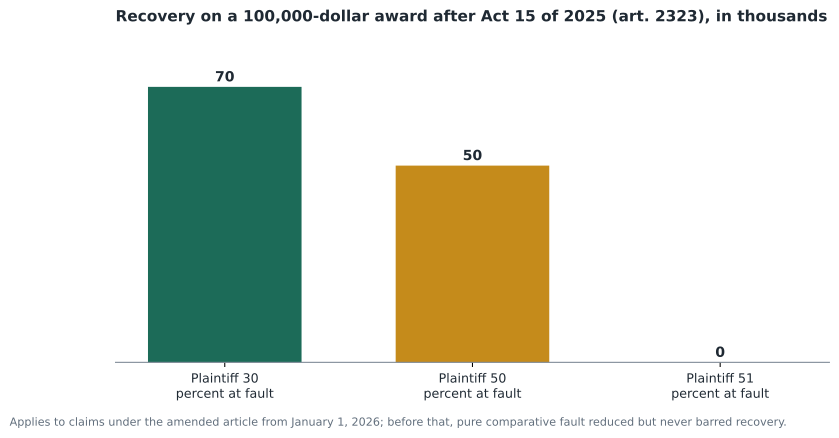
The 51 percent bar changes the strategy of every serious negligence case. Defendants now have a strong incentive to prove that the plaintiff was the majority cause of the accident, and plaintiffs have a strong incentive to keep their own fault below the line, because one percentage point can make the difference between a substantial recovery and none. On the examination, a question with a plaintiff at fault calls for a precise allocation and a statement of the result under the amended article, with attention to when the claim arose.
The two-year delictual prescription
For generations, delictual actions in Louisiana prescribed in one year from the day injury or damage was sustained, under former article 3492. A 2024 act of the legislature replaced that period with a two-year liberative prescription for delictual actions, effective July 1, 2024. The legislature made the change prospective: it applies to delictual actions arising after the effective date, and claims that arose earlier remain subject to the former one-year period. Some special periods remain, such as the longer periods for certain crimes of violence and for sexual abuse of a minor, and medical malpractice claims have their own statute with a one-year discovery rule and a three-year outside limit.
Liberative prescription is interrupted by the filing of suit in a court of competent jurisdiction and venue, or by service on the defendant within the prescriptive period if suit was filed in an incompetent court or improper venue, and by the defendant's acknowledgment of the plaintiff's right. When prescription is interrupted, the time that has run is not counted, and prescription begins to run anew from the last day of interruption. Interruption against one solidary obligor is effective against all.
Other 2025 reforms worth knowing
The 2025 package contained several other changes that a February 2027 candidate should know at the level of the main rule and effective date.
| Change | What it does | Effective |
|---|---|---|
| Act 15 of 2025, article 2323 | Plaintiff 51 percent or more at fault recovers nothing | January 1, 2026 |
| R.S. 9:2800.27 | Limits recovery of medical expenses to amounts actually paid or owed rather than amounts billed, with collateral source adjustments | Actions filed on or after January 1, 2026 |
| Code of Evidence article 306.1 | Eliminates the judicial presumption of causation that helped plaintiffs who were healthy before an accident | May 28, 2025 |
| R.S. 32:866 | Raises the no pay, no play threshold that uninsured motorists cannot recover to 100,000 dollars | August 1, 2025 |
| 2024 prescription act | Two-year delictual prescription, prospective only | July 1, 2024 |
The causation change deserves a word. For decades, Louisiana courts applied a presumption, often associated with the Louisiana Supreme Court's decision in Housley v. Cerise, that a medical condition was caused by an accident if the plaintiff was in good health before the accident, symptoms appeared soon after and continuously manifested themselves, and there was a reasonable possibility of a causal connection. The 2025 legislation eliminated that presumption, so plaintiffs must now prove medical causation by a preponderance of the evidence without its help.
Damages
Louisiana allows recovery of special damages, such as medical expenses and lost earnings, and general damages, such as pain and suffering, mental anguish and loss of enjoyment of life. The survival action under article 2315.1 allows designated beneficiaries to recover the damages the deceased could have recovered, and the wrongful death action under article 2315.2 allows them to recover their own damages from the death. Article 2315.6 allows certain close relatives who witness an injury or come upon the scene soon after to recover for their own severe and foreseeable mental anguish. Punitive damages are available only when a statute authorizes them, as with injuries caused by a drunk driver under article 2315.4.
Worked problem
A parking lot collision in Opelousas
In March 2026, Delphine backs out of a grocery store space without looking and collides with a pickup driven by Marc, who was speeding through the lot while looking at his phone. Delphine suffers a back injury and sues Marc in April 2026. A jury assesses her total damages at 200,000 dollars and allocates fault 55 percent to Delphine and 45 percent to Marc. What does Delphine recover, and was her suit timely?
Show solution
- Timeliness: the accident happened after July 1, 2024, so the two-year delictual prescription applies; a suit filed one month later is timely.
- Duty-risk: Marc had a duty to drive at a reasonable speed and keep a lookout; speeding while looking at his phone breached it; the breach was a cause in fact and within the scope of the duty; Delphine has damages.
- Allocation: Delphine is 55 percent at fault and Marc 45 percent.
- Amended article 2323: the accident occurred after January 1, 2026, so the 51 percent bar applies on these facts, subject to the act's application provisions; at 55 percent, Delphine recovers nothing.
- Contrast: under the pre-2026 pure comparative fault rule, she would have recovered 45 percent of 200,000 dollars, or 90,000 dollars.
Answer: Delphine's suit is timely, but because she is 55 percent at fault under the amended article 2323, she recovers nothing; under the old rule she would have recovered 90,000 dollars.
Common mistakes
MistakeLouisiana still applies pure comparative fault to every claim.
InsteadAmended article 2323, effective January 1, 2026, bars a plaintiff 51 percent or more at fault.
MistakeDelictual actions prescribe in one year.
InsteadThe 2024 prescription act adopted a two-year period for delictual actions arising after July 1, 2024; older claims keep the one-year period.
MistakeCustodians of things are strictly liable for defects.
InsteadUnder article 2317.1, the plaintiff must prove the custodian knew or should have known of the defect and failed to exercise reasonable care.
MistakeJoint tortfeasors are solidarily liable for all damages.
InsteadUnder article 2324, only those who conspire to commit intentional acts are solidarily liable; others pay only their own share.
MistakePunitive damages are available whenever a defendant acts recklessly.
InsteadLouisiana allows punitive damages only where a statute authorizes them.
A checklist for a Louisiana torts essay
Marchetti gave Eddie a short checklist to run on every torts fact pattern. First, identify the source of liability: article 2315 negligence, custody under articles 2317 and 2317.1, vicarious liability under article 2320, or a special statute such as the merchant liability statute or the Products Liability Act. Second, work the duty-risk elements in order, spending the most time on the element the facts put in doubt, usually breach or scope of duty. Third, check timeliness: when did the injury occur, which prescriptive period applies, and was prescription interrupted. Fourth, allocate fault among all persons who caused the harm, including nonparties and immune persons, and apply article 2323 as it stood when the claim arose. Fifth, apply article 2324 to decide how much each defendant pays. Sixth, address damages, including any special limits such as the medical expense rule for actions filed from 2026, the public entity cap or the malpractice cap.
The order matters because the reforms change the last three steps more than the first three. A candidate who identifies the right theory and works the duty-risk elements well has earned most of the credit; the reforms then decide the bottom line. Eddie practiced the checklist on three fact patterns in a week and found that it kept him from skipping prescription, the issue candidates most often forget when the facts focus on fault.
Summary and key terms
- Article 2315 imposes liability for damage caused by fault; courts apply the five-element duty-risk analysis.
- Custodial liability under articles 2317 and 2317.1 requires actual or constructive knowledge of the defect; employers answer for employees under article 2320.
- Article 2324 makes non-intentional tortfeasors liable only for their own share; fault is allocated to all persons, including nonparties.
- Amended article 2323 bars recovery by a plaintiff 51 percent or more at fault from January 1, 2026; delictual actions arising after July 1, 2024 prescribe in two years.
- The 2025 reforms also limit medical expense recovery to amounts paid or owed, eliminated the Housley presumption and raised the no pay, no play threshold.
- Delictual liability
- Louisiana's term for tort liability arising from offenses and quasi-offenses under article 2315.
- Duty-risk analysis
- The five-element framework for negligence: duty, breach, cause in fact, legal cause or scope of duty, and damages.
- Modified comparative fault
- A rule that reduces a plaintiff's recovery by his fault and bars it when his fault reaches a threshold, in Louisiana 51 percent.
- Joint and divisible obligation
- Liability under which each tortfeasor pays only the share attributable to his own fault.
- Liberative prescription
- A mode of barring actions as a result of inaction for a period of time, the Louisiana counterpart of a statute of limitations.
Lesson quiz · 5 questions
Score 60% or more to complete this lesson.
Create a free account to save your progress, take quizzes and earn a certificate.