
BAR-219 · Lesson 10 of 12 · 16 min
The Code of Civil Procedure and the Rules of Professional Conduct
▶ Video coming soon A video version of this lesson is on the way.
The tenth session opened with a story from Eddie's summer clerkship. A partner at the Lafayette firm had handed him a petition filed against a client in St. Martin Parish and asked him to list every exception the client could raise before answering. 'I came back with a memo that said motion to dismiss for failure to state a claim,' Eddie admitted. 'He circled it in red and wrote "peremptory exception of no cause of action, and you forgot venue." I have never forgotten it.'
Marchetti laughed. 'That partner taught you the two things the Civil Procedure test checks most: whether you use the Code's vocabulary and whether you know which objections are waived if you do not raise them on time. We will cover the structure of a Louisiana civil action, the exceptions, the main pretrial and trial rules and appeals. Then we will spend the second half on the Louisiana Rules of Professional Conduct, because new lawyers trip over the places where Louisiana departs from the Model Rules you studied for the MPRE.'
The courts
Louisiana's trial courts of general jurisdiction are the district courts, organized by judicial district, with each district covering one or more parishes. Parish and city courts handle smaller civil matters and misdemeanors within limits set by statute. Five circuit courts of appeal hear appeals from the district courts, and the Louisiana Supreme Court sits at the top, with supervisory jurisdiction over all courts and appellate jurisdiction in specified cases. Louisiana courts of appeal review both law and facts; on facts, they apply the manifest error standard and do not overturn a factfinder's reasonable findings.
Starting a civil action
A civil action is commenced by filing a petition in a court of competent jurisdiction. Under article 891, the petition must contain a short, clear and concise statement of all causes of action arising out of, and of the material facts of, the transaction or occurrence that is the subject matter of the litigation. Louisiana is a fact-pleading state: the petition must allege facts, not just conclusions or legal theories. A petition generally may not state a specific monetary amount of damages, although a party may state that damages are above or below a threshold relevant to jurisdiction or the right to a jury.
Venue is governed by articles 42 through 86. The general rule in article 42 is that an individual domiciled in Louisiana is sued in the parish of his domicile and a domestic corporation in the parish where its registered office is located. Supplementary rules allow suit elsewhere: an action for an offense or quasi-offense may be brought in the parish where the wrongful conduct occurred or where the damages were sustained, and actions on contracts may be brought in the parish where the contract was executed or where work was performed. Some venue rules are mandatory.
Service of citation must be requested on all named defendants within ninety days of the commencement of the action, and failure to do so without good cause leads to dismissal without prejudice on a defendant's motion. A defendant generally must file an answer within twenty-one days after service of citation. Electronic filing in Louisiana courts has expanded in recent years, including amendments to article 253 that took effect on January 1, 2026; candidates should know that electronic filing is available and governed by the Code and court rules, without needing the technical details.
Exceptions
Louisiana does not use motions to dismiss in the federal sense. Objections to a petition are raised by exceptions, of which there are three kinds under articles 921 through 934.
The declinatory exception, under article 925, raises objections such as lis pendens, insufficiency of citation, insufficiency of service of process, improper venue, lack of jurisdiction over the person and lack of jurisdiction over the subject matter. The dilatory exception, under article 926, raises objections such as prematurity, want of amicable demand, unauthorized use of summary proceeding, nonconformity of the petition with article 891, vagueness or ambiguity, lack of procedural capacity, improper cumulation of actions, improper joinder of parties and discussion. The peremptory exception, under article 927, raises objections such as prescription, peremption, res judicata, nonjoinder of a party, no cause of action, no right of action and discharge in bankruptcy.
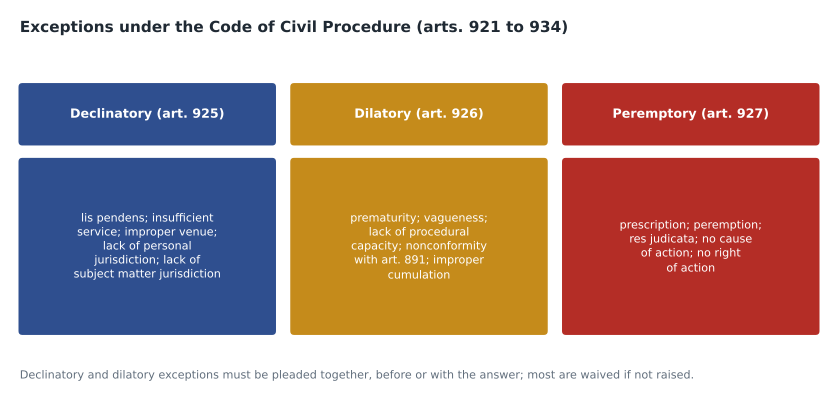
Timing is the heart of the matter. Under article 928, the declinatory and dilatory exceptions must be pleaded prior to or in the answer, and all objections available at the time must be pleaded at the same time. Most of those objections are waived if not raised then; lack of subject matter jurisdiction is the important exception, because it cannot be waived and may be noticed by the court on its own motion. The peremptory exception may be pleaded at any stage of the proceeding in the trial court prior to submission of the case for decision, and the court may notice no cause of action and no right of action on its own. When the grounds of an exception can be removed by amendment of the petition, the court must allow the plaintiff to amend, under article 934.
Two peremptory exceptions are easy to confuse. No cause of action asks whether the law affords any remedy on the facts alleged in the petition, accepting them as true, and is tried on the face of the petition without evidence. No right of action asks whether this particular plaintiff belongs to the class of persons to whom the law grants the remedy, and evidence may be introduced to support or controvert it. A widow suing for wrongful death has a right of action under article 2315.2; a neighbor who was fond of the deceased does not.
Pretrial and trial
Discovery in Louisiana follows a familiar pattern of depositions, interrogatories, requests for production and requests for admission. Summary judgment under article 966 is available when the motion, memorandum and supporting documents show that there is no genuine issue as to material fact and the mover is entitled to judgment as a matter of law; the Code limits the documents that may be filed in support of or in opposition to the motion and sets deadlines for filing and hearing it.
Jury trial is more limited in Louisiana than in many states. Under article 1732, a jury trial is not available in a suit where no individual petitioner's cause of action exceeds ten thousand dollars exclusive of interest and costs, with exceptions; it is also unavailable in certain other proceedings, such as suits against political subdivisions unless the subdivision waives the prohibition, summary and executory proceedings and successions. A party who wants a jury must request it timely and post the required bond or cash deposit.
An action is abandoned under article 561 when the parties fail to take any step in its prosecution or defense in the trial court for a period of three years. Abandonment operates automatically without a formal order, although a formal order of dismissal is entered on motion, and it is a frequent trap for lawyers who let files sit.
Judgments and appeals
A final judgment determines the merits in whole or in part; an interlocutory judgment does not. A partial final judgment under article 1915 is appealable in some cases only if the court designates it as final after an express determination that there is no just reason for delay. A party may move for a new trial within the time set by the Code after notice of judgment.
Louisiana distinguishes two kinds of appeal. A devolutive appeal does not suspend the effect or execution of the judgment, and it may be taken within sixty days of the expiration of the delay for applying for a new trial or of notice of the court's refusal to grant a timely new trial. A suspensive appeal suspends the effect or execution of the judgment, and it must be taken, and the required security furnished, within thirty days of the same starting points. An appellant who misses the suspensive deadline may still take a devolutive appeal within the longer period, but the judgment can be executed in the meantime.
Louisiana also has distinctive special proceedings. Executory proceedings allow a creditor whose mortgage or privilege is evidenced by an authentic act importing a confession of judgment to seize and sell the property without a prior citation and judgment. Summary proceedings are conducted with rapidity and without citation or the usual delays for specified matters, such as incidental questions and some family matters.
| Point | Rule | Common exam trap |
|---|---|---|
| Pleading | Fact pleading under article 891 | Pleading only legal conclusions |
| Declinatory and dilatory exceptions | Plead before or in the answer, all at once | Raising venue after answering |
| Peremptory exceptions | Any time before submission in the trial court | Confusing no cause with no right of action |
| Jury | Available only above the article 1732 threshold, with exceptions | Requesting a jury in a small claim or summary proceeding |
| Appeals | Devolutive 60 days; suspensive 30 days with security | Assuming any appeal stops execution |
The Louisiana Rules of Professional Conduct
The Louisiana Rules of Professional Conduct appear in Article XVI of the Articles of Incorporation of the Louisiana State Bar Association and are adopted and enforced by the Louisiana Supreme Court. Louisiana modeled its current rules on the ABA Model Rules, and most rules track the Model Rules closely, so a candidate's MPRE preparation carries over. The differences matter in practice, and some may appear in questions on the examination. The safest approach is to learn the major differences and to check the Louisiana text before relying on Model Rule memory in a real matter.
The best-known difference is Rule 1.8(e), on financial assistance to clients. The Model Rule allows a lawyer to advance court costs and litigation expenses and, in pro bono matters, to give modest gifts for basic living expenses to indigent clients. The Louisiana rule is longer and more permissive in specific ways: it allows a lawyer to provide financial assistance to a client who is in necessitous circumstances for minimal living expenses, subject to conditions, and allows the lawyer to make or guarantee loans to the client under detailed conditions, including limits on the interest charged that are tied to the prime rate. The rule also prohibits using such assistance as an inducement to obtain the representation. A lawyer handling a personal injury case in Louisiana must read the Louisiana text carefully.
Louisiana's rules on lawyer advertising are also more detailed than the Model Rules, with specific content requirements and a process for filing many advertisements with the LSBA for review. Trust account rules require client funds to be held in a separate account, and Louisiana participates in an interest on lawyers' trust accounts program. Louisiana lawyers have a duty to report another lawyer's misconduct that raises a substantial question about honesty, trustworthiness or fitness, as under the Model Rules.
Discipline
Lawyer discipline in Louisiana is governed by Supreme Court Rule XIX. Complaints go to the Office of Disciplinary Counsel, which investigates and may file formal charges. Hearing committees and the Louisiana Attorney Disciplinary Board hear and review cases, and the Supreme Court decides on serious sanctions, including suspension and disbarment. Common grounds for discipline include neglect of client matters, failure to communicate, conversion of client funds, conflicts of interest and dishonesty. The best protection for a new lawyer is the habits that also protect clients: calendars, prompt communication, careful trust accounting and asking a senior lawyer or the LSBA ethics counsel before acting when unsure.
Worked problem
Exceptions on a St. Martin Parish petition
A petition filed in St. Martin Parish alleges that the defendant, a Lafayette Parish resident, breached a contract signed in Lafayette for work performed in Iberia Parish. The petition says only that "defendant owes plaintiff money." Service was made eight days ago. Which exceptions should the defendant consider, and when?
Show solution
- Venue: the defendant is domiciled in Lafayette Parish, and the contract was executed in Lafayette and performed in Iberia; St. Martin appears improper, so file the declinatory exception of improper venue.
- Vagueness and nonconformity with article 891: the petition alleges a conclusion without material facts, so file the dilatory exceptions at the same time.
- No cause of action: if, accepting the allegations as true, no remedy is stated, the peremptory exception is available, and it may be filed now or later before submission.
- Timing: the declinatory and dilatory exceptions must be filed together, before or with the answer, which is due twenty-one days after service; filing an answer first would waive venue and the dilatory objections.
- Amendment: if the court sustains the vagueness or no cause of action exception and the defect can be cured, the plaintiff will be allowed to amend under article 934.
Answer: File the declinatory exception of improper venue and the dilatory exceptions of vagueness and nonconformity together before answering, and consider the peremptory exception of no cause of action.
Common mistakes
MistakeA Louisiana defendant files a motion to dismiss for failure to state a claim.
InsteadThe objection is the peremptory exception of no cause of action.
MistakeVenue can be raised at any time.
InsteadImproper venue is a declinatory exception, waived unless pleaded before or in the answer.
MistakeAny party may demand a jury in any civil case.
InsteadArticle 1732 bars juries below a monetary threshold and in certain proceedings.
MistakeEvery appeal suspends execution of the judgment.
InsteadOnly a suspensive appeal, taken within thirty days with security, suspends execution; a devolutive appeal does not.
MistakeLouisiana's Rule 1.8(e) is the same as the Model Rule.
InsteadLouisiana's rule has its own provisions on necessitous-circumstances assistance and loans to clients.
Summary and key terms
- Louisiana is a fact-pleading state; venue starts from the defendant's domicile, with supplementary rules such as the place of the wrongful conduct.
- Exceptions are declinatory, dilatory or peremptory; declinatory and dilatory exceptions must be pleaded together before or in the answer, and most are waived otherwise.
- No cause of action tests the petition on its face; no right of action tests whether this plaintiff can sue, and evidence may be admitted.
- Jury trials are limited by article 1732; actions are abandoned after three years without a step; devolutive appeals take 60 days and suspensive appeals 30 days with security.
- The Louisiana Rules of Professional Conduct track the Model Rules with differences such as Rule 1.8(e) and detailed advertising rules; discipline runs under Rule XIX.
- Declinatory exception
- An exception that declines the court's jurisdiction or challenges venue, citation or service.
- Dilatory exception
- An exception that retards the progress of the action, such as prematurity or vagueness.
- Peremptory exception
- An exception that defeats the action, such as prescription, no cause of action or no right of action.
- Abandonment
- The automatic dismissal of an action when no step is taken in its prosecution or defense for three years.
- Suspensive appeal
- An appeal that suspends the execution of the judgment, taken within thirty days with security.
Lesson quiz · 5 questions
Score 60% or more to complete this lesson.
Create a free account to save your progress, take quizzes and earn a certificate.