
BAR-219 · Lesson 4 of 12 · 15 min
The Louisiana bar exam: nine tests, scoring and the 650 passing score
▶ Video coming soon A video version of this lesson is on the way.
Eddie arrived at his fourth session with a printout of the Committee's examination schedule and a page of arithmetic in the margin. 'I tried to work out how much each test is worth,' he said, 'and I got three different answers. One commercial outline says the Code subjects are double weighted, another says the Civil Code counts for more than half the exam, and a friend told me you need 72 on every test. Which is it?'
Marchetti took the printout. 'The Committee's own page answers it in three sentences, and they are worth memorizing. Examinations one through five are Code examinations, and six through nine are non-Code examinations. Each subject is worth 100 raw points. Code subjects carry twice the weight of non-Code subjects, and an applicant who earns a total weighted score of at least 650 out of a possible 900 passes. Your friend is wrong about one thing: there is no minimum on any single test. It is a total. Let us build the arithmetic from those three sentences.'
The schedule
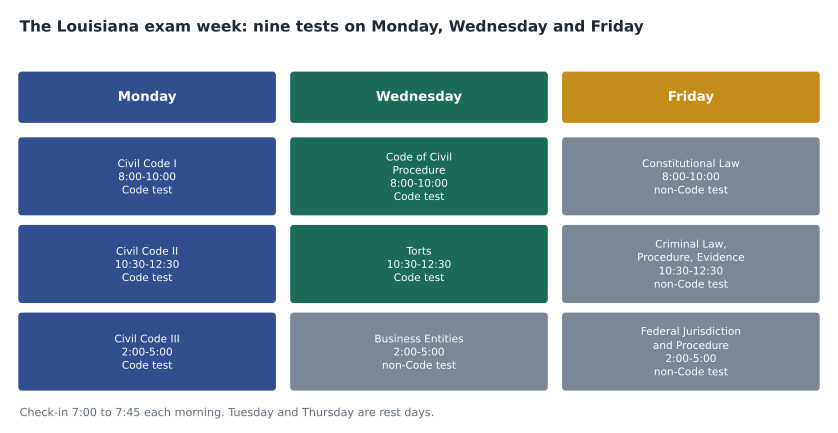
Part I of the Louisiana examination is given over three days in a single week: Monday, Wednesday and Friday, with Tuesday and Thursday free. Each day has three tests: a two-hour morning test from 8:00 to 10:00, a two-hour late-morning test from 10:30 to 12:30, and a three-hour afternoon test from 2:00 to 5:00. Check-in runs from 7:00 to 7:45 each morning.
On Monday, applicants sit Civil Code I, Civil Code II and Civil Code III. On Wednesday, they sit the Louisiana Code of Civil Procedure, Torts and Business Entities. On Friday, they sit Constitutional Law; Criminal Law, Procedure and Evidence; and Federal Jurisdiction and Procedure. The Committee's numbering follows the schedule, so the five Code examinations are the three Civil Code tests, Civil Procedure and Torts, and the four non-Code examinations are Business Entities, Constitutional Law, the criminal test and the federal test.
What each Civil Code test covers
The Committee publishes a scope document for each subject. For the Civil Code tests, the scope documents describe a division that every Louisiana candidate should know cold. Civil Code I begins with persons and family law, including domicile, absent persons, marriage, divorce and separation, and also covers property law, including ownership, servitudes, boundaries, co-ownership, possession and acquisitive prescription. Civil Code II begins with intestate distribution, including representation and the devolution of community and separate property, and covers forced heirship, testaments, donations and the Louisiana Trust Code. Civil Code III begins with obligations, including conventional obligations or contracts, sale and exchange, lease and mandate, and covers security rights and liberative prescription. The scope for Civil Code III expressly excludes security interests under Chapter 9 of the Uniform Commercial Code.
Matrimonial regimes, the law of community and separate property between spouses, run through both family law and the devolution of community property at death, so candidates should be ready to see community property issues on more than one Monday test and should check the current scope documents for where the Committee places them. Lessons 7 and 8 cover the core Civil Code material.
The format of the questions
The Committee describes Part I as primarily essay, with the possibility of multiple-choice questions. Commercial guides report that recent tests have combined several essay questions with a block of multiple-choice questions in each section, often described as two or three essays and ten to twenty multiple-choice questions per test. The mix can change, and the Committee's page is the authority on the current format. The Committee also posts a sample of multiple-choice questions and, for each subject, prior questions and topic lists covering several years, which candidates can use for practice.
Essay questions present a fact pattern, often with several parties and issues, and ask what rights and obligations arise or how a court should rule. Graders reward answers that identify the issues, state the governing rule, preferably with the Code article for the key Code rules, apply it to the facts and reach a conclusion. Multiple-choice questions test narrower points, such as a prescriptive period, an exception or the form required for a testament.
The weighting, worked out
Here is the arithmetic that confused Eddie. Each test is graded out of 100 raw points. The five Code tests count twice as much as the four non-Code tests. So, in units of weight, the Code tests contribute five times two, or ten units, and the non-Code tests contribute four units, for a total of fourteen units. The Committee expresses the weighted total out of 900. Dividing 900 by fourteen gives about 64.3 points for each unit, so each Code test is worth about 128.6 weighted points and each non-Code test about 64.3.
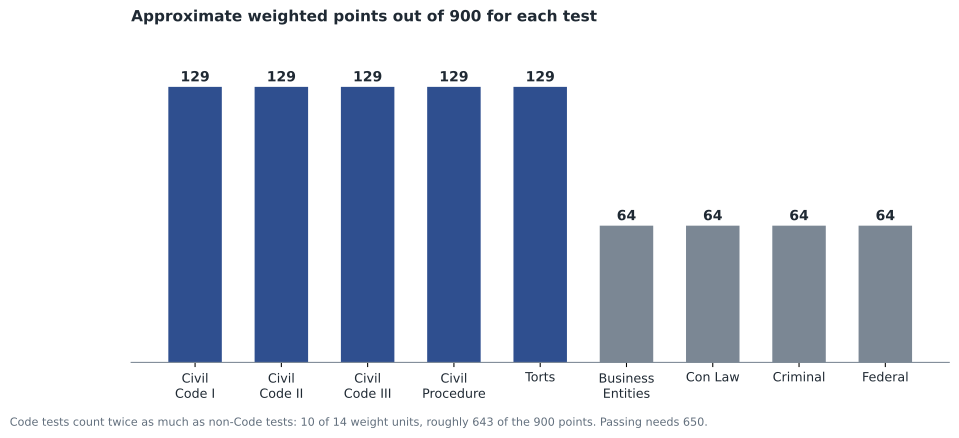
The five Code tests together are worth about 643 of the 900 weighted points, roughly 71 percent of the total. The four non-Code tests together are worth about 257 points. Passing requires 650 points, which is about 72.2 percent of 900. In practice, that means an applicant needs to average roughly 72 raw points across the tests, with Code tests counting double in the average.
Because the passing score is a total, strengths on some tests can offset weaknesses on others. But the weighting makes the offset lopsided. Ten extra raw points on a Code test add about 12.9 weighted points; ten extra raw points on a non-Code test add about 6.4. A candidate who is strong on Federal Jurisdiction and weak on Civil Code III is in a far worse position than one with the opposite profile.
Worked problem
Will this candidate pass?
A candidate earns these raw scores: Civil Code I 74, Civil Code II 70, Civil Code III 68, Civil Procedure 75, Torts 78, Business Entities 66, Constitutional Law 72, Criminal 80 and Federal 62. Does the candidate pass?
Show solution
- Add the Code raw scores: 74 plus 70 plus 68 plus 75 plus 78 equals 365. Doubled for weight, that is 730 weighted raw units.
- Add the non-Code raw scores: 66 plus 72 plus 80 plus 62 equals 280.
- Total weighted raw units: 730 plus 280 equals 1,010, out of a possible 1,400 (fourteen units of 100).
- Convert to the 900 scale: 1,010 divided by 1,400, times 900, equals about 649.3.
- Compare with the passing score: 649.3 is just below 650.
Answer: The candidate falls short by less than one point; one more raw point on any Code test would have added about 1.3 weighted points and carried the candidate over the line.
Marchetti likes that example because it shows how close the line can be and why Code tests deserve the extra hours. 'If that candidate had spent one more week on Civil Code III instead of polishing Criminal, the result would probably have been different,' she said.
No scaling to a national test
In UBE jurisdictions, essay scores are scaled to the MBE so that scores mean the same thing across administrations. Louisiana has no MBE, so there is no MBE scaling. Each test is graded by Louisiana graders against the Committee's standards, and the weighted total is compared with 650. The Committee's graders are appointed by the court and grade anonymously, and Louisiana uses procedures to keep grading consistent among graders. But a candidate should not expect a curve that rescues a weak sitting. The best protection is a margin above the line.
New legislation
Louisiana's legislature changes the Civil Code and the Code of Civil Procedure regularly, and candidates sometimes worry about studying a rule that changed last month. The Committee's page states that new legislation is not tested until six months after its effective date. That policy matters for the February 2027 sitting. The 2025 amendment to Civil Code article 2323, which replaced pure comparative fault with a bar on recovery for a plaintiff who is 51 percent or more at fault, took effect on January 1, 2026, more than six months before February 2027, so it is fair game. Lesson 9 covers the torts reforms in detail.
Typing, timing and the essay day
Most candidates type their answers using the approved examination software. The software locks other programs during the test and saves answers continuously. Candidates who register for laptop use must complete the setup and practice test by the Committee's deadlines. The three-hour afternoon tests are long, and candidates who type can usually write more and revise more easily than those writing by hand.
Timing matters on every test. With two hours for the morning tests and three for the afternoon tests, a candidate needs to divide time among the essays and the multiple-choice block in proportion to their value and stick to it. Running long on the first essay and rushing the last is the most common way to lose points that the candidate actually knows. Lesson 12 includes a timing plan.
Pass rates
Louisiana's pass rates vary from sitting to sitting. Figures reported by commercial providers show, for example, an overall pass rate of about 75 percent for July 2025, with first-time takers passing at about 82 percent, and about 56 percent overall for February 2026. February rates are typically lower because February draws more repeat takers. The Committee publishes the official results and pass lists. The numbers are a reminder that a well-prepared first-time taker has good odds, and that the five-attempt limit makes preparation for the first attempt worth the investment.
| Feature | Louisiana rule | Why it matters |
|---|---|---|
| Number of tests | Nine, over Monday, Wednesday and Friday | Stamina and scheduling across a week |
| Weighting | Five Code tests count double | Code tests carry about 643 of 900 points |
| Passing score | 650 of 900 weighted | A total; no minimum on any single test |
| Format | Primarily essay; may include multiple choice | Practice timed essays with article citations |
| New legislation | Not tested until six months after effective | Changes effective by mid-2026 are testable in February 2027 |
Common mistakes
MistakeEach test must be passed separately.
InsteadPassing depends on the total weighted score of 650 of 900; there is no minimum on a single test.
MistakeAll nine tests carry equal weight.
InsteadThe five Code tests carry twice the weight of the four non-Code tests.
MistakeTorts is a non-Code test because it is a common law subject elsewhere.
InsteadIn Louisiana, Torts is one of the five Code tests; delictual liability comes from the Civil Code.
MistakeScores are scaled to the MBE.
InsteadLouisiana has no MBE; tests are graded against the Committee's standards and weighted.
MistakeLast month's new statute will be tested.
InsteadThe Committee does not test new legislation until six months after its effective date.
The non-Code tests
The four non-Code tests carry less weight, but together they are still worth about 257 points, far too many to neglect. Business Entities, the Wednesday afternoon test, draws on Louisiana statutes rather than the Civil Code's core: the Louisiana Business Corporation Act, the Louisiana limited liability company law in Title 12 of the Revised Statutes, and the partnership articles of the Civil Code, under which a partnership is a juridical person distinct from its partners. Candidates should expect formation, fiduciary duties, limited liability and its exceptions, member and shareholder rights, and dissolution, and should read the scope document for the current list.
The Friday tests look more familiar to candidates trained in national subjects. Constitutional Law covers the federal constitution and, depending on the scope document, may reach the Louisiana constitution. Criminal Law, Procedure and Evidence draws on the Louisiana Criminal Code in Title 14 of the Revised Statutes, the Louisiana Code of Criminal Procedure and the Louisiana Code of Evidence, which follows the Federal Rules of Evidence in structure but differs in places. Federal Jurisdiction and Procedure covers subject matter and personal jurisdiction in federal court, venue, the Erie doctrine and the Federal Rules of Civil Procedure.
Eddie's work in the Saturday constitutional law sessions and the Monday evidence drills means he starts the non-Code tests with a base. 'I scored six of eight on the evidence set in the capstone,' he said. 'That is good, but it is not 72 on a whole test.' Marchetti agreed: the plan is to keep the non-Code subjects warm with weekly practice while spending most of the hours on the Code.
What the totals mean for study time
A simple way to allocate study time is in proportion to weight. If Code tests carry about 71 percent of the points, they should get roughly two thirds to three quarters of the study hours, with the balance spread across the four non-Code tests. Within the Code, Civil Code III and Torts tend to reward the most practice because they produce long, issue-rich fact patterns, while Civil Code II rewards careful memorization of fractions, forms and order of succession.
Summary and key terms
- Part I is nine tests over Monday, Wednesday and Friday, each day with two two-hour tests and one three-hour test.
- The Code tests are Civil Code I, II and III, Civil Procedure and Torts; the non-Code tests are Business Entities, Constitutional Law, the criminal test and the federal test.
- Each test is graded out of 100 raw points, Code tests count double, and the weighted total out of 900 must reach 650.
- Code tests together carry about 643 of the 900 points, so they deserve most of the study time.
- The format is primarily essay with possible multiple choice, and new legislation is not tested until six months after its effective date.
- Part I
- The nine-test Louisiana examination, passed with a weighted total of 650 of 900.
- Code test
- One of the five Louisiana tests on Code subjects, each carrying twice the weight of a non-Code test.
- Weighted score
- The total of the raw scores with Code tests counted twice, expressed out of 900.
- Scope document
- The Committee's published description of the topics covered by each test.
- Six-month rule
- The Committee's policy of not testing new legislation until six months after it takes effect.
Lesson quiz · 5 questions
Score 60% or more to complete this lesson.
Create a free account to save your progress, take quizzes and earn a certificate.