
BAR-219 · Lesson 1 of 12 · 17 min
Becoming a lawyer in Louisiana
▶ Video coming soon A video version of this lesson is on the way.
Etienne Boudreaux, who has answered to Eddie since grade school, grew up in Lafayette, two blocks from the church where his grandparents were married and three blocks from the coffee shop where he now spends most mornings with a Civil Code and a highlighter. He finished law school in May 2026 on the civil law track, and he has been part of Hollis Marchetti's online study group since early October, sitting in on the Saturday constitutional law sessions and the Monday evening evidence drills. In mid-November he drove to Baton Rouge to sit the MPRE, and he is waiting for that score now. He is aiming at the February 2027 Louisiana bar examination.
At his first one-on-one session after the MPRE, Eddie told Marchetti what had been bothering him. 'My friends who moved to Texas and Georgia keep talking about the MBE and their UBE score,' he said. 'Half the commercial outlines I see are built around the same seven subjects. I know Louisiana is different, but I want to be sure I understand how different, and I do not want to find out in February that I studied for the wrong test.'
Marchetti nodded. 'That instinct will save you months. Louisiana writes, gives and grades its own examination. There is no MBE, no MEE, no MPT and no UBE score. The test is nine separate examinations over three days, mostly essay, and more than half of the weight sits on Code subjects that no other state tests. The admission rules are Louisiana rules, too, and they are stricter than most: no admission on motion for lawyers from other states and a limit on how many times you can sit. So this course does two jobs. It gets you through admission, and it gets you comfortable with the civil law you will use from your first week at work.'
This lesson maps the whole process: the institutions involved, the routes to practice, the requirements for the examination route and the usual order of events. Later lessons take each step in detail and then turn to the Louisiana law that the examination emphasizes and that a new lawyer in Lafayette, Shreveport or New Orleans meets first.
Who controls admission
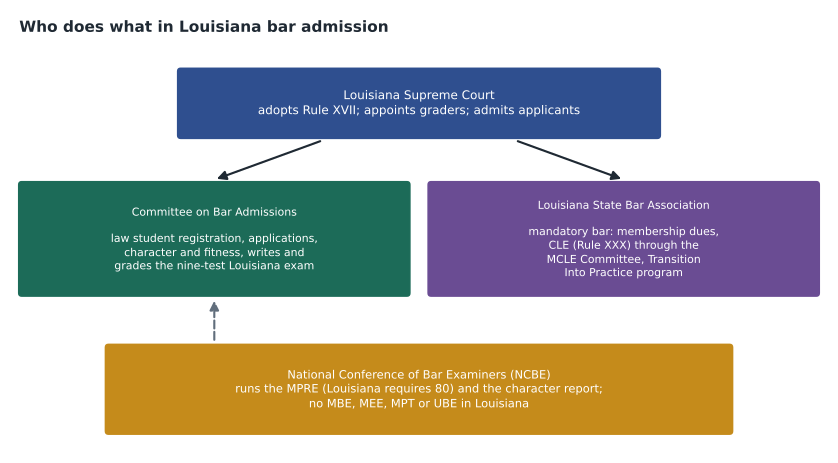
Admission to the practice of law in Louisiana is controlled by the Louisiana Supreme Court. The Louisiana Constitution gives the court general supervisory authority over the courts, and the court has long treated the regulation of the practice of law as part of its inherent judicial power. It exercises that power through its own rules. The admission rules are in Rule XVII of the Rules of the Supreme Court of Louisiana, which sets out the requisites for admission, the examination, the scoring standard, the character and fitness process, the limited ways a lawyer licensed elsewhere may practice in Louisiana, and the fees, which appear in an appendix to the rule.
The court does its admissions work through the Committee on Bar Admissions, a body of lawyers the court appoints. The Committee runs law student registration, processes applications, conducts the character and fitness review, writes the nine tests, and grades them. The Committee's examiners for each subject write the questions, and the court appoints the graders, who read essays anonymously: your papers carry an applicant number, not your name. When the Committee has finished its work for an examination, it reports to the court, and the court admits the successful applicants.
Two consequences follow. The first is that every rule that matters to you is a court rule, published with the other Supreme Court rules and amended by court order. When you check a deadline or a fee, the authoritative source is Rule XVII, its appendix and the Committee's current instructions, not an outline written three years ago. The second is that the Committee, not a national organization, decides what is tested. Its published scope documents for each subject are the closest thing Louisiana has to a subject matter outline, and they are worth more of your time than any commercial summary.
The Louisiana State Bar Association
Once you are admitted, a second institution becomes important. Louisiana has a mandatory, unified bar: every lawyer who practices in the state must belong to the Louisiana State Bar Association (LSBA) and pay its dues. The LSBA administers continuing legal education under Supreme Court Rule XXX through its Mandatory Continuing Legal Education Committee, runs the Transition Into Practice mentoring program for new lawyers, publishes the Louisiana Bar Journal, and offers practice management help, ethics advisory opinions and a lawyer assistance program.
The Louisiana Rules of Professional Conduct are set out in Article XVI of the LSBA's Articles of Incorporation, adopted and enforced by the Supreme Court. Discipline runs through the Office of Disciplinary Counsel and the Louisiana Attorney Disciplinary Board under Supreme Court Rule XIX, with the court deciding the serious cases. The unified bar is a real difference from states such as Kansas or New York, where bar association membership is voluntary and licensing sits entirely with the court and its offices.
The role of NCBE
The National Conference of Bar Examiners (NCBE) plays a much smaller role in Louisiana than in most states. NCBE writes none of the Louisiana examination. It does run the Multistate Professional Responsibility Examination (MPRE), which Louisiana requires as Part II of the bar examination, with a scaled score of 80. And NCBE prepares a character report on each applicant, which the Committee uses as part of its character and fitness review, alongside Louisiana's own supplemental questions and fingerprint check.
What makes Louisiana different
Louisiana is the only state whose private law comes from the civil law tradition of continental Europe rather than the English common law. Its Civil Code, first adopted in 1808 and revised in large parts since the 1970s, governs persons and family, property, successions and donations, matrimonial regimes, obligations and contracts, sale, lease, mandate, security rights and prescription. Its Code of Civil Procedure, adopted in 1960, governs civil litigation with its own vocabulary of exceptions, ordinary and summary proceedings, executory process and devolutive and suspensive appeals. Louisiana public law, criminal law and procedure, evidence and constitutional law look much more like the law of other states, and federal law applies in Louisiana as it does everywhere.
The examination reflects that mix. Five of the nine tests are what the Committee calls Code examinations, and they carry twice the weight of the four non-Code examinations. A candidate who knows the national subjects well but is weak on the Civil Code cannot make up the difference elsewhere. Lesson 4 works through the arithmetic.
The admission rules reflect Louisiana's independence as well. Because there is no portable score, a Louisiana pass cannot be transferred to another state, and a UBE score from elsewhere cannot be transferred into Louisiana. There is no admission on motion: a lawyer with twenty years of practice in Mississippi who wants a full Louisiana license must sit and pass the Louisiana examination. Rule XVII allows limited exceptions, such as pro hac vice appearances, registration as in-house counsel and admission of military spouses, which Lesson 11 covers.
The requirements for admission by examination
Rule XVII lists the requisites for admission. In summary, an applicant must be at least eighteen years old; be a United States citizen, a lawful permanent resident, or otherwise authorized to work lawfully in the United States, with Rule XVII addressing non-citizens in a separate section; hold a J.D. from a law school approved by the American Bar Association, with the dean's certification of graduation; pass both parts of the bar examination; satisfy the Committee and the court of good moral character and fitness; and take the oath of office in person before a justice of the Louisiana Supreme Court or the clerk of court.
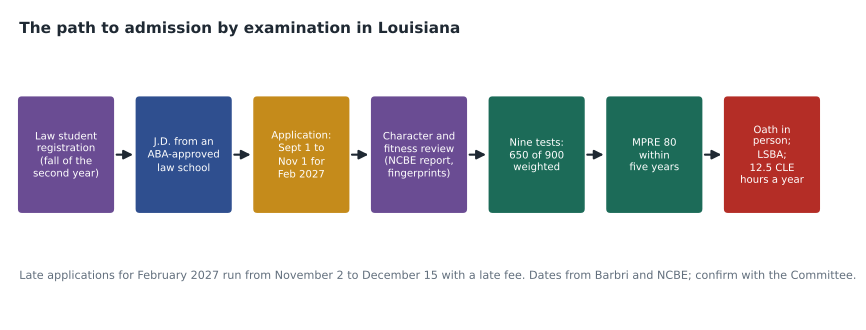
Part I of the examination is the nine-test Louisiana examination, which an applicant passes with a total weighted score of at least 650 out of a possible 900. Part II is the MPRE, with a scaled score of 80. An applicant who passes Part I has five years to complete the other requirements, and an MPRE score generally remains usable for five years, so the order in which you pass the two parts is flexible within those limits.
Applicants educated outside the United States are not shut out entirely, but there is no shortcut. NCBE's jurisdiction data and commercial guides describe a route for foreign-educated applicants that requires substantial study at an ABA-approved law school in addition to an equivalency showing. Graduates of law schools that are not ABA-approved should read Rule XVII closely and contact the Committee before planning around a Louisiana sitting.
The routes to practice
Louisiana offers one route to a full license and several limited permissions to practice.
| Route | Rule XVII section | Who uses it | Key limits |
|---|---|---|---|
| Admission by examination | Sections 3, 7 and 8 | Graduates of ABA-approved law schools | Pass Part I with 650 of 900 and the MPRE with 80; at most five failed attempts |
| Pro hac vice | Section 13 | Lawyers admitted elsewhere appearing in one Louisiana case | Association with Louisiana counsel; case by case |
| In-house counsel registration | Section 14 | Lawyers employed by a single organization | Advises only the employer; no court appearances on that basis |
| Military spouse admission | Section 15 | Lawyers married to service members stationed in Louisiana | Ends when the service member leaves or the conditions change |
| Admission on motion | Section 11 | Not available | Louisiana grants no reciprocity |
The usual order of events
For a law student planning ahead, the order of events runs roughly as follows. In the fall of the second year of law school, the student completes law student registration with the Committee, which starts the character and fitness file early. In the final year, the student takes the MPRE, often in the spring or summer. After graduation, or in the months before, the applicant files the bar examination application within the timely window and arranges for the dean's certificate. The Committee completes the character and fitness review while the applicant studies. The applicant sits the nine tests over three days, waits about two to three months for results, and if successful, takes the oath, joins the LSBA and begins practice.
Eddie has already done most of the early steps. He registered as a law student in his second year, filed his February application in October, and sat the MPRE in November. 'So what is left is the part I actually have to study for,' he said. 'And the character review, which I hope is quiet.' Marchetti laughed. 'Quiet is the goal. We will make sure it stays that way in Lesson 3.'
Worked problem
Mapping the remaining steps
Eddie graduated in May 2026 from an ABA-approved Louisiana law school, completed law student registration as a second-year student, filed a timely application for the February 2027 examination in October 2026 and sat the MPRE on November 13, 2026, with scores pending. What remains before he can practice?
Show solution
- Education: complete, subject to the dean's certificate reaching the Committee.
- Application: filed within the timely window for February 2027; he must answer any Committee requests and update his disclosures if anything changes.
- Character and fitness: under review; NCBE's character report and Louisiana's supplemental review must be finished before admission.
- MPRE: score pending. If he scores 80 or higher, Part II is satisfied. If not, he can retake the MPRE at a later administration without affecting his Part I result.
- Part I: the nine tests in February 2027, with a weighted score of at least 650 of 900.
- Admission: the oath, taken in person, followed by LSBA membership and the continuing legal education requirement.
Answer: Eddie still needs a passing MPRE score, a completed character and fitness review and a passing Part I score; after that come the oath, LSBA membership and CLE.
The civil law habit of mind
Marchetti ended the session with something Eddie had heard from his professors but had not thought about as an examination skill. 'In a common law state, a good bar essay often starts with the rule from a leading case. In Louisiana, the Code essays start with the article. The graders want to see that you go to the legislation first, read it as a coherent system, and treat court decisions as persuasive applications of the Code rather than as the source of the rule. You do not need article numbers for everything, but the important ones, such as article 2315 on fault or article 1967 on cause and detrimental reliance, show the grader that you think like a civilian.'
That habit matters well beyond the examination. When a client walks into a Lafayette firm with a boundary dispute, a contested succession or a lease gone sour, the first question is what the Code says, and the second is how the courts have applied it. Lesson 6 explains the sources of law in the Civil Code and why that order matters.
Planning around the calendar
The Louisiana examination is given twice a year, in February and July. Each sitting has its own timely and late filing windows, and the Committee publishes the dates for each administration. For the February 2027 examination, commercial guides and NCBE's jurisdiction data describe a timely window from September 1 to November 1, 2026 and a late window from November 2 to December 15, 2026, with a late fee. Requests for testing accommodations for a February sitting are due by November 1. Results for a February sitting usually arrive about eight to nine weeks after the examination; July results take longer, about ten to twelve weeks, because more applicants sit in the summer.
Eddie's February plan gives him about twelve weeks of focused study, a realistic amount for someone who took the civil law track and already knows the Code's structure. Lesson 12 lays out a week-by-week plan that weights the Code subjects in proportion to their share of the score.
Common mistakes
MistakeLouisiana gives the UBE with a Louisiana essay component.
InsteadLouisiana gives its own nine-test examination with no MBE, MEE, MPT or UBE score.
MistakeA lawyer with years of practice elsewhere can be admitted on motion.
InsteadLouisiana has no admission on motion; a full license requires passing the Louisiana examination.
MistakeBar association membership is optional after admission.
InsteadLouisiana has a mandatory unified bar; every practicing lawyer must belong to the LSBA.
MistakeNCBE writes and grades the Louisiana examination.
InsteadThe Committee on Bar Admissions writes the tests, and court-appointed graders grade them; NCBE runs the MPRE and prepares the character report.
MistakeThe MPRE must be passed before you can sit Part I.
InsteadThe parts can be passed in either order within the time limits; a passing Part I result remains usable for five years.
Summary and key terms
- The Louisiana Supreme Court controls admission through Rule XVII and admits applicants on the Committee on Bar Admissions' report.
- The Committee runs law student registration, applications, character and fitness, and writes and grades the nine-test examination.
- Part I is passed with 650 of 900 weighted points; Part II is the MPRE with a scaled score of 80.
- Louisiana has no UBE, no score transfer and no admission on motion; limited routes include pro hac vice, in-house registration and military spouse admission.
- Louisiana has a mandatory unified bar, the LSBA, which administers continuing legal education under Rule XXX.
- Committee on Bar Admissions
- The court-appointed body that registers law students, reviews applications and character, and writes and grades the Louisiana bar examination.
- Rule XVII
- The Louisiana Supreme Court rule governing admission to the bar, including requisites, the examination, scoring and fees.
- Code examinations
- The five Louisiana bar tests on Louisiana code subjects, each carrying twice the weight of a non-Code test.
- Unified bar
- A bar association to which every licensed lawyer in the state must belong; in Louisiana, the LSBA.
- Law student registration
- An early filing with the Committee, normally in the second year of law school, that begins the character and fitness file.
Lesson quiz · 5 questions
Score 60% or more to complete this lesson.
Create a free account to save your progress, take quizzes and earn a certificate.