
BAR-219 · Lesson 6 of 12 · 16 min
The civil law tradition and how the exam tests the Civil Code
▶ Video coming soon A video version of this lesson is on the way.
Eddie's sixth session started with a practice essay he had written the night before, on a dispute between neighbors over a drainage ditch. Marchetti read it twice and then pointed to the first paragraph. 'Everything you say is correct,' she said, 'but you start with a 1990s court of appeal case and get to the Code article in the third paragraph. Flip it. Start with the article, explain what it requires, and then use the case to show how courts apply it. That is not just style. It is how Louisiana law actually works, and the graders are reading for it.'
Eddie knew the theory from his first-year civil law courses. What he had not done was turn it into a habit under time pressure. This lesson covers the sources of law in the Civil Code, the rules of interpretation, the role of court decisions and scholarly writing, and the practical technique of writing a Code essay that reads like a Louisiana lawyer wrote it.
A brief history
Louisiana's private law grew from French and Spanish colonial law and the European codification movement. The territorial legislature adopted the Digest of the Civil Laws in 1808, drawing heavily on French sources, including drafts of the Code Napoléon, and on Spanish law. The Civil Code of 1825 replaced the Digest, and the Civil Code of 1870 revised it again after the Civil War. For most of the twentieth century the 1870 Code remained in force with amendments. Since the 1970s, the Louisiana State Law Institute, the state's official law revision body, has revised most of the Code title by title, with official revision comments explaining the sources and purpose of each article.
The result is a code that is old in structure and modern in much of its text. It is organized in a Preliminary Title and four books: Book I on persons, Book II on things and the different modifications of ownership, Book III on the different modes of acquiring the ownership of things, which includes successions, donations, matrimonial regimes, obligations and the special contracts, and Book IV on conflict of laws. Knowing where a topic sits in that structure helps candidates find the right articles quickly and see how rules relate to one another.
The sources of law
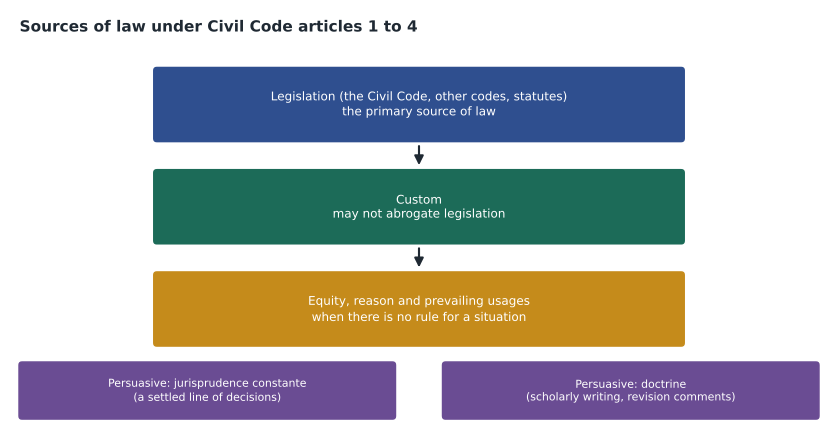
The Preliminary Title begins with a statement of the sources of law that every Louisiana lawyer can recite. Article 1 provides that the sources of law are legislation and custom. Article 2 describes legislation as a solemn expression of legislative will. Article 3 defines custom as practice repeated for a long time and generally accepted as having acquired the force of law, and adds that custom may not abrogate legislation. Article 4 tells the court what to do when no rule for a particular situation can be derived from legislation or custom: the court must proceed according to equity, and to decide equitably, resort is made to justice, reason and prevailing usages.
One thing is missing from that list: court decisions. In the civilian view, judges apply the law; they do not make it. Legislation is the primary source, custom is secondary and cannot override legislation, and equity fills gaps. Court decisions and scholarly writing are persuasive sources that help interpret the law but are not themselves law in the way legislation is.
Jurisprudence constante
Louisiana courts do pay close attention to prior decisions, and in practice they follow them most of the time. But the doctrine that governs is jurisprudence constante rather than stare decisis. Under stare decisis, a single decision of a higher court binds lower courts on the point decided. Under jurisprudence constante, a long line of consistent decisions on a point carries great persuasive weight, but no single decision is binding in the same way, and a court may depart from prior decisions it finds inconsistent with the legislation.
The practical picture is more nuanced. Louisiana courts of appeal follow the Louisiana Supreme Court's decisions, and trial courts follow their circuit's court of appeal, so lower courts treat higher court decisions as authoritative. In federal matters, federal decisions bind Louisiana courts as they bind every state. But in the Code subjects, a candidate who writes that a single decision establishes the rule, without starting from the Code, is describing the wrong system.
Doctrine and the revision comments
Doctrine means the writing of legal scholars: treatises, law review articles and commentary. In the civil law tradition, doctrine has a much larger role than in common law systems, because scholars organize and explain the codes as systems. Louisiana lawyers and courts cite the Louisiana Civil Law Treatise series, the work of professors at Louisiana law schools and, for historical questions, French and Spanish sources.
The revision comments deserve special mention. When the Law Institute revises a title, it publishes comments with each article explaining what the article changes, where it comes from and how it relates to other articles. The comments are not law, but courts rely on them heavily, and they are often the fastest way to understand what an article means. For candidates, the comments on key articles are worth reading because they explain the purpose behind rules that otherwise seem arbitrary.
Rules of interpretation
The Preliminary Title also contains rules for interpreting legislation, and they appear in essay answers whenever an article's meaning is in question. Article 9 provides that when a law is clear and unambiguous and its application does not lead to absurd consequences, the law shall be applied as written, and no further interpretation may be made in search of the intent of the legislature. Article 10 provides that when the language of the law is susceptible of different meanings, it must be interpreted as having the meaning that best conforms to the purpose of the law. Article 11 gives words their generally prevailing meaning, and technical words their technical meaning. Article 12 directs that ambiguous words be read in context and in light of the text as a whole. Article 13 provides that laws on the same subject matter must be interpreted in reference to each other.
Two further articles come up often. Article 6 governs the temporal effect of new legislation: in the absence of contrary legislative expression, substantive laws apply prospectively only, while procedural and interpretative laws apply both prospectively and retroactively. That rule matters for the recent torts reforms, several of which the legislature expressly made prospective. Article 7 provides that persons may not, by their juridical acts, derogate from laws enacted for the protection of the public interest, which explains why some contract clauses are null whatever the parties agree.
| Article | Rule | When it appears on the exam |
|---|---|---|
| 1 to 4 | Sources: legislation, custom, then equity | Questions on gaps or on the role of decisions |
| 6 | Substantive laws prospective; procedural and interpretative retroactive | Which version of a changed rule applies |
| 7 | No derogation from laws for the public interest | Clauses that try to waive mandatory rules |
| 9 | Clear law applied as written | An article whose text answers the question |
| 10 to 13 | Purpose, ordinary meaning, context, related laws | Ambiguous articles |
Reading the Code as a system
A civil code is designed to be read as a whole. General rules come first, and specific rules follow. The general rules of obligations apply to every contract unless a special rule for a particular contract, such as sale or lease, provides otherwise. Definitions in one article govern the meaning of terms in others. Candidates who learn the structure can often reason to the right answer even when they have forgotten a specific article, by asking which general rule applies and whether a special rule displaces it.
Eddie's drainage ditch essay is a good example. The dispute involved a servitude of drainage, which the Code treats as a natural servitude: the owner of a lower estate must receive the surface waters that flow naturally from a higher estate. That rule sits within the title on predial servitudes, which also contains general rules on the rights and duties of the dominant and servient estates. A strong answer starts from the specific article on natural drainage, notes the general limits that apply to servitudes, and only then turns to cases about how much alteration of natural flow the courts have allowed.
Worked problem
Rewriting a Code essay opening
Eddie's original first sentence was: "In a 1990s case, the court of appeal held that an upper landowner who deepened a ditch was liable for flooding the lower estate." How should he rewrite the opening of his answer?
Show solution
- Start with the rule in the Code: the owner of the lower estate is bound to receive the surface waters that flow naturally from the higher estate, and neither owner may do anything to make that servitude more burdensome.
- Identify the issue in the facts: whether deepening and redirecting the ditch made the servitude more burdensome for the lower owner.
- Apply the rule to the facts: the upper owner concentrated the flow and increased its volume at one point, which goes beyond natural drainage.
- Use decisions as support: courts applying the article have held upper owners liable for works that increase the burden on the lower estate.
- Conclude with the remedy: the lower owner may seek removal of the works and damages.
Answer: Lead with the article and its requirements, apply them to the facts and use cases as persuasive support; that order shows the grader civilian method.
How the Code tests are graded
The Committee's graders read answers looking for issue identification, accurate statement of the governing rule, application to the facts and a reasoned conclusion. In Code subjects, accurate rules mean the Code's rules, and graders give credit for citing the key articles correctly. Article numbers are not required for every point, and a correct rule stated without a number earns most of the credit. But a candidate who cites article 2315 for fault, article 1967 for cause and detrimental reliance, article 3473 for ten-year acquisitive prescription or article 1493 for forced heirs shows command of the system in a way graders notice.
Marchetti's advice is to memorize a manageable set of anchor articles for each Code test, perhaps fifteen to twenty-five for each, rather than trying to memorize hundreds. The anchors are the articles that state the central rules and that an answer is likely to need. Lessons 7 to 10 suggest anchor articles for each subject.
Common law habits to break
Candidates trained partly in common law subjects should watch for a few habits. The first is starting with cases rather than the Code. The second is using common law vocabulary, such as consideration, adverse possession, easement or will, where the Code uses cause, acquisitive prescription, servitude and testament. The third is assuming common law doctrines exist in Louisiana. The doctrine of consideration does not exist; a gratuitous promise can be enforceable if made in the proper form. The mailbox rule, the parol evidence rule and the statute of frauds have Louisiana analogs, but the Code's rules differ in content and in source. The fourth is ignoring the general part of the Code. Many Code essays turn on a general rule of obligations or property that a candidate thinking in common law categories would miss.
Why it matters after the exam
The habits that earn points on the Code tests are the habits of a good Louisiana lawyer. Louisiana judges expect briefs to start from the Code. Clients' problems often turn on articles that have no common law counterpart. And Louisiana lawyers regularly face questions that no decision has answered, where the only tools are the text, the structure of the Code, the revision comments and doctrine. A lawyer who has learned to reason from those sources is well equipped for a career of such questions.
Common mistakes
MistakeCourt decisions are a primary source of law in Louisiana.
InsteadUnder articles 1 to 4, the sources of law are legislation and custom; decisions are persuasive.
MistakeA single court of appeal decision binds every Louisiana court on the point.
InsteadLouisiana follows jurisprudence constante; consistent lines of decisions carry great weight, and lower courts follow their superior courts in practice.
MistakeCustom can override a Code article if it is old enough.
InsteadUnder article 3, custom may not abrogate legislation.
MistakeNew substantive legislation applies to past events.
InsteadUnder article 6, substantive laws apply prospectively only unless the legislature says otherwise.
MistakeRevision comments are binding law.
InsteadRevision comments are not law, but courts rely on them heavily to interpret the articles.
A daily drill for civilian method
Marchetti gave Eddie a drill to build the habit. Each morning, before any other study, Eddie picks one anchor article and writes a short paragraph in three parts: what the article says in his own words, where it sits in the Code and which general rule it refines or displaces, and one fact pattern where it would decide the outcome. The drill takes ten minutes. Over twelve weeks it covers more than eighty articles, and by the end Eddie can place almost any Code issue in its title and chapter without looking.
The second part of the drill matters most. Knowing that the rules on redhibition sit within the title on sale, and that they supplement the general rules of obligations on failure to perform, tells a candidate that a buyer of a defective thing may have both a redhibition claim and a general contract claim, and that the special rules on notice, prescription and the seller's good or bad faith govern the redhibition claim. Knowing that the surviving spouse's usufruct over community property sits within the rules of intestate succession, and that it ends on remarriage unless the deceased provided otherwise, keeps a candidate from treating it as a gift or a life estate.
Eddie added a twist of his own. Each Friday he rereads the week's five paragraphs and checks them against the revision comments. 'Half the time the comments tell me something I missed about why the article exists,' he said. 'That is usually the part a grader would reward.'
Summary and key terms
- Louisiana's Civil Code descends from the 1808 Digest and the 1825 and 1870 Codes and has been largely revised since the 1970s by the Law Institute.
- Articles 1 to 4 name legislation and custom as the sources of law, bar custom from abrogating legislation and send courts to equity when no rule applies.
- Jurisprudence constante and doctrine are persuasive sources; revision comments are a key aid to interpretation.
- Articles 9 to 13 govern interpretation, article 6 governs temporal effect and article 7 protects laws enacted for the public interest.
- A strong Code essay starts from the article, reads the Code as a system, applies the rule to the facts and uses decisions as support.
- Jurisprudence constante
- A settled line of consistent decisions that carries great persuasive weight in a civil law system.
- Doctrine
- Scholarly writing that explains and organizes the law, an important persuasive source in civil law systems.
- Revision comments
- The Law Institute's official explanations published with revised Civil Code articles.
- Preliminary Title
- The opening part of the Civil Code, containing the sources of law and the rules of interpretation.
- Anchor articles
- A small set of central Code articles a candidate memorizes for each Code test.
Lesson quiz · 5 questions
Score 60% or more to complete this lesson.
Create a free account to save your progress, take quizzes and earn a certificate.