
BAR-219 · Lesson 7 of 12 · 19 min
Obligations, contracts and property under the Civil Code
▶ Video coming soon A video version of this lesson is on the way.
For the seventh session, Marchetti sent Eddie a fact pattern the night before. A rice farmer near Crowley agreed by text message to sell his neighbor forty acres for a price the neighbor later learned was less than half the land's value. The neighbor had already moved a fence onto part of the land, and a third person had been grazing cattle on a strip along the bayou for twelve years under a deed from a cousin who never owned it. 'That is three tests' worth of issues in one paragraph,' Eddie said when he logged on. 'Form of a sale, lesion, and acquisitive prescription, plus whatever the fence does.'
'Exactly,' Marchetti said. 'Civil Code III and the property half of Civil Code I overlap constantly in real disputes, and the examiners like to combine them. Today we cover the general law of obligations and contracts, the special rules on sale and lease that come up most, and the core of property: things, ownership, possession, acquisitive prescription and servitudes. We will finish with your Crowley farmer.'
Obligations in general
Article 1756 defines an obligation as a legal relationship whereby a person, called the obligor, is bound to render a performance in favor of another, called the obligee. Performance may consist of giving, doing or not doing something. Obligations arise from contracts and other declarations of will, and they also arise directly from the law, as with delictual obligations under article 2315, obligations from management of the affairs of another and enrichment without cause.
The general rules of obligations apply to every contract unless a special rule displaces them. That structure is the key to Civil Code III. A question about a defective tractor sold by a dealer involves the special rules on sale and redhibition, but the general rules on consent, interpretation, damages and dissolution still apply where the special rules are silent.
Formation of contracts
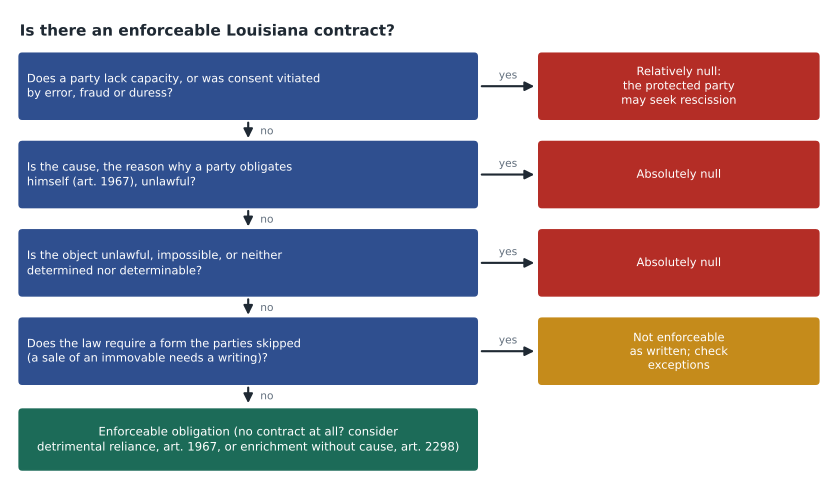
Article 1906 defines a contract as an agreement by two or more parties whereby obligations are created, modified or extinguished. A valid contract requires capacity, consent, a lawful cause and a lawful object, and in some cases a required form.
Capacity is the rule: under article 1918, all persons have capacity to contract except unemancipated minors, interdicts and persons deprived of reason at the time of contracting. Contracts made by persons without capacity are relatively null, which means the protected party may seek to annul them.
Consent is established through offer and acceptance under article 1927, and it may be given orally, in writing or by action or inaction that under the circumstances clearly indicates consent, unless the law prescribes a form. Consent may be vitiated by error, fraud or duress under article 1948. Error vitiates consent only when it concerns a cause without which the obligation would not have been incurred and that cause was known or should have been known to the other party, under article 1949. Fraud is a misrepresentation or suppression of the truth made with the intention of obtaining an unjust advantage for one party or causing a loss or inconvenience to the other, under article 1953. Duress is pressure of such a nature as to cause a reasonable fear of unjust and considerable injury to a party's person, property or reputation, under article 1959.
Cause and detrimental reliance
Cause is the concept that most clearly separates Louisiana contract law from the common law. Article 1966 provides that an obligation cannot exist without a lawful cause, and article 1967 defines cause as the reason why a party obligates himself. Cause is not consideration. A party may obligate himself for a gratuitous reason, such as generosity, and the obligation can be enforceable if made in the form the law requires; a donation inter vivos, for example, generally requires an authentic act.
Article 1967 also contains Louisiana's rule on detrimental reliance. A party may be obligated by a promise when he knew or should have known that the promise would induce the other party to rely on it to his detriment and the other party was reasonable in so relying. Recovery may be limited to the expenses incurred or the damages suffered as a result of the promisee's reliance. Reliance on a gratuitous promise made without required formalities is not reasonable. Courts have generally required a representation by conduct or word, justifiable reliance and a change in position to one's detriment because of the reliance.
Article 1971 completes the picture: parties are free to contract for any object that is lawful, possible and determined or determinable.
Nullity
The Code distinguishes absolute and relative nullity. Under article 2030, a contract is absolutely null when it violates a rule of public order, as when the object is illicit or immoral; an absolutely null contract cannot be confirmed, and any party or the court on its own motion may invoke the nullity. Under article 2031, a contract is relatively null when it violates a rule intended to protect private parties, as when a party lacked capacity or did not give free consent; only those persons for whose interest the ground was established may seek the nullity, and the contract may be confirmed. An action to annul a relatively null contract must be brought within five years from the time the ground for nullity ceased or was discovered. A null contract is deemed never to have existed, and the parties are restored to the situation before the contract was made.
Effects, interpretation and damages
Article 1983 states that contracts have the effect of law for the parties and must be performed in good faith. Interpretation seeks the common intent of the parties under article 2045, and when the words are clear and explicit and lead to no absurd consequences, no further interpretation may be made under article 2046. A provision in a standard-form contract that is susceptible of different meanings is interpreted against the party who furnished its text, and in case of doubt that cannot be otherwise resolved, a provision is interpreted against the obligee and in favor of the obligor.
An obligor is liable for the damages caused by his failure to perform under article 1994. An obligor in good faith is liable only for the damages that were foreseeable at the time the contract was made, under article 1996. An obligor in bad faith is liable for all the damages, foreseeable or not, that are a direct consequence of his failure to perform, under article 1997. Damages for nonpecuniary loss may be recovered when the contract, because of its nature, is intended to gratify a nonpecuniary interest and the obligor knew or should have known that his failure to perform would cause that kind of loss, under article 1998. When the obligation is to pay money, damages for delay are measured by interest from the time it is due.
Sale
A sale is a contract whereby a person transfers ownership of a thing to another for a price in money, under article 2439. Ownership is transferred between the parties as soon as there is agreement on the thing and the price, even before delivery or payment, under article 2456. The sale of an immovable must be made by authentic act or by act under private signature, under article 2440, and a sale of an immovable affects third persons only when filed for registry in the conveyance records of the parish where the immovable is located. Louisiana's electronic signature law can satisfy the writing requirement in some settings, and examiners like to ask whether an exchange of messages amounts to an act under private signature, so candidates should be ready to analyze the form requirement rather than assume it is met or missed.
The seller is bound to deliver the thing and to warrant the buyer's peaceful possession, or warranty against eviction, and the absence of hidden defects, or warranty against redhibitory defects, under article 2475. Under article 2520, a defect is redhibitory when it renders the thing useless or its use so inconvenient that the buyer would not have bought it had he known of the defect, which supports rescission, or when, without rendering the thing totally useless, it diminishes its usefulness or value so that the buyer would still have bought it but for a lesser price, which supports a reduction of the price. A seller who knew of the defect and failed to declare it is in bad faith and is liable for damages and attorney fees as well as return of the price.
Lesion is a remedy unique among American jurisdictions. Under article 2589, the sale of an immovable may be rescinded for lesion when the price is less than one half of the fair market value of the immovable at the time of the sale. The remedy is available to the seller, not the buyer, and does not apply to sales of movables. The buyer may avoid rescission by paying the supplement to the just price, less a deduction set by the Code. An action for lesion must be brought within the period the Code sets, and a buyer who has resold the immovable may face different rules.
Lease and mandate
Lease is a synallagmatic contract by which one party, the lessor, binds himself to give the other party, the lessee, the use and enjoyment of a thing for a term in exchange for a rent that the lessee binds himself to pay, under article 2668. The lessor must deliver the thing in good condition, maintain it in a condition suitable for its purpose and warrant the lessee's peaceful possession. The lessor also warrants the thing against vices or defects that prevent its use, and the lessee must pay rent, use the thing as a prudent administrator and return it in the condition it was received, except for normal wear and tear.
Mandate is a contract by which a person, the principal, confers authority on another person, the mandatary, to transact one or more affairs for the principal, under article 2989. A mandate to execute an act for which the law requires a certain form must be in that form; a mandate to sell an immovable, for example, must be in writing.
Property: things and ownership
Article 448 divides things into common, public and private things, into corporeals and incorporeals, and into movables and immovables. Tracts of land, with their component parts, are immovables. Buildings, other constructions permanently attached to the ground, standing timber and unharvested crops are component parts of a tract of land when they belong to the owner of the ground. When they belong to someone else, as with a building on leased land, a building or standing timber may be a separate immovable.
Ownership is the right that confers on a person direct, immediate and exclusive authority over a thing, under article 477. The owner may use, enjoy and dispose of the thing within the limits and under the conditions established by law. When two or more persons own a thing in indivision, each co-owner's share is called an undivided share, and no one may be compelled to hold a thing in indivision with another unless otherwise provided by law or juridical act; any co-owner may demand partition.
Possession and acquisitive prescription
Possession is the detention or enjoyment of a corporeal thing, movable or immovable, that one holds or exercises by himself or by another who keeps or exercises it in his name. A possessor who has possessed for more than a year acquires the right to possess and may bring the possessory action under the Code of Civil Procedure within a year of a disturbance. A person claiming ownership against a possessor brings the petitory action and bears the burden of proving ownership.
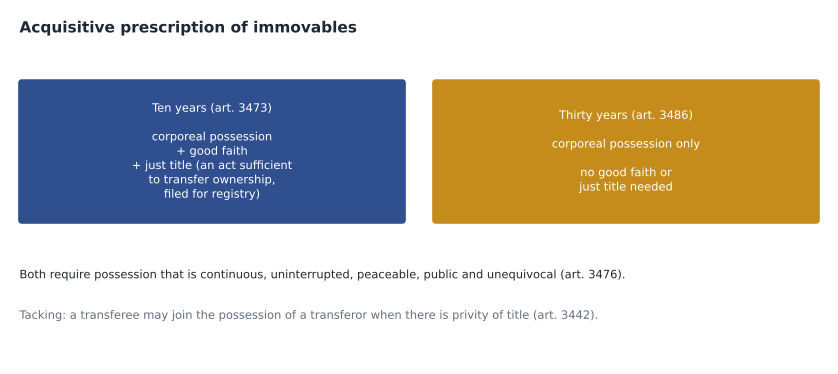
Acquisitive prescription is the mode of acquiring ownership by possession for a period of time. For immovables, the Code provides two periods. Under article 3473, ownership of an immovable is acquired by acquisitive prescription of ten years when the possessor has good faith and just title. Good faith means the possessor reasonably believes, in light of objective considerations, that he is owner of the thing he possesses; good faith is presumed. Just title is a juridical act, such as a sale, exchange or donation, sufficient to transfer ownership, written, valid in form and filed for registry in the conveyance records of the parish where the immovable is situated. A deed from someone who did not own the land can be just title, because the point of ten-year prescription is to cure exactly that defect.
Under article 3486, ownership of an immovable is acquired by acquisitive prescription of thirty years without the need of just title or good faith. In both cases, the possession must be continuous, uninterrupted, peaceable, public and unequivocal, under article 3476. A possessor may tack on the possession of his ancestor in title when there is privity of title between them, under article 3442.
Servitudes
A servitude is a charge on property for the benefit of a person or another property. Personal servitudes, such as usufruct, habitation and rights of use, benefit a person. A predial servitude, under article 646, is a charge on a servient estate for the benefit of a dominant estate; the two estates must belong to different owners. Predial servitudes are natural, such as the servitude of drainage, legal, such as the right of passage of an enclosed estate, or voluntary, created by title, by destination of the owner or, for apparent servitudes, by acquisitive prescription. Nonapparent servitudes may be acquired only by title. A predial servitude is extinguished by nonuse for ten years.
The owner of an estate that has no access to a public road is entitled to a right of passage over neighboring property to the nearest public road, subject to payment of an indemnity for the damage he may occasion. If the enclosed estate was created by a voluntary act, such as a partition or sale, the owner of the land that was alienated or partitioned must give passage to the enclosed estate without indemnity, even if it is not the shortest route.
Worked problem
The Crowley farmer
A farmer agrees by text message to sell forty acres to his neighbor for a price less than half its fair market value. Before any formal act, the neighbor moves a fence onto part of the land. A third person has openly grazed cattle on a strip along the bayou for twelve years under a recorded deed from a cousin who never owned it, believing the deed was good. What are the main issues?
Show solution
- Form of the sale: a sale of an immovable requires an authentic act or an act under private signature under article 2440; whether the text messages satisfy that requirement depends on the electronic signature rules and the content of the messages, and the answer should analyze both.
- Lesion: if a valid sale exists, the farmer as seller may seek rescission under article 2589 because the price is less than half the fair market value; the buyer may keep the land by paying the supplement to the just price.
- The fence: the neighbor has no ownership without a valid sale; his act may disturb the farmer's possession, and the farmer may bring the possessory action within a year of the disturbance.
- The grazing strip: the third person has possessed for twelve years with a recorded deed, which is just title, and good faith, which is presumed; if the possession was continuous, uninterrupted, peaceable, public and unequivocal, he acquired ownership by ten-year prescription under article 3473.
- Effect on the sale: the farmer cannot sell what he no longer owns, so the strip is outside any sale, and a buyer would have a warranty claim if the sale purported to include it.
Answer: The sale's form is the threshold question, lesion protects the farmer if a sale exists, the fence triggers possessory remedies, and the strip likely belongs to the grazier by ten-year acquisitive prescription.
Common mistakes
MistakeA contract requires consideration.
InsteadLouisiana requires a lawful cause, the reason why a party obligates himself; gratuitous obligations can be valid in proper form.
MistakeA buyer can rescind a sale for lesion.
InsteadLesion beyond moiety protects the seller of an immovable sold for less than half its fair market value.
MistakeOwnership passes only on delivery or payment.
InsteadBetween the parties, ownership passes on agreement on the thing and the price under article 2456.
MistakeA deed from a non-owner can never support ten-year prescription.
InsteadA recorded act from a non-owner can be just title; ten-year prescription cures that defect if the possessor is in good faith.
MistakeAny servitude can be acquired by prescription.
InsteadOnly apparent servitudes can be acquired by acquisitive prescription; nonapparent servitudes require title.
Summary and key terms
- An obligation is a legal relationship binding an obligor to render a performance; general rules apply to every contract unless a special rule displaces them.
- A contract needs capacity, consent free of error, fraud and duress, a lawful cause, a lawful and determinable object and any required form; detrimental reliance is in article 1967.
- Absolute nullity protects public order and cannot be confirmed; relative nullity protects private parties and can be confirmed.
- A sale of an immovable needs an authentic act or an act under private signature; sellers warrant against eviction and redhibitory defects, and lesion protects sellers of immovables.
- Ownership of an immovable is acquired by ten years' possession with good faith and just title, or thirty years' possession without them; apparent predial servitudes can be acquired by prescription.
- Cause
- The reason why a party obligates himself, required for every obligation under articles 1966 and 1967.
- Redhibition
- The buyer's remedy for a hidden defect that renders a thing useless or diminishes its value.
- Lesion beyond moiety
- The seller's right to rescind the sale of an immovable sold for less than half its fair market value.
- Just title
- A written juridical act sufficient to transfer ownership, valid in form and filed for registry.
- Predial servitude
- A charge on a servient estate for the benefit of a dominant estate belonging to a different owner.
Lesson quiz · 5 questions
Score 60% or more to complete this lesson.
Create a free account to save your progress, take quizzes and earn a certificate.