
BAR-218 · Lesson 8 of 12 · 20 min
Kentucky torts: pure comparative fault, the one-year limitation period and jural rights
▶ Video coming soon A video version of this lesson is on the way.
Most of the files that crossed Sadie's desk as a clerk were tort cases: car wrecks on Interstate 65, falls in parking lots, a dog bite, a dispute over a medical procedure. Her bar review outline covered the same subjects in general terms, and on most points the outline and the files agreed. On three points they did not, and those three points shape almost every Kentucky injury case. Kentucky uses pure comparative fault. Its general limitation period for personal injury is one year. And its constitution forbids the General Assembly to cap damages for injury or death. This lesson takes each in turn and then looks at how they combine in practice.
Pure comparative fault
Kentucky abandoned contributory negligence in Hilen v. Hays, decided by the Kentucky Supreme Court in 1984. Under the old rule, a plaintiff whose own negligence contributed to the injury could recover nothing. Hilen replaced that rule with pure comparative fault: the plaintiff's recovery is reduced in proportion to the plaintiff's share of fault, but is not barred, however large that share.
The General Assembly later codified apportionment of fault in KRS 411.182. In a tort action involving the fault of more than one party, the jury is instructed to find each party's total damages and to assign each party a share of fault. The court then enters judgment against each liable party according to that party's share.
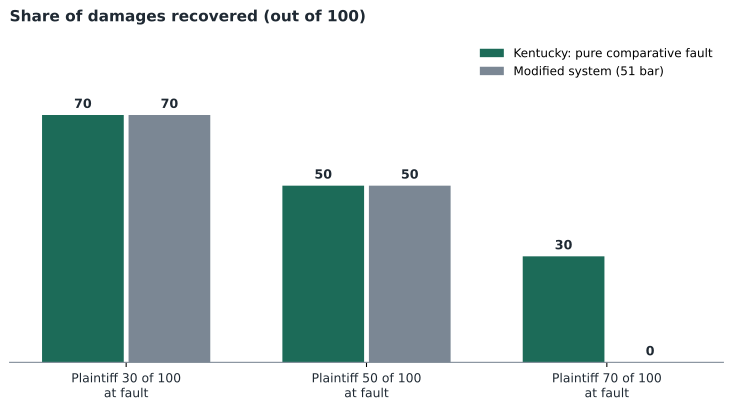
Pure comparative fault differs from the modified systems used in many states. Under a modified system, a plaintiff who is as much at fault as the defendants, or more, recovers nothing. Under Kentucky's pure system, a plaintiff found 70 parts in 100 at fault still recovers 30 parts in 100 of the damages.
Several liability and the empty chair
Apportionment has a second consequence that surprises lawyers trained on joint and several liability. Because KRS 411.182 directs judgment against each party according to its share of fault, liability in Kentucky tort cases is generally several rather than joint. A plaintiff who settles with one defendant or cannot collect from another may not shift that share to the remaining defendants.
Fault may be apportioned to parties who have settled, and in some circumstances to others who were part of the case. Defense lawyers therefore pay close attention to who is in the case and who has been released, and plaintiff's lawyers think hard about whom to sue and when to settle. The details of who may appear on the verdict form have been the subject of repeated litigation, so the current case law should be checked on any apportionment question.
The one-year limitation period
KRS 413.140 provides that an action for an injury to the person must be commenced within one year after the cause of action accrues. One year is short by national standards, and it catches lawyers who move to Kentucky from states with two- or three-year periods.
There are important variations. In medical malpractice cases, the statute provides that the action accrues when the injury is first discovered or in the exercise of reasonable care should have been discovered, which builds a discovery rule into the statute. Claims arising from motor vehicle accidents covered by the Kentucky Motor Vehicle Reparations Act follow that act's own limitation provision, which is generally two years from the injury or from the last payment of basic reparation benefits. Property damage, contract claims and other claims have their own periods. The one-year rule is the default, not the only rule.
A new lawyer's first duty on any injury matter is to identify the applicable limitation period and calendar it. Sadie's firm has a rule that no injury file is opened without a written limitation date, checked by a second lawyer.
| Claim | General period | Source |
|---|---|---|
| Personal injury, general rule | One year from accrual | KRS 413.140 |
| Medical malpractice | One year, accruing at discovery | KRS 413.140 |
| Motor vehicle injury under the reparations act | Generally two years from injury or last basic reparation payment | Motor Vehicle Reparations Act |
Jural rights and the ban on damages caps
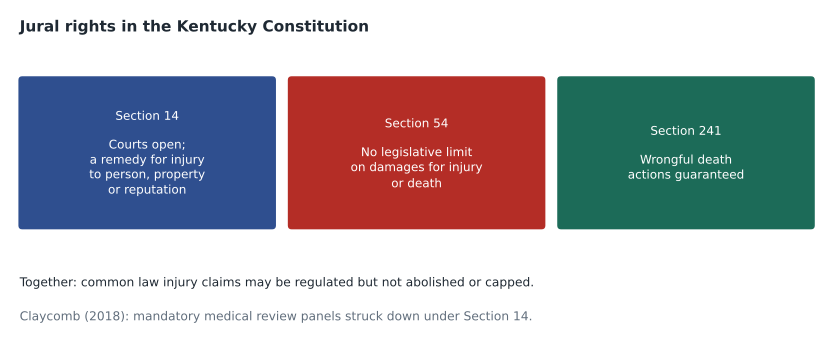
Three sections of the Kentucky Constitution protect the right to sue for injury. Section 14 provides that courts shall be open and that every person shall have a remedy for an injury done to person, property or reputation. Section 54 provides that the General Assembly shall have no power to limit the amount to be recovered for injuries resulting in death or for injuries to person or property. Section 241 provides for wrongful death actions.
Kentucky courts read these sections together as protecting jural rights, meaning common law causes of action that existed when the constitution was adopted. The legislature may regulate those actions in many ways, but it may not abolish them or cap the damages recoverable for them. Section 54 is the reason Kentucky has no statutory cap on damages in ordinary personal injury or medical malpractice cases, unlike many states.
The jural rights doctrine also limits procedural barriers. In 2017 the General Assembly created medical review panels that were required to review medical malpractice claims before suit. In Commonwealth, Cabinet for Health and Family Services ex rel. Meier v. Claycomb, decided in November 2018, the Kentucky Supreme Court held that the panel requirement violated Section 14 because it delayed access to the courts.
Punitive damages
Kentucky allows punitive damages under KRS 411.184 and KRS 411.186. The plaintiff must prove by clear and convincing evidence that the defendant acted with oppression, fraud or malice. The statute's definitions have been narrowed by later case law, and the jury instructions on punitive damages should be drafted with the current cases in hand.
Worked problem
How much does Ms. Ray recover?
Ms. Ray, a pedestrian, was struck by a car while crossing outside a crosswalk in Bowling Green. The jury finds her damages are 200,000 dollars and assigns fault as follows: Ms. Ray 60 parts, the driver 40 parts, out of 100. Suit was filed eleven months after the accident.
Show solution
- The suit was filed within one year, but because this is a motor vehicle case the reparations act's limitation provision may apply in any event.
- Under pure comparative fault, Ms. Ray's recovery is reduced by her share of fault but not barred.
- Her share is 60 of 100, so she recovers 40 of 100 of her damages.
- Forty hundredths of 200,000 dollars is 80,000 dollars.
- Under a modified system she would recover nothing, because her fault exceeds the driver's.
Answer: Ms. Ray recovers 80,000 dollars under Kentucky's pure comparative fault rule.
Common mistakes
MistakeBarring a plaintiff who is mostly at fault.
InsteadKentucky uses pure comparative fault; the plaintiff recovers a reduced amount.
MistakeAssuming joint and several liability.
InsteadKRS 411.182 apportions liability by each party's share of fault.
MistakeApplying a two-year period to a personal injury claim.
InsteadThe general rule in KRS 413.140 is one year.
MistakeAssuming a statutory cap on malpractice damages.
InsteadSection 54 of the Kentucky Constitution forbids the legislature to limit damages for injury or death.
MistakeTreating every injury claim the same.
InsteadMotor vehicle claims and malpractice claims have their own limitation rules.
Practice problems
Work each problem on paper first, then reveal the answer to check.
Which case adopted pure comparative fault in Kentucky?
Show answer
Hilen v. Hays (Ky. 1984).
What is the general limitation period for personal injury in Kentucky?
Show answer
One year under KRS 413.140.
Which section of the Kentucky Constitution bars limits on damages for injury or death?
Show answer
Section 54.
Why were medical review panels struck down in 2018?
Show answer
Because they delayed access to courts in violation of Section 14.
What standard of proof applies to punitive damages?
Show answer
Clear and convincing evidence of oppression, fraud or malice.
Open and obvious hazards
Premises cases make up a large share of Kentucky tort practice, and Kentucky's treatment of open and obvious hazards follows from its commitment to comparative fault. Under the traditional rule, a landowner owed no duty to warn of a danger that was open and obvious to the invitee, so the claim failed at the duty stage. In a pair of decisions, Kentucky River Medical Center v. McIntosh in 2010 and Shelton v. Kentucky Easter Seals Society in 2013, the Kentucky Supreme Court moved away from treating obviousness as an automatic bar. The obviousness of a hazard now usually bears on whether the landowner acted reasonably and on the plaintiff's own share of fault, questions that typically go to the jury.
For new lawyers, the practical result is that a premises defendant's summary judgment motion on an obvious hazard is harder to win than the bar exam's general rule would suggest. Combined with the Steelvest standard discussed in Lesson 7, many premises cases in Kentucky are decided by juries rather than by motion.
Motor vehicle claims and the reparations act
Kentucky's Motor Vehicle Reparations Act is a no-fault system with an important exception: Kentucky allows motorists to reject the tort limitations of the act by filing a written rejection. For those who have not rejected them, the act provides basic reparation benefits for economic loss regardless of fault and limits tort claims for noneconomic damages unless the injury meets a statutory threshold, such as medical expenses above a set amount or certain serious injuries. A new lawyer handling a car wreck case should check early whether any party rejected the limitations, whether the threshold is met, and which limitation period applies.
Wrongful death and consortium
Section 241 of the Kentucky Constitution guarantees a wrongful death action, and KRS 411.130 provides that the action is brought by the personal representative of the deceased. The statute directs how any recovery is distributed among the family. Kentucky also recognizes loss of consortium claims: a spouse's claim is provided by statute, and the Kentucky Supreme Court has recognized claims by minor children for the loss of a parent's consortium. These claims have their own procedural wrinkles, including who must be joined and when.
Dog bites
Kentucky's dog statute imposes liability on the owner of a dog for damage the dog causes to a person or property, which Kentucky courts treat as a form of strict liability. Ownership is defined broadly enough to reach some people who harbor or keep a dog on their property. That makes dog cases different from the common law rule the bar exam tests, under which liability for domestic animals generally depends on knowledge of the animal's dangerous propensities.
Workers' compensation
When an employee is injured at work, Kentucky's workers' compensation statute generally provides the exclusive remedy against the employer, so the employee cannot also sue the employer in tort. There are exceptions, including one for deliberate intention to injure, and the employee may still sue third parties, such as the manufacturer of a defective machine. Fault apportionment and the employer's subrogation rights then interact in ways that call for careful analysis.
Tolling and the minor plaintiff
The one-year period does not always run from the day of injury. Kentucky's limitation statutes include provisions that suspend the running of the period for certain plaintiffs, most commonly a plaintiff who was a minor when the cause of action accrued; KRS 413.170 generally allows such a plaintiff to bring the action within the usual period after reaching the age of majority. Other provisions address a defendant's absence from the state or conduct that obstructs the bringing of the action. Each has conditions, and each has been interpreted by the courts.
These rules cut both ways for a new lawyer. A claim that looks barred may be timely because of a tolling provision, so an injury file should never be turned away on the calendar alone. But a lawyer should never rely on tolling without reading the statute and the cases, because a plaintiff who guesses wrong loses the claim entirely. Sadie's firm treats tolling as a reason to look harder, not as a reason to wait: when a claim depends on tolling, the firm files as early as it reasonably can.
Putting the pieces together
Marchetti closes the torts session with a checklist. For any Kentucky injury case, ask: What is the limitation period, and when does it run? Who was at fault, and in what shares? Has every potentially liable party been identified, given that liability is several? Does any statute, such as the reparations act or the workers' compensation act, change the remedy? And does any statute purport to limit damages or access to court in a way that raises a jural rights question? A lawyer who answers those five questions at the start of a case avoids most of the errors that cost Kentucky clients their claims.
Summary and key terms
- Hilen v. Hays (1984) adopted pure comparative fault, and KRS 411.182 apportions fault among parties.
- Liability is generally several, according to each party's share of fault.
- KRS 413.140 sets a one-year period for most personal injury claims, with special rules for malpractice and motor vehicle claims.
- Sections 14, 54 and 241 of the Kentucky Constitution protect jural rights and bar damages caps.
- Claycomb (2018) struck down mandatory medical review panels under Section 14.
- Pure comparative fault
- A system in which a plaintiff's recovery is reduced by the plaintiff's share of fault but never barred.
- Apportionment
- The jury's assignment of shares of fault among the parties under KRS 411.182.
- Jural rights
- Common law causes of action protected by the Kentucky Constitution from abolition or damages limits.
- Several liability
- Liability limited to a party's own share of the damages.
Lesson quiz · 5 questions
Score 60% or more to complete this lesson.
Create a free account to save your progress, take quizzes and earn a certificate.