
BAR-218 · Lesson 1 of 12 · 17 min
Becoming a lawyer in Kentucky
▶ Video coming soon A video version of this lesson is on the way.
Sadie Mattingly joined Hollis Marchetti's Tuesday study group in September 2026 with a plan that sounded simple: pass the Kentucky bar exam in February 2027 and start full-time at the small Bowling Green firm where she has clerked since her second year of law school. Within ten minutes of her first call, Marchetti had added three complications. February 2027 is the last time Kentucky will give the exam Sadie has been preparing for. Kentucky asks new lawyers to complete an online course on Kentucky law that the national exam does not test. And the Kentucky Bar Association will expect her to complete a New Lawyer Program within a year of admission. 'None of that is hard,' Marchetti said. 'It just has to be on the calendar.'
This course walks through the whole path to a Kentucky law license, from eligibility to the first year of practice, and then through the Kentucky law a new lawyer meets most often. This first lesson maps the institutions and the steps. Later lessons fill in the details.
Who admits lawyers in Kentucky
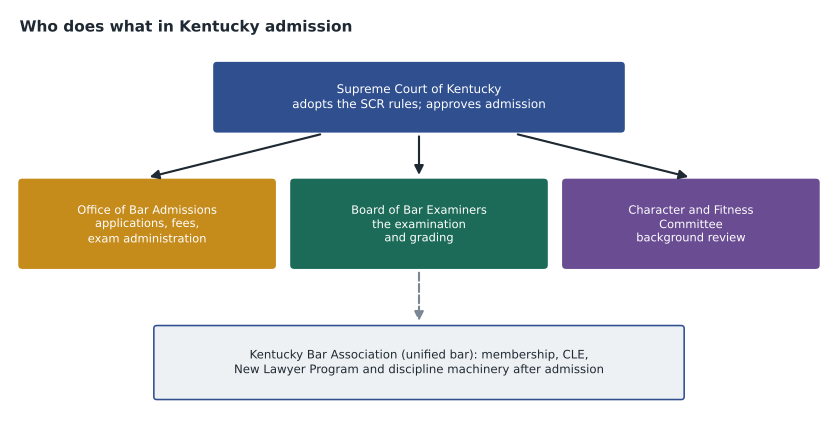
Admission to the practice of law in Kentucky belongs to the Supreme Court of Kentucky. The Kentucky Constitution gives the Supreme Court authority over the admission and discipline of lawyers, and the court exercises it through its rules, the Rules of the Supreme Court, cited as SCR. Part II of those rules, the SCR 2 series, governs admission. Part III, the SCR 3 series, governs the Kentucky Bar Association, discipline, continuing legal education and the Kentucky Rules of Professional Conduct, which appear as SCR 3.130.
The court does not run the process day to day. It delegates the work to the Kentucky Office of Bar Admissions, which receives applications, collects fees and administers the exam. Two bodies sit within that structure. The Board of Bar Examiners is responsible for the examination itself. The Character and Fitness Committee investigates applicants' backgrounds and decides whether each applicant has shown the good moral character and fitness the rules require. When the board and committee have done their work, the Supreme Court approves admission, and the new lawyer takes the oath.
The Kentucky Bar Association is a separate body. It is a unified, or integrated, bar: every lawyer licensed in Kentucky must be a member. The association does not decide who is admitted, but it runs much of what happens after admission, including continuing legal education reporting, the New Lawyer Program and the machinery of attorney discipline under the court's supervision.
The routes to admission
Kentucky's rules describe several routes to a license. Order 2025-43, entered October 31, 2025, reorganized the baseline requirements in SCR 2.010 so that one rule lists what every route shares, with the details for each route in the rules that follow. The routes that matter for most readers of this course are these.
Admission by examination is the ordinary route for new graduates. The applicant meets the education requirements, passes the MPRE, passes the Kentucky bar exam, satisfies the Character and Fitness Committee and completes the remaining requirements for admission.
Admission by transferred score lets a candidate who earned a qualifying Uniform Bar Examination score in another jurisdiction apply in Kentucky without sitting again, within limits on the age of the score and the number of attempts used to earn it.
Admission without examination is for experienced lawyers. Under SCR 2.110, a lawyer admitted elsewhere who has actively practiced for five of the seven years before applying, in a jurisdiction that offers reciprocity or comity to Kentucky lawyers, may apply without taking the exam.
Kentucky also has limited routes for particular situations, such as limited certificates for in-house counsel and for lawyers working in defender or legal services programs, and, since Order 2025-43, provisional admission for the dependent spouses of active-duty service members stationed in Kentucky under new SCR 2.113. Lesson 11 covers the transfer and motion routes in more detail.
| Route | Who it is for | Key requirement |
|---|---|---|
| Examination | New graduates and others who sit in Kentucky | Passing score on the Kentucky exam, the MPRE and character and fitness |
| Transferred UBE score | Candidates who passed the UBE elsewhere | Qualifying score earned within five years and in five or fewer attempts |
| Without examination (SCR 2.110) | Experienced lawyers admitted elsewhere | Active practice in five of the past seven years in a reciprocal jurisdiction |
| Military spouse (SCR 2.113) | Dependent spouses of service members stationed in Kentucky | Provisional admission, renewed each year |
The steps in order
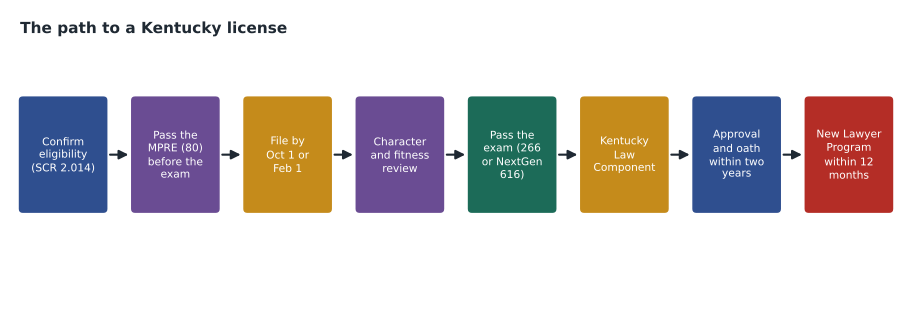
For a candidate taking the exam, the steps fall into a predictable sequence. Marchetti had Sadie write them on a single page and tape it above her desk.
First, confirm eligibility. Kentucky requires a law degree from a law school approved by the American Bar Association or the Association of American Law Schools, with narrow exceptions for experienced graduates of other schools and for foreign-educated lawyers. Lesson 2 explains them.
Second, pass the MPRE. Kentucky requires a scaled score of at least 80, and under SCR 2.015 the MPRE must be passed before the candidate sits for the bar exam, not merely before admission. That timing surprises candidates from jurisdictions that let the MPRE come afterward. Lesson 3 covers it.
Third, file the application by the deadline. Under SCR 2.022 the deadline is October 1 for the February exam and February 1 for the July exam, and an application may not be filed more than 90 days before the deadline. Kentucky has also published late filing periods with additional fees; the Office of Bar Admissions sets those each cycle.
Fourth, go through character and fitness review, which begins when the application is filed and continues until admission.
Fifth, sit for and pass the bar exam. Kentucky gives the Uniform Bar Examination through February 2027 and switches to the NextGen bar exam in July 2027. Lessons 4 and 5 cover both.
Sixth, complete the Kentucky Law Component, an online course on Kentucky law, before admission. Lesson 6 explains it.
Seventh, receive the Supreme Court's approval and take the oath. Under SCR 2.085, admission must occur within two years after the court approves it, or the applicant must start over.
Finally, after admission, register with the Kentucky Bar Association, complete the New Lawyer Program within 12 months under SCR 3.640, and meet the annual continuing legal education requirement.
Sadie's timeline
Sadie took the MPRE in March of her third year and scored 94, comfortably above Kentucky's 80. She filed her application for the February 2027 exam in early September, inside the 90-day window that opens before the October 1 deadline. Her character and fitness review was under way by October. She will sit for the exam in late February 2027, which makes her part of the last group of Kentucky candidates to take the legacy UBE. If she passes, she will complete the Kentucky Law Component in the spring and expects to be sworn in after results are released.
Marchetti pointed out what Sadie's timeline leaves no room for. If Sadie does not pass in February, her next chance in Kentucky will be the NextGen exam in July 2027, with different question formats and a different scoring scale. 'That doesn't mean you should panic,' Marchetti said. 'It means you should take February seriously enough that you don't need July.' Lesson 5 discusses how candidates near a format change should plan.
What Kentucky law will matter
The Kentucky bar exam itself is a national exam, so Kentucky law is not tested on it directly. But Kentucky law matters in three ways. It is the subject of the Kentucky Law Component. It is the law a new Kentucky lawyer must actually practice, and it differs from the general rules the UBE tests in places that trap the unwary. And it explains why the state's lawyers think about certain problems the way they do.
The differences that come up again and again in Kentucky practice are concentrated in a few areas, and the second half of this course is organized around them.
Kentucky courts and civil procedure. Kentucky has a four-level court system with a family court division in many circuits, and its own Rules of Civil Procedure, which resemble the federal rules but differ in important details. Lesson 7.
Torts. Kentucky adopted pure comparative fault by court decision in 1984, imposes a one-year limitation period on most personal injury actions, and has a constitution that forbids the legislature to limit damages for injury or death. Lesson 8.
Family law, wills and estates. Kentucky is widely described as the first state to adopt a rebuttable presumption of joint custody and equal parenting time, keeps statutory dower and curtesy, and allows handwritten wills. Lesson 9.
Government claims, criminal law and professional conduct. Negligence claims against the Commonwealth go to the Board of Claims, with dollar caps. Kentucky's Rules of Professional Conduct follow the ABA Model Rules in most places but not all. Lesson 10.
Common mistakes
MistakeAssuming the Kentucky Bar Association admits lawyers.
InsteadThe Supreme Court of Kentucky admits lawyers; the Office of Bar Admissions and its board and committee do the work; the KBA is the mandatory bar association after admission.
MistakePlanning to take the MPRE after the bar exam.
InsteadIn Kentucky the MPRE must be passed before sitting for the bar exam.
MistakeTreating admission as automatic once the exam is passed.
InsteadCharacter and fitness, the Kentucky Law Component and the court's approval all remain, and admission must occur within two years of approval.
MistakeForgetting the requirements that follow admission.
InsteadThe New Lawyer Program must be completed within 12 months, and continuing legal education is required every year.
Practice problems
Work each problem on paper first, then reveal the answer to check.
Which body has the final authority to admit lawyers in Kentucky?
Show answer
The Supreme Court of Kentucky.
Which order reorganized Kentucky's admission rules in late 2025, and when did it take effect?
Show answer
Order 2025-43, entered and effective October 31, 2025.
What are the filing deadlines for the February and July exams under SCR 2.022?
Show answer
October 1 for February and February 1 for July.
How long after the court approves admission does a candidate have to be admitted?
Show answer
Two years under SCR 2.085; otherwise the candidate must reapply.
Reading the rules yourself
Marchetti's first assignment for every new member of the group is the same: find the jurisdiction's admission rules and read them. For Kentucky, that means the SCR 2 series, which the Supreme Court publishes, together with the orders that amend it. Bar-prep summaries, law school handouts and even the national guides compiled by NCBE are useful starting points, but they lag behind the rules, and the rules control. In Kentucky the lag is real. Order 2025-06, entered January 5, 2025, amended more than two dozen admission rules at once, and Order 2025-43 followed in October 2025. A handout printed in 2024 can be wrong on fees, transferred-score conditions or attempt limits.
She also taught Sadie to read an order the way a lawyer reads a statute. Start with the date it was entered and the date it takes effect, which are not always the same. Then find each rule it amends and compare the new text with the old. Finally, check whether a later order has changed the same rule again. Sadie found that Order 2025-43, for example, rewrote SCR 2.080 to state the passing score for both the legacy UBE and NextGen, set the attempt limit, and said in plain terms that the legacy exam runs from February 2021 through February 2027.
Keeping records
Every step on the path generates paper, and the Office of Bar Admissions expects applicants to keep track of it. Sadie set up a single folder with her application confirmation, her MPRE score report, her fee receipts, her law school's certification and every message from the Office. Marchetti recommended one more habit: when a rule or deadline matters, save a copy of the page or order as it read on the day you relied on it. If a question comes up later, a dated copy is far more persuasive than a memory of what a website once said.
Candidates should also keep their contact details current. The Office communicates by email and through its online system, and missing a request for information can delay character and fitness review. The same discipline carries into practice: the Kentucky Bar Association requires members to report a change of address within ten days, and most notices about continuing education and dues go to the address on file.
Where help comes from
Sadie's law school has an academic success office that helps graduates through bar preparation, and the Office of Bar Admissions answers procedural questions. The Kentucky Lawyer Assistance Program, created under the Supreme Court's rules, offers confidential help with stress, mental health and substance use; applicants unsure whether they qualify for its help can simply ask. Marchetti's view is that asking a procedural question early costs nothing, while guessing wrong about a deadline can cost a full exam cycle.
Summary and key terms
- The Supreme Court of Kentucky controls admission through the SCR 2 rules; the Office of Bar Admissions, the Board of Bar Examiners and the Character and Fitness Committee administer the process.
- The Kentucky Bar Association is the mandatory bar after admission and runs continuing education and the New Lawyer Program.
- Routes include examination, transferred UBE score, admission without examination under SCR 2.110 and military spouse provisional admission under new SCR 2.113.
- The steps run from eligibility and the MPRE through the application, character and fitness, the exam, the Kentucky Law Component, approval and the oath.
- February 2027 is Kentucky's last legacy UBE; NextGen begins in July 2027.
- SCR
- Rules of the Supreme Court of Kentucky; Part II governs admission and Part III the bar association, discipline and professional conduct.
- Office of Bar Admissions
- The office that administers Kentucky bar applications and the exam on behalf of the Supreme Court.
- Unified bar
- A bar association that every licensed lawyer must join, as in Kentucky.
- Order 2025-43
- The Supreme Court order of October 31, 2025 that reorganized the admission rules and added military spouse provisional admission.
Lesson quiz · 5 questions
Score 60% or more to complete this lesson.
Create a free account to save your progress, take quizzes and earn a certificate.