
BAR-218 · Lesson 12 of 12 · 32 min
Capstone: Kentucky practice questions and an exam-day plan
▶ Video coming soon A video version of this lesson is on the way.
The last meeting of Marchetti's group before the holidays has two parts. In the first hour, the members work through a set of original Kentucky practice questions that pull together everything they have studied about admission and about Kentucky law. In the second, each member writes an exam-day plan and reads it aloud. Sadie expected the questions to be the hard part. She found that the plan took more thought, because it forced her to decide in advance what she would do when something went wrong. This lesson follows the same structure.
How to use the practice questions
The questions below are original. They are not drawn from any bar exam, and the Kentucky exam does not test Kentucky law directly, so their purpose is different from MBE practice. They check whether a reader can apply the Kentucky admission rules and the Kentucky law discussed in this course to new facts, the same skill the Kentucky Law Component and the first year of practice demand. Marchetti asks the group to answer each one in writing before reading the explanation.
Practice set one: admission
Worked problem
The late MPRE
Renee plans to sit for the July 2027 Kentucky exam. She has not yet taken the MPRE and plans to take it in August 2027, after the bar exam, because that is what her friends in another state did.
Show solution
- Kentucky requires a scaled MPRE score of 80.
- Under SCR 2.015, the MPRE must be passed before the candidate sits for the bar exam.
- An August MPRE comes too late for the July exam.
- Renee must take and pass the MPRE before July 2027, which means registering for an earlier administration.
Answer: Renee's plan does not work in Kentucky; she must pass the MPRE before she sits.
Worked problem
The old score
Dana passed the UBE in Colorado in July 2020 with a 280 and has practiced there since. In December 2026 she wants to apply in Kentucky on her score.
Show solution
- A transferred score must have been earned within five years under SCR 2.090.
- Her score is more than six years old, so it cannot be transferred.
- She has practiced for more than five of the past seven years, so admission without examination under SCR 2.110 may be available.
- That route requires that Colorado offer reciprocity or comity to Kentucky lawyers, which she should confirm.
Answer: Dana cannot transfer her score but may qualify for admission without examination under SCR 2.110.
Worked problem
The forgotten deadline
Owen meant to file for the February exam but did not start his application until October 15.
Show solution
- The regular filing deadline for the February exam is October 1 under SCR 2.022.
- Kentucky has published late filing periods in past cycles, with additional fees, but they vary.
- Owen should contact the Office of Bar Admissions immediately to learn whether a late window is open.
- If not, his next opportunity is July, which will be the NextGen exam, with a February 1 deadline.
Answer: Owen may be able to file late if the Office has a late window; otherwise he should plan for July and NextGen.
Practice set two: Kentucky law
Worked problem
The rear-end collision
Lila was rear-ended at a stoplight in Lexington. She was texting and had stopped short, and the jury assigns her 25 parts in 100 of the fault and the other driver 75. Her damages are 120,000 dollars.
Show solution
- Kentucky follows pure comparative fault under Hilen v. Hays and KRS 411.182.
- Lila's recovery is reduced by her share of fault.
- Seventy-five hundredths of 120,000 dollars is 90,000 dollars.
- Because this is a motor vehicle case, the reparations act may affect both the threshold for noneconomic damages and the limitation period.
Answer: Lila recovers 90,000 dollars, subject to the reparations act's rules.
Worked problem
The state park fall
Ben fell on a broken step at a state park lodge operated by a state agency. He wants damages for pain and suffering and medical bills of 40,000 dollars.
Show solution
- A negligence claim against a state agency goes to the Board of Claims.
- The Board may not award damages for pain and suffering.
- Medical expenses are recoverable, reduced by any insurance or other benefits he receives.
- He should file within one year, the Board's general deadline.
Answer: Ben should file with the Board of Claims within one year; he may recover medical expenses net of collateral benefits but not pain and suffering.
Worked problem
The handwritten will
Before he died, Mr. Coyle wrote a will by hand on a legal pad and signed it. No one witnessed it. He left all his property to his brother. His wife survives him, and he owned a house in his own name at death.
Show solution
- Kentucky recognizes holographic wills that are wholly in the testator's handwriting and signed.
- The will is probably valid if the handwriting can be proved.
- Mrs. Coyle may renounce the will and claim her statutory share under KRS 392.020.
- Her share would include a fee simple interest in one half of the house.
Answer: The will is likely valid, but Mrs. Coyle can renounce it and take her statutory share, including half of the house in fee.
Worked problem
The custody hearing
At a custody hearing, the mother asks for sole custody. No domestic violence order has been entered. She offers evidence that the father has missed many scheduled visits over two years and moved three hours away.
Show solution
- KRS 403.270 presumes joint custody and equally shared parenting time.
- The presumption applies because no domestic violence order has been entered.
- The mother may rebut it by a preponderance of the evidence.
- Evidence of missed visits and distance bears on the best interests factors and on whether equal time is workable.
Answer: The court starts with the presumption, but the mother's evidence may rebut it by a preponderance, leading to a different arrangement.
A short essay for practice
Marchetti closes the question hour with one essay. Write it in 30 minutes, then compare it with the outline that follows.
The prompt: A Kentucky client was injured fourteen months ago when a city bus struck her car. She also wants to sue the bus driver personally, and she asks whether there is any limit on the damages she can recover. Advise her.
A strong answer would identify the issues in order. First, the limitation question: a motor vehicle claim may be governed by the reparations act's limitation provision, generally two years from injury or from the last basic reparation payment, rather than the one-year personal injury rule, so her claim may still be timely. Second, the defendants: a city is not the Commonwealth, so the Board of Claims is not the forum; claims against the city are governed by the Claims Against Local Governments Act, including any notice rules; the driver, as an employee, may face personal liability depending on the immunity analysis. Third, damages: Section 54 of the Kentucky Constitution bars the General Assembly from limiting damages for injury, so there is no general statutory cap, though the reparations act's threshold affects claims for noneconomic damages. Fourth, comparative fault: any fault on her part reduces but does not bar recovery. The answer should end with practical advice: confirm the reparations payment dates and file promptly.
| Time | Plan |
|---|---|
| Week before | Taper study; confirm exam location, schedule, identification and laptop requirements |
| Night before | Pack identification, admission materials and permitted items; stop studying by early evening |
| Morning | Arrive early; eat; review a one-page checklist only |
| During sessions | Follow the time plan for each section; mark and move on when stuck |
| Between sessions | Do not discuss answers; eat and rest |
| After day one | Short review of the next day's subjects; sleep |
The exam-day plan
Every member's plan answers the same questions. Where and when must I be, and how will I get there? What must I bring, and what is prohibited? What is my time plan for each session? What will I do if I fall behind, if my laptop fails or if a question makes no sense? How will I spend the evening between the two days? And what will I do the moment the exam ends?
The answer to the problem questions matters most. A candidate who falls behind on the MBE should already know the rule: guess, mark and move on, and use the checkpoints to recover. A candidate whose laptop fails should know to raise a hand immediately rather than try to fix it alone. A candidate who meets a baffling essay question should already have decided to write a structured answer anyway: issue, rule, application, conclusion, using the facts given.
Common mistakes
MistakeStudying until midnight the night before.
InsteadRest is part of performance; stop studying early in the evening.
MistakeDiscussing answers between sessions.
InsteadIt raises anxiety and changes nothing; move on to the next session.
MistakeLeaving MBE questions blank.
InsteadThere is no penalty for wrong answers; answer every question.
MistakeWriting an unstructured essay when unsure.
InsteadUse the same structure every time, applying the facts given.
MistakeForgetting what comes after the exam.
InsteadPlan the Kentucky Law Component, character and fitness updates and the oath.
Practice problems
Work each problem on paper first, then reveal the answer to check.
When must a July 2027 Kentucky candidate pass the MPRE?
Show answer
Before sitting for the July exam.
Can a UBE score from July 2020 be transferred to Kentucky in December 2026?
Show answer
No; it is more than five years old.
What does a plaintiff 25 parts in 100 at fault recover in Kentucky?
Show answer
Seventy-five parts in 100 of the damages.
Where does a negligence claim against a state agency go?
Show answer
The Board of Claims.
What does a surviving spouse who renounces the will take in a house owned at death?
Show answer
A fee simple interest in one half under KRS 392.020.
The last three weeks
Marchetti divides the final three weeks before the exam into three phases. In the third week out, candidates finish any remaining substantive review and take a full simulated exam under real time limits, ideally at the same time of day as the actual exam. In the second week out, they review the results of that simulation, return to the subjects and skills that cost the most points, and write timed essays and performance tests in those areas. In the final week, they taper: shorter sessions, mostly review of their own outlines and checklists, with a full day of rest before the exam.
The taper is the hardest part for many candidates, because it feels like wasted time. Marchetti's answer is that the last week cannot add much knowledge but can easily subtract sleep and focus. Candidates who arrive rested tend to read more carefully, and careful reading is worth more on exam day than one more pass through a subject outline.
Sadie's checklist
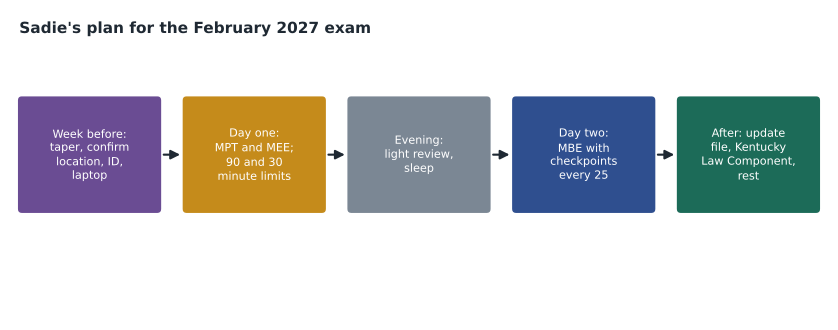
Sadie's one-page checklist for the February exam has four parts. The first lists what to bring: identification, admission materials, permitted items and a laptop charged and updated. The second lists her time plan: checkpoints for each MBE session, 30 minutes for each MEE essay and 90 minutes for each MPT task. The third lists her responses to problems: guess, mark and move on; raise a hand for technical problems; structure every essay. The fourth lists what happens next: update her character and fitness file with anything new, complete the Kentucky Law Component, watch for results and plan for the oath.
After the exam
The exam ends, but the process does not. Candidates must keep their applications current until admission, so any change in address, employment or circumstances that the application asks about should be reported promptly. Candidates who have not completed the Kentucky Law Component should do so. And candidates should watch for communications from the Office of Bar Admissions about results and the next steps toward admission.
For Sadie's cohort, the weeks after the February exam also bring a decision point. If results are favorable, the path leads to the oath, bar association registration and the New Lawyer Program. If they are not, the next exam is NextGen in July 2027, and the planning advice in Lesson 5 applies: read the score report, settle the July filing question with the Office, and change preparation materials to match the new formats.
Rest and recovery
Two days of testing are exhausting, and many candidates are surprised by how tired they feel in the days that follow. Marchetti recommends that candidates plan a few days of genuine rest after the exam before returning to full-time work, and that they avoid replaying questions in their heads or discussing them online. The exam has been written; what remains is the work that follows admission, and that work goes better with a rested mind.
A last word from the group
At the end of the session, Marchetti asks each member to name one thing they will do differently because of the course. Sadie's answer was simple. She would never again answer a Kentucky question from a national outline. Her partner's circled line, 'Not in Kentucky,' is taped above her desk next to the page of steps she wrote in September. Between the two, she says, she has the whole course.
Summary and key terms
- The capstone questions apply the admission rules and Kentucky law from the course to new facts.
- Admission questions turn on the MPRE timing rule, transfer limits, SCR 2.110 and filing deadlines.
- Kentucky law questions turn on pure comparative fault, the Board of Claims, holographic wills, dower and the custody presumption.
- A written exam-day plan answers logistics, timing and what to do when something goes wrong.
- The plan should continue past the exam to the Kentucky Law Component and the oath.
- Exam-day plan
- A written plan covering logistics, timing and responses to problems during the bar exam.
- Checkpoint
- A planned point in a session to compare progress with the time plan.
- Renunciation
- A surviving spouse's election to take the statutory share instead of under the will.
- Claims Against Local Governments Act
- The Kentucky statute governing many claims against cities and other local governments.
Lesson quiz · 5 questions
Score 60% or more to complete this lesson.
Create a free account to save your progress, take quizzes and earn a certificate.