
BAR-218 · Lesson 10 of 12 · 20 min
Kentucky government claims, criminal law and the Rules of Professional Conduct
▶ Video coming soon A video version of this lesson is on the way.
In December, the firm took a call from a man whose car had been hit by a state highway truck. He had already spoken to an adjuster and assumed he would sue the Commonwealth in circuit court like anyone else. Sadie, who answered the call, knew enough to say that claims against the state work differently, but not enough to say how. That evening she asked the group, and Marchetti turned the question into a session on three areas where Kentucky's institutions shape the answer: claims against the Commonwealth, the state's criminal justice system, and the rules that govern lawyers themselves.
Sovereign immunity and the Board of Claims
The Kentucky Constitution, in Section 231, provides that the General Assembly may direct in what manner and in what courts suits may be brought against the Commonwealth. Kentucky courts treat that section as recognizing the Commonwealth's sovereign immunity, which can be waived only by the General Assembly. Agencies that perform governmental functions share that immunity.
For negligence claims, the General Assembly has waived immunity in a limited way and sent the claims to an administrative forum rather than to court. The Board of Claims hears negligence claims against the Commonwealth, its agencies and its employees acting within the scope of their duties. Since 2017, when House Bill 453 created the Kentucky Claims Commission under KRS Chapter 49, the board's functions have been part of that commission, which also handles crime victims' compensation and tax appeals.
The limits are significant. Under KRS 49.040, a single award may not exceed 250,000 dollars, and when several claims arise from one act of negligence the total may not exceed 400,000 dollars, divided among the claimants, with no individual claimant receiving more than 250,000 dollars. The Board's own guidance says that it may not award damages for mental distress or pain and suffering, that awards are reduced by benefits the claimant receives from sources such as insurance, and that claims generally must be filed within one year. Hearings are held in the county where the incident occurred before a hearing officer, and the Board's decision may be reviewed in circuit court.
Those limits explain the firm's advice to the caller. His property damage claim belongs before the Board of Claims, not in circuit court, and he should file within a year of the accident.
| Feature | Board of Claims rule |
|---|---|
| Claims heard | Negligence claims against the Commonwealth, its agencies and employees |
| Single award cap | 250,000 dollars (KRS 49.040) |
| Multiple claims, one occurrence | 400,000 dollars total, no claimant above 250,000 dollars |
| Pain and suffering | Not awarded |
| Filing deadline | Generally one year from the incident |
| Review | Circuit court in the county where the incident occurred |
Suing officials and local governments
Not every claim involving government goes to the Board. Kentucky distinguishes between the state and its agencies, which have sovereign immunity, and individual officials and employees, who have qualified official immunity for discretionary acts performed in good faith within the scope of their authority but not for negligent performance of ministerial duties. The leading case, Yanero v. Davis, decided by the Kentucky Supreme Court in 2001, explains the distinction. Counties have immunity similar to the state's. Cities are treated differently, and claims against them are governed largely by the Claims Against Local Governments Act in KRS Chapter 65. Each category has its own notice rules and limitation periods, so the first question in any government claim is exactly whom the client is suing.
Kentucky criminal law
Kentucky's substantive criminal law is codified in the Kentucky Penal Code, which begins at KRS Chapter 500 and was enacted in the 1970s with the Model Penal Code as a major influence. Its culpability terms, such as intentionally, wantonly and recklessly, track the Model Penal Code structure, though Kentucky uses wantonly where the Model Penal Code uses recklessly and uses recklessly for what the Model Penal Code calls negligence. That vocabulary trap catches new lawyers who studied the MBE's common law and Model Penal Code terms.
Two procedural features also stand out. First, in felony cases tried to a jury, Kentucky uses a bifurcated trial in which the jury that convicts the defendant then hears evidence in a separate penalty phase and fixes or recommends the sentence within the statutory range, a process set out in the truth-in-sentencing statute. Second, Kentucky's persistent felony offender statute allows enhanced sentences for defendants with qualifying prior felony convictions, and the enhancement is decided by the jury.
| Model Penal Code term | Kentucky Penal Code term |
|---|---|
| Purposely | Intentionally |
| Knowingly | Knowingly |
| Recklessly | Wantonly |
| Negligently | Recklessly |
The Kentucky Rules of Professional Conduct
Kentucky's Rules of Professional Conduct appear as SCR 3.130 and follow the ABA Model Rules in numbering and most substance. Rule numbers are cited with the rule in parentheses, so the confidentiality rule is SCR 3.130(1.6). The differences tend to be in details, and new lawyers should read the Kentucky text and comments rather than assuming the Model Rules apply word for word.
Advertising is one area where Kentucky has its own machinery. The Attorneys' Advertising Commission administers the advertising rules. A lawyer may request an advisory opinion on an advertisement by submitting it with a fee, and an advertisement the commission finds compliant is generally protected from discipline. Submission is tied to requesting an opinion, but every advertisement must comply with the rules whether or not it is submitted.
The Kentucky Bar Association's Ethics Committee also issues formal ethics opinions on questions such as conflicts, fees and technology. They are not binding on the Supreme Court, but they are a useful guide and are often cited.
How discipline works
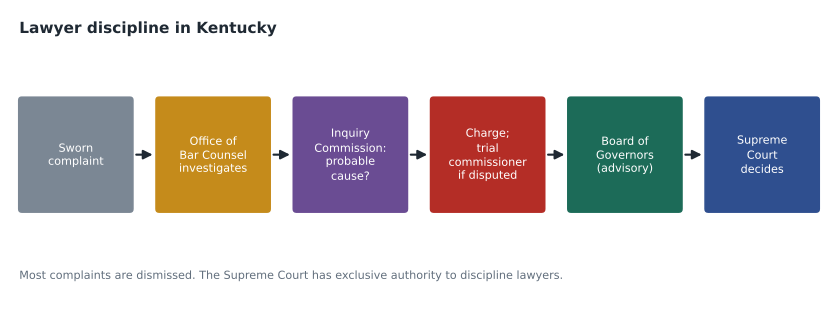
The Supreme Court has exclusive authority to discipline lawyers. The Office of Bar Counsel investigates sworn complaints. The Inquiry Commission, made up of lawyers and nonlawyers, reviews the investigation and decides whether probable cause supports a charge. If a charge is filed and the facts are disputed, a trial commissioner holds a hearing. The Board of Governors of the Kentucky Bar Association may review the case and issue an advisory decision, and the Supreme Court makes the final decision and imposes any discipline. Most complaints are dismissed, but the process is serious, and a lawyer who receives a complaint should respond promptly and consider consulting counsel.
Worked problem
Where does Mr. Pruitt file?
Mr. Pruitt's parked car was struck by a truck owned by the Kentucky Transportation Cabinet and driven by a cabinet employee on the job. Repairs cost 6,000 dollars. Eight months have passed.
Show solution
- The Transportation Cabinet is a state agency, so the claim against it is a negligence claim against the Commonwealth.
- Such claims go to the Board of Claims rather than circuit court.
- The claim is well under the 250,000-dollar cap, and property damage is a recoverable loss.
- Claims generally must be filed within one year, so Mr. Pruitt has about four months left.
- Any insurance payment he receives will reduce the award.
Answer: Mr. Pruitt should file with the Board of Claims promptly, within one year of the accident.
Common mistakes
MistakeSuing a state agency for negligence in circuit court.
InsteadNegligence claims against the Commonwealth go to the Board of Claims.
MistakeSeeking pain and suffering from the Board of Claims.
InsteadThe Board may not award damages for mental distress or pain and suffering.
MistakeUsing the old Board of Claims caps.
InsteadKRS 49.040 now caps a single award at 250,000 dollars and an occurrence at 400,000 dollars.
MistakeReading wantonly as negligence.
InsteadIn the Kentucky Penal Code, wantonly corresponds to the Model Penal Code's recklessly.
MistakeAssuming the Model Rules apply word for word.
InsteadRead SCR 3.130 and its comments; Kentucky differs in places, including its advertising machinery.
Practice problems
Work each problem on paper first, then reveal the answer to check.
Which body hears negligence claims against the Commonwealth?
Show answer
The Board of Claims, now part of the Kentucky Claims Commission.
What is the cap on a single Board of Claims award?
Show answer
250,000 dollars under KRS 49.040.
What Kentucky Penal Code term corresponds to the Model Penal Code's recklessly?
Show answer
Wantonly.
Which body decides whether probable cause supports a disciplinary charge?
Show answer
The Inquiry Commission.
Who imposes lawyer discipline in Kentucky?
Show answer
The Supreme Court of Kentucky.
Who prosecutes and who defends
Kentucky divides prosecution between two offices. The Commonwealth's attorney in each judicial circuit prosecutes felonies in circuit court, and the county attorney in each county prosecutes misdemeanors and violations in district court and handles juvenile matters, among other duties. The Attorney General's office handles criminal appeals for the Commonwealth and has its own investigative and prosecutorial roles. On the defense side, the Department of Public Advocacy provides representation to indigent defendants across the state, through its own offices and through contracts in some counties.
For new lawyers, this structure determines whom to call. A defense lawyer negotiating a felony plea deals with the Commonwealth's attorney's office; a lawyer handling a DUI or a misdemeanor in district court deals with the county attorney. Many new Kentucky lawyers begin in one of these offices, and the experience of daily courtroom practice is one reason those jobs are prized.
The penalty phase in practice
The bifurcated felony trial changes how lawyers prepare. Because the jury that convicts also hears penalty-phase evidence, both sides must plan for two hearings. The Commonwealth may introduce the defendant's prior record and information about parole eligibility, and the defense may offer mitigating evidence. Defense lawyers therefore think about the penalty phase from the start of the case, and many plea negotiations turn on the parties' predictions of what a jury would recommend.
Safekeeping client money
The rules on client funds are where many disciplinary cases begin, and they deserve a new lawyer's close attention. SCR 3.130(1.15) requires a lawyer to hold client and third-party funds separately from the lawyer's own money, to keep complete records, to deliver funds promptly to those entitled to them and to keep disputed funds separate until the dispute is resolved. Kentucky also has an interest on lawyers' trust accounts program, under which nominal or short-term client funds are held in pooled accounts whose interest supports civil legal services.
Sadie's firm reconciles its trust account every month and has two people review each reconciliation. Marchetti tells the group that the habits matter more than the rules: never deposit client money into an operating account, never pay firm expenses from the trust account, and never let a single person handle every step of a client fund transaction without review.
Getting ethics guidance
New lawyers face ethics questions sooner than they expect: whether a former client's matter creates a conflict, how to handle a client who wants to pay in cash, whether a social media post is an advertisement. The Kentucky Bar Association publishes its formal ethics opinions, and members can seek informal guidance from the association on questions about their own prospective conduct. A lawyer who asks before acting, documents the question and the answer, and follows the guidance is in a far better position than one who guesses.
Duties that start at admission
Several duties under SCR 3.130 begin on the first day of practice. A new lawyer must communicate with clients, keep them reasonably informed and explain matters well enough for them to make decisions. Fees must be reasonable, and contingent fee agreements must be in writing. Conflicts must be checked before a new matter begins, including conflicts arising from a new lawyer's work at a prior job or clerkship. And a lawyer who knows of another lawyer's serious misconduct may have a duty to report it. Marchetti's advice is to read the full text of the rules once, carefully, in the first month after admission, and to return to them whenever a question arises rather than relying on memory of the MPRE.
A government claims checklist
Because the forum, the caps and the deadlines all depend on the defendant, Marchetti gives the group a short checklist for any claim that involves government. Identify every potential defendant by name and type: the Commonwealth or a state agency, a county, a city, a school board, or an individual officer or employee. For each, ask whether immunity applies and whether it has been waived, and if so, where. Note any written notice requirement and its deadline, which for some local government claims can be shorter than the limitation period itself. Confirm the limitation period separately for each defendant. And check whether any damages limit or bar on certain kinds of damages applies. The answers often point to two forums at once, such as the Board of Claims for the agency and circuit court for an employee's negligent ministerial act, and the client's strategy has to account for both.
Summary and key terms
- Section 231 of the Kentucky Constitution underpins sovereign immunity, which only the General Assembly may waive.
- Negligence claims against the Commonwealth go to the Board of Claims, capped at 250,000 dollars per award and 400,000 dollars per occurrence, with no pain and suffering awards and a general one-year filing period.
- Officials have qualified immunity for good-faith discretionary acts but not for negligent ministerial acts.
- The Kentucky Penal Code uses intentionally, knowingly, wantonly and recklessly; felony juries sentence in a separate phase.
- SCR 3.130 follows the Model Rules closely; discipline runs from the Office of Bar Counsel and Inquiry Commission to the Supreme Court.
- Board of Claims
- The forum for negligence claims against the Commonwealth, now part of the Kentucky Claims Commission.
- Qualified official immunity
- Protection for officials' good-faith discretionary acts within their authority.
- Wantonly
- The Kentucky Penal Code term for conscious disregard of a substantial and unjustifiable risk.
- Inquiry Commission
- The body that decides whether probable cause supports a disciplinary charge.
Lesson quiz · 5 questions
Score 60% or more to complete this lesson.
Create a free account to save your progress, take quizzes and earn a certificate.