
BAR-218 · Lesson 4 of 12 · 20 min
The Kentucky bar exam: the UBE, scoring and the 266 passing score
▶ Video coming soon A video version of this lesson is on the way.
At the November meeting, Marchetti asked each member of the group a question that sounds simpler than it is: how is a 266 actually made? Most could say that Kentucky's passing score is 266. Few could explain where the number comes from, why a strong essay day can rescue a weak multiple-choice day, or why raw percentages from practice tests do not translate directly into a scaled score. Sadie admitted she had been tracking her practice MBE results as if 60 right answers out of 100 were the same as a passing score. 'They might be,' Marchetti said. 'But you won't know that from the raw number alone.' This lesson explains the exam Kentucky gives through February 2027, how it is scored, and what the 266 means.
Kentucky and the UBE
Kentucky adopted the Uniform Bar Examination and first administered it in February 2021. The UBE is prepared by the National Conference of Bar Examiners and given in the same form in every UBE jurisdiction, which is what makes a score portable. Kentucky grades its own written answers, using NCBE's grading materials, and NCBE scales the written score to the MBE so that scores mean the same thing from one administration to the next.
SCR 2.080, as rewritten by Order 2025-43, states the passing standard directly: a combined scaled score of 266 on the UBE, and a scaled score of 616 on the NextGen bar exam once it begins. The same rule describes the legacy UBE as running from February 2021 through February 2027. Lesson 5 covers NextGen; this lesson stays with the legacy exam.
The three parts
The UBE has three components, given over two days.
The Multistate Bar Examination is 200 multiple-choice questions, split into a morning and an afternoon session of 100 questions and three hours each. Of the 200 questions, 175 are scored and 25 are unscored pretest questions that look exactly like the others. The MBE covers seven subjects: civil procedure, constitutional law, contracts, criminal law and procedure, evidence, real property and torts.
The Multistate Essay Examination is six essay questions in three hours, about 30 minutes each. The MEE may test any MBE subject and also business associations, conflict of laws, family law, trusts and estates, and secured transactions under Article 9 of the Uniform Commercial Code. A single question often mixes subjects.
The Multistate Performance Test is two tasks of 90 minutes each. Each task gives the candidate a file of facts and a library of legal authorities and asks for a practical document, such as an objective memo, a persuasive brief or a client letter. The MPT tests skills rather than memorized law: the law the candidate needs is in the library.
The usual pattern puts the MEE and MPT on the first day and the MBE on the second.
| Component | Format | Time | Weight |
|---|---|---|---|
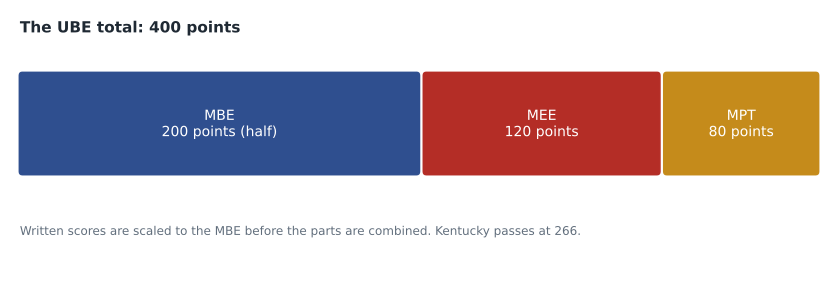
| MBE | 200 multiple-choice questions, 175 scored | Two sessions of three hours | Half of the total |
| MEE | Six essays | Three hours | Three tenths of the total |
| MPT | Two performance tasks | Three hours | One fifth of the total |
From raw answers to a scaled score
Scoring happens in steps. On the MBE, the candidate's raw score is the number of the 175 scored questions answered correctly. NCBE converts that raw score into a scaled score through equating, a statistical process that adjusts for small differences in difficulty between exam forms. A raw score of 120 on a harder form may scale higher than a raw score of 120 on an easier one. That is why practice-test percentages are only a rough guide: they come from released questions on unequated forms.
On the written side, graders in Kentucky score each MEE and MPT answer. Those raw written scores are then scaled to the MBE. In plain terms, scaling places the written scores on the same scale as the MBE for that group of candidates, so that the spread of written scores mirrors the spread of MBE scores. One consequence surprises candidates: a written answer is judged relative to other answers in the same administration. Graders are looking for the answers that best identify issues, state rules and apply them; a good answer is one that is clearly better than most.
The scaled MBE score and the scaled written score are then combined. The MBE counts for half of the total and the written components for the other half, three fifths of that half from the MEE and two fifths from the MPT. Totals run on a 400-point scale.
What 266 means
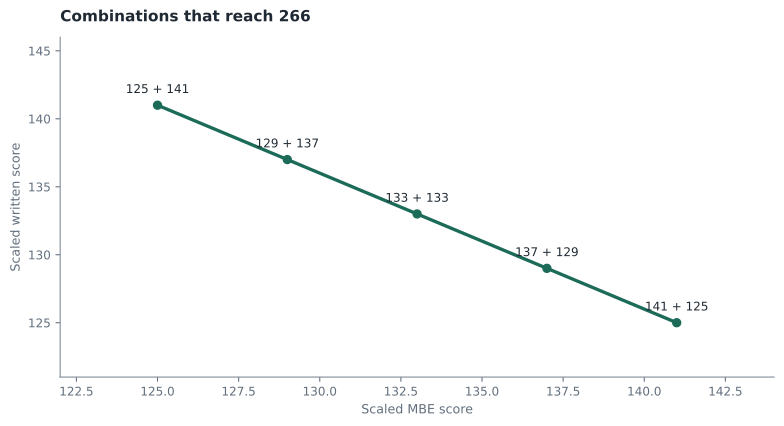
A total of 266 out of 400 is the Kentucky passing line. It is a combined, compensatory score. Kentucky does not require a minimum on each component; a candidate who is weaker on the MBE can pass with stronger written scores, and the reverse. Because the MBE is half of the total, a scaled MBE of about 133 paired with written work scaled to the same level produces a 266. A candidate with a scaled MBE of 125 would need written work scaling to about 141 to reach the same total.
Different UBE jurisdictions set different passing scores, generally from 260 to 270. Kentucky's 266 sits in the middle of that range. That matters for portability. A 266 earned in Kentucky meets the passing score in jurisdictions that require 266 or less but not in those that require more, and a candidate who earned 264 in a jurisdiction with a lower line cannot transfer it to Kentucky.
| Scaled MBE | Scaled written needed | Total |
|---|---|---|
| 125 | 141 | 266 |
| 129 | 137 | 266 |
| 133 | 133 | 266 |
| 137 | 129 | 266 |
| 141 | 125 | 266 |
Planning study around the weights
The weights shape how candidates should spend their time. The MBE is half the score, so steady practice with timed question sets pays off. But the MEE and MPT together are the other half, and candidates often neglect them because essay practice is slower and harder to grade. Marchetti's group writes at least two timed essays a week and one full MPT every other week from January on.
The MPT deserves special mention. It is one fifth of the total and rewards skills a new lawyer already uses: reading a file closely, following the assigning partner's instructions, organizing authorities and writing clearly. Candidates who practice a handful of MPTs under time pressure often see quick gains, because the main errors, such as ignoring the format the task requests or running out of time on the second task, are correctable.
Worked problem
Can Sadie pass with a weak MBE?
On her last full practice exam, Sadie's estimated scaled MBE was 128. Her essays and performance test were graded by her review course at a level the course estimated would scale to about 140.
Show solution
- Kentucky uses a combined, compensatory score, so there is no separate MBE minimum.
- With equal weighting of the two halves, the total is the sum of the scaled MBE and the scaled written score.
- 128 plus 140 is 268, which is above 266.
- The margin is thin, and both numbers are estimates from unequated practice materials, so she should keep working on both halves rather than relying on her written strength.
Answer: On those estimates Sadie would pass narrowly; the result shows why compensatory scoring helps her, and why she should still raise her MBE.
Common mistakes
MistakeTreating raw practice percentages as scaled scores.
InsteadScaled scores come from equating; practice percentages are only a rough guide.
MistakeBelieving each component has its own passing score.
InsteadKentucky uses a single combined score of 266 on a 400-point scale.
MistakeNeglecting the MPT because it tests no memorized law.
InsteadThe MPT is one fifth of the total and responds well to timed practice.
MistakeAssuming a passing Kentucky score transfers everywhere.
InsteadJurisdictions set different passing scores, so a 266 does not meet a higher line elsewhere.
MistakeIgnoring the pretest questions.
InsteadTwenty-five MBE questions are unscored but look identical; treat every question as if it counts.
Practice problems
Work each problem on paper first, then reveal the answer to check.
When did Kentucky first administer the UBE?
Show answer
February 2021.
How many MBE questions are scored?
Show answer
175 of the 200.
How is the UBE total weighted?
Show answer
MBE half, MEE three tenths, MPT one fifth, on a 400-point scale.
Does Kentucky require a minimum score on each component?
Show answer
No; it uses a combined compensatory score of 266.
What does scaling the written score to the MBE do?
Show answer
It places written scores on the same scale as the MBE so the two can be combined.
How an MEE answer earns points
Graders work quickly and look for the same things in every answer. The first is whether the candidate spotted the issues the question raises; an answer that discusses three of the four issues has lost a quarter of the available credit before anything else happens. The second is an accurate statement of the governing rule. The third, and usually the largest, is application: using the facts in the question to reach a conclusion on each issue. Candidates who state rules well but say little about the facts tend to score in the middle.
Marchetti's group uses a simple template for every essay. Each issue gets a short heading taken from the call of the question. Under it comes a one- or two-sentence rule, then a paragraph applying the rule to the specific facts, then a one-line conclusion. The template is not elegant, but it makes an answer easy to grade, and an easy answer to grade is one in which the grader can see every point the candidate earned.
Because MEE questions often mix subjects, the call of the question is the map. If a question asks about a partner's liability and then about the validity of a security interest, the answer should be organized in that order and should not wander into issues the question did not ask about. Time spent on unasked issues is time not spent on the ones that score.
Pacing the MBE
Each MBE session allows 180 minutes for 100 questions, a little under two minutes a question. Most candidates do best with a checkpoint system: a quick look at the clock after every 25 questions, with a target of about 45 minutes per block. A question that is still unclear after a careful read should get a best answer and a mark, so the candidate can return if time allows. Leaving a question blank never helps, because there is no penalty for a wrong answer.
The MBE rewards close reading of the call. Questions ask for the most likely outcome, the strongest argument, or the best defense, and those are different tasks. A candidate who knows the law but answers a different question from the one asked loses the point anyway.
Managing the performance test
The MPT gives 90 minutes per task, and the two tasks are given together in one three-hour session, so the candidate controls the split. Running long on the first task is the most common and most expensive mistake. Marchetti suggests a firm 90-minute limit for each, with roughly the first third spent reading the file and library and outlining, and the rest writing. The assigning memo states the format, the audience and sometimes the length; following those instructions is part of the grade.
If the result is not a pass
Candidates who do not pass receive their scores, and those scores are the best guide to what to change. A candidate whose scaled MBE was well above the written score should shift study time toward essays and performance tests, and the reverse. Many candidates who fail narrowly pass on the next attempt by targeting the weaker half rather than repeating the same course from the start.
For Sadie's cohort, the next attempt after February 2027 will be NextGen, so a retake also means a change of format. A candidate who misses in February should look at the NextGen preparation materials promptly and should not assume that legacy MBE practice alone will carry over, a point Lesson 5 develops.
Reading the numbers on a practice exam
Review courses usually estimate a scaled score from a practice MBE, and those estimates are useful as trends rather than as predictions. A run of practice sets that climbs from the low fifties to the mid sixties in percentage of correct answers tells a candidate that the work is paying off, whatever the precise scaled figure turns out to be. Essay estimates are harder still, because a grader who reads one answer cannot rank it against hundreds of others in the same administration. Marchetti asks the group to track three things each week: the share of MBE questions answered correctly by subject, the number of timed essays written, and whether each MPT was finished inside 90 minutes. If all three are moving in the right direction by early February, she tells them, the scaled score will usually follow. A candidate whose numbers are flat should change the method, not just add hours.
Summary and key terms
- Kentucky gives the UBE through February 2027; SCR 2.080 sets the passing score at 266.
- The UBE has three parts: the 200-question MBE, six MEE essays and two MPT tasks.
- The MBE is half the score, the MEE three tenths and the MPT one fifth, on a 400-point scale.
- MBE scores are equated and written scores are scaled to the MBE before they are combined.
- Scoring is compensatory: a strong half can offset a weaker one.
- UBE
- The Uniform Bar Examination, prepared by NCBE and given in the same form across adopting jurisdictions.
- Equating
- A statistical adjustment that makes MBE scores comparable across exam forms.
- Scaling
- Placing written scores on the MBE scale so the two can be combined.
- Compensatory scoring
- A system in which a strong score on one part can offset a weaker score on another.
Lesson quiz · 5 questions
Score 60% or more to complete this lesson.
Create a free account to save your progress, take quizzes and earn a certificate.