
BAR-218 · Lesson 11 of 12 · 19 min
Score transfer, admission without examination and practice after admission
▶ Video coming soon A video version of this lesson is on the way.
Not everyone in Marchetti's group will sit for the Kentucky exam. One member passed the UBE in Ohio last year and wants to add a Kentucky license because her firm has clients across the river. Another has practiced in Tennessee for eight years and is moving to Louisville. And everyone who passes will face the same question the day after the oath: what does Kentucky expect of a new lawyer now? This lesson covers the two main routes into Kentucky for lawyers who do not sit here, and the requirements that begin once a lawyer is admitted.
Transferring a UBE score
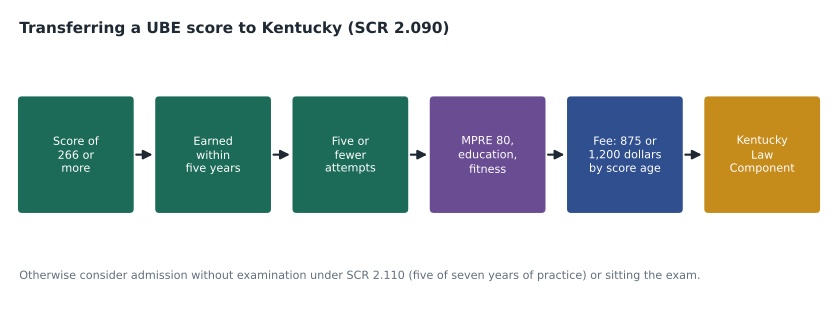
SCR 2.090 lets an applicant who earned a qualifying UBE score in another jurisdiction apply for admission in Kentucky on that score. The core conditions are these. The score must meet Kentucky's passing standard. It must have been earned within the period the rule allows, which is five years under the amended rule. It must have been earned in no more than five attempts. The applicant must meet Kentucky's MPRE requirement and the other requirements every applicant meets, including education and character and fitness. And the applicant completes the Kentucky Law Component before admission.
The fee depends on the age of the score. Under SCR 2.090 as amended in 2025, the application fee is 875 dollars if the score was released within 12 months before the application and 1,200 dollars if it is older.
The Ohio member's plan illustrates the timing. Her score from July 2025 is well above 266 and was earned on her first attempt. She has a passing MPRE score and is admitted in Ohio in good standing. She can apply in Kentucky on her transferred score, pay the higher fee because more than 12 months have passed since her score was released, complete character and fitness review and the Kentucky Law Component, and be admitted without sitting again.
Admission without examination
Experienced lawyers may qualify for admission without examination under SCR 2.110. The applicant must be admitted in another jurisdiction and must have been engaged in the active practice of law for at least five of the seven years immediately before applying. The other jurisdiction must offer reciprocity or comity to Kentucky lawyers on substantially similar terms. The applicant must also satisfy the education and character and fitness requirements, and the fee under the rule as amended is 1,500 dollars.
Active practice is defined in the rules and generally includes private practice, work as in-house counsel, government legal work, judicial service and full-time law teaching, but the practice must have been lawful where it occurred. A lawyer who practiced in a jurisdiction where he or she was not admitted may find that those years do not count.
The Tennessee member's eight years of practice comfortably satisfy the five-of-seven requirement. Before relying on the route, she will confirm with the Office of Bar Admissions that Tennessee meets the reciprocity condition, and if it does she plans to apply under SCR 2.110 rather than sit for the exam.
| Route | Rule | Key conditions | Fee |
|---|---|---|---|
| Transferred UBE score | SCR 2.090 | Score meets 266, earned within five years, five or fewer attempts, MPRE | 875 or 1,200 dollars by score age |
| Without examination | SCR 2.110 | Active practice in five of seven years; reciprocal jurisdiction | 1,500 dollars |
| Military spouse provisional admission | SCR 2.113 | Dependent spouse of a service member stationed in Kentucky | As set by the rule |
Limited and provisional admission
Kentucky's rules also allow limited forms of admission. In-house counsel may obtain a limited certificate to work for an employer in Kentucky without full admission. Lawyers working for certain public defender and legal services programs may also practice under limited admission rules. And since Order 2025-43, new SCR 2.113 allows provisional admission for the dependent spouses of active-duty service members stationed in Kentucky, renewable annually, recognizing the frequent moves military families face. Each of these routes carries limits on the kind of practice permitted.
From approval to oath
Once the Supreme Court approves an applicant for admission, SCR 2.085 gives the applicant two years to be admitted. An applicant who does not take the oath within that time must begin the process again. Most new lawyers are sworn in at a ceremony soon after results are released and character and fitness review is complete.
Continuing legal education
Every Kentucky lawyer must complete continuing legal education each year. The requirement is 12 credit hours a year, including at least two hours of ethics. The educational year runs from July 1 through June 30, and completion must be reported by August 10 following the end of the year. Lawyers who earn more credits than required may carry forward a limited number to later years under the carryover rule, which caps the carryover at 24 credits including four ethics credits.
Some summaries describe Kentucky's annual requirement as 12.5 hours. That figure does not appear in the current requirement, which is 12 hours with two in ethics.
The New Lawyer Program
New Kentucky lawyers must complete the New Lawyer Program under SCR 3.640 within 12 months after admission. The program provides at least 12 credits, including two ethics credits, and covers practice management, professionalism and topics a new lawyer is likely to meet in the first year. Credits earned in the program count toward the new lawyer's continuing education, so new lawyers should plan their first year's education around it and confirm with the Kentucky Bar Association how the program's credits apply to their first educational year.
Worked problem
Can Malik transfer his score?
Malik took the UBE in Missouri three times, passing in February 2023 with a 271. He passed the MPRE with an 84. He wants to apply in Kentucky in December 2026.
Show solution
- His score of 271 meets Kentucky's passing score of 266.
- He earned it in three attempts, within the five-attempt limit.
- The score was released in 2023, less than five years before December 2026, so it is within the transfer period.
- His MPRE score of 84 meets Kentucky's requirement of 80.
- Because the score is more than 12 months old, the fee is 1,200 dollars.
Answer: Malik may apply on his transferred score, subject to character and fitness and the Kentucky Law Component.
Common mistakes
MistakeAssuming any passing UBE score transfers.
InsteadThe score must meet 266, be within the transfer period and be earned in five or fewer attempts.
MistakeCounting unlawful practice toward the five-of-seven requirement.
InsteadOnly lawful active practice counts.
MistakeMissing the two-year window after approval.
InsteadUnder SCR 2.085, admission must occur within two years or the applicant starts over.
MistakeReporting 12.5 CLE hours.
InsteadKentucky requires 12 hours a year, including two ethics hours.
MistakeSkipping the New Lawyer Program.
InsteadSCR 3.640 requires it within 12 months of admission.
Practice problems
Work each problem on paper first, then reveal the answer to check.
Which rule governs transferred UBE scores?
Show answer
SCR 2.090.
How many years of practice does SCR 2.110 require?
Show answer
Five of the seven years before applying.
What is Kentucky's annual CLE requirement?
Show answer
12 hours, including two in ethics, for the July 1 to June 30 year.
By when must CLE be reported?
Show answer
August 10 after the end of the educational year.
When must the New Lawyer Program be completed?
Show answer
Within 12 months after admission.
Membership in the Kentucky Bar Association
Admission to practice and membership in the Kentucky Bar Association go together. Because the association is a unified bar, every lawyer licensed in Kentucky is a member, pays annual dues and is subject to its rules. New lawyers receive information about registration and dues after admission. Members must keep their contact information current with the association, which uses it for notices about dues, continuing education and, if it ever comes to that, discipline.
Membership categories matter for lawyers who do not practice full time in Kentucky. Lawyers who move away or step back from practice may be able to change their status, with different obligations for dues and continuing education. A lawyer who simply stops paying dues or reporting continuing education risks suspension, which is far harder to undo than a voluntary change of status. Marchetti's advice is to decide deliberately what status fits and to file the paperwork, rather than letting obligations lapse.
Planning continuing education
Twelve hours a year is not much, and most Kentucky lawyers meet the requirement without difficulty. The problems come from timing. Because the educational year ends on June 30 and reporting is due by August 10, a lawyer who leaves everything until June may find the programs full or not relevant. The association and many local bars, law schools and private providers offer programs throughout the year, including recorded programs that may be accredited for credit within the limits the rules set.
Sadie's plan for her first year is to complete the New Lawyer Program as early as she can after admission, then choose the rest of her programs around the work she is actually doing, such as civil litigation, family law and estates. Marchetti adds one more suggestion: use the ethics credits to learn about the problems most likely to arise in the lawyer's own practice, not just to meet the requirement.
Practicing across state lines
Kentucky's location means that many lawyers practice near a state line. A lawyer admitted in Kentucky who wants to appear in a single case in another state usually seeks admission for that case through the other state's pro hac vice rules, and Kentucky has its own rules for out-of-state lawyers who want to appear in a Kentucky case. Those rules typically require association with a local lawyer, a fee and a showing of good standing. Lawyers who regularly practice in two states are generally better served by full admission in both, which is one reason the transfer and motion routes in this lesson matter.
Remote work raises related questions. A lawyer admitted only in Kentucky who lives in another state and works remotely on Kentucky matters, or the reverse, should check the rules of both jurisdictions on unauthorized practice. Many jurisdictions have addressed remote work in ethics opinions in recent years, but the answers are not uniform.
Pro bono and public service
Kentucky's Rules of Professional Conduct, like the Model Rules, state that every lawyer has a professional responsibility to provide legal services to those unable to pay. The rule is aspirational rather than enforceable, but Kentucky's legal aid organizations depend on volunteer lawyers, and pro bono work gives new lawyers courtroom and client experience early. Sadie's firm encourages each associate to take at least one pro bono matter a year through the local legal aid program, which provides training and mentoring for volunteers.
The first year as a whole
Marchetti ends the session by asking each member to write a one-page plan for the first year after admission: the oath date, bar association registration, the New Lawyer Program, the remaining continuing education hours, a trust account review if the lawyer will handle client funds, and a mentor to call with questions. The plan takes twenty minutes to write. The members who have used it in past years say it is the most useful page they wrote during bar preparation, because the first year of practice moves too quickly to plan as it happens.
Assembling a transfer or motion application
Transfer and motion applicants do much of the same work as exam applicants, plus a few steps of their own. A transfer applicant must arrange for NCBE to send an official score report to Kentucky, because the Office relies on NCBE's record rather than on a copy the applicant provides. Both transfer and motion applicants who are admitted elsewhere need certificates of good standing from each jurisdiction where they are admitted and statements from the disciplinary authorities about any complaints. Motion applicants also need proof of their years of practice, which usually means letters from employers, partners or judges who can confirm the dates and the nature of the work.
Each of those documents comes from someone else's office, on someone else's schedule. Marchetti's advice is to request them all in the first week, keep a list of when each was requested and received, and follow up after two weeks on anything still missing. The Ohio member found that her Ohio good standing certificate arrived in four days, while a letter confirming a clerkship from 2023 took six weeks. Starting early made the difference between a quiet review and a stalled one.
Summary and key terms
- SCR 2.090 allows admission on a transferred UBE score of at least 266, earned within five years and in five or fewer attempts, with the MPRE.
- Transfer fees are 875 dollars for scores released within 12 months and 1,200 dollars for older scores.
- SCR 2.110 allows admission without examination after active practice in five of seven years in a reciprocal jurisdiction, for a 1,500-dollar fee.
- Admission must occur within two years after approval under SCR 2.085.
- Lawyers complete 12 CLE hours a year with two in ethics, reported by August 10; new lawyers complete the New Lawyer Program within 12 months.
- Transferred score
- A UBE score earned in another jurisdiction and used to apply in Kentucky.
- Reciprocity
- An arrangement under which jurisdictions admit each other's experienced lawyers on similar terms.
- New Lawyer Program
- The required program for newly admitted Kentucky lawyers under SCR 3.640.
- Carryover
- CLE credits beyond the annual requirement that may be applied to later years, within limits.
Lesson quiz · 5 questions
Score 60% or more to complete this lesson.
Create a free account to save your progress, take quizzes and earn a certificate.