
BAR-215 · Lesson 8 of 12 · 21 min
Indiana torts: comparative fault, government claims and medical malpractice
▶ Video coming soon A video version of this lesson is on the way.
Hannah's firm takes a steady stream of injury cases: car accidents, falls, and the occasional claim against a county or a hospital. Her supervising lawyer told her that the three Indiana statutes she would use most were the Comparative Fault Act, the Tort Claims Act and the Medical Malpractice Act, and that each one had a trap for new lawyers. Marchetti built this lesson around those three statutes. Section numbers are given for reference; always check the current Indiana Code.
The Comparative Fault Act
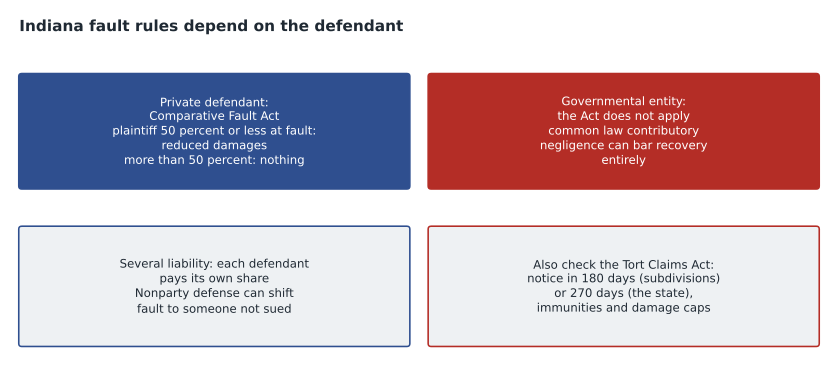
Indiana abandoned contributory negligence for most cases when it adopted the Comparative Fault Act, now in Indiana Code chapter 34-51-2. Indiana uses modified comparative fault. The jury compares the fault of the claimant, the defendants and any nonparties, and the claimant's damages are reduced by the claimant's percentage of fault. But a claimant whose fault is greater than the fault of all other persons whose fault proximately contributed to the harm, in other words more than 50 percent, recovers nothing. A claimant exactly 50 percent at fault still recovers half of their damages.
Two other features of the Act matter in practice. First, Indiana generally uses several liability under the Act: each defendant pays only its own percentage of fault, not the whole judgment. Second, a defendant may assert a nonparty defense, claiming that a person who is not a party, such as a driver who settled or was never sued, caused all or part of the harm. If the jury allocates fault to the nonparty, the defendants' shares shrink. The Act sets procedural requirements for pleading the nonparty defense, including timing tied to the limitation period, so both sides need to watch for it early.
Here is the first trap. The Comparative Fault Act does not apply to claims against governmental entities. For those claims, Indiana's older common law of contributory negligence still applies, so a plaintiff whose own negligence contributed at all to the harm can be barred entirely. Marchetti called this the single most surprising rule for new Indiana lawyers.
The Tort Claims Act
Claims against the state and its political subdivisions, such as counties, cities, towns and school corporations, are governed by the Indiana Tort Claims Act, in Indiana Code chapter 34-13-3. The Act does two big things. It requires written notice of a tort claim before suit, within short deadlines, and it lists immunities that bar certain claims entirely.
The notice requirement is the second trap. A claim against the state must generally be noticed in writing within 270 days after the loss, and a claim against a political subdivision within 180 days, filed with the officials the statute names. The notice must describe the facts, the circumstances, the extent of the loss and other information the statute requires. Failing to give timely notice can bar the claim even though the ordinary two-year limitation period has not run. A lawyer who receives a file involving a government defendant should calculate the notice deadline before anything else.
The Act also lists situations in which a government entity or employee is immune, such as many discretionary functions, the enforcement of laws in certain circumstances, and some conditions of unimproved property. It caps the damages recoverable against government entities and bars punitive damages against them. The immunity list is detailed and heavily litigated, so new lawyers should read the current statute and the cases interpreting the specific immunity at issue.
| Statute | Key rule | Trap for new lawyers |
|---|---|---|
| Comparative Fault Act (IC 34-51-2) | Modified comparative fault; barred above 50 percent; several liability; nonparty defense | Does not apply to governmental entities, where contributory negligence still applies |
| Tort Claims Act (IC 34-13-3) | Written notice before suit; listed immunities; damage caps; no punitive damages against government | Notice within 270 days for the state and 180 days for political subdivisions |
| Medical Malpractice Act (IC 34-18) | Medical review panel before suit; total cap of 1.8 million dollars for acts after June 30, 2019 | Most claims must go to a panel first; the provider pays at most 500,000 dollars |
The Medical Malpractice Act
Indiana's Medical Malpractice Act, in Indiana Code article 34-18, applies to claims against qualified health care providers, those who carry the required insurance and pay into the state's Patient's Compensation Fund. The Act has two defining features: a medical review panel process before suit, and caps on damages.
Before a malpractice claim can proceed in court against a qualified provider, the claimant generally must file a proposed complaint with the Indiana Department of Insurance and have it reviewed by a medical review panel of health care providers, which gives an expert opinion on whether the standard of care was breached. The opinion is admissible later but not conclusive. There is a small claims exception: a claimant who seeks no more than 15,000 dollars and says so in the pleadings can sue without first going to a panel, and recovery in that action is limited to that amount, except as the statute provides.
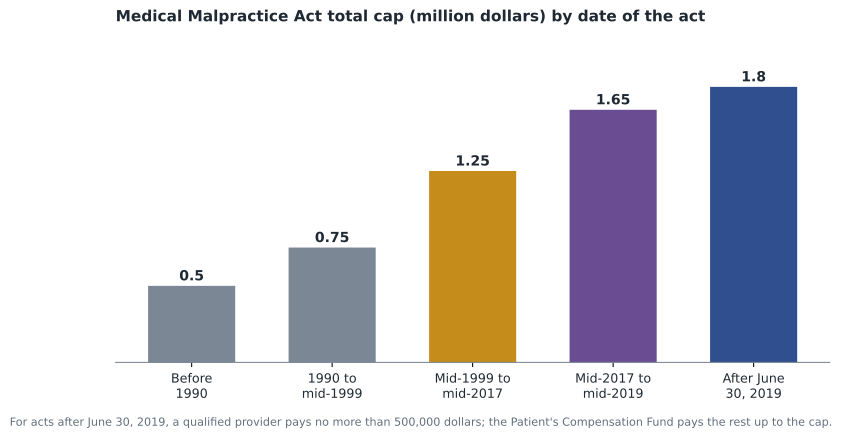
The Act caps total recovery for an act of malpractice. For acts occurring after June 30, 2019, the total cap is 1.8 million dollars, and a qualified health care provider is not liable for more than 500,000 dollars; amounts above the provider's share, up to the total cap, come from the Patient's Compensation Fund. Earlier periods had lower caps: 1.25 million dollars for acts from July 1, 1999 to June 30, 2017, and 1.65 million dollars for acts from July 1, 2017 to June 30, 2019. The date of the malpractice, not the date of suit, determines which cap applies.
Worked problem
A claim against a county
A client fell into an unmarked hole on a county maintenance lot on March 1, 2026. She was looking at her phone. She comes to Hannah's firm on October 15, 2026.
Show solution
- The defendant is a political subdivision, so the Tort Claims Act applies.
- Written notice was due within 180 days after the loss, which ran out at the end of August 2026; the firm must assess whether any exception applies, because late notice can bar the claim.
- Even if notice were timely, the Comparative Fault Act would not apply against the county, so contributory negligence could bar recovery if she was at all negligent.
- The firm must also consider whether a statutory immunity applies to the condition of the lot.
Answer: The claim faces serious obstacles: a likely missed notice deadline, contributory negligence and possible immunity. This is why government files get checked on day one.
Common mistakes
MistakeApplying comparative fault to a claim against a city.
InsteadThe Comparative Fault Act does not apply to governmental entities; contributory negligence can bar the claim.
MistakeRelying on the two-year limitation period for a claim against a county.
InsteadTort Claims Act notice is due within 180 days for political subdivisions and 270 days for the state.
MistakeFiling a malpractice suit in court first.
InsteadMost claims against qualified providers must first go to a medical review panel, unless the claim is for 15,000 dollars or less.
MistakeUsing the current cap for an old act of malpractice.
InsteadThe cap in force on the date of the act applies: 1.8 million dollars only for acts after June 30, 2019.
Practice problems
Work each problem on paper first, then reveal the answer to check.
When is an Indiana claimant barred under the Comparative Fault Act?
Show answer
When the claimant's fault is greater than 50 percent.
What is the Tort Claims Act notice deadline for a political subdivision?
Show answer
Within 180 days after the loss.
What is the total malpractice cap for acts after June 30, 2019?
Show answer
1.8 million dollars, with the provider liable for no more than 500,000 dollars.
When can a malpractice claimant skip the medical review panel?
Show answer
When the claim seeks 15,000 dollars or less and the pleadings say so.
Comparative fault arithmetic
Marchetti had the group work three short allocation problems, because the Comparative Fault Act is easy to state and easy to misapply. In each, the jury finds total damages of 100,000 dollars.
Worked problem
Allocating fault under the Act
Problem 1: the plaintiff is 30 percent at fault and the single defendant 70 percent. Problem 2: the plaintiff is 20 percent at fault, defendant A 50 percent and defendant B 30 percent. Problem 3: the plaintiff is 40 percent at fault, the defendant 20 percent, and a nonparty driver 40 percent.
Show solution
- Problem 1: the plaintiff's fault does not exceed 50 percent, so she recovers 70,000 dollars from the defendant.
- Problem 2: the plaintiff recovers 80,000 dollars in total; under several liability, A pays 50,000 dollars and B pays 30,000 dollars, and neither pays the other's share.
- Problem 3: the plaintiff's 40 percent is not greater than the combined 60 percent of everyone else, so she is not barred; but the defendant pays only its own 20 percent, or 20,000 dollars, and the nonparty's 40 percent is not recovered in this case.
- In each problem, compare the plaintiff's fault with the total fault of all others, including nonparties, to decide whether the bar applies.
Answer: 70,000 dollars; 80,000 dollars split 50,000 and 30,000; and 20,000 dollars, because the nonparty defense moved 40 percent of the fault away from the defendant.
Problem 3 shows why plaintiffs' lawyers watch for the nonparty defense. A plaintiff who did not sue the other driver, perhaps because he could not be found or had no insurance, may see a large share of fault assigned to him anyway, and that share is lost. A plaintiff's lawyer who learns of a possible nonparty early can consider adding that person as a defendant before the limitation period runs.
Premises liability
Indiana still uses the traditional categories of entrants for premises liability: invitees, licensees and trespassers, with the duty owed depending on the category. In Burrell v. Meads (1991), the Indiana Supreme Court adopted a broader definition of invitee that includes social guests invited onto the land, so a dinner guest is owed the duty of reasonable care that an invitee receives. Licensees, such as people who enter with permission for their own purposes, are owed a lesser duty, and trespassers less still, subject to doctrines such as attractive nuisance for children.
This matters for Hannah's firm because many of its cases are falls: on ice, on wet floors, on broken steps. The first questions are who owned or controlled the property, why the plaintiff was there, and whether the owner knew or should have known of the condition. If the owner is a government entity, the Tort Claims Act questions come first.
Product liability
Product claims in Indiana are governed largely by the Indiana Product Liability Act, which applies to claims by users or consumers against manufacturers and sellers for physical harm caused by a product. The Act has its own rules on defenses, such as misuse and modification, and on who counts as a manufacturer or seller. It also contains a statute of repose that generally bars claims brought more than ten years after the product was delivered to the first user or consumer, even if the injury happens later, subject to limited exceptions. A new lawyer handling a claim involving an older product should check the repose period at the start.
Damages
Indiana allows compensatory damages for economic loss, such as medical expenses and lost earnings, and for noneconomic loss, such as pain and suffering. Punitive damages are available in some cases on clear and convincing evidence, but Indiana caps them by statute and directs a large share of any punitive award to a state fund for crime victims rather than to the plaintiff, which affects how lawyers value those claims. Punitive damages are not available against government entities under the Tort Claims Act. Indiana also has statutes on wrongful death, including special limits on damages for the death of an adult without dependents, and on the effect of collateral source payments. Each statute has details that should be read in full before advising a client.
Checking the date and the defendant
Marchetti finished the session with what she called the two-question habit for tort files: who is the defendant, and when did it happen? The answer to the first tells the lawyer whether the Tort Claims Act or the Medical Malpractice Act applies and whether comparative fault or contributory negligence governs. The answer to the second tells the lawyer which deadlines are running, which cap applies in a malpractice case, and whether a product claim is within the repose period. Hannah wrote the two questions on a sticky note and put it on her monitor.
Summary and key terms
- Indiana uses modified comparative fault: a claimant more than 50 percent at fault recovers nothing.
- The Comparative Fault Act does not apply to governmental entities, where contributory negligence still applies.
- The Tort Claims Act requires written notice within 180 days (political subdivisions) or 270 days (the state), and lists immunities.
- The Medical Malpractice Act requires a medical review panel for most claims and caps recovery at 1.8 million dollars for acts after June 30, 2019.
- Check the defendant and the date of the act on the first day of every file.
- Modified comparative fault
- A system that reduces damages by the plaintiff's fault and bars recovery above a threshold.
- Nonparty defense
- A defendant's claim that a person not in the case caused some or all of the harm.
- Tort claim notice
- The written notice the Tort Claims Act requires before suing a government entity.
- Medical review panel
- A panel of health care providers that reviews a malpractice claim before suit.
Lesson quiz · 5 questions
Score 60% or more to complete this lesson.
Create a free account to save your progress, take quizzes and earn a certificate.