
BAR-215 · Lesson 1 of 12 · 20 min
Becoming a lawyer in Indiana
▶ Video coming soon A video version of this lesson is on the way.
Hannah Kessinger grew up in Columbus, Indiana, finished her JD at an ABA-approved law school in May 2026, and now works as a law clerk for a small general practice firm in Bloomington while she studies for the February 2027 bar exam. She joined Hollis Marchetti's study group in October. Marchetti has coached bar candidates for fifteen years and graded essays for six, and she starts every jurisdiction course the same way: before anyone opens an outline, she wants the candidate to understand who actually decides whether they become a lawyer. 'Every deadline, every form and every rule you will meet comes from one place,' she told Hannah on their first call. 'In Indiana, that place is the Indiana Supreme Court.'
This course follows Hannah from that first conversation through the exam and her first months of practice. It covers the people and offices that control admission, the rules they apply, the exam Indiana gives, the change to the NextGen bar exam, and the Indiana law a new lawyer meets in practice. Facts about deadlines, fees and scores are current as of November 22, 2026. Rules change, so the official sources always control: the Indiana Supreme Court's Rules for Admission to the Bar and the Discipline of Attorneys, the Board of Law Examiners' portal, and NCBE's jurisdiction information.
The Indiana Supreme Court controls admission
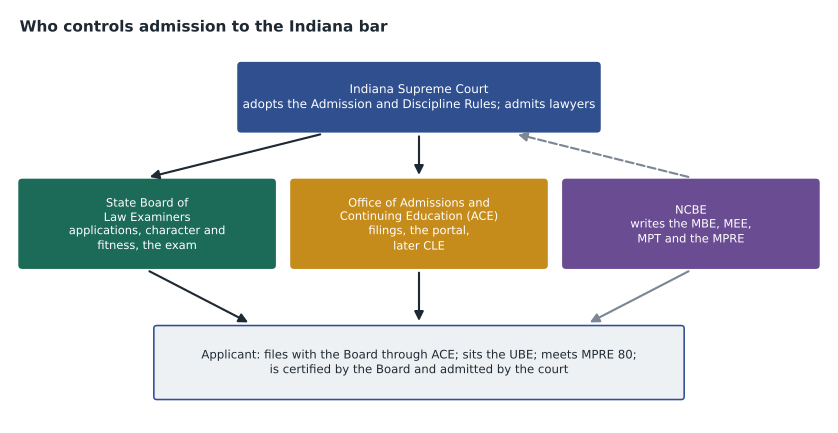
In Indiana, as in every US state, the power to admit people to practice law belongs to the state's highest court. The Indiana Supreme Court decides who may practice law in Indiana, adopts the rules that govern admission and discipline, and issues the orders that change those rules. When the court amended several admission rules effective August 1, 2026, for example, it did so by a single order amending Rules 2.1, 6, 6.1, 13, 15 and 17.1 and adding a new Rule 13.1. Those changes did not come from the legislature or the state bar association; they came from the court.
The court's rules on admission are collected in the Indiana Rules for Admission to the Bar and the Discipline of Attorneys, usually shortened to the Admission and Discipline Rules. Candidates will hear particular rules referred to by number. Rule 13 sets the educational requirements for taking the exam. Rule 15 sets filing dates and fees. Rule 17.1 governs admission on a transferred Uniform Bar Examination score. Rule 6 governs admission without examination for experienced lawyers. Rule 29 sets continuing legal education requirements once you are admitted. Learning to look up a rule by number is the first practical skill this course teaches.
The Board of Law Examiners
The court does not run the exam itself. It delegates that work to the State Board of Law Examiners, a body the court appoints. The Board reviews applications, decides whether applicants meet the educational and character requirements, administers the bar exam, grades the parts it grades, and certifies to the court the applicants who have passed and qualified. When an applicant asks for a waiver of an educational requirement, the Board considers it first, and under the 2026 amendments some waivers then need the court's final approval.
The Board works through the Indiana Office of Admissions and Continuing Education, often shortened to ACE. ACE is the staff office that handles the day-to-day work: processing applications, answering questions, running the online portal, and administering continuing legal education once lawyers are admitted. Applicants file electronically through the Board's portal. Rule 15 is blunt about deadlines: requests to file late or to waive a filing deadline are not accepted.
Where NCBE fits
The National Conference of Bar Examiners is not an Indiana body and does not admit anyone. It writes the national components that Indiana uses: the Multistate Bar Examination, the Multistate Essay Examination and the Multistate Performance Test that together make up the Uniform Bar Examination, and the Multistate Professional Responsibility Examination. It also writes the NextGen bar exam that will replace the UBE in Indiana from July 2028. Indiana decides how to use those components, what score passes, and whether to accept scores earned elsewhere.
This division explains a common confusion. Questions about the content of the MBE or the MPRE go to NCBE. Questions about whether you are eligible, when you must file, what you owe and whether your score is good enough in Indiana go to the Board and ACE.
The paths into the Indiana bar
There are three main ways to become an Indiana lawyer. Each has its own rule and its own application.
The first is admission by examination: you meet the educational requirements of Rule 13, pass character and fitness review, achieve the required MPRE score, and pass the Indiana bar exam. This is Hannah's path and the main subject of this course.
The second is admission on a transferred UBE score under Rule 17.1. A person who earned a sufficient UBE score in another jurisdiction within the allowed time can apply to be admitted in Indiana without sitting the exam again, subject to the character, education and MPRE requirements.
The third is admission without examination under Rule 6, for lawyers already admitted elsewhere who have practiced for a required period. Lesson 11 covers both of these routes in detail. Indiana also issues limited licenses, such as business counsel licenses for in-house lawyers and temporary licenses while an application is pending, which Lesson 11 also covers.
Whichever path a person takes, two more requirements follow admission. Lawyers admitted on a UBE score, whether earned in Indiana or transferred, and lawyers admitted without examination must complete the Indiana Law Course within the time the rules set. Every new lawyer must also meet continuing education requirements, including a six-hour Applied Professionalism Program for newly admitted attorneys. Lesson 6 covers the Indiana Law Course; Lesson 11 covers CLE.
A calendar for the February 2027 exam
Marchetti's first assignment for Hannah was a calendar. The Board does not accept applications for the February exam before October 1. The regular filing deadline for a first-time applicant is November 15, with a late filing window ending November 30 at a higher fee. Hannah had filed in October, so her application was in on time. The exam itself is given in late February over two days, and results follow some weeks later. Hannah wrote each date on a single page that she taped above her desk.
Marchetti added three dates of her own: the date by which Hannah wanted her MPRE score in hand, the date she would finish her first full pass through the MBE subjects, and the date of her first timed practice exam. 'The Board's calendar tells you when you can't be late,' she said. 'Your calendar tells you when you'll be ready.'
Worked problem
Planning the first month
It is November 20, 2026. A friend of Hannah's, a May 2026 graduate of an ABA-approved school, has not yet filed for the February 2027 Indiana exam and asks whether it is too late.
Show solution
- The regular filing deadline for a first-time February applicant is November 15 of the prior year, so the regular window has closed.
- Rule 15 provides a late filing window to November 30 of the prior year at a higher fee.
- November 20 falls within the late window, so the friend can still file if they act before November 30 and pay the late fee.
- Rule 15 does not allow requests to file after the late deadline, so missing November 30 means waiting for the July exam.
Answer: The friend can still sit in February 2027 by filing in the late window, at the late fee, before November 30.
What Indiana admission is not
Two misconceptions come up every year. The first is that the Indiana State Bar Association has a role in admission. It is a voluntary professional association that offers services, sections and CLE programs, but it does not admit lawyers, and membership is not required to practice in Indiana. The second is that passing the exam makes you a lawyer. It does not. A person becomes an Indiana lawyer only when the Supreme Court admits them, after the Board certifies that every requirement is met, and after they take the oath. Indiana holds admission ceremonies; the fall 2026 ceremony was set for Monday, October 26, 2026, at the Indianapolis Convention Center.
Common mistakes
MistakeTreating the Indiana State Bar Association as the admitting body.
InsteadAdmission belongs to the Indiana Supreme Court, acting through the Board of Law Examiners and ACE. The state bar association is voluntary.
MistakeAssuming a deadline can be extended for a good reason.
InsteadRule 15 says requests to file past the stated deadlines or to waive them will not be accepted. Plan around the late window, not beyond it.
MistakeAsking NCBE whether you are eligible to sit in Indiana.
InsteadNCBE writes the national components. Eligibility, scores and admission are Indiana decisions made under the court's rules.
MistakeThinking passing the exam is the last step.
InsteadAdmission requires character and fitness clearance, the MPRE, certification by the Board and admission by the court; UBE admittees then complete the Indiana Law Course.
Practice problems
Work each problem on paper first, then reveal the answer to check.
Which body adopts the rules that govern admission to the Indiana bar?
Show answer
The Indiana Supreme Court, which publishes them as the Admission and Discipline Rules.
What does ACE stand for and what does it do?
Show answer
The Office of Admissions and Continuing Education, the staff office that processes applications, runs the portal and later administers CLE.
Name the three main paths to admission in Indiana and the rule for each.
Show answer
By examination (Rule 13 and the bar exam), by transferred UBE score (Rule 17.1) and without examination (Rule 6).
What is the late filing deadline for a first-time February applicant?
Show answer
November 30 of the prior year, at a higher fee than the November 15 regular deadline.
Reading the rules yourself
Marchetti ended the first session with a homework assignment that had nothing to do with torts or contracts. She asked Hannah to open the Admission and Discipline Rules, find Rules 13, 15, 17.1 and 29, and write one sentence about each in her own words. 'Most candidates learn the rules from a classmate or a commercial outline,' she said. 'That works until the rule changes, and in 2026 it did. If you can read the rule itself, you will never be caught by an old summary.'
Reading a court rule is a skill in its own right. Start with the heading and the first sentence, which usually say what the rule covers. Then look for the operative words: shall and must signal a requirement, may signals permission, and phrases such as unless or except as provided introduce exceptions. Check the definitions, which can be in a separate rule. Finally, look at the date of the most recent amendment, which the court publishes with the rule. A rule amended effective August 1, 2026, may say something different from a rule you read last spring.
Hannah found that Rule 15 had a table of deadlines and fees, that Rule 13 had been rewritten, and that Rule 13.1 was entirely new. She also noticed that several rules referred to the Board's own procedures and forms, which live on the Board's website and portal rather than in the court's rules. Marchetti told her that both sources matter: the court's rule sets the requirement, and the Board's instructions tell you how to meet it.
Building a study plan around a job
Hannah works about 30 hours a week at the firm, which is common for candidates who cannot afford to stop working. Marchetti's rule of thumb is that a full-time candidate studies about 400 to 500 hours for the UBE, spread over ten to twelve weeks, and that a candidate who works needs either more weeks or fewer work hours near the end. Together they built a plan: fifteen to twenty study hours a week from late November through December, rising to forty or more in January after Hannah cut her firm hours, and a final two weeks of full-time review.
The plan had three layers. The first was content review, working through each MBE subject and the MEE subjects in a fixed rotation. The second was practice, with timed MBE sets every week, two or three essays a week, and an MPT every other week. The third was administration: the application, character and fitness follow-up, and exam logistics. Marchetti insisted on putting the third layer on the calendar too, because the candidates who get into trouble usually miss an administrative step rather than a rule of law.
| Weeks before the exam | Main focus | Practice |
|---|---|---|
| 12 to 9 | MBE subjects in rotation; first pass of MEE subjects | Two timed MBE sets a week; one essay a week |
| 8 to 5 | Second pass of weak subjects; MPT method | Three MBE sets, two essays, one MPT a week |
| 4 to 2 | Full review; memorize rule statements | Full-length simulated MBE; four to six essays a week |
| Final week | Light review and rest | A few questions a day; no new material |
The habit of keeping a record
Marchetti's last piece of advice in the first session was to keep a single admission folder, paper or electronic, with every document Hannah filed, every receipt, every email from the Board and a log of dates. 'If anyone ever asks when you filed something or what you said, you want the answer in thirty seconds,' she said. Hannah set up the folder that evening and added her application confirmation, her MPRE admission ticket and her law school's graduation certificate.
The same habit carries into practice. Lawyers keep records of advice given, deadlines calendared and documents filed, and a new lawyer who already keeps an admission log is halfway to good file management.
A quick check of the session: Rule 15 sets the deadlines and fees; the word may in a rule usually signals permission rather than a requirement; and the Board's forms and procedures sit on its website and portal alongside the court's rules.
Summary and key terms
- The Indiana Supreme Court controls admission and adopts the Admission and Discipline Rules.
- The State Board of Law Examiners reviews applications, decides character and fitness and runs the exam; ACE is its staff office.
- NCBE writes the UBE components and the MPRE but does not admit anyone.
- The main paths are admission by examination, by transferred UBE score and without examination.
- Rule 15 deadlines are strict, with a regular and a late window and no extensions beyond them.
- Admission and Discipline Rules
- The Indiana Supreme Court's rules governing admission to the bar and attorney discipline.
- State Board of Law Examiners
- The court-appointed body that reviews applications and administers the Indiana bar exam.
- ACE
- The Indiana Office of Admissions and Continuing Education, the Board's staff office.
- NCBE
- The National Conference of Bar Examiners, which writes the UBE components, NextGen and the MPRE.
Lesson quiz · 5 questions
Score 60% or more to complete this lesson.
Create a free account to save your progress, take quizzes and earn a certificate.