
BAR-215 · Lesson 5 of 12 · 18 min
Exam changes ahead: NextGen in July 2028
▶ Video coming soon A video version of this lesson is on the way.
Hannah's group included candidates from states that had already switched to the NextGen bar exam. Marcus, who passed Missouri's first NextGen exam in July 2026, described a different exam from the one Hannah was preparing for: integrated question sets, performance tasks with research, a single score on a new scale. Hannah wanted to know whether any of it affected her. 'For February 2027, no,' Marchetti said. 'But if things go wrong and you are still testing in 2028, it affects you a lot. And every lawyer should understand the exam the next generation will take.' This lesson covers Indiana's move to NextGen.
The decision and the dates
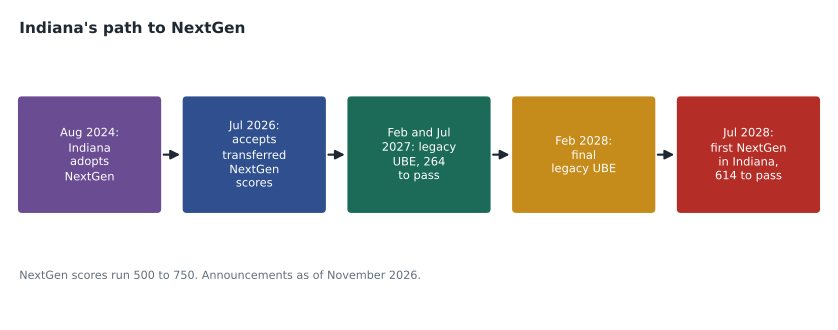
In August 2024, the Indiana Supreme Court adopted the NextGen bar exam, and NCBE announced that Indiana would administer it beginning in July 2028. NCBE's jurisdiction information for Indiana lists the key dates: the final administration of the legacy UBE in Indiana is February 2028, and the first NextGen administration is July 2028. Indiana has already started accepting transferred NextGen scores, beginning with the July 2026 administration, so a candidate who passed NextGen in another jurisdiction can seek admission in Indiana on that score.
Indiana has also announced its NextGen passing score: 614 on the NextGen scale. NCBE recommended that jurisdictions set NextGen passing scores in a range of about 610 to 620, and jurisdictions have spread across that range: several, such as Missouri and Washington, at 610; Indiana at 614; Connecticut, the District of Columbia and Idaho at 616; and many others, including Illinois, at 620. Whether Indiana will add an Indiana-specific component to NextGen is listed by NCBE as still to be announced.
What NextGen looks like
NextGen is a different exam, not a renamed UBE. It is given over a day and a half in three three-hour sections: two on the first day and one on the second. Each section contains multiple-choice questions, integrated question sets and a performance task. Integrated question sets combine a fact pattern with several linked questions, some multiple choice and some short written answers. Performance tasks, including tasks that require legal research in a provided library, ask candidates to produce work such as a memo or a client communication.
NextGen tests eight foundational subjects and seven foundational lawyering skills, including legal research, legal writing, issue spotting, investigation and evaluation, client counseling and advising, negotiation and dispute resolution, and client relationship and management. Family law becomes one of the tested foundational subjects starting in July 2028, which means Indiana's first NextGen exam is also the first one where family law is tested as a foundational subject. Trusts and estates may appear with the law supplied.
NextGen produces a single score on a scale from 500 to 750, rather than a 400-point UBE score. NCBE describes the score as scaled and equated, not curved. It has also warned that NextGen and legacy UBE scores should not be compared numerically, because they measure performance on different exams.
| Feature | Legacy UBE (through Feb 2028) | NextGen (from July 2028) |
|---|---|---|
| Structure | MPT and MEE on day one, MBE on day two | Three three-hour sections over a day and a half |
| Question types | Multiple choice, essays, performance tests | Multiple choice, integrated question sets, performance tasks including research |
| Score scale | 400 points | 500 to 750 |
| Indiana passing score | 264 | 614 |
| Family law | Not on the MEE from July 2026; may appear on the MPT with law supplied | A tested foundational subject from July 2028 |
Who is affected
For Hannah, sitting in February 2027, the legacy UBE is the only exam that matters. She has two more legacy chances in Indiana after that, July 2027 and February 2028, and none after. A candidate who fails in February 2028 and retakes in July 2028 will be sitting a completely different exam. That is the practical risk of the transition, and Marchetti made sure Hannah understood it. 'If you are going to take the old exam, take it seriously now,' she said. 'Don't plan on a second try in 2028 without realizing it's a new test.'
Transferred scores also need attention. A legacy UBE score earned in another jurisdiction still transfers to Indiana if it meets Indiana's transfer rules, covered in Lesson 11. A NextGen score earned elsewhere can transfer too, since Indiana began accepting them with July 2026 scores, provided it meets Indiana's 614 requirement and other rules. The two kinds of scores are not interchangeable, and each receiving jurisdiction decides what it accepts.
Worked problem
Planning around the transition
A candidate plans to sit the Indiana exam for the first time in February 2028 and asks what happens if she fails.
Show solution
- February 2028 is the final legacy UBE administration in Indiana.
- A retake in July 2028 would be on the NextGen exam, which has a different format, a 500 to 750 scale and a 614 passing score.
- Her February 2028 legacy score could not simply be carried into a NextGen attempt, and legacy and NextGen scores are not compared numerically.
- She should either sit earlier, in July 2027, to leave a legacy retake, or prepare for the possibility of a NextGen retake.
Answer: A February 2028 first attempt leaves no legacy retake; a failure means preparing for a different exam in July 2028.
How to stay current
Two things are still open as of November 22, 2026: whether Indiana adds a state-specific component to NextGen, and the exact local logistics for the July 2028 exam. Candidates planning to sit in 2028 should watch the Board's portal and NCBE's Indiana page. Marchetti also suggested that anyone facing NextGen look at NCBE's free sample questions and study aids early, because the integrated question sets reward practice with the format.
Common mistakes
MistakeAssuming a July 2028 retake will be the same exam as February 2028.
InsteadJuly 2028 is Indiana's first NextGen exam, with a different format and a 614 passing score.
MistakeComparing a NextGen score with a legacy UBE score number for number.
InsteadNCBE warns they are on different scales and should not be compared numerically.
MistakeThinking Indiana does not yet accept NextGen scores.
InsteadIndiana began accepting transferred NextGen scores with the July 2026 administration.
MistakeIgnoring family law because it left the MEE.
InsteadIt returns as a tested foundational subject on NextGen from July 2028.
Practice problems
Work each problem on paper first, then reveal the answer to check.
When is the final legacy UBE in Indiana?
Show answer
February 2028.
What is Indiana's NextGen passing score?
Show answer
614.
On what scale are NextGen scores reported?
Show answer
From 500 to 750.
From which administration did Indiana start accepting transferred NextGen scores?
Show answer
July 2026.
What Marcus noticed
Marchetti asked Marcus to describe his July 2026 NextGen exam to the group, because firsthand accounts help candidates see what the score scale and section descriptions do not. Three things stood out to him. First, the questions felt closer to practice: a fact pattern about a client would lead to a question about the governing rule, then a question about what document to request, then a short written answer advising the client. Second, he could not rely on rote memorization alone, because many questions asked him to use a rule rather than recite it. Third, the performance tasks used a library of authorities that he had to search, so time management in the research task mattered more than he expected.
He also said that preparation had been harder because there was less practice material than for the legacy exam, which has decades of released questions. NCBE has published sample questions and study aids for NextGen, and commercial courses have built new materials, but the pool is still smaller. Marchetti tells candidates facing NextGen to use NCBE's own samples first, because they show the format exactly.
Choosing when to sit
For most current law students, the exam date follows graduation. But candidates near the transition have choices, and the choice depends on whether they want a legacy retake available. Marchetti built a planning table for the group, using Indiana's announced dates.
| Graduation | First Indiana exam | Retake if needed | What to plan for |
|---|---|---|---|
| May 2026 (Hannah) | February 2027 | July 2027 or February 2028, legacy | Two legacy retakes remain after February 2027 |
| May 2027 | July 2027 legacy | February 2028 legacy | One legacy retake; a second failure means NextGen |
| December 2027 | February 2028 legacy | July 2028 NextGen | No legacy retake; prepare for both formats or wait |
| May 2028 and later | July 2028 NextGen | NextGen | Prepare for NextGen from the start |
The December 2027 graduate faces the hardest decision. Sitting in February 2028 gives a chance to finish on the familiar exam, but a failure means switching to a different exam in July. Waiting until July 2028 means preparing for NextGen from the start, with less practice material but no format switch. Neither choice is wrong; the point is to make it deliberately. A candidate in that position should talk with her law school's academic support office, which will be advising many students on the same question.
How preparation changes
Legacy preparation leans heavily on recognizing rules in multiple-choice questions and writing essays from memory. NextGen preparation shifts some of that weight toward skills. Candidates still need to know the core rules of the foundational subjects, such as civil procedure, contracts, evidence, torts, constitutional law, criminal law, real property and business associations. But they also need practice in reading a client file, choosing what to investigate, drafting short written answers under time pressure, and finding and applying authority in a research library.
Marchetti's advice for NextGen candidates had three parts. Start practicing integrated question sets early, because the format is unfamiliar and improves with repetition. Practice the research performance task under time, because candidates tend to over-read the library. And keep a short list of client-counseling principles, such as explaining options and risks in plain language and confirming the client's goals, since several skills questions turn on what a careful lawyer would do next rather than on a rule of law.
A sample integrated question set, described
To show the format without using any real exam material, Marchetti described an original set in the NextGen style. A short file describes a client who runs a small bakery and wants to end a supply contract after the supplier delivered late twice. The first question asks which body of law governs the contract, with four choices. The second asks which additional fact would matter most to whether the late deliveries were a material breach. The third asks for a short written answer: two or three sentences advising the client on the risk of terminating now. The fourth asks which document the lawyer should request from the client first. Each question builds on the last, and a candidate who misidentifies the governing law in the first question will struggle with the rest.
Marchetti used the example to make two points. First, the set rewards a clear understanding of a few core rules, here the sale of goods and material breach, rather than a long list of exceptions. Second, it asks the candidate to think like a lawyer advising a real person, which means stating risks plainly and identifying what information is still missing. Candidates who practice explaining a rule to a client in a few sentences find the short-answer questions far less intimidating.
What does not change
The transition changes the exam, not the rest of the admission process. Candidates still apply to the Board under Rule 15, still need an MPRE score of 80, still go through character and fitness review, and still complete the Indiana Law Course after admission. The eligibility rules in Rule 13 and the Rule 13.1 waiver route apply to both exams. And whatever the exam, the Indiana Supreme Court still decides who is admitted.
Watching for announcements
Several details of Indiana's first NextGen administration were not yet public as of November 22, 2026, including whether Indiana will add a state-specific component and the exact logistics for July 2028. Marchetti gave the group a simple routine: check the Board's portal and NCBE's Indiana page at the start of each month, read any court order amending the Admission and Discipline Rules, and save a copy of each announcement in the admission folder. A candidate planning for 2028 who sees an announcement should read it in full, not just the headline, because transition rules often include exceptions for candidates who have already applied.
Hannah, who expects to finish on the legacy exam, will not need most of this. But Marchetti pointed out that the newest lawyers in Indiana will soon include NextGen takers, and a lawyer who supervises clerks or mentors students will be asked about the exam for years. Understanding the change now is part of understanding the profession she is joining.
Summary and key terms
- Indiana adopted NextGen in 2024; its first NextGen exam is July 2028 and its final legacy UBE is February 2028.
- Indiana's NextGen passing score is 614, within NCBE's recommended range of about 610 to 620.
- Indiana has accepted transferred NextGen scores since the July 2026 administration.
- NextGen uses three three-hour sections, integrated question sets and performance tasks, scored from 500 to 750.
- A candidate failing the February 2028 legacy exam faces a different exam in July 2028.
- NextGen
- NCBE's new bar exam testing foundational concepts and lawyering skills, replacing the UBE.
- Integrated question set
- A NextGen fact pattern with several linked multiple-choice and short-answer questions.
- Performance task
- A NextGen task requiring a practical document, sometimes with legal research.
- Legacy UBE
- The current UBE, given in Indiana through February 2028.
Lesson quiz · 5 questions
Score 60% or more to complete this lesson.
Create a free account to save your progress, take quizzes and earn a certificate.