
BAR-215 · Lesson 10 of 12 · 18 min
The Indiana Constitution, criminal law and the Rules of Professional Conduct
▶ Video coming soon A video version of this lesson is on the way.
The last of Marchetti's four practice lessons pulled together three Indiana Law Course modules: Indiana constitutional law, criminal law and procedure, and professional responsibility. Hannah's firm takes court-appointed misdemeanor cases from time to time, and her supervising lawyer had already told her that a good Indiana criminal defense lawyer always checks the Indiana Constitution as well as the federal one. This lesson explains why, outlines Indiana's criminal code, and then turns to the rules that will govern Hannah's own conduct as a lawyer.
Why the Indiana Constitution matters
The Indiana Constitution of 1851 has its own Bill of Rights in Article 1. Indiana courts interpret it independently: some provisions are worded differently from their federal counterparts and have been read to give different, sometimes greater, protection. A lawyer who argues only the US Constitution may miss an Indiana argument that would win.
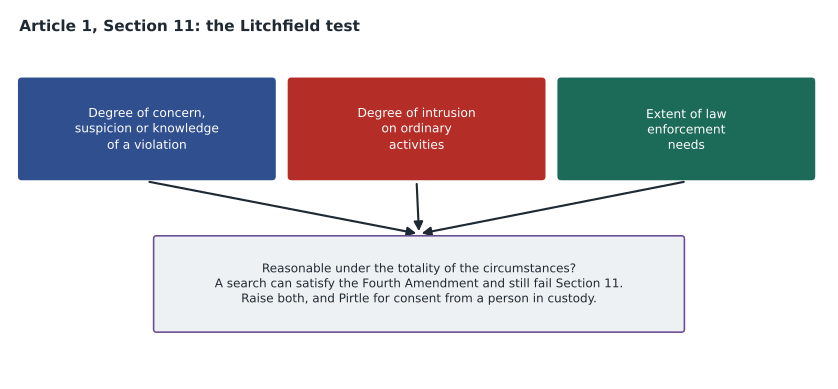
Search and seizure is the clearest example. Article 1, Section 11 protects against unreasonable searches and seizures in words similar to the Fourth Amendment, but the Indiana Supreme Court applies its own test. Under Litchfield v. State (2005), the reasonableness of a search or seizure under Section 11 turns on a balance of three factors: the degree of concern, suspicion or knowledge that a violation has occurred; the degree of intrusion the method imposes on the person's ordinary activities; and the extent of law enforcement needs. Because the test looks at the totality of the circumstances, a search that passes federal review can still fail under Section 11, and Indiana lawyers routinely raise both.
Indiana also has a distinctive rule about consent searches of people in custody. Under the Pirtle doctrine, which comes from Pirtle v. State (1975), a person in police custody must generally be advised of the right to consult an attorney before giving valid consent to a search, a protection with no federal equivalent. Its scope has been refined by later cases, so it should be checked against current law, but it remains a standard part of an Indiana suppression analysis.
Other Article 1 provisions come up often. Section 12 guarantees open courts and a remedy by due course of law. Section 23, the equal privileges and immunities clause, is interpreted under its own test from Collins v. Day (1994), which asks whether a legislative classification is reasonably related to inherent characteristics that distinguish the classes and whether the preferential treatment is uniformly applicable to all similarly situated persons. Section 32 protects the right of the people to bear arms in defense of themselves and the state.
Indiana's criminal code in outline
Indiana's criminal statutes are collected in Indiana Code title 35. Since a major revision that took effect in 2014, Indiana classifies felonies by level, from Level 1, the most serious, to Level 6, the least serious, with murder treated separately. Misdemeanors are divided into Class A, B and C. Each level carries a statutory sentencing range with an advisory sentence, and courts may adjust within the range based on aggravating and mitigating circumstances. Indiana also has habitual offender provisions that add time for repeat felony offenders, and it allows some Level 6 felonies to be entered or later converted as misdemeanors in appropriate cases.
Criminal procedure in Indiana courts follows the Indiana Rules of Criminal Procedure, which include speedy trial protections. A defendant held in jail or awaiting trial can invoke time limits for bringing the case to trial, subject to delays caused by the defense or court congestion. The exact periods and exceptions are detailed and should be read in the current rule; missing them can lead to discharge, so both prosecutors and defense lawyers calendar them carefully.
| Category | Indiana classification |
|---|---|
| Murder | Treated separately from the felony levels |
| Felonies | Level 1 (most serious) through Level 6 (least serious), each with a sentencing range and advisory sentence |
| Misdemeanors | Class A, B and C |
| Repeat offenders | Habitual offender enhancement |
| Some Level 6 felonies | May be entered or later converted as misdemeanors in appropriate cases |
The Indiana Rules of Professional Conduct
Indiana's Rules of Professional Conduct are adopted by the Indiana Supreme Court and are based on the ABA Model Rules, which is why the MPRE is good preparation for practicing in Indiana. But Indiana has made its own choices in places, and a lawyer is bound by the Indiana text, not the Model Rule.
Indiana's version of Rule 8.4 has long included its own provision on bias: it treats as misconduct a lawyer's conduct, in a professional capacity, that manifests bias or prejudice based on race, gender, religion, national origin, disability, sexual orientation, age, socioeconomic status or similar factors, while making clear that legitimate advocacy about those factors is not prohibited. This provision predates the ABA's 2016 Model Rule 8.4(g) and is worded differently, so Indiana lawyers should read their own rule rather than the ABA's.
Client money is another area where Indiana practice has its own detail. Rule 1.15 requires lawyers to keep client and third-party funds separate in trust accounts, and Indiana lawyers holding nominal or short-term client funds must use interest-bearing trust accounts under the state's IOLTA program, with the interest going to fund legal services. Overdraft notification and recordkeeping requirements apply, and trust account problems are among the most common sources of discipline.
Discipline in Indiana is handled by the Indiana Supreme Court Disciplinary Commission, which investigates grievances and prosecutes charges. The Supreme Court decides discipline, which ranges from private and public reprimands to suspension and disbarment. Lawyers also have duties to cooperate with investigations and, in some circumstances, to report another lawyer's serious misconduct.
Worked problem
A suppression motion on two grounds
Police stop a car for a broken taillight, detain the driver for 40 minutes waiting for a drug dog, and find a small amount of marijuana. Earlier, while the driver was in custody, an officer asked for consent to search and the driver agreed, without being told he could talk to a lawyer.
Show solution
- Under the Fourth Amendment, the prolonged detention must be analyzed under Rodriguez v. United States, which limits extending a traffic stop without reasonable suspicion.
- Under Article 1, Section 11, the court balances the degree of suspicion, the degree of intrusion and law enforcement needs under Litchfield.
- Because the driver was in custody, the Pirtle doctrine may require that he was advised of his right to counsel before consenting.
- A motion should raise both constitutions, because Indiana's protections can be independent and sometimes broader.
Answer: Hannah's supervisor files a motion raising the Fourth Amendment, Section 11 under Litchfield, and Pirtle.
Common mistakes
MistakeArguing only the Fourth Amendment in an Indiana suppression motion.
InsteadRaise Article 1, Section 11 under the Litchfield balancing test as well.
MistakeAssuming consent from a person in custody is valid without more.
InsteadUnder the Pirtle doctrine, the person generally must be advised of the right to counsel first.
MistakeUsing the old Class A to D felony labels.
InsteadSince 2014, Indiana felonies are classified as Levels 1 through 6, with murder separate.
MistakeReading ABA Model Rule 8.4(g) as Indiana's rule.
InsteadIndiana has its own differently worded bias provision in Rule 8.4.
Practice problems
Work each problem on paper first, then reveal the answer to check.
What test applies under Article 1, Section 11?
Show answer
The Litchfield balancing of suspicion, intrusion and law enforcement needs.
What does the Pirtle doctrine require?
Show answer
That a person in custody generally be advised of the right to counsel before consenting to a search.
How are Indiana felonies classified since 2014?
Show answer
Level 1 through Level 6, with murder separate.
Which body prosecutes attorney discipline in Indiana?
Show answer
The Indiana Supreme Court Disciplinary Commission.
More of the Indiana Bill of Rights
Section 11 is the provision Indiana lawyers cite most, but several others have their own Indiana interpretations. Article 1, Section 9 protects free expression in words different from the First Amendment, and Indiana courts have developed their own analysis for it, giving particular weight to political expression. Article 1, Section 13 sets out the rights of the accused, including the right to counsel and to a public trial, and Indiana courts have sometimes read it independently of the Sixth Amendment. Article 1, Section 14 protects against double jeopardy. In Wadle v. State (2020), the Indiana Supreme Court replaced its earlier framework for claims of substantive double jeopardy with a new approach that focuses first on statutory language and legislative intent and then on whether the offenses are included in each other, so older cases applying the prior test should be read with care. And Article 1, Section 16 requires that penalties be proportioned to the nature of the offense.
Marchetti's practical advice was to treat the Indiana Constitution as a second source of rights in every criminal case and many civil ones. A brief that cites only federal law may leave an argument unmade, and Indiana appellate courts expect a separate state constitutional argument to be developed rather than mentioned in passing. A lawyer who simply asserts that the Indiana Constitution gives broader protection, without analysis under its own test, may waive the point.
Sentencing and review
Indiana gives appellate courts an unusual power over sentences. Under Indiana Appellate Rule 7(B), an appellate court may revise a sentence authorized by statute if, after due consideration of the trial court's decision, it finds that the sentence is inappropriate in light of the nature of the offense and the character of the offender. This is broader than review in many jurisdictions, where an appellate court can disturb a sentence within the statutory range only for an abuse of discretion. Defense lawyers routinely include a Rule 7(B) argument in sentencing appeals, though appellate courts give the trial court's judgment considerable deference and grant relief in a minority of cases.
After an appeal, a convicted person may seek relief through Indiana's post-conviction procedure, which allows claims such as ineffective assistance of counsel to be raised and decided in the trial court with an evidentiary hearing. Post-conviction relief has its own rules, standards and limits on successive petitions, and it is a specialized area of practice.
Juvenile and other specialized courts
Indiana trial courts also handle juvenile delinquency cases, child in need of services cases, and termination of parental rights cases, often through specialized juvenile divisions. Many counties operate problem-solving courts, such as drug courts, veterans treatment courts and mental health courts, which combine supervision and treatment as an alternative to traditional sentencing for eligible participants. A general practice lawyer who takes court appointments may appear in any of these courts and should learn the local procedures before the first hearing.
Rules of Professional Conduct in daily practice
For a new lawyer, the Rules of Professional Conduct matter most in a handful of recurring situations. Conflicts must be checked before taking a new client, which is why Hannah's firm runs every name through its conflict system and the online court docket. Engagement terms should be written, and Rule 1.5 requires that a contingent fee agreement be in writing and signed by the client, stating how the fee is calculated. Confidential information must be protected under Rule 1.6, including in email and cloud storage, which the rules address through the duty of reasonable efforts to prevent unauthorized disclosure. Client money goes into the trust account under Rule 1.15. And a lawyer who cannot handle a matter competently must learn the area, associate with someone who can, or decline it.
Indiana lawyers also have a professional responsibility to provide pro bono legal services, which the Indiana rules describe as an aspirational goal rather than a mandatory requirement. Indiana has a network of district pro bono plans and legal aid organizations, and new lawyers are often encouraged to take a first pro bono case through one of them, with mentoring from an experienced volunteer. Marchetti told Hannah that a first pro bono case is one of the fastest ways to gain courtroom experience.
Professional conduct and the Indiana Law Course
The professional responsibility module of the Indiana Law Course reviews the Indiana Rules of Professional Conduct with attention to Indiana's variations, including its own bias provision in Rule 8.4 and trust account requirements, and to the work of the Disciplinary Commission. Combined with the MPRE, which tests the Model Rules, and the Applied Professionalism Program for new lawyers, a newly admitted Indiana lawyer meets professional responsibility three times in the first year. Marchetti called that a sign of how seriously the Indiana Supreme Court takes the subject.
Summary and key terms
- Indiana interprets its own Bill of Rights independently, sometimes giving broader protection than the federal Constitution.
- Section 11 searches are judged by the Litchfield balancing test, and the Pirtle doctrine protects people in custody asked to consent.
- Indiana felonies are classified as Levels 1 to 6 since 2014, with misdemeanors in Classes A to C.
- The Indiana Rules of Professional Conduct follow the Model Rules with Indiana variations, including its own bias provision.
- The Disciplinary Commission investigates and prosecutes; the Supreme Court decides discipline.
- Litchfield test
- Indiana's reasonableness balancing test for searches and seizures under Section 11.
- Pirtle doctrine
- Indiana's rule on advising people in custody of the right to counsel before a consent search.
- Advisory sentence
- The sentence Indiana law suggests within the range for an offense level.
- IOLTA
- Interest on Lawyers' Trust Accounts, which funds legal services from interest on client trust funds.
Lesson quiz · 5 questions
Score 60% or more to complete this lesson.
Create a free account to save your progress, take quizzes and earn a certificate.