
BAR-215 · Lesson 2 of 12 · 21 min
Eligibility, education, deadlines and fees
▶ Video coming soon A video version of this lesson is on the way.
Hannah's application was already filed when she joined the group, but Marchetti asked her to walk through it line by line anyway. 'You will be asked about this application again,' she said. 'By the Board, by a character and fitness interviewer, maybe by an employer. You should know exactly what you told them and why you were allowed to sit.' This lesson covers who may take the Indiana exam, the educational rule and the waivers added in 2026, and the filing deadlines and fees in Rule 15.
The educational requirement
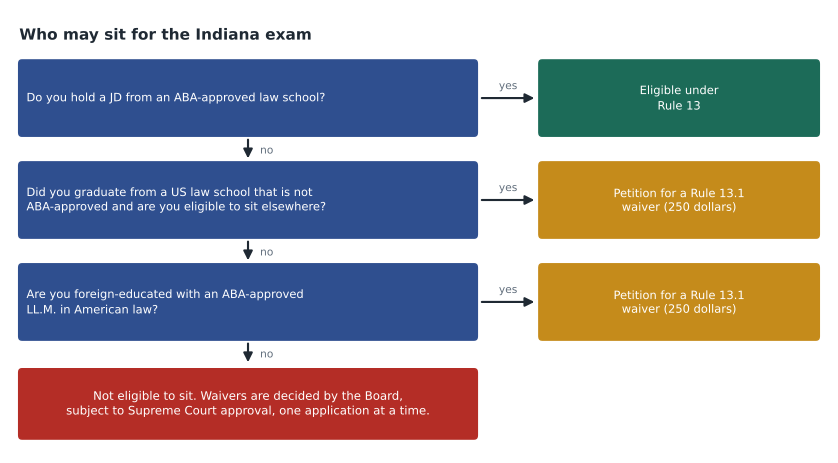
Rule 13 sets the educational qualifications for the Indiana bar exam. The standard requirement is a law degree from a law school approved by the American Bar Association. Hannah's degree met that requirement, so the educational part of her file was simple: her school sent the documents the rules require, and she was done.
The rules attach several documents to the educational requirement. Rule 15 requires an affidavit from the dean of the applicant's law school, or the dean's designee, stating that nothing in the school's records or the faculty's knowledge suggests the applicant lacks good moral character or fitness. It also requires a certified law school transcript showing the graduation date and degree, filed before admission. An applicant who sits before every document is in should expect the Board to hold admission until the file is complete.
Indiana also allows some candidates to sit shortly before they graduate, if they are close to finishing and have met particular course requirements, such as a professional responsibility course. Bar preparation providers describe the conditions as having fewer than five credit hours left and being within 100 days of graduation. Because these conditions are specific and can change, anyone hoping to sit early should read the current version of Rule 13 and confirm with ACE before relying on them.
The 2026 waiver rule
Effective August 1, 2026, the Indiana Supreme Court adopted a new Rule 13.1 that lets the Board of Law Examiners waive the ABA-approved law school requirement for certain applicants, subject to final approval by the Supreme Court. The order describes two groups who may seek a waiver: graduates of US law schools that are not ABA-approved who are eligible to sit for the bar exam in another state, and holders of an LL.M. from an ABA-approved school, based on American law, who completed their first legal education outside the United States.
A waiver is not automatic. The applicant files a petition with transcripts, a written narrative and information about bar results, and pays a nonrefundable 250 dollar fee. The waiver applies only to the exam application, or the transferred-score application, for which it was sought; it does not carry forward to a later application. The same order extended the waiver route to applicants for admission on a transferred UBE score under Rule 17.1, and allowed students at non-ABA-approved schools who would be eligible for a waiver to serve as legal interns under Rule 2.1.
Marchetti used the new rule to make a broader point. 'Every few years a court changes who may sit,' she said. 'Texas did it in 2026, Florida did it in 2026, and now Indiana has a waiver route. The rule in force on the day you file is the one that counts.'
Filing through the portal
Applications are filed electronically through the Board's portal in the form the Board prescribes. The application asks for education, employment, residence and legal history, and supports the character and fitness review covered in Lesson 3. It is long, and Marchetti's advice was the same as every year: start early, gather documents before you start typing, and answer every question completely even when the answer is unflattering.
Rule 15 deadlines
Rule 15 sets two deadlines for each exam: a regular deadline at a lower fee and a late deadline at a higher fee. The deadlines are different for first-time applicants and reexamination applicants.
| Applicant | Exam | Regular deadline and fee | Late deadline and fee |
|---|---|---|---|
| First-time | February | November 15 of the prior year, 250 dollars | November 30 of the prior year, 500 dollars |
| First-time | July | April 1, 250 dollars | April 15, 500 dollars |
| Reexamination | February | December 15 of the prior year, 250 dollars | December 30 of the prior year, 500 dollars |
| Reexamination | July | May 30, 250 dollars | June 15, 500 dollars |
The Board will not accept February applications before October 1 or July applications before March 1, so there is also an opening date for each window. Indiana's exam fee is modest compared with many states; NCBE's jurisdiction information lists the same 250 dollar fee for first-time takers, attorneys and repeaters. Other costs, such as the fee for using a laptop and separate fees for transferred scores or admission without examination, are covered where they arise.
Rule 15 also deals with applicants who are approved but do not sit. If an approved applicant skips the first exam, the application can be carried to the next scheduled exam at no extra charge. If the applicant skips that exam too, the application is dismissed and half the fee is refunded. After a dismissal, the applicant files a new application with a new fee, meeting the regular or late deadline.
A candidate who has a pending petition to the Board, or an appeal to the court, about the grading of a failed exam must still meet the reexamination deadlines. If the challenge succeeds, the reexamination fee is refunded in full. The lesson is that a grading challenge does not stop the clock.
Worked problem
Fees for a repeat taker
Hannah's classmate failed the July 2026 Indiana exam and wants to sit in February 2027. On December 20, 2026, she is ready to file.
Show solution
- She is a reexamination applicant, so the reexamination deadlines apply, not the first-time deadlines.
- The regular reexamination deadline for February is December 15 of the prior year, which has passed.
- The late reexamination deadline is December 30 of the prior year, so December 20 falls within it.
- The late fee is 500 dollars, double the 250 dollar regular fee.
Answer: She can file on December 20 in the late reexamination window and pay 500 dollars.
Practical habits
Marchetti ended with three habits. Keep a copy of everything you file, as filed, because later questions will refer to it. Put every deadline on a calendar with a reminder a week ahead, because the rules do not forgive a missed date. And when a rule changes during your application, as several Indiana rules did on August 1, 2026, read the new version and ask ACE how it applies to you rather than assuming.
Common mistakes
MistakeAssuming the first-time deadlines apply to a repeat taker.
InsteadReexamination applicants have their own later deadlines: December 15 and 30 for February, May 30 and June 15 for July.
MistakeTreating a Rule 13.1 waiver as permanent.
InsteadA waiver applies only to the application for which it was sought and must be sought again for a later application.
MistakeBelieving a grading challenge pauses the reexamination deadline.
InsteadRule 15 requires the applicant to meet reexamination deadlines anyway, with a full refund if the challenge succeeds.
MistakeFiling before the window opens.
InsteadThe Board does not accept February applications before October 1 or July applications before March 1.
Practice problems
Work each problem on paper first, then reveal the answer to check.
What is the standard educational requirement for the Indiana exam?
Show answer
A law degree from an ABA-approved law school, under Rule 13.
Who may seek a Rule 13.1 waiver?
Show answer
Graduates of non-ABA-approved US law schools eligible to sit elsewhere, and foreign-educated holders of an ABA-approved LL.M. in American law.
What happens if an approved applicant misses two exams in a row?
Show answer
The application is dismissed and half the fee is refunded.
What two documents from the law school does Rule 15 require?
Show answer
A dean's affidavit about character and fitness and a certified transcript showing the degree and graduation date.
Gathering the documents
The online application is only part of the file. Marchetti gave Hannah a checklist of what candidates usually need to collect, and she worked through it with the firm's office manager, who had helped two earlier clerks through the same process.
First, education records: the law school must certify the degree, usually through a dean's certificate or affidavit sent directly to the Board, and undergraduate information is reported on the application. Second, a complete history: every address, every job (including part-time and summer work), and every school attended, with dates. Gaps of more than a few months should be explained rather than left blank. Third, legal history: traffic matters, arrests, citations, civil suits, bankruptcies and any professional or academic discipline, with court records where the application asks for them. Fourth, financial information where the application asks for it, such as defaulted loans or judgments. Fifth, the fee, paid through the portal by the method the Board accepts.
Hannah's employment history was the hardest part. She had worked at a summer camp, a campus library, a coffee shop and a legal aid clinic during college and law school, and she had to find addresses and supervisor names for each. Marchetti told her that this is normal and that the Board would rather see a complete list with an occasional unknown than a short list that leaves jobs out.
A worked fee problem
Fees trip up candidates because the amount depends on who you are and when you file. Here is the reasoning Marchetti walked through with the group, using the Rule 15 table from this lesson.
Worked problem
Three candidates, three fees
Candidate A is a first-time applicant for July 2027 who files on April 10, 2027. Candidate B is a reexamination applicant for February 2027 who files on December 28, 2026. Candidate C is a first-time applicant for February 2027 who files on December 2, 2026.
Show solution
- Candidate A files after the April 1 regular deadline but before the April 15 late deadline, so the late fee of 500 dollars applies.
- Candidate B is a reexamination applicant, whose February late deadline is December 30; filing on December 28 is timely with the 500 dollar late fee.
- Candidate C is a first-time applicant, whose last day for February was November 30; December 2 is too late, so she must apply for July 2027 instead, opening March 1.
- In each case, the candidate should confirm the current figures in Rule 15 and the portal before paying.
Answer: A pays 500 dollars for July; B pays 500 dollars for February; C cannot sit in February and should file for July 2027 in the March 1 to April 1 window.
The example shows why Marchetti asks candidates to identify their category first. The same date can be timely for one candidate and too late for another, because first-time and reexamination applicants have different deadlines.
Testing accommodations and other requests
Candidates with a disability may request testing accommodations, such as extra time, a separate room or assistive technology. Requests are made through the Board's process with supporting documentation from a qualified professional, and they have their own deadlines, which can come before the filing deadline for the exam itself. Candidates who need accommodations should start early, because documentation takes time to collect and the Board may ask for more. Similar advance requests apply for other needs on exam day, such as lactation space or medical devices. The current instructions are on the Board's site and portal.
Keeping the application alive
Filing does not end the applicant's responsibilities. Between filing and admission, the Board may ask for more information, a law school may need to send a final certification after graduation, and the applicant must update any answer that changes. A candidate who moves, changes jobs or has a new legal matter must report it. Missing a Board request can delay certification even after a passing score, and a passing score alone does not admit anyone.
Marchetti also reminded the group that the application is a sworn document. Statements in it can be compared with what the applicant says later, in an interview, on a later application in another state, or on a court's admission papers. Consistency comes from answering carefully the first time and keeping a copy.
Questions candidates ask about eligibility
Can a candidate sit before graduation? Indiana's rules require the law degree, so a student finishing in May sits in July, not February, unless the rules provide otherwise for a particular situation. Can a candidate who failed in another state sit in Indiana? Yes, if she meets Indiana's requirements; a failure elsewhere is not a bar, though the application asks about prior exams. Does Indiana limit the number of attempts? Candidates should read the current rules on reexamination rather than assume there is or is not a limit, and anyone who has failed more than once should ask the Board about any conditions that apply. Can a graduate of a foreign law school sit? Only through the Rule 13.1 waiver route described in this lesson, which requires an ABA-approved LL.M. in American law among other conditions.
Marchetti's general advice for any question not answered clearly by the rules was to write to the Board's staff, keep the reply, and put it in the admission folder. A written answer from the office that administers the rules is better than any forum post.
Summary and key terms
- Rule 13 requires a degree from an ABA-approved law school; some applicants may sit shortly before graduation under its conditions.
- New Rule 13.1, effective August 1, 2026, allows petitions to waive the ABA requirement for certain applicants, with a 250 dollar fee and court approval.
- Rule 15 sets regular and late deadlines: November 15 and 30 for February first-timers, April 1 and 15 for July first-timers.
- Reexamination applicants have later deadlines, and fees are 250 dollars regular and 500 dollars late.
- Missing two exams after approval leads to dismissal with a half refund.
- Rule 13
- The Indiana rule setting educational qualifications for the bar exam.
- Rule 13.1
- The 2026 rule allowing the Board to waive the ABA-approved school requirement for certain applicants.
- Late filing window
- The period after the regular deadline when an application can still be filed at a higher fee.
- Dean's affidavit
- A statement from the law school about the applicant's character and fitness, required by Rule 15.
Lesson quiz · 5 questions
Score 60% or more to complete this lesson.
Create a free account to save your progress, take quizzes and earn a certificate.