
BAR-215 · Lesson 6 of 12 · 19 min
The Indiana Law Course and how Indiana law appears
▶ Video coming soon A video version of this lesson is on the way.
Hannah's first question about Indiana law was whether she needed to learn it for the exam. Marchetti's answer surprised her. 'For the exam itself, no. The UBE doesn't test Indiana law at all. But Indiana makes you learn some of it anyway, right after you're admitted, and you'll need it the first week on the job.' This lesson covers Indiana's jurisdiction-specific requirement, the Indiana Law Course, and the ways Indiana law and the general law tested on the UBE can differ.
No Indiana component before admission
Many UBE jurisdictions add a requirement on their own law: some give a separate state law test, some require an online course before admission. NCBE's jurisdiction information lists Indiana as having no jurisdiction-specific component that must be completed before admission on a UBE score. Hannah's February 2027 exam will contain only the three national components, and nothing about Indiana law stands between her passing score and her admission.
The Indiana Law Course after admission
Indiana's requirement comes after admission instead. Under the Admission and Discipline Rules, an applicant admitted on a UBE score, whether earned by sitting in Indiana or transferred from another jurisdiction, must complete the Indiana Law Course no later than six months after the date of admission. The August 1, 2026 amendments also describe the course as required for lawyers admitted without examination under Rule 6 and for business counsel licensees; the exhibit to that order gives two different deadlines for Rule 6 admittees, so those lawyers should confirm their exact deadline with ACE.
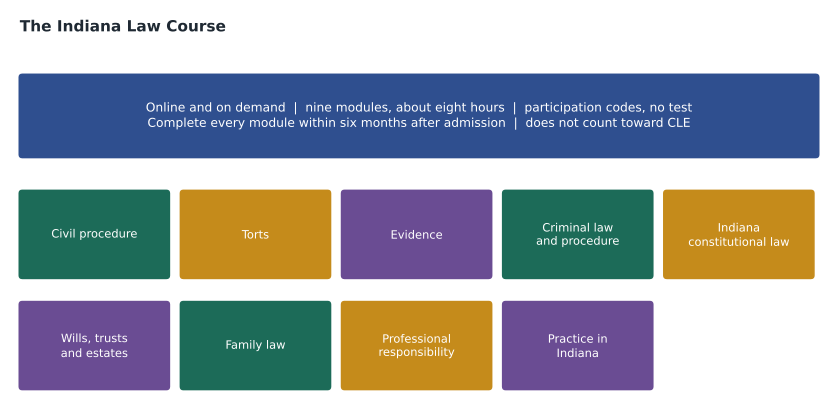
The Board's portal describes the course in practical terms. It is an online, on-demand course of nine modules that can be viewed separately, totaling about eight hours. Attendance is tracked with participation codes, and there is no formal test. Credit is given only when all nine modules are complete; there is no partial credit. The course does not count toward annual continuing legal education credits or toward the Rule 6 requirements. And the deadline matters: failing to finish within the time allowed can lead to sanctions, including suspension of the lawyer's license.
The modules cover civil procedure, torts, evidence, criminal law and procedure, Indiana constitutional law, wills, trusts and estates, family law, professional responsibility, and the practical aspects of practicing in Indiana. Those topics map closely onto Lessons 7 through 10 of this course, which preview the Indiana law a new lawyer meets first.
| Feature | Indiana Law Course |
|---|---|
| Who must take it | Lawyers admitted on a UBE score earned in Indiana or transferred; also described as required for Rule 6 admittees and business counsel licensees |
| When | No later than six months after admission for UBE admittees; Rule 6 admittees should confirm their deadline |
| Format | Online, on demand, nine modules, about eight hours |
| Testing | Participation codes, no formal test |
| Credit | All nine modules required; does not count toward annual CLE |
| Consequence of missing it | Possible sanctions, including suspension |
Planning the course into the first months
Marchetti suggested Hannah plan the course the way she planned the bar: as dates on a calendar. If Hannah passes in February and is admitted in the spring, her six months run into the fall. She should not wait until the last month, when a busy stretch at work could push her past the deadline. The course also helps with the job: its modules preview the Indiana procedure and substantive law she will see in her firm's files.
The six-hour Applied Professionalism Program that Indiana requires of newly admitted attorneys is a separate obligation. It counts toward continuing legal education, while the Indiana Law Course does not. Lesson 11 covers CLE.
Why the exam and Indiana law can differ
The UBE tests general principles: majority rules, the Federal Rules of Civil Procedure and Evidence, the common law and uniform acts. Indiana law sometimes agrees and sometimes does not. The danger is not that Indiana law will appear on the exam; it will not. The danger runs the other way: a candidate who works with Indiana law every day, as Hannah does at her firm, may apply an Indiana rule on the MBE or MEE where the general rule is expected.
Marchetti gave three examples from Hannah's own work. Indiana uses modified comparative fault with a bar when the plaintiff's fault exceeds 50 percent; the MBE generally assumes pure comparative negligence unless a question says otherwise. Indiana has its own Trial Rules, which follow the federal rules in many ways but differ in details; the MBE tests the Federal Rules. And Indiana follows notice pleading in its state courts, while the MBE tests the federal plausibility standard from Twombly and Iqbal. On exam day, the general rule wins.
Worked problem
Which rule applies?
An MBE question describes a plaintiff found 55 percent at fault for her own injuries and asks what she recovers. The question says nothing about the jurisdiction's rule.
Show solution
- The MBE expects the general approach unless the question specifies otherwise.
- NCBE's instructions for torts point to pure comparative negligence as the default.
- Under pure comparative negligence, the plaintiff recovers 45 percent of her damages.
- Under Indiana's modified rule she would recover nothing, but that rule is not what the MBE tests.
Answer: On the exam she recovers 45 percent of her damages; in an Indiana courtroom she would be barred.
A habit for the next three months
Marchetti gave Hannah a simple exercise: every time she met an Indiana rule at work that differed from the bar rule, she wrote it in a two-column notebook, Indiana on one side and exam on the other. The notebook served two purposes. Before the exam, it kept the two systems separate. After admission, it became a head start on the Indiana Law Course.
Common mistakes
MistakeStudying Indiana law for the February exam.
InsteadThe Indiana UBE tests only the national components; Indiana law is learned through the Indiana Law Course after admission.
MistakeLeaving the Indiana Law Course until the deadline.
InsteadAll nine modules are required within six months of admission, and missing the deadline can lead to suspension.
MistakeCounting the Indiana Law Course toward CLE.
InsteadIt does not count toward annual CLE; the separate Applied Professionalism Program does.
MistakeApplying Indiana's 51 percent bar on an MBE torts question.
InsteadUse the general rule the exam expects unless the question says otherwise.
Practice problems
Work each problem on paper first, then reveal the answer to check.
Does Indiana require a state law component before admission on a UBE score?
Show answer
No; NCBE lists no pre-admission component.
When must a UBE admittee complete the Indiana Law Course?
Show answer
No later than six months after admission.
How long is the Indiana Law Course and how is it structured?
Show answer
About eight hours in nine online modules, with participation codes and no test.
Name two topics covered by the course.
Show answer
Any two of civil procedure, torts, evidence, criminal law and procedure, Indiana constitutional law, wills trusts and estates, family law, professional responsibility and practice in Indiana.
Hannah's two-column notebook
By the end of November, Hannah's notebook had a dozen entries. Marchetti asked her to read them aloud, and the group turned them into a table that every Indiana candidate could use. The left column is what a candidate should apply on the UBE unless a question says otherwise. The right column is what an Indiana lawyer applies in an Indiana court. Each Indiana entry is explained later in this course.
| Topic | On the UBE (general rule) | In Indiana practice |
|---|---|---|
| Comparative fault | Pure comparative negligence unless the question says otherwise | Modified comparative fault; barred above 50 percent (Lesson 8) |
| Claims against government | General negligence principles | Tort Claims Act notice and immunities; contributory negligence still applies (Lesson 8) |
| Pleading | Federal plausibility standard under Twombly and Iqbal | Notice pleading under the Indiana Trial Rules (Lesson 7) |
| Summary judgment | Federal Celotex approach | Hughley: the movant must affirmatively negate an element (Lesson 7) |
| Evidence | Federal Rules of Evidence | Indiana Rules of Evidence, similar in structure with Indiana differences |
| Dividing marital property | Not tested on the MEE since July 2026; law supplied if it appears on an MPT | One pot, with a presumption of equal division (Lesson 9) |
| Wills | Not tested on the MEE since July 2026; law supplied if it appears on an MPT | Two witnesses; self-proving clause; electronic wills (Lesson 9) |
| Search and seizure | Fourth Amendment | Fourth Amendment plus Article 1, Section 11 and the Litchfield test (Lesson 10) |
Marchetti stressed that the left column is not a set of wrong answers. It is the body of general law the exam measures, and an Indiana lawyer will use much of it too, especially in federal court. The point of the table is to know which box a question belongs in.
A short drill
To test the habit, Marchetti read the group six short prompts and asked whether each called for the exam rule or the Indiana rule. First: an MBE question about whether a federal complaint states a claim. Exam rule, the federal plausibility standard. Second: Hannah's supervising lawyer asks whether a defendant in Monroe County can win summary judgment by pointing out that the plaintiff has no expert yet. Indiana rule, and under Hughley the answer is probably no. Third: an MEE torts question in which the plaintiff is 40 percent at fault and the call says nothing about the jurisdiction. Exam rule, and the plaintiff recovers 60 percent of her damages under pure comparative negligence. Fourth: a client injured by a town garbage truck. Indiana rule, starting with the Tort Claims Act notice deadline. Fifth: an MPT with a library of statutes on dividing marital property in a fictional state. Neither: use the library, because the MPT supplies the law. Sixth: a suppression motion in an Indiana criminal case. Both, because Indiana lawyers raise the Fourth Amendment and Section 11 together.
The fifth prompt surprised the group. Marchetti explained that MPT libraries are written for a fictional jurisdiction, and the candidate must apply the law in the library even if it differs from both the general rule and Indiana law. A candidate who imports Indiana's one-pot rule into an MPT that supplies a different rule loses credit for not following the materials.
What each module previews
The Indiana Law Course modules line up with the rest of this course. The civil procedure module covers the Indiana Trial Rules and how state practice differs from federal practice, which Lesson 7 introduces. The torts module covers the Comparative Fault Act, the Tort Claims Act and the Medical Malpractice Act, the subject of Lesson 8. The evidence module covers the Indiana Rules of Evidence, which follow the federal rules in structure but include Indiana provisions, such as a rule requiring that many custodial interrogations in felony cases be electronically recorded to be admissible. The criminal law and procedure module and the Indiana constitutional law module connect with Lesson 10. The wills, trusts and estates and family law modules connect with Lesson 9. The professional responsibility module covers the Indiana Rules of Professional Conduct, and the final module covers practical matters such as e-filing, court administration and the institutions of the Indiana bar.
Because each module is short, Marchetti suggested Hannah take one module a week after admission, matching it to whatever her firm's files were raising at the time. A module on family law taken the week she sits in on her first dissolution hearing will stick far better than the same module watched at speed in the last week of the deadline.
Keeping the notebook useful
Marchetti gave Hannah two rules for the notebook. Each entry should cite its source, such as a Trial Rule number, an Indiana Code section or a case name, so that she can find the authority again later. And each entry should be short enough to read in a few seconds, with the exam rule and the Indiana rule stated in one line each. A notebook full of long notes will not be read; a notebook of short contrasts will be, both in the last weeks before the exam and in the first months of practice, when Hannah will open it whenever a file raises one of the issues.
Where to find Indiana law
New lawyers also need to know where Indiana law lives. The Indiana Code contains the statutes, organized by title, article and chapter, so that a citation such as Indiana Code 34-51-2 points to title 34, article 51, chapter 2. The Indiana Administrative Code contains agency regulations. The Indiana Supreme Court publishes its rules, including the Trial Rules, the Rules of Evidence, the Rules of Appellate Procedure, the Rules of Criminal Procedure and the Admission and Discipline Rules, on the court's website. Opinions of the Supreme Court and the Court of Appeals are available through the courts' site and the usual research services. Marchetti's advice was to bookmark the official sources for the rules and the Code, because commercial summaries lag behind amendments.
Summary and key terms
- Indiana has no state law component before admission on a UBE score.
- UBE admittees must complete the online Indiana Law Course within six months after admission.
- The course has nine modules, about eight hours, with no test and no CLE credit.
- Missing the deadline can lead to sanctions, including suspension.
- On the exam, use the general rule; in practice, use Indiana law.
- Indiana Law Course
- Indiana's required online course on Indiana law, completed after admission.
- Jurisdiction-specific component
- A state law requirement a UBE jurisdiction adds to the national exam.
- Participation code
- A code used to track attendance in the Indiana Law Course modules.
- Applied Professionalism Program
- Indiana's required six-hour CLE program for newly admitted attorneys.
Lesson quiz · 5 questions
Score 60% or more to complete this lesson.
Create a free account to save your progress, take quizzes and earn a certificate.