
BAR-211 · Lesson 9 of 12 · 20 min
Georgia family law, wills, trusts and estates
▶ Video coming soon A video version of this lesson is on the way.
Family law and trusts, wills and estates are Georgia-only essay subjects, and Malik's firm handles both. He still finds the call useful. 'You know how a probate file works at your firm,' Marchetti tells him. 'The exam wants you to know why it works that way, and to spot the three or four Georgia rules that a lawyer from another state would get wrong.' This lesson covers Georgia divorce, property division, alimony, child custody and support, legitimation, wills, intestacy, year's support, probate and trusts. The rules are stated in general terms; the statutes have details and exceptions that a practitioner would check.
Divorce
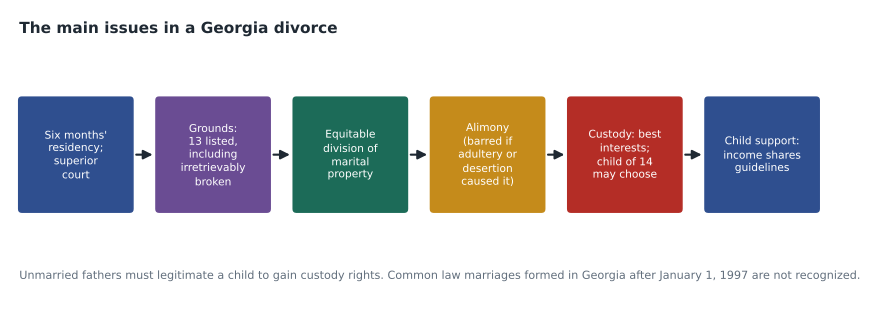
Georgia family law is mainly in Title 19 of the Official Code of Georgia Annotated. A Georgia divorce requires that at least one party has been a bona fide resident of Georgia for six months before filing, with some exceptions such as for persons living on military bases. Divorce cases are heard in superior court.
Georgia lists thirteen grounds for divorce. Most are fault grounds, such as adultery, desertion, cruel treatment, habitual intoxication and conviction of certain crimes. The last ground is that the marriage is irretrievably broken, Georgia's no-fault ground, and it is the ground used in most cases. A party may plead fault grounds as well, because fault can matter to alimony and to the division of property. An uncontested divorce on the no-fault ground cannot be granted until a short waiting period after service has passed.
Georgia abolished common law marriage for marriages formed after January 1, 1997. A common law marriage validly formed in Georgia before that date, or validly formed in a state that still allows it, is still recognized. Essays sometimes test whether a couple who began living together in the 1990s is married.
Property division and alimony
Georgia is an equitable division state, not a community property state. Marital property, generally property acquired during the marriage through the efforts of either spouse, is divided equitably, which does not necessarily mean equally. Separate property, such as property owned before the marriage or received by gift or inheritance, generally stays with the spouse who owns it, although appreciation caused by marital effort can become marital. If the parties have a jury trial, which Georgia allows in divorce cases on certain issues, the jury may decide the division of property.
Alimony is support from one spouse to the other. Georgia law bars alimony to a spouse whose adultery or desertion was the cause of the separation. Otherwise, the court or jury weighs factors such as the length of the marriage, the parties' standard of living, their ages and health, their financial resources and earning capacity, contributions to the marriage and the condition of each party after the division of property. Alimony may be temporary or permanent, periodic or lump sum. Prenuptial agreements are enforceable in Georgia if they meet requirements of fair disclosure and fairness that Georgia courts have developed.
Child custody
Custody decisions are made in the best interests of the child. Georgia distinguishes legal custody, the right to make major decisions, from physical custody, where the child lives, and courts may award joint custody of either kind. Parties must submit parenting plans that address schedules, holidays, decision-making and similar issues.
Georgia has a distinctive rule about a child's preference. A child who has reached age 14 may choose which parent to live with, and the choice is presumptive unless the court finds that the chosen parent is not fit or that the choice is not in the child's best interests. For children between 11 and 14, the court considers the child's wishes and educational needs but the choice is not presumptive. Essays on custody often include a teenager with strong views.
Child support
Georgia calculates child support under income shares guidelines, which have applied since 2007. The court combines both parents' gross incomes, finds the basic child support obligation for that combined income and number of children from the statutory table, and divides it between the parents in proportion to their incomes. Adjustments are made for health insurance, work-related child care and deviations such as extraordinary expenses or parenting time, with written findings required for deviations. Support generally continues until the child turns 18, or up to 20 if the child is still in high school.
Legitimation
A father who is not married to the mother has no legal right to custody or visitation, and no right to inherit from the child, until he legitimates the child. Legitimation is a court proceeding, usually in superior court, in which the father asks the court to declare the child legitimate. Paternity alone, established for child support, does not give the father custody rights. The distinction between paternity and legitimation is a frequent Georgia essay issue.
Worked problem
A custody and legitimation question
Andre and Simone had a son, Darius, in 2011. They never married. Andre has paid child support since a 2012 paternity order. Darius, now 15, wants to live with Andre in Columbus rather than with Simone in Savannah. What should Andre do?
Show solution
- Legitimation: a paternity order for support does not give Andre custody rights. He should petition to legitimate Darius, which he can combine with a request for custody.
- Child's election: Darius is over 14, so his choice to live with Andre is presumptive unless the court finds Andre unfit or the choice not in Darius's best interests.
- Parenting plan and support: the court will adopt a parenting plan and recalculate child support under the income shares guidelines, which may now run from Simone to Andre.
- Venue and court: legitimation and custody are matters for superior court; venue rules for legitimation and custody modification should be checked.
Answer: Andre should file for legitimation and custody. Once he has legitimated Darius, Darius's election, as a 15-year-old, will carry presumptive weight, subject to the court's best-interest review.
Wills
Georgia's law of wills is in its Revised Probate Code, Title 53. A person who is at least 14 years old and has testamentary capacity may make a will. The will must be in writing, signed by the testator or by someone at the testator's direction and in the testator's presence, and attested and subscribed in the testator's presence by two competent witnesses. Georgia does not recognize holographic wills that lack the required witnesses. A will may be made self-proved by an affidavit of the testator and witnesses, which avoids the need to call the witnesses at probate.
Georgia has two revocation rules that differ from many states. First, a divorce revokes provisions in the will for the former spouse, unless the will provides otherwise. Second, a later marriage or the birth or adoption of a child after the will was made can revoke the whole will unless the will was made in contemplation of that event. A candidate who writes the general pretermitted-child rule, which gives the child a share but leaves the will standing, misses Georgia's broader rule.
Intestacy
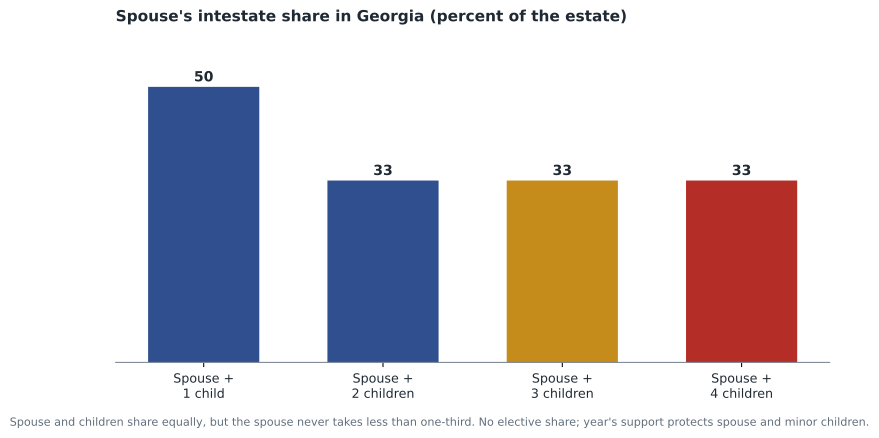
When a person dies without a valid will, Georgia's intestacy statute divides the estate. A surviving spouse and children share the estate equally, with each taking an equal share, except that the spouse's share is never less than one-third. If there are no children, the surviving spouse takes the whole estate. If there is no spouse, the children take equally, and descendants of a deceased child take that child's share. Without spouse or descendants, the estate passes to parents, then siblings and their descendants, and then more distant relatives.
| Survivors | Spouse's share | Children's share |
|---|---|---|
| Spouse and one child | One-half | One-half |
| Spouse and two children | One-third | One-third each |
| Spouse and four children | One-third (minimum) | One-sixth each |
| Spouse, no descendants | All | None |
Year's support
Georgia has no elective share, the right found in most states for a surviving spouse to take a fixed fraction of the estate regardless of the will. Instead, Georgia provides year's support. A surviving spouse and minor children may petition the probate court for an award of property from the estate sufficient for their support and maintenance for 12 months from the date of death. Year's support has priority over most other claims against the estate, including many debts and gifts in the will, and it can include the family home. The petition must be filed within a time limit after death, generally 24 months, and other interested persons may object to the amount. Year's support is a favorite Georgia essay topic because it surprises candidates trained on the elective share.
Worked problem
Disinheriting a spouse in Georgia
Harold's will leaves everything to his adult daughter from a first marriage and nothing to his second wife, Ruth, who lives in the house titled in Harold's name. Harold dies in 2026 owing 40,000 dollars on a credit card. What can Ruth do?
Show solution
- No elective share: Georgia has no elective share, so Ruth cannot claim a fixed fraction of the estate against the will.
- Year's support: Ruth can petition the probate court for year's support, property sufficient to support her for 12 months after Harold's death, filed within the time limit.
- Priority: a year's support award generally has priority over the credit card debt and over the gift to the daughter in the will.
- The house: the award can include the house if the amount is reasonable for her support and standard of living; the daughter may object to the amount.
Answer: Ruth's remedy is year's support, not an elective share. Depending on the estate's size, year's support may give her the house ahead of both the creditor and the daughter.
Probate and administration
Wills are probated in the probate court of the county where the testator was domiciled. Georgia offers probate in common form, which is quick and does not require notice to heirs but can be challenged for a period afterward, and probate in solemn form, which requires notice to the heirs and is conclusive once completed. An heir who wants to challenge a will files a caveat, raising grounds such as lack of capacity, undue influence, fraud or improper execution. The executor named in a will, or an administrator appointed when there is no will, serves as personal representative, collects assets, pays debts and distributes the estate. Georgia allows estates to be administered with relatively little court supervision when the will or the heirs grant the personal representative broad powers.
Trusts
Georgia's trust law is in the Georgia Trust Code of 2010, which drew on the Uniform Trust Code but kept Georgia features. An express trust requires intent, a trust property, a beneficiary and, for a trust of land, a writing. Trustees owe fiduciary duties of loyalty, prudence and impartiality, and Georgia follows the prudent investor rule. Spendthrift provisions are generally enforceable. Revocable trusts are common in Georgia estate planning, and a revocable trust becomes irrevocable at the settlor's death. Essays on trusts often ask whether a trust was validly created, whether a trustee breached a duty, or how a trust interacts with year's support or with a will.
Common mistakes
MistakeApplying community property rules to a Georgia divorce.
InsteadGeorgia divides marital property equitably; it is not a community property state.
MistakeTelling an unmarried father that a paternity order gives him custody rights.
InsteadHe must legitimate the child to gain custody and visitation rights.
MistakeGiving a surviving spouse an elective share.
InsteadGeorgia has no elective share; the protection is year's support.
MistakeTreating a later-born child as a pretermitted heir with the will left standing.
InsteadIn Georgia, a later marriage or birth of a child can revoke the will unless it was made in contemplation of that event.
Practice problems
Work each problem on paper first, then reveal the answer to check.
Can a spouse whose adultery caused the separation receive alimony in Georgia?
Show answer
No. Georgia bars alimony to a spouse whose adultery or desertion caused the separation.
A 17-year-old Georgian writes and signs a will in her own handwriting with no witnesses. Is it valid?
Show answer
No. She is old enough (14 or older), but Georgia requires two attesting witnesses and does not recognize unwitnessed holographic wills.
A man dies intestate, survived by his wife and three children. How is the estate divided?
Show answer
Equal shares would be one-fourth each, but the spouse must receive at least one-third, so the spouse takes one-third and the three children share the remaining two-thirds equally (two-ninths each).
Intestacy and year's support together
When a Georgia resident dies without a will and leaves a spouse and children, the spouse and children share the estate equally, but the spouse always receives at least one-third. With one child the spouse takes half; with three or more children the one-third floor controls. Georgia has no elective share, so a spouse disinherited by a will relies on year's support, which provides support for 12 months for the spouse and minor children and has priority over most other claims against the estate. A strong answer on an estate essay checks both: what the spouse takes by will or intestacy, and whether year's support should be claimed.
Summary and key terms
- Georgia divorce requires six months' residency; most cases use the no-fault irretrievably broken ground; property is divided equitably.
- Alimony is barred when the recipient's adultery or desertion caused the separation; a child of 14 may choose a custodial parent, presumptively.
- Unmarried fathers must legitimate a child to gain custody rights; child support uses income shares guidelines.
- Wills need two witnesses (no holographic wills); a later marriage or child can revoke a will; there is no elective share, but year's support protects the spouse and minor children.
- Equitable division
- Dividing marital property fairly, though not necessarily equally, at divorce.
- Legitimation
- A court proceeding by which an unmarried father establishes his legal relationship and rights to a child.
- Year's support
- Property awarded from an estate to a surviving spouse and minor children for 12 months' support, with priority over most claims.
- Solemn form
- Probate of a will with notice to the heirs, conclusive once completed.
Lesson quiz · 5 questions
Score 60% or more to complete this lesson.
Create a free account to save your progress, take quizzes and earn a certificate.