
BAR-211 · Lesson 2 of 12 · 19 min
Eligibility, education, deadlines and fees
▶ Video coming soon A video version of this lesson is on the way.
Malik's second call with Marchetti is about forms. 'Georgia has two applications, two fees and two sets of deadlines,' she tells him. 'Most people who lose a Georgia exam cycle don't lose it on the essays. They lose it on a date.' This lesson covers who is eligible to sit the Georgia exam, the two filings every applicant makes, the deadlines for the February and July exams, and the fees. The figures are the ones published for the February and July 2027 exams as of November 2026. The Office of Bar Admissions revises them, so the current schedule on its website controls.
Who may sit the exam
The standard route to the Georgia exam has two educational requirements. The applicant must hold a bachelor's degree, such as a BA, BS or BBA, from an institution accredited by an agency recognized for that purpose, and a JD or equivalent first law degree from a law school approved by the ABA. Georgia's admission rules treat the ABA approval requirement seriously. A graduate of a law school that is not ABA approved, including a Georgia school with only state approval, should read the current rules closely and ask the Office before filing, because exceptions are narrow and depend on the school and the date of graduation.
Law students may begin the process before graduating. Fitness certification can be requested during law school, and an applicant may file the exam application before the degree is conferred, as long as the law school later certifies the degree by the transcript deadline. A current law student pays a lower exam application fee than a graduate, which rewards early filing.
Foreign-educated applicants
Georgia has a separate route for lawyers educated outside the United States. In summary, a foreign-educated applicant must have graduated from a law school that is sanctioned and regulated by the government of the country where it is located, must be authorized to practice law in that country, and must have completed, or be enrolled in, a qualifying Master of Laws (LLM) program at an ABA-approved law school that meets Georgia's curriculum requirements. As of 2026, prep providers that track the rule list the University of Georgia, Georgia State University and Emory University as schools whose LLM programs qualify.
The foreign-educated applicant must first file a Petition for Admission of Foreign-Educated Applicants, which includes the fitness application. Only after the petition is approved may the applicant file to sit the exam. The petition fee was published at 1,000 dollars. Ngozi, the New York LLM candidate from the core courses, asks whether her New York route would work in Georgia. Marchetti tells her no: Georgia evaluates foreign education under its own rule, and an LLM from a school outside Georgia's approved list may not qualify. She would need to read the rule and petition, and she would still sit the full Georgia exam.
Two filings: fitness and the exam
Every applicant files two separate applications with the Office of Bar Admissions.
The first is the Application for Certification of Fitness to Practice Law. It goes to the Board to Determine Fitness of Bar Applicants and covers the applicant's background in detail: education, employment, residences, criminal history, civil litigation, finances, bar admissions elsewhere and similar matters. The applicant pays the fitness fee, files the application, and then completes fingerprinting and uploads supporting documents. Lesson 3 covers the review itself. A certification is generally valid for five years, so an applicant certified in 2026 does not need to recertify for an exam in 2027 or 2028, but must keep the application current.
The second is the Application to Take the Georgia Bar Examination. It is filed for a specific exam, February or July, during that exam's filing period. It is short compared with the fitness application, but it carries its own fee, its own deadline and its own requirements, such as the transcript and, for candidates who will type their answers, laptop registration.
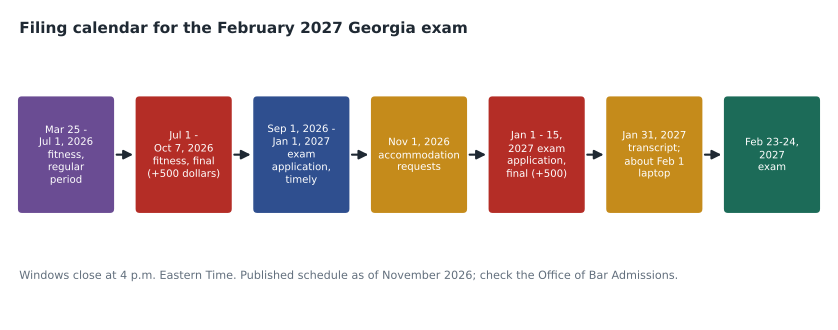
Deadlines for the February 2027 exam
For the February 2027 exam, the published schedule is:
| Filing | Window | Notes |
|---|---|---|
| Fitness application, regular period | March 25 to July 1, 2026 | Standard fee |
| Fitness application, final period | July 1 to October 7, 2026 | Late fee of 500 dollars |
| Exam application, timely period | September 1, 2026 to January 1, 2027 | Standard fee |
| Exam application, final period | January 1 to January 15, 2027 | Additional 500 dollars |
| Testing accommodations request | By November 1, 2026 | With supporting documentation |
| Law school transcript | By January 31, 2027 | Must show the degree and conferral date |
| Laptop registration | About February 1, 2027 | Closes about two weeks before the exam |
For the July 2027 exam, the pattern shifts by about six months. The fitness application's regular period ran from October 21 to December 2, 2026, and its final period runs from December 2, 2026 to March 3, 2027, again with a 500-dollar late fee. The exam application's timely period is expected to run from March 1 to June 1, 2027, with a final period to June 15, 2027. The Office labels some of these July dates as estimates until it confirms them.
Two features of the schedule surprise candidates from other states. First, the fitness deadline for an exam falls months before the exam application deadline. An applicant who decides in December to sit the February exam is already too late for fitness unless he or she was certified earlier. Second, the windows close at 4 p.m. Eastern Time on the stated date, not at midnight. Marchetti makes Malik put both facts on a sticky note.
Fees
The published fees as of November 2026 are listed below. The exam application fees include the NCBE fee for the MBE and MPT, which the Office collects and forwards.
| Item | Fee |
|---|---|
| Fitness application filed before the first law degree is awarded | 450 dollars |
| Fitness application filed after the first law degree is awarded | 750 dollars |
| Fitness application for the one-day Attorneys' Examination | 1,200 dollars |
| Foreign-educated applicant petition (includes fitness) | 1,000 dollars |
| Admission on motion petition (includes fitness) | 2,500 dollars |
| Fitness recertification | 800 dollars |
| Exam application, current law student | 400 dollars (includes 107 dollars for NCBE) |
| Exam application, law school graduate | 550 dollars (includes 107 dollars for NCBE) |
| One-day Attorneys' Examination application | 550 dollars (includes 35 dollars for NCBE) |
| Late filing in a final period | 500 dollars added |
| Laptop or handwriting fee | 105 dollars |
The fee structure rewards early filing in two ways. A law student who files for fitness before graduating pays 450 dollars instead of 750, and a law student who files the exam application before graduating pays 400 dollars instead of 550. Malik filed his fitness application in June 2026, after he graduated, so he paid 750. He grumbles. Marchetti points out that his classmates who waited until the final period paid 1,250.
Worked problem
Totaling Malik's filing costs
Malik filed for fitness after graduation during the regular period, will file his exam application during the timely period as a graduate, and will type his essays. What does he pay the Office in total, before any card convenience fees?
Show solution
- Fitness application after the degree, regular period: 750 dollars.
- Exam application as a graduate, timely period: 550 dollars, of which 107 dollars goes to NCBE.
- Laptop fee: 105 dollars.
- Total: 750 + 550 + 105 = 1,405 dollars.
Answer: Malik pays 1,405 dollars to the Office. Had he filed both applications in their final periods, he would have paid two 500-dollar late fees as well, for 2,405 dollars. The MPRE fee, paid to NCBE separately, is not included.
Typing or handwriting
Georgia allows candidates to type the essay and MPT answers on a laptop using the testing software the Office designates, or to write by hand. Either choice carries a 105-dollar fee. Candidates who type must select the laptop option on the exam application, pay the fee and register the laptop and software before the laptop deadline, which typically closes about two weeks before the exam. Candidates who miss that deadline write by hand. Marchetti's advice is to type unless you have a strong reason not to, and to run a full practice session with the software well before exam week.
Testing accommodations
Applicants with disabilities may request testing accommodations, such as extra time, a separate room or assistive technology. The request has its own deadline, November 1, 2026 for the February 2027 exam, and must be supported by documentation from a qualified professional. Requests filed late may not be decided in time. Medical emergencies that arise after the deadline are handled case by case. Candidates who received accommodations on the MPRE or in law school should still file a full Georgia request; Georgia decides for itself.
Transcripts and the degree
Each applicant's law school must send an official transcript directly to the Office, showing the degree and the date it was conferred. The transcript deadline for the February 2027 exam is January 31, 2027. Applicants should not request the transcript before the degree is posted, because a transcript without the degree does not satisfy the rule. Undergraduate transcripts are required as part of the fitness file, so applicants should arrange those early as well.
Repeat takers
Georgia publishes no limit on the number of times an applicant may sit the exam, according to prep providers that track the rule as of 2026. A repeat taker files a new exam application for each exam, pays the fee again and keeps the fitness certification current, recertifying if it lapses after five years. Repeat takers who want to move to a UBE or NextGen state should remember that a Georgia score never transfers, and that after July 2028 Georgia itself will give NextGen.
Common mistakes
MistakeWaiting until the exam application period to file for fitness.
InsteadThe fitness deadlines come first; for February 2027 the final fitness period closed October 7, 2026.
MistakeAssuming the deadline runs until midnight.
InsteadGeorgia's filing windows close at 4 p.m. Eastern Time on the stated date.
MistakeRequesting the law school transcript before the degree is posted.
InsteadThe transcript must show the degree and conferral date, and is due by the Office's transcript deadline.
MistakeAssuming an LLM from any ABA school qualifies a foreign-educated lawyer.
InsteadGeorgia requires an LLM meeting its own curriculum rules and an approved petition before the applicant can file for the exam.
Practice problems
Work each problem on paper first, then reveal the answer to check.
Kiara is a 3L who will graduate in May 2027 and wants to sit the July 2027 exam. When should she file for fitness, and what fee will she pay?
Show answer
She should file during the regular fitness period for July 2027 (October 21 to December 2, 2026). Because she has not yet received her degree, she pays the lower 450-dollar fee.
An applicant files his exam application on January 10, 2027 for the February exam. What happens?
Show answer
He is in the final period (January 1 to 15, 2027) and must pay an additional 500 dollars.
Why does Georgia ask for a transcript showing the degree date rather than a letter from the dean?
Show answer
The rule requires proof that the degree was actually conferred; an official transcript from the school is the required proof.
Building a personal filing calendar
Marchetti asks the study group to turn the published windows into a one-page calendar before anyone opens an outline. Malik's version has two columns. The first column tracks fitness certification: the date he filed in June 2026, the date the Board certified him in October 2026, and the date that certification will lapse if he does not use it. The second column tracks the exam application: the September 1 opening of the timely period, the January 1 close, the January 15 close of the final period, and the November 1 deadline for accommodation requests. A third short list holds the documents that arrive from other people, such as the final law school transcript due January 31 and any certificate of good standing a lawyer applicant must order.
The point of the exercise is to see which deadlines depend on someone else. Malik controls when he files and pays. He does not control how fast his law school certifies his degree, how fast a court in another state answers a records request, or how long a former employer takes to return a reference. Those outside steps are where most late fees begin, so Marchetti tells the group to start them first and to keep a note of when each request went out.
Fees in practice
Georgia charges separately for fitness and for the exam, and each charge rises if the applicant misses the regular window. Malik paid the regular fitness fee because he filed before July 1, 2026, and he plans to file his exam application in the timely period to avoid the higher fee that applies in the final period. A laptop fee applies to applicants who type the written portion. Applicants who sit again after an unsuccessful attempt pay the exam fee again but do not repeat the full fitness application while their certification remains valid, although they must keep their answers current.
Fees and windows change from year to year, and the Office of Bar Admissions posts the current schedule with each administration. The habit that protects a candidate is simple: read the current notice for the specific exam, copy every date into a calendar with a reminder a week ahead, and keep the payment receipts with the application file.
Questions that come up in the study group
Tre asks whether he can file the exam application before his fitness application is decided. He can: the two run in parallel, and many applicants file the exam application while fitness review is still open. What he cannot do is receive a Certificate of Eligibility, and therefore be admitted, until both are complete along with the MPRE score. Corinne asks whether a pending accommodation request delays the application. It does not delay filing, but the request has its own deadline and its own documentation, so she should treat it as a third application with its own checklist.
Summary and key terms
- Standard applicants need a bachelor's degree and a JD from an ABA-approved law school; foreign-educated lawyers petition separately with a qualifying LLM.
- Every applicant files two applications: fitness certification and the exam application, each with its own fee and deadlines.
- For February 2027, the final fitness period closed October 7, 2026, and the exam application is timely through January 1, 2027.
- Filing before graduation lowers both fees; final-period filings add 500 dollars each; windows close at 4 p.m. Eastern.
- Fitness application
- The Application for Certification of Fitness to Practice Law, reviewed by the Board to Determine Fitness of Bar Applicants.
- Exam application
- The separate application to sit a particular February or July exam.
- Final period
- The late filing window for a Georgia application, which carries an added 500-dollar fee.
Lesson quiz · 5 questions
Score 60% or more to complete this lesson.
Create a free account to save your progress, take quizzes and earn a certificate.