
BAR-211 · Lesson 6 of 12 · 18 min
The Georgia essays: subjects and how Georgia law appears
▶ Video coming soon A video version of this lesson is on the way.
Malik's sixth call is the first one about substance. Marchetti asks him to list the subjects he expects on the Georgia essays. He names the seven MBE subjects and stops. 'That's the trap,' she says. 'The essays test the MBE subjects too, but the Georgia-only subjects are where you separate yourself, and where Georgia law changes the answer you'd give on the MEE.' This lesson lists the essay subjects, explains how the Board drafts and grades the essays, and shows how Georgia law appears in them. Lessons 7 to 10 then teach the Georgia rules most worth knowing.
The subject list
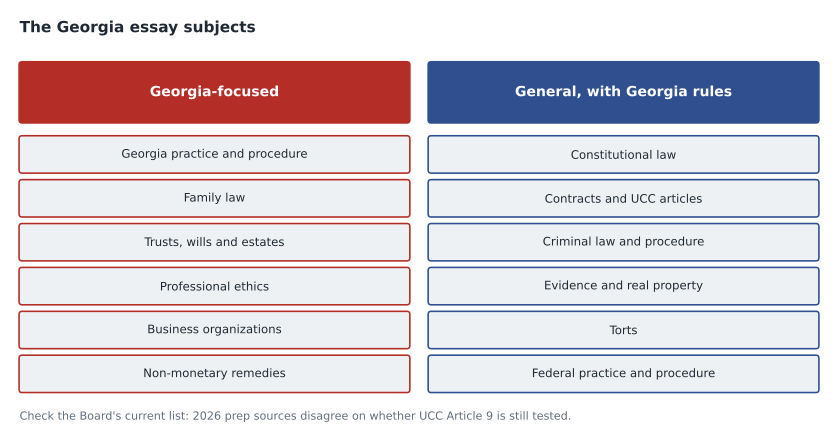
The Board of Bar Examiners publishes the subjects that may be tested on the essays. Prep providers that summarize the list as of 2026 agree on its core: business organizations, family law, federal practice and procedure, Georgia practice and procedure, non-monetary remedies, professional ethics, and trusts, wills and estates, together with Uniform Commercial Code articles and the MBE subjects (constitutional law, contracts, criminal law and procedure, evidence, real property and torts). The sources disagree on one point. Barbri's 2026 summary lists UCC Articles 2, 3 and 9. UWorld's 2026 summary lists Articles 2 and 3 and states that secured transactions under Article 9 are no longer tested on the essays. Because the Board's own list controls and was not available to this course, check the Board's current subject list before you decide how much Article 9 to review.
Two kinds of subjects
Marchetti divides the list into two groups. The first group is subjects that are largely Georgia-specific on the essays: Georgia practice and procedure, family law, trusts, wills and estates, professional ethics under the Georgia Rules of Professional Conduct, business organizations under Georgia's corporate and LLC statutes, and non-monetary remedies such as injunctions and specific performance. For these, a candidate who writes the general multistate rule will often miss the point the graders are looking for.
The second group is the general subjects: the MBE subjects, federal practice and procedure, and the UCC. For these, the general rule is usually the right starting point, and Georgia law appears only where Georgia has a distinctive statute or doctrine. Torts is the clearest example. A Georgia torts essay may turn on the apportionment statute or on the 2025 tort reform law, both of which differ from the multistate approach.
How the essays are written
Georgia essays tend to be practical. A typical question describes a client's situation and asks what the lawyer should advise, what claims or defenses are available, what procedural steps come next, or how a court is likely to rule. Many questions have several numbered sub-questions, and the sub-questions often move across subjects: a family law fact pattern might end with a question about the ethics of representing both spouses, or a probate question might include a procedural question about where the will must be filed. Candidates who answer each sub-question in order, with a heading for each, make the grader's job easier.
The essays reward application more than recitation. A paragraph that states a rule and then applies it to the specific facts, reaching a conclusion, earns more than a page of memorized rules. Marchetti's formula is the familiar one: state the issue, state the rule as it applies in Georgia, apply it to the facts, and conclude. She adds one Georgia-specific instruction. 'When Georgia has a statute, name it,' she says. 'You don't need the code section number, though it doesn't hurt if you know it. But say Georgia's apportionment statute or the Civil Practice Act, by name, so the grader knows you know it's Georgia law.'
How the essays are graded
Each essay is graded by Georgia graders, usually practicing lawyers, against a grading guide the Board prepares. Graders work relatively: they compare answers to one another and assign raw scores that sort answers from strongest to weakest, then the raw scores are scaled as Lesson 4 described. A candidate does not need a perfect answer to earn a strong score. An answer that spots the main issues, states the Georgia rules correctly, applies them to the facts and is organized clearly will usually score above the group's average.
Where Georgia law changes the answer
The table below lists some of the rules that Lessons 7 to 10 teach in more detail, with the general rule a candidate might write by habit.
| Topic | General or multistate habit | Georgia rule |
|---|---|---|
| Comparative fault | Pure comparative fault, or a 51 percent bar | Plaintiff barred at 50 percent or more; damages apportioned by percentage of fault |
| Answer deadline in civil cases | 21 days under the federal rules | 30 days after service under the Civil Practice Act |
| Renewal of a dismissed case | Often no renewal right | Renewal statute allows refiling within six months after dismissal of a valid case, in many circumstances |
| Surviving spouse protection | Elective share of the estate | No elective share; year's support for the spouse and minor children |
| Will witnesses | Two witnesses; holographic wills in some states | Two witnesses; no holographic wills |
| Custody preference of a child | Child's wishes considered | A child of 14 may choose the custodial parent, subject to the court's best-interest finding |
| Medical expenses in injury cases | Billed amounts often admissible | For claims arising on or after April 21, 2025, evidence of amounts actually paid or owed is admissible |
Federal practice and procedure
One Georgia subject surprises candidates: federal practice and procedure. The MBE already tests federal civil procedure, but the Georgia essays may ask about federal court practice in more detail, such as removal of a case from a Georgia court to federal court, federal jurisdiction over a Georgia dispute, or the relationship between federal and Georgia procedure in the same case. Candidates should be ready to compare the Federal Rules of Civil Procedure with Georgia's Civil Practice Act, because a common essay question asks what changes when a Georgia case is removed to the United States District Court for the Northern, Middle or Southern District of Georgia.
Professional ethics on the essays
Professional ethics appears as its own subject and as a sub-question in many fact patterns. The essays apply the Georgia Rules of Professional Conduct, which follow the ABA Model Rules closely but add Georgia features, such as a stated maximum penalty for violating each rule. A candidate who knows the Model Rules from the MPRE has most of what is needed, but should learn the Georgia differences covered in Lesson 10.
Worked problem
Spotting the Georgia issues in a short fact pattern
Keisha Wilkes, a Georgia resident, was injured when her car was struck by a delivery van in Fulton County in June 2025. She was not wearing a seat belt and was driving slightly over the speed limit. Her medical bills were 48,000 dollars, but her insurer paid 19,000 dollars to settle them. She wants to know what she can recover and what happens if she is found partly at fault. List the issues a Georgia grader will look for.
Show solution
- Apportionment: under Georgia's apportionment statute, Keisha's recovery is reduced by her percentage of fault, and she recovers nothing if she is 50 percent or more at fault.
- Medical expenses: because her claim arose after April 21, 2025, the 2025 tort reform law allows evidence of the amounts actually paid or necessary to satisfy the charges, not only the billed amount.
- Procedure: a negligence claim for personal injury must be filed within Georgia's two-year limitation period, and the defendant has 30 days after service to answer.
- Seat belt evidence: whether the jury may hear that she was not wearing a seat belt is governed by Georgia statute and the 2025 changes; state the rule carefully and note any limits.
- Damages structure: noneconomic damages, and the 2025 limits on how counsel may argue amounts to the jury.
Answer: A strong answer names Georgia's apportionment rule and the 2025 medical expense rule, applies both to Keisha's facts, and notes the procedural deadlines. A weak answer discusses comparative negligence in general terms and never mentions what Georgia changed.
Marchetti flags the seat belt point as a place to be careful. Georgia's seat belt evidence rule was the subject of debate during the 2025 reform session, and the summaries of the final law she relied on did not address it. 'If you aren't sure of a rule on exam day,' she says, 'say what you know, flag the uncertainty briefly and move on. Don't invent a statute.'
Building a study plan for the essays
Marchetti gives Malik a simple plan for January and February. Learn the Georgia-focused subjects first, using a short outline for each. Then write at least two timed practice essays a week, mixing Georgia-focused and general subjects, and compare each answer with a model answer to find missing issues. In the last two weeks, write a full timed afternoon of four essays in three hours at least twice. The goal is not to memorize every Georgia statute, but to make the main Georgia rules automatic, so that the 45 minutes per essay go to analysis rather than recall.
Common mistakes
MistakePreparing only the MBE subjects for the essays.
InsteadThe essays also test Georgia-focused subjects such as Georgia practice and procedure, family law, and trusts, wills and estates.
MistakeWriting the multistate rule when Georgia has a statute.
InsteadName and apply the Georgia rule, such as the apportionment statute or the 30-day answer deadline.
MistakeAssuming Article 9 is or is not tested because a prep course said so.
InsteadSources disagree in 2026; check the Board's current subject list.
MistakeAnswering sub-questions out of order without headings.
InsteadAnswer each numbered sub-question in order with a heading; graders work from a guide organized the same way.
Practice problems
Work each problem on paper first, then reveal the answer to check.
Name three subjects tested on the Georgia essays that the MBE does not cover.
Show answer
Any three of: Georgia practice and procedure, family law, trusts, wills and estates, business organizations, professional ethics, non-monetary remedies, federal practice and procedure (beyond the MBE), and UCC articles.
A Georgia essay asks whether a surviving spouse can claim a share of the estate despite the will. What Georgia rule should the answer address?
Show answer
Georgia has no elective share; the answer should discuss year's support for the surviving spouse and minor children.
Why should a candidate name Georgia statutes in an essay answer?
Show answer
To show the grader that the answer applies Georgia law rather than a general rule, which the grading guide rewards.
Writing a Georgia answer, not a general one
The most common reason a well-prepared candidate loses points on a Georgia essay is answering from the general rule when Georgia has its own. The grader expects the answer to state the Georgia rule, apply it to the facts and, where it matters, note how the result differs from the majority approach. Malik practices with a three-line habit for each issue: name the Georgia statute or doctrine, state its elements, and tie each element to a fact in the question.
Keisha's crash problem shows how this works. A general negligence answer would discuss comparative fault in broad terms. A Georgia answer states that under Georgia's apportionment statute a plaintiff found 50 percent or more at fault recovers nothing, and a plaintiff found less at fault has damages reduced by her percentage. It then applies the statute to Keisha's speed and her failure to wear a seat belt, notes the timing of the 2025 reforms against the June 2025 crash date, and discusses how the medical expense rule affects the 48,000 dollars of billed charges and the 19,000 dollars actually paid.
Time, structure and headings
With 45 minutes per essay, Malik spends about eight minutes reading and outlining and the rest writing. He uses a heading for each call of the question, so a grader can see at once that he answered every part. Short paragraphs that move from rule to application help more than long statements of law with no facts. When he is unsure of a Georgia detail, he states the rule he is confident about and moves on rather than guessing at a precise number.
Using past essays well
The Board publishes past essay questions and selected answers that scored well. Those materials show the style and depth graders reward. The study group reads a released answer only after writing its own, then compares structure rather than memorizing wording. Marchetti stresses that copying an answer from memory does not work: each new question changes the facts, and graders reward applying the rule to the facts in front of them.
A subject-by-subject reminder
Some subjects lean heavily on Georgia law: practice and procedure, family law, wills and estates, ethics under the Georgia rules, and business entities. Others, such as constitutional law and evidence, often track federal or general rules, with Georgia points where Georgia differs. Georgia adopted a new Evidence Code in 2013 modeled on the Federal Rules of Evidence, so much of the general evidence analysis carries over, but candidates should still note Georgia statutes where the question invites it.
Summary and key terms
- The essays test Georgia-focused subjects and the general MBE subjects, plus federal practice and UCC articles; check the Board's list for Article 9.
- Georgia essays are practical, often with several sub-questions crossing subjects; answer each in order with headings.
- Graders compare answers relatively; clear application of the Georgia rules to the facts earns the points.
- Where Georgia has a statute or distinctive doctrine, name it and apply it.
- Georgia practice and procedure
- The essay subject covering Georgia's courts, the Civil Practice Act and related procedure.
- Non-monetary remedies
- Equitable remedies such as injunctions, specific performance, declaratory relief and reformation.
- Relative grading
- Grading essays by comparing answers to one another rather than to a fixed standard.
Lesson quiz · 5 questions
Score 60% or more to complete this lesson.
Create a free account to save your progress, take quizzes and earn a certificate.