
BAR-211 · Lesson 1 of 12 · 19 min
Becoming a lawyer in Georgia
▶ Video coming soon A video version of this lesson is on the way.
Malik Ashford grew up in Macon, finished law school at a Georgia law school in May 2026 and took a job as a law clerk at a small Augusta firm that handles car wrecks, probate files and the occasional divorce. He planned to sit the Georgia bar exam in February 2027. When he joined Hollis Marchetti's Tuesday study group, he assumed his plan would look like everyone else's: take a commercial review course, sit the Uniform Bar Exam (UBE), and move his score wherever he ended up. Marchetti stopped him in the first five minutes. 'Georgia doesn't give the UBE,' she said. 'Your score stays in Georgia, and so does the essay law. Let's talk about what that means.'
That is the first lesson for anyone headed to the Georgia bar. Georgia is one of a small group of jurisdictions that never adopted the UBE. It gives its own two-day bar examination, built from two national tests and one Georgia test: the Multistate Bar Examination (MBE), two Multistate Performance Test (MPT) tasks, and four essay questions written by Georgia's own Board of Bar Examiners. Georgia also runs its own character review, called fitness certification, on its own timeline, without the National Conference of Bar Examiners (NCBE) character service that many states use. Marchetti scheduled a series of undated evening calls with Malik to walk through all of it. This course follows those calls.
Every practice question in this course was written for it. None comes from the Georgia Board of Bar Examiners, NCBE or any released exam. The rules, fees and deadlines in this course were checked against NCBE's published jurisdiction information, the State Bar of Georgia, Georgia statutes and other public sources as of November 2026. They change, and the Georgia Office of Bar Admissions has the final word. Confirm anything that matters with that office before you rely on it.
Who controls admission
Admission to the practice of law in Georgia belongs to the Supreme Court of Georgia. The court adopts the Rules Governing Admission to the Practice of Law and appoints two boards that do the work. The Board to Determine Fitness of Bar Applicants decides whether each applicant has the character and fitness to practice. The Board of Bar Examiners writes and grades the Georgia essays, administers the MBE and MPT, and decides who passed. Both boards are staffed by the Office of Bar Admissions, which sits in the Nathan Deal Judicial Center in Atlanta, next to the Supreme Court.
The two-board structure matters because the two halves of admission run separately. An applicant can be certified as fit years before sitting the exam, and an applicant can pass the exam while the fitness file is still open. Only when both boards are satisfied, and the applicant has met the remaining requirements such as the MPRE score, does the Office issue a Certificate of Eligibility. With that certificate, the applicant is sworn in, usually before a superior court judge or at a ceremony, and becomes a member of the State Bar of Georgia.
The State Bar of Georgia is a unified, or integrated, bar. Every lawyer who practices in Georgia must belong to it and pay its dues. The State Bar runs lawyer discipline under the Supreme Court's supervision, administers continuing legal education (CLE) requirements, and runs the Transition into Law Practice Program for new lawyers. It does not decide admission, which stays with the court and its boards.
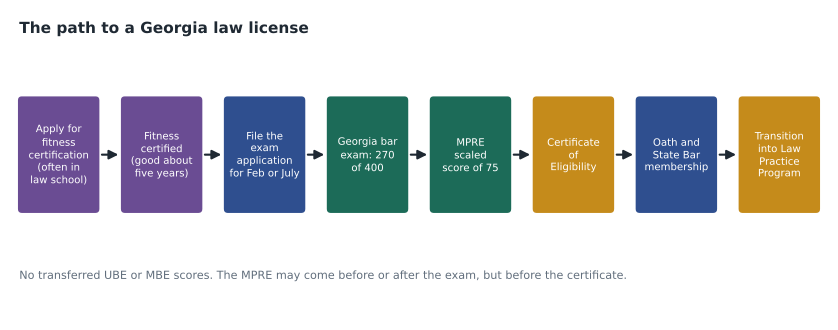
The requirements in one list
In summary, a first-time applicant who graduated from an American law school must:
Hold a bachelor's degree from an accredited institution and a JD from a law school approved by the American Bar Association (ABA), unless one of Georgia's narrow exceptions applies.
Apply for and receive fitness certification from the Board to Determine Fitness of Bar Applicants. The certification is generally good for five years.
File a separate application to sit the bar exam, by the exam's deadline, and have the law school send a transcript showing the degree and the date it was conferred.
Pass the Georgia bar examination with a total score of at least 270 on a 400-point scale.
Earn a scaled score of at least 75 on the Multistate Professional Responsibility Examination (MPRE) before the Certificate of Eligibility is issued.
Take the oath and enroll in the State Bar, then complete the Transition into Law Practice Program within the deadline.
Marchetti points out what is missing from that list. There is no clerkship requirement, as Delaware has, and no required online course on state law, as Arizona and Alabama have. Georgia tests its law on the essays instead, and it front-loads the character review so that it is usually finished before the exam.
The exam in brief
The Georgia bar examination is given twice a year, on the last Tuesday and Wednesday of February and July. The February 2027 exam falls on February 23 and 24, 2027. Day one is the written day: two 90-minute MPT tasks in the morning and four Georgia essays, about 45 minutes each, in the afternoon. Day two is the MBE, NCBE's 200-question multiple-choice test. Each day counts for half of the total. The written scores are converted to the MBE's scale and added to the scaled MBE score, and a total of 270 passes. Lesson 4 explains the scoring in detail.
| Feature | Georgia (February 2027 exam) |
|---|---|
| Exam | Georgia's own exam: two MPTs and four Georgia essays (Tuesday), MBE (Wednesday) |
| Passing score | 270 of 400 |
| Dates | February 23 and 24, 2027 |
| MPRE | Scaled score of 75, needed before the Certificate of Eligibility |
| Character review | Fitness certification from the Board to Determine Fitness, filed first and good for about five years |
| Score transfer in | None: Georgia accepts no transferred UBE or MBE scores |
| Admission on motion | Available for lawyers from reciprocal jurisdictions with five of the last seven years in practice |
| Next change | NextGen bar exam from July 2028, plus a Georgia-specific component |
What makes Georgia different
Candidates who prepared for the UBE elsewhere usually notice five differences, and each gets its own lesson.
Georgia writes its own essays. The four essays are drafted by the Board of Bar Examiners and test Georgia law in subjects such as Georgia practice and procedure, family law, and trusts, wills and estates, alongside the general subjects the MBE covers. A candidate who memorized the Multistate Essay Examination (MEE) outlines alone will miss the Georgia rules that the graders reward.
Georgia's score is not portable. Because the essays are Georgia's own, a Georgia score cannot be transferred to a UBE state, and Georgia accepts no UBE or MBE score from elsewhere. Malik's coach puts it simply: pick Georgia because you want to practice in Georgia.
Fitness comes first. Georgia asks applicants to file for fitness certification long before the exam, often during law school, and the deadline for the February exam's fitness filing falls in the summer or early fall before it. Missing that deadline can cost an applicant a whole exam cycle.
Georgia's courts and statutes have their own shape. Georgia's procedure statute, the Civil Practice Act, follows the federal rules in many places but not all. Its apportionment statute, its 2025 tort reforms, its year's support for surviving family members and its probate courts all show up on the essays and in the first year of practice. Lessons 7 to 10 cover them.
Georgia is moving to NextGen. The Supreme Court of Georgia announced in July 2024 that Georgia will give the NextGen bar exam beginning in July 2028, with a Georgia-specific component whose details had not been announced as of November 2026. Until then, the current exam continues.
Malik's starting point
At the end of the first call, Marchetti asks Malik three questions. Has he been certified as fit? Yes. He filed his fitness application in June 2026, during the regular filing period for the February 2027 exam, disclosed a minor-in-possession citation from college and a credit card account that went to collections during law school, and received his certification in October. Has he taken the MPRE? Yes, in August 2025, with a scaled score of 88. Has he filed the exam application? Not yet. The timely filing period for February 2027 runs from September 1, 2026 to January 1, 2027, so he still has time without a late fee.
'You're in better shape than most people who call me in November,' Marchetti says. 'Fitness is done, the MPRE is done. File the exam application this week so you don't forget, and then we'll spend the winter on the essays, because that's where Georgia candidates lose points they didn't need to lose.'
Worked problem
Building Malik's admission timeline
Malik wants to be sworn in as soon as possible after the February 23-24, 2027 exam. Using the requirements in this lesson, put his remaining steps in order.
Show solution
- File the bar exam application during the timely period (by January 1, 2027) and pay the graduate fee, plus the laptop fee if he will type.
- Confirm his law school has sent the official transcript showing his degree and conferral date by the Office's deadline.
- Keep his fitness application current, updating any changed answer within 30 days.
- Sit the exam on February 23 and 24, 2027.
- When results are released, usually about two months later, and if he passes, receive the Certificate of Eligibility (his MPRE score is already on file) and schedule his oath.
- Enroll in the State Bar and begin the Transition into Law Practice Program.
Answer: Because Malik's fitness certification and MPRE score are already in place, the only thing standing between him and the oath after a passing score is paperwork. Applicants who leave fitness until after the exam can wait months longer.
Why Georgia keeps its own exam
Malik asks why a large state with several law schools and a busy legal market still writes its own essays when most of the country gives the UBE. Marchetti gives three reasons that come up repeatedly in Georgia's public discussion of the exam.
First, the Board of Bar Examiners and the Supreme Court have long taken the view that new Georgia lawyers should be tested on Georgia law. Georgia procedure, Georgia probate and Georgia family law affect clients from the first week of practice, and the essays are the court's way of making candidates learn them.
Second, Georgia has a large population of applicants who will practice only in Georgia. Portability matters less to them than to graduates who might move. The court has chosen local testing over a portable score, and admission on motion remains available for experienced lawyers from reciprocal states.
Third, the system is changing anyway. The move to NextGen in July 2028 will bring Georgia closer to the national exam, while the planned Georgia component keeps a local piece. Candidates sitting before then take the current exam, and candidates who fail in early 2028 should plan for the transition, as Lesson 5 explains.
How this course is organized
Lessons 2 to 5 cover the admission process: eligibility and deadlines, fitness and the MPRE, the exam and its scoring, and the move to NextGen. Lesson 6 surveys the Georgia essays and how Georgia law appears on them. Lessons 7 to 10 teach the Georgia law that most often separates a passing essay from a failing one: courts and civil practice, torts and the 2025 reforms, family law and estates, and professional conduct, business organizations and remedies. Lesson 11 covers admission on motion, the Attorneys' Examination and what happens after admission. Lesson 12 is a capstone with practice essays and an exam-day plan.
Each lesson ends with a short quiz, and the course ends with a final exam. The quizzes test the facts and rules in the lessons, not general bar review, which the core courses in this program cover. If you are taking the Georgia exam, pair this course with MBE Review I and II for the multiple-choice day and with the essay and performance test courses for method.
Common mistakes
MistakeAssuming a UBE score from another state can be transferred to Georgia.
InsteadGeorgia does not give the UBE and accepts no transferred UBE or MBE scores; every new applicant sits the Georgia exam.
MistakeFiling the fitness application at the same time as the exam application.
InsteadFitness certification is a separate, earlier filing with its own deadlines; for a February exam the fitness deadlines fall the summer and early fall before.
MistakeThinking the State Bar of Georgia admits lawyers.
InsteadThe Supreme Court of Georgia admits lawyers through its two boards and the Office of Bar Admissions; the State Bar is the unified bar that every admitted lawyer joins.
MistakePreparing only from national MEE outlines.
InsteadGeorgia writes its own essays and rewards Georgia rules, especially in procedure, family law and estates.
Practice problems
Work each problem on paper first, then reveal the answer to check.
Name the two boards that handle admission in Georgia and what each decides.
Show answer
The Board to Determine Fitness of Bar Applicants decides character and fitness; the Board of Bar Examiners writes, administers and grades the exam and decides who passed.
What three tests make up the Georgia bar exam?
Show answer
The MBE, two MPT tasks and four Georgia essays written by the Board of Bar Examiners.
Can a lawyer who passed the UBE in Alabama transfer the score to Georgia?
Show answer
No. Georgia accepts no transferred UBE or MBE scores. The lawyer may sit the Georgia exam, sit the Attorneys' Examination if eligible, or seek admission on motion after enough years of practice in a reciprocal jurisdiction.
Summary and key terms
- The Supreme Court of Georgia controls admission through the Board to Determine Fitness of Bar Applicants, the Board of Bar Examiners and the Office of Bar Admissions.
- Georgia gives its own two-day exam: two MPTs and four Georgia essays on day one, the MBE on day two, with 270 of 400 to pass.
- Fitness certification is filed first and is generally good for five years; the MPRE score of 75 must be earned before the Certificate of Eligibility.
- Georgia accepts no transferred UBE or MBE scores and moves to the NextGen bar exam, with a Georgia component, in July 2028.
- Board to Determine Fitness of Bar Applicants
- The Georgia board that reviews character and fitness and certifies applicants as fit to practice.
- Board of Bar Examiners
- The Georgia board that writes the Georgia essays, administers the exam and decides who passed.
- Certificate of Eligibility
- The document the Office of Bar Admissions issues when an applicant has met every requirement, allowing the applicant to take the oath.
- Unified bar
- A state bar to which every practicing lawyer must belong; the State Bar of Georgia is one.
Lesson quiz · 5 questions
Score 60% or more to complete this lesson.
Create a free account to save your progress, take quizzes and earn a certificate.