
BAR-211 · Lesson 11 of 12 · 17 min
Admission on motion, the Attorneys' Examination and practice after admission
▶ Video coming soon A video version of this lesson is on the way.
Malik will take the full exam, but two members of the study group will not. Dana, who is sitting the Texas exam, has a cousin with 12 years of practice in Tennessee who wants to move to Atlanta. Ngozi wants to know whether her eventual New York license would help her practice in Georgia. Marchetti uses this call to cover the other routes into the Georgia bar, the rules for lawyers who practice in Georgia temporarily, and what every new Georgia lawyer must do after taking the oath. As elsewhere in this course, the fees and requirements are the published ones as of November 2026; the Office of Bar Admissions and the State Bar publish the current versions.
Three routes into the Georgia bar
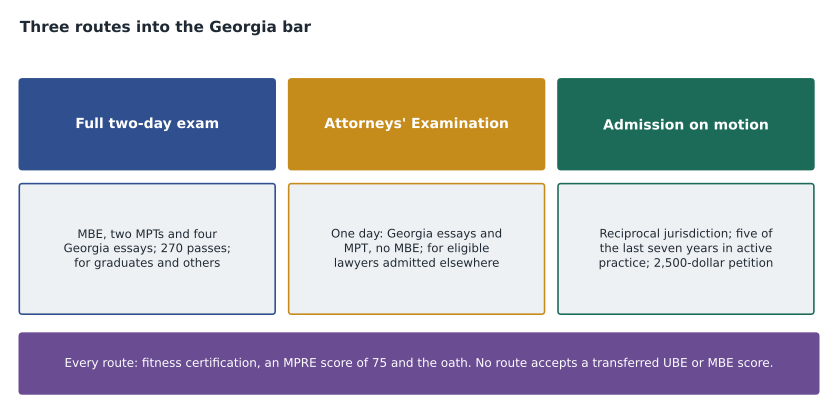
A lawyer can be admitted in Georgia in three main ways. First, by passing the full two-day Georgia bar examination, the route this course has followed. Second, by passing the one-day Attorneys' Examination, available to eligible lawyers already admitted elsewhere. Third, by admission on motion, without any examination, for experienced lawyers from jurisdictions that offer Georgia lawyers the same courtesy. Every route requires fitness certification, an MPRE score of 75 and the oath.
Admission on motion
Georgia allows admission without examination for lawyers from reciprocal jurisdictions, that is, jurisdictions that would admit a Georgia lawyer on motion on comparable terms. NCBE's Georgia information and prep provider summaries describe the main requirements as follows: a JD from an ABA-approved law school; admission by examination in a reciprocal jurisdiction, while meeting any stricter requirement that jurisdiction would impose on a Georgia lawyer; active practice of law for at least five of the seven years before applying; good standing in every jurisdiction where the applicant is admitted; no prior denial of fitness certification in Georgia and no prior failure of the Georgia bar exam; fitness certification; a statement of intent to practice in Georgia; and confirmation that the applicant has not engaged in unauthorized practice in Georgia. The petition fee, which includes the fitness application, was published at 2,500 dollars.
The reciprocity requirement is the one that trips people up. Georgia does not admit on motion a lawyer from a jurisdiction that refuses to admit Georgia lawyers on motion. The Office publishes the list of reciprocal jurisdictions, and it changes when other states change their rules. California, for example, has no admission on motion for anyone, so a California lawyer cannot use this route in Georgia.
Dana's cousin in Tennessee is a good candidate. Tennessee offers admission on motion, he was admitted there by examination, he graduated from an ABA-approved school, and he has practiced full time for 12 years. If Tennessee remains on Georgia's reciprocal list and his record is clean, he can petition for admission on motion, obtain fitness certification and be admitted without an exam. Marchetti warns that he must not open an Atlanta office or advise Georgia clients on Georgia law before he is admitted, because unauthorized practice in Georgia would disqualify him.
Worked problem
Is she eligible for admission on motion?
Leah graduated from an ABA-approved law school in 2015, passed the bar exam in a reciprocal state, practiced there full time from 2015 to 2020, stayed home with her children from 2020 to 2023, and returned to full-time practice in 2023. She applies in Georgia in November 2026. Is she eligible?
Show solution
- Practice requirement: Georgia requires at least five of the seven years before the application.
- Count the window: the seven years before November 2026 run from about November 2019 to November 2026.
- Count her practice: about November 2019 to 2020 (roughly one year) plus 2023 to November 2026 (about three years), for roughly four years.
- Result: she falls short of five years in the window, despite having more than eight years of practice in total.
Answer: Leah is not eligible yet. She could wait until her recent practice fills five of the last seven years, or take the one-day Attorneys' Examination if she meets its requirements, or sit the full exam.
The Attorneys' Examination
Georgia's one-day Attorneys' Examination is designed for lawyers already admitted in another United States jurisdiction who meet the eligibility requirements in the admission rules but do not qualify for admission on motion. It is given on the first day of the regular exam and consists of the Georgia essays and the MPT, without the MBE. It is therefore useful for experienced lawyers from non-reciprocal states, and for lawyers who lack the practice years for admission on motion. The fitness application fee for this route was published at 1,200 dollars and the exam application at 550 dollars, including 35 dollars for NCBE. Eligibility details, such as how long the applicant must have been admitted and in good standing, are set by the rules and should be checked before filing.
Foreign lawyers and foreign legal consultants
Lawyers educated abroad who want full admission follow the foreign-educated applicant route covered in Lesson 2: a petition, a qualifying LLM, fitness certification and the full exam. Georgia also allows a lawyer licensed in a foreign country to register as a foreign law consultant, permitted to advise on the law of the foreign country but not on Georgia or United States law, without becoming a full member of the bar. The fitness application for foreign law consultants was published at 1,500 dollars. Ngozi, whose home country license and New York admission would qualify her for different routes, decides to revisit the question after she is admitted in New York.
Practicing in Georgia without full admission
A lawyer admitted elsewhere may appear in a particular Georgia case by permission of the court, known as admission pro hac vice, under the uniform rules of Georgia's trial courts and the appellate courts' rules. The out-of-state lawyer generally must associate with a Georgia lawyer, pay a fee and be approved by the court for that case only. Georgia's Rules of Professional Conduct also permit limited temporary practice by lawyers admitted elsewhere, in circumstances that follow the ABA's multijurisdictional practice rule, but they do not allow a lawyer to establish a continuing presence in Georgia without admission. Unauthorized practice of law is a crime in Georgia and a ground for denial of fitness certification.
After the oath: the State Bar of Georgia
Once admitted, every new lawyer must join the State Bar of Georgia, pay dues and register an address. Active members must keep the State Bar informed of changes to their contact information, maintain trust accounts properly if they handle client funds, and comply with CLE. Lawyers who are not practicing may elect inactive status, with lower dues and no CLE obligation, but inactive members may not practice law in Georgia.
The Transition into Law Practice Program
Most newly admitted Georgia lawyers must complete the Transition into Law Practice Program, run by the State Bar with the Chief Justice's Commission on Professionalism. According to published summaries, the program pairs each new lawyer with an experienced mentor for a structured mentoring plan and requires 12 CLE hours, including six hours from the Beginning Lawyers Program, by December 31 of the year after the lawyer's admission. Exemptions apply to some lawyers, such as those admitted on motion with substantial experience elsewhere or those serving in certain judicial clerkships, and the program's own rules control. After completing the program, a lawyer moves into Georgia's regular CLE cycle.
Continuing legal education
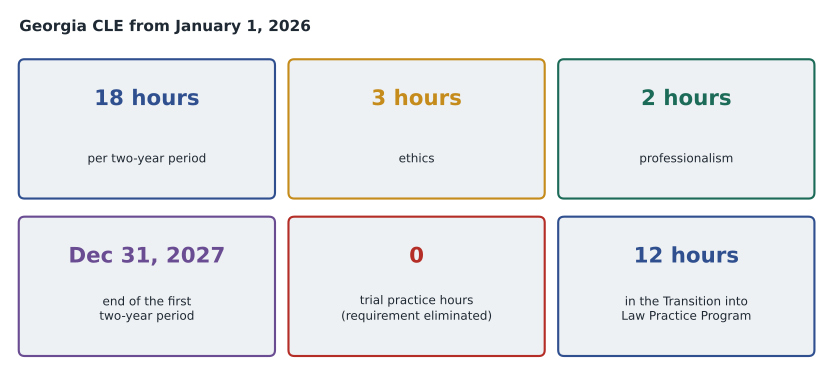
Georgia changed its CLE rules effective January 1, 2026. Under the old rules, active lawyers needed 12 hours a year, including one hour of ethics and one hour of professionalism, and lawyers who appeared in court as lead counsel needed additional trial practice hours. Under the new rules, published by the State Bar, the requirement is 18 hours every two years, including three hours of ethics and two hours of professionalism. The first two-year period runs from January 1, 2026 to December 31, 2027, and the deadline falls on December 31 of each odd-numbered year. The separate trial practice requirement was eliminated. All hours may be completed through approved online programs, and excess hours can carry over to the next period.
| Item | Old rules (through 2025) | New rules (from January 1, 2026) |
|---|---|---|
| Hours | 12 per year | 18 per two-year period |
| Ethics | 1 hour per year | 3 hours per period |
| Professionalism | 1 hour per year | 2 hours per period |
| Trial practice | 3 hours for lead trial counsel | Eliminated |
| Deadline | December 31 each year | December 31 of each odd-numbered year |
| First new period | January 1, 2026 to December 31, 2027 |
Noncompliance has consequences. The State Bar's published rules give a cure period after the deadline, then add a late fee, and finally report lawyers who remain noncompliant to the Supreme Court for suspension. Lawyers who have been active members for 40 years without serious discipline are exempt under the new rules, and lawyers who reached age 70 before 2026 remain exempt under the old age exemption.
Malik's plan after admission
Marchetti asks Malik to sketch his first two years as a lawyer, assuming he passes in February 2027 and is sworn in during the spring. He will join the State Bar, sign up for the Transition into Law Practice Program with a mentor at another Augusta firm, complete the program's 12 CLE hours, including the Beginning Lawyers Program, by December 31, 2028, and then fall into the regular two-year CLE cycle. 'And open your trust account correctly the first time,' Marchetti adds. 'More new lawyers get into trouble with trust money than with anything they learned for the exam.'
Common mistakes
MistakeAssuming any experienced lawyer can be admitted on motion.
InsteadGeorgia requires admission in a reciprocal jurisdiction, five of the last seven years of practice and the other listed conditions.
MistakeCounting total career years for admission on motion.
InsteadThe test is five of the seven years immediately before the application.
MistakeThinking the Attorneys' Examination includes the MBE.
InsteadIt is a one-day exam of the Georgia essays and the MPT, without the MBE.
MistakeApplying the old 12-hours-a-year CLE rule after 2025.
InsteadSince January 1, 2026, Georgia requires 18 hours per two-year period, including 3 ethics and 2 professionalism hours.
Practice problems
Work each problem on paper first, then reveal the answer to check.
A lawyer from a state that does not admit Georgia lawyers on motion has practiced for 15 years. What are her options?
Show answer
She cannot use admission on motion; she can take the one-day Attorneys' Examination if eligible, or the full exam.
What must most new Georgia lawyers complete by December 31 of the year after admission?
Show answer
The Transition into Law Practice Program, with mentoring and 12 CLE hours including six from the Beginning Lawyers Program.
How many CLE hours does a Georgia lawyer need for the 2026-2027 period?
Show answer
18 hours, including three of ethics and two of professionalism, by December 31, 2027.
Planning the first two years of practice
After admission, a new Georgia lawyer's first obligations are the Transition into Law Practice Program and annual State Bar dues. The program pairs the new lawyer with a mentor and requires 12 hours of CLE, including 6 hours from the Beginning Lawyers Program, by December 31 of the year after admission. Malik expects to be admitted in spring 2027, which would give him until the end of 2028 to finish. Once he completes the program, he moves to the regular CLE requirement: 18 hours per two-year period, including 3 hours of ethics and 2 hours of professionalism.
Inactive status, emeritus status and reinstatement
Georgia lawyers who stop practicing can change their membership status rather than let it lapse. Inactive members pay lower dues and are exempt from CLE, but cannot practice law in Georgia. A lawyer who returns to active status must satisfy the CLE and other requirements the State Bar sets for reinstatement. Lawyers who fail to pay dues or meet CLE deadlines can be suspended administratively, which is not a disciplinary sanction but still prevents practice until the problem is fixed.
Practicing in more than one state
Dana's cousin from Tennessee illustrates a common path: a lawyer admitted elsewhere who wants to move to Georgia. If he qualifies for admission on motion, he must still pass fitness review, show an MPRE score of 75 and take the oath. If he does not qualify, the Attorneys' Examination offers a shorter test than the full exam. In either case, he cannot practice Georgia law while the application is pending except under the narrow rules for temporary practice, so the safe plan is to start the application well before the move.
Summary and key terms
- Georgia admits lawyers by the full exam, the one-day Attorneys' Examination (essays and MPT, no MBE) or admission on motion.
- Admission on motion requires admission in a reciprocal jurisdiction, five of the last seven years of practice and fitness certification, among other conditions.
- Pro hac vice and limited temporary practice are available, but a continuing Georgia practice requires admission.
- New lawyers complete the Transition into Law Practice Program; CLE is now 18 hours every two years, including 3 ethics and 2 professionalism.
- Admission on motion
- Admission without examination for experienced lawyers from reciprocal jurisdictions.
- Attorneys' Examination
- Georgia's one-day exam for eligible lawyers admitted elsewhere, consisting of the Georgia essays and the MPT.
- Pro hac vice
- Permission for an out-of-state lawyer to appear in a single case.
- Transition into Law Practice Program
- Georgia's mentoring and CLE program for newly admitted lawyers.
Lesson quiz · 5 questions
Score 60% or more to complete this lesson.
Create a free account to save your progress, take quizzes and earn a certificate.