
BAR-211 · Lesson 12 of 12 · 16 min
Capstone: Georgia practice essays and an exam-day plan
▶ Video coming soon A video version of this lesson is on the way.
The last call before the holidays is a practice session. Marchetti sends Malik two original Georgia-style essay questions and asks him to write each in 45 minutes, as he will on the afternoon of February 23. Then they go through model answers together and build his plan for the exam itself. This lesson reproduces both essays, a model answer and grading points for each, a short MPT warm-up and the exam-day plan. The essays were written for this course and are not released Georgia questions. Try each one under time before reading the model answer.
Essay 1: torts and procedure
On August 3, 2025, Carla Benton was injured in Gwinnett County when her car was struck by a pickup truck owned by Peachtree Landscaping, LLC and driven by its employee, Omar Haskins, who ran a red light. Carla was talking on a handheld phone at the time. A gas station clerk, Ray Doyle, had sold Omar a six-pack of beer an hour earlier, when Omar was visibly unsteady and mentioned he was driving to a job site. Carla's medical providers billed 92,000 dollars, but her health insurer paid 38,000 dollars to satisfy the charges in full. Carla sued Omar and Peachtree in the State Court of Gwinnett County on July 20, 2027, and served both defendants on August 9, 2027. Peachtree did not answer until September 30, 2027.
Answer the following: (1) Is Carla's suit timely? (2) What is the status of Peachtree's answer, and what should Peachtree do? (3) If the jury finds Carla 25 percent at fault, Omar 55 percent and Ray Doyle's gas station 20 percent, what can Carla recover, and what must the defendants do to have the gas station's fault considered? (4) What evidence of medical expenses is admissible? (5) Can Carla recover punitive damages, and is there a cap?
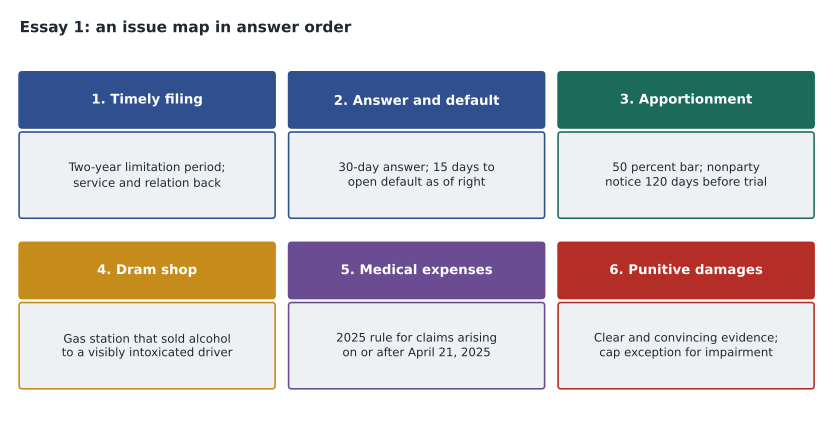
Model answer, part 1: timeliness. A personal injury action in Georgia must be brought within two years after the injury. Carla was injured on August 3, 2025, so the period ran until August 3, 2027. She filed on July 20, 2027, within the period. Service on August 9, 2027 came after the period expired, but Georgia law treats service as relating back to the filing date when the plaintiff serves within five days of filing or otherwise exercises reasonable diligence in perfecting service; service about three weeks after filing, with no indication of delay caused by Carla, likely satisfies that standard. A strong answer flags the issue and concludes that the suit is likely timely if Carla acted diligently.
Model answer, part 2: Peachtree's answer. A defendant in a Georgia court must answer within 30 days after service. Peachtree was served on August 9, 2027, so its answer was due about September 8, 2027. The case went into default automatically when no answer was filed. Peachtree could have opened the default as a matter of right within 15 days after default, by about September 23, 2027, by filing its answer and paying costs. Its September 30 answer came after that window, so Peachtree must move to open the default, showing a ground recognized by the statute, such as excusable neglect or a proper case, along with a meritorious defense and a willingness to proceed to trial. A strong answer applies both deadlines to the dates.
Model answer, part 3: apportionment. Under Georgia's apportionment statute, Carla's damages are reduced by her 25 percent fault, and she is not barred because she is less than 50 percent responsible. The remaining fault is divided among the persons responsible: 55 percent to Omar, whose fault is imputed to Peachtree as his employer acting within the scope of employment, and 20 percent to the gas station. Each defendant pays only its own share. For the gas station's fault to be considered when the station is not a party, a defendant must give notice not later than 120 days before trial identifying the station as a nonparty wholly or partly at fault. The station's liability, if Carla sued it, would be governed by Georgia's dram shop statute: a seller is liable only if it knowingly sold to a noticeably intoxicated person knowing that person would soon be driving. Omar's visible unsteadiness and his statement that he was driving support that standard. If the station is a nonparty, the 20 percent assigned to it reduces Carla's recovery against Omar and Peachtree, who would pay 55 percent of her damages.
Model answer, part 4: medical expenses. Carla's cause of action arose on August 3, 2025, after April 21, 2025, so the 2025 tort reform law applies. Under it, evidence of the amounts actually paid or necessary to satisfy the medical charges, here the 38,000 dollars her insurer paid, is admissible, rather than only the 92,000 dollars billed. The jury may consider both figures under the statute's terms. A strong answer explains why the date matters.
Model answer, part 5: punitive damages. Punitive damages require clear and convincing evidence of willful misconduct, malice, fraud, wantonness, oppression or an entire want of care showing conscious indifference to consequences. Driving after drinking while visibly impaired and running a red light may meet that standard against Omar. The usual 250,000-dollar cap does not apply when the defendant acted while under the influence of alcohol to the degree that his judgment was substantially impaired, so the cap may not limit an award against Omar if that exception is proved. Punitive damages against Peachtree would require evidence of Peachtree's own culpable conduct, such as negligent hiring or entrustment with knowledge of Omar's drinking. The 2025 law allows a party to elect a separate phase for punitive damages.
| Grading point | Credit |
|---|---|
| Two-year limitation period and relation back of service with diligence | Issue 1 |
| 30-day answer, automatic default, 15-day right to open, then motion with grounds and meritorious defense | Issue 2 |
| Apportionment: reduction for plaintiff's 25 percent, 50 percent bar, several shares, 120-day nonparty notice, dram shop standard | Issue 3 |
| 2025 medical expense rule applies because the claim arose after April 21, 2025 | Issue 4 |
| Punitive standard, 250,000-dollar cap and impairment exception, employer liability, phased trial | Issue 5 |
Essay 2: family law and estates
Walter Finch, a widower, executed a will in 2015 leaving his entire estate to his son, Paul. The will was signed by Walter and by two witnesses in his presence. In 2019 Walter married Gloria. They lived in a house in Macon titled in Walter's name. In 2022 Walter and Gloria had a daughter, Ivy. Walter died in October 2026 without changing his will. His estate includes the house (worth 310,000 dollars), a bank account of 60,000 dollars and a car. He owed 25,000 dollars to a credit card company. Paul has petitioned to probate the 2015 will in solemn form.
Answer the following: (1) Is the 2015 will effective? (2) If the will is not effective, how is Walter's estate distributed? (3) What can Gloria seek for herself and Ivy, and how does it rank against the credit card debt? (4) What ethical issue arises if the lawyer who drafted the 2015 will is asked to represent both Paul and Gloria in the estate?
Model answer, part 1: the will. The will was properly executed: in writing, signed by Walter and attested by two witnesses in his presence. But under Georgia law, a testator's later marriage, or the birth of a child, revokes a will made before that event unless the will shows it was made in contemplation of it. Walter married Gloria in 2019 and Ivy was born in 2022, and nothing suggests the 2015 will contemplated either event. The will is therefore revoked, and Paul's petition to probate it should fail. A strong answer distinguishes this Georgia rule from the pretermitted-spouse and pretermitted-child rules of other states, which would leave the will standing with a share for the omitted family member.
Model answer, part 2: intestacy. With the will revoked, Walter died intestate. His survivors are his spouse, Gloria, and two children, Paul and Ivy. Under Georgia's intestacy statute, the spouse and children share equally, with each taking an equal share, but the spouse never takes less than one-third. With three takers, each would take one-third, which satisfies the spouse's minimum. Gloria, Paul and Ivy each take one-third of the net estate after debts and expenses. Ivy's share, as a minor's property, will require a conservator or other arrangement through the probate court.
Model answer, part 3: year's support. Georgia has no elective share, but Gloria may petition the probate court for year's support for herself and Ivy, a minor child, in an amount sufficient for their support for 12 months after Walter's death, considering their standard of living and other resources. The petition must be filed within the time limit after death. Year's support has priority over most claims against the estate, including the credit card debt and the shares of other heirs. An award could include the house, and if it did, the house would pass to Gloria and Ivy ahead of the creditor and ahead of Paul's intestate share. Paul may object to the amount.
Model answer, part 4: ethics. Paul and Gloria have directly adverse interests: Paul seeks to probate the will that would give him everything, and Gloria benefits from its revocation and from year's support, which reduces what Paul receives. A lawyer cannot represent both in the probate proceeding, because the conflict involves the assertion of a claim by one client against another in the same proceeding, which is not consentable. The drafting lawyer may also be a necessary witness about the will's execution, which raises a separate issue under the lawyer-as-witness rule. Under Georgia's rules, which state a maximum penalty for each violation, the lawyer should decline the joint representation.
A short MPT warm-up
Marchetti closes the practice session with a 20-minute drill for the morning session. The task memo asks Malik to write the opening paragraph and point headings for a persuasive brief opposing a motion to dismiss, using a two-page library of fictional cases from the State of Franklin. He reads the task memo first, then the library, then the file, and writes headings that state conclusions favorable to the client. 'The MPT is a reading test before it is a writing test,' Marchetti says. 'Spend half your time reading and organizing, and the writing goes fast.'
The exam-day plan
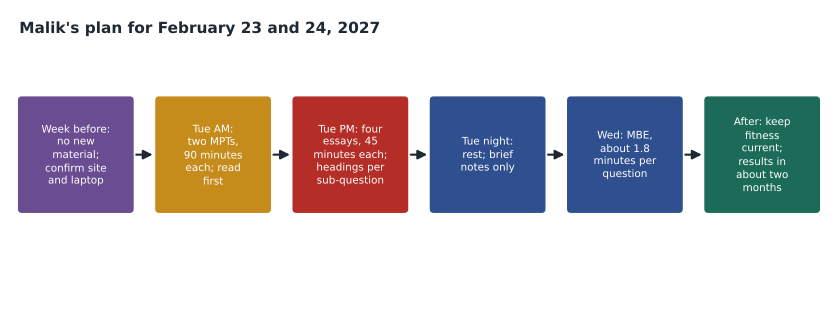
Malik's plan for the exam, built with Marchetti, has five parts.
The week before: no new material. Two short reviews a day of Georgia rule outlines, one timed essay, and 50 MBE questions. Confirm the testing site, the arrival time, the items allowed and the laptop registration. Run the testing software once more.
Tuesday morning, the MPTs: 90 minutes for each task. Read the task memo carefully, then the library, then the file, and outline before writing. Finish both tasks; a complete, organized answer beats a polished half-answer.
Tuesday afternoon, the essays: 45 minutes for each of the four. Spend about five minutes reading and outlining each, then write, using a heading for each numbered sub-question. State the Georgia rule by name when Georgia has one. If time runs short, finish every sub-question with short conclusions rather than leaving one blank.
Tuesday evening and Wednesday, the MBE: no studying Tuesday night beyond a short look at notes. On Wednesday, pace at about 1.8 minutes per question, which is 100 questions in three hours, checking progress at question 50 in each session. Answer every question; there is no penalty for wrong answers.
After the exam: rest. Keep the fitness application current. Results usually arrive about two months later, in late April for a February exam. If the result is a pass, schedule the oath and sign up for the Transition into Law Practice Program. If it is not, change the method, as Lesson 4 advised, and plan around the July 2027 exam and the February 2028 last current-format exam.
The last word
Marchetti ends the series the way she ends every one. 'You have the fitness certificate, you have the MPRE, you have the Georgia rules,' she tells Malik. 'Now go write like a Georgia lawyer: name the rule, apply it to the facts, and move on. The graders want to give you the points. Make it easy for them.'
Common mistakes
MistakeLeaving a sub-question unanswered when time runs short.
InsteadWrite a short conclusion for every sub-question; partial credit is better than none.
MistakeTreating a will revoked by later marriage as still valid with a share for the spouse.
InsteadIn Georgia a later marriage or child revokes a will not made in contemplation of the event.
MistakeForgetting the 15-day window when analyzing a late answer.
InsteadWithin 15 days after default, the defendant opens it as of right; after that, a motion with grounds is required.
MistakeWriting the MPT before reading the library.
InsteadRead the task memo, then the library and file, and outline before writing.
Practice problems
Work each problem on paper first, then reveal the answer to check.
In Essay 1, why does the 2025 medical expense rule apply?
Show answer
Because Carla's cause of action arose on August 3, 2025, after the April 21, 2025 effective date.
In Essay 2, why does Paul's petition to probate the 2015 will fail?
Show answer
Walter's 2019 marriage and Ivy's 2022 birth revoked the will, which was not made in contemplation of either event.
How much time should a candidate spend on each Georgia essay and each MPT?
Show answer
About 45 minutes per essay and 90 minutes per MPT task.
Summary and key terms
- Essay 1 tests the limitation period, Georgia default rules, apportionment with nonparty notice, dram shop liability, the 2025 medical expense rule and punitive damages.
- Essay 2 tests revocation of a will by later marriage and birth, intestate shares, year's support and a nonconsentable conflict.
- Use the MPT's 90 minutes by reading first; use each essay's 45 minutes with a short outline and headings per sub-question.
- After the exam, keep fitness current, expect results in about two months and plan the oath and the Transition into Law Practice Program.
- Relation back
- Treating service made after the limitation period as made on the filing date when the plaintiff acted diligently.
- Nonconsentable conflict
- A conflict of interest so serious that client consent cannot cure it, such as representing opposing parties in the same proceeding.
- Pacing
- Planning time per question or task so that every part of the exam is completed.
Lesson quiz · 5 questions
Score 60% or more to complete this lesson.
Create a free account to save your progress, take quizzes and earn a certificate.