
BAR-209 · Lesson 9 of 12 · 15 min
District housing and civil rights law
▶ Video coming soon A video version of this lesson is on the way.
On a Tuesday morning, Jasper sits beside Constance at a table in the Landlord and Tenant Branch while she negotiates with a landlord's lawyer over a tenant who has fallen two months behind. Over lunch she gives him the advice she gives every new lawyer in her office. 'Housing law in DC is not one statute,' she says. 'It is a stack of them, layered over decades, and they change often. The tenant in front of you may be protected by rent stabilization, by eviction rules, by the right to buy the building and by the Human Rights Act all at once. Your job is to know which layers apply.'
This lesson introduces three bodies of District law that a new lawyer in the District is very likely to meet and that differ sharply from what the bar exam tests: the Rental Housing Act, including rent stabilization and eviction protections; the Tenant Opportunity to Purchase Act, as amended by the RENTAL Act of 2025; and the District of Columbia Human Rights Act. The bar exam's real property questions assume general landlord and tenant law. District practice adds a great deal.
The Rental Housing Act
The Rental Housing Act of 1985, codified in Title 42 of the DC Code, is the foundation of District rental law. It does several things. It creates the District's rent stabilization program, which limits how much and how often rents may increase for covered rental units. It sets out the grounds on which a landlord may recover possession of a rental unit, a list that functions as a requirement of good cause for eviction. And it creates the administrative structure, including the Rent Administrator and the Rental Housing Commission, that hears tenant petitions and landlord petitions about rents and services.
Rent stabilization does not apply to every unit. The Act exempts several categories, such as many buildings built after 1975 and units owned by small landlords who own no more than a stated number of units and meet registration requirements, along with government-subsidized units that are regulated under other programs. Whether a unit is covered depends on the facts and on the landlord's registration filings with the District. A tenant in a covered unit is protected by limits on the size and timing of rent increases, which are tied to inflation under the formula in the Act, and by procedures that require landlords to notify tenants and the District of increases. A tenant in an exempt unit is not protected by those limits, but the eviction grounds and other protections may still apply.
Eviction in the District
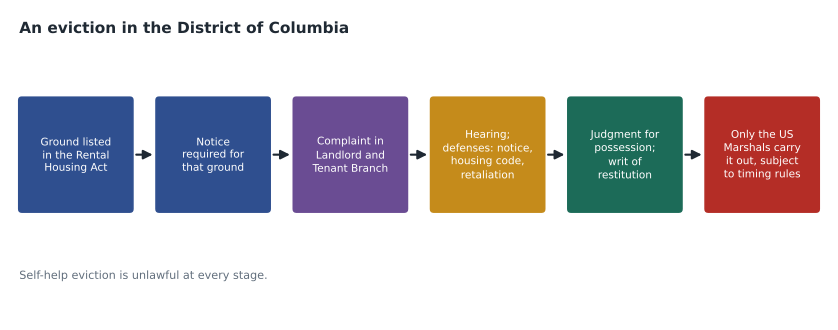
A District landlord cannot remove a tenant without going to court. Self-help eviction, such as changing the locks or removing a tenant's belongings without a court order, is unlawful. To recover possession, the landlord must have a ground listed in the Rental Housing Act, such as nonpayment of rent, a violation of a lease obligation that the tenant has failed to correct after notice, the landlord's good faith intention to occupy the unit personally, or certain renovation or demolition plans, and must give the notice the Act requires for that ground. The landlord then files a complaint in the Landlord and Tenant Branch of the Superior Court. If the landlord wins, the court enters judgment for possession, and an eviction may be carried out only by the United States Marshals Service under a writ of restitution, subject to timing rules and protections, such as restrictions in extreme weather.
These rules have changed often in recent years, especially after the emergency measures adopted during the COVID-19 pandemic and the measures that followed. The RENTAL Act of 2025, discussed next, also made changes to rental law. Because the procedural rules, notice periods and defenses can shift from year to year, a new lawyer should check the current statute, the Superior Court's current Landlord and Tenant rules and any standing orders before advising a client. Constance tells Jasper never to rely on a notice period he remembers from last year.
The Tenant Opportunity to Purchase Act
The District's Tenant Opportunity to Purchase Act, known as TOPA, is one of the most distinctive housing laws in the country. First enacted in 1980 and now part of the Rental Housing Conversion and Sale Act in Title 42 of the DC Code, TOPA gives tenants a right to purchase their housing accommodation before the owner sells it to someone else. When an owner decides to sell a covered building, the owner must give the tenants an offer of sale. In a building with multiple units, the tenants can form a tenant organization, register it, and then negotiate to buy the building themselves or assign their rights to a developer or nonprofit that will buy it, often in exchange for commitments about affordability or repairs. TOPA has helped preserve affordable housing in the District, and it has also been criticized for slowing sales and for practices in which tenants sold their rights to buyers.
The RENTAL Act of 2025 made the most significant changes to TOPA in years. The Act's full name is the Rebalancing Expectations for Neighbors, Tenants, and Landlords Act. The Council passed it in the fall of 2025, the Mayor signed it on November 13, 2025, and after congressional review it took effect on December 31, 2025. According to law firm summaries of the Act, its TOPA changes include the following. A sale of a housing accommodation within fifteen years after a prior sale or transfer is not treated as a sale that triggers an offer of sale, so tenants have no purchase right for those sales, if the landlord discloses the exemption to prospective tenants in leases and gives existing tenants written notice by March 31, 2026; the owner must still give tenants a notice of transfer. The Act narrowed what counts as a sale when ownership interests in an entity change hands, so that only transfers of control of a majority of interests in an entity whose principal asset is the rental property count. It created a system of certified tenant support providers and qualified purchasers, a cooling-off period during which tenant associations in larger buildings generally cannot assign their rights, and disclosure and anti-interference rules for those who contact tenants about offers. It directed the District's Department of Housing and Community Development to issue implementing regulations, and practitioners expected the regulations to take time, with interim guidance in the meantime.
For a new lawyer, the point is not to memorize every detail but to recognize when TOPA is in play. Any sale or transfer of a rental building in the District, any foreclosure, and any change in control of an entity that owns rental housing raises a TOPA question that must be answered before closing.
| Issue | Before the RENTAL Act | After December 31, 2025 (summary) |
|---|---|---|
| Recent sales | Offers of sale generally required for covered sales | Sales within 15 years of a prior sale or transfer exempt from offer requirement, with lease disclosure and notice to tenants by March 31, 2026 |
| Entity transfers | Broader rules on transfers of interests | Counted only if control of a majority changes and the property is the entity's principal asset |
| Notice of transfer | Required in some cases | Required for exempt transfers, foreclosures and other excluded transfers |
| Assignment of tenant rights | Fewer limits | Cooling-off period for larger buildings; limits on reassignment |
| Support and buyers | No certification system | Certified tenant support providers and qualified purchasers |
The District of Columbia Human Rights Act
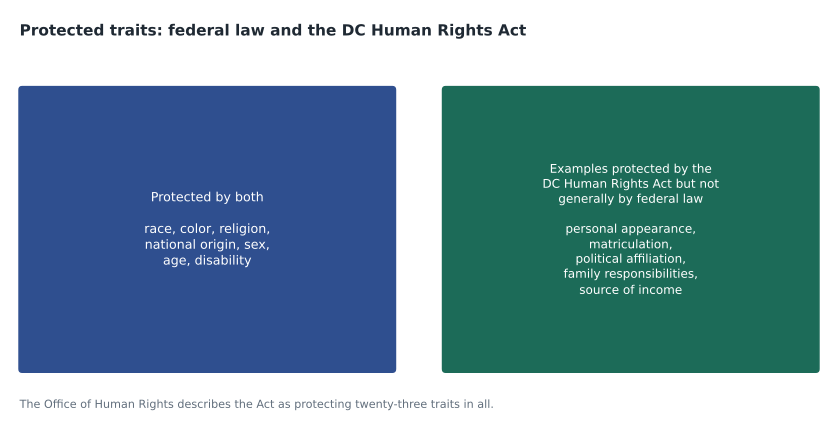
The District of Columbia Human Rights Act, enacted in 1977 and codified in Title 2 of the DC Code, is one of the broadest civil rights statutes in the country. It prohibits discrimination in employment, housing, public accommodations, educational institutions and District government services on the basis of a long list of protected traits. The District's Office of Human Rights, which enforces the Act, describes it as protecting twenty-three traits. The list includes the traits protected by federal law, such as race, color, religion, national origin, sex, age and disability, and many that federal law does not protect, including personal appearance, matriculation, political affiliation, family responsibilities and source of income. Additional traits have been added over the years.
Source of income protection matters greatly in housing practice. A landlord in the District may not refuse to rent to a tenant because the tenant will pay rent with a housing voucher or other lawful source of income, and advertising that excludes voucher holders can itself violate the Act. Personal appearance protection is distinctive as well, though the Act allows employers to require reasonable standards of dress and grooming for legitimate business purposes.
Complaints under the Human Rights Act may be filed with the Office of Human Rights, which investigates and may refer cases to the Commission on Human Rights for hearing. The Act also gives individuals a private right of action in the Superior Court. Filing deadlines are short, and choosing an administrative complaint can affect the right to sue in court, so a lawyer must check the current deadlines and election rules at the outset of any matter.
Putting the layers together
Constance's point about layers becomes concrete in an ordinary case. Suppose a tenant who pays part of her rent with a housing voucher lives in a 1960s apartment building. Rent stabilization probably applies, limiting increases. Any eviction requires a ground under the Rental Housing Act, proper notice and a court judgment. If the owner tries to sell the building, TOPA may give her and her neighbors the right to buy it, unless the RENTAL Act's fifteen-year exemption applies. And if the landlord refused to renew her lease because of her voucher, the Human Rights Act could provide a claim. A lawyer who checks only one layer can miss the rest.
Worked problem
A voucher tenant facing a notice
A tenant in a 1965 building receives a notice from a new owner, who bought the building in 2024, stating that the tenancy will end because the owner prefers tenants who do not use vouchers. What District laws should Jasper flag?
Show solution
- Eviction: the owner needs a ground listed in the Rental Housing Act; a preference against voucher holders is not one.
- Human Rights Act: refusing to rent or renew because of a voucher is source of income discrimination.
- Rent stabilization: a 1965 building is likely covered, so any rent increase must follow the Act.
- TOPA: if the owner sells again within fifteen years of the 2024 purchase, the RENTAL Act exemption may apply, but notice rules still matter.
Answer: The notice lacks a lawful eviction ground and suggests source of income discrimination; rent stabilization and TOPA should be checked too.
Common mistakes
MistakeA District landlord can change the locks after a tenant stops paying.
InsteadSelf-help eviction is unlawful; possession requires a court judgment and enforcement by the US Marshals Service.
MistakeEvery District rental unit is rent stabilized.
InsteadThe Rental Housing Act exempts several categories, including many post-1975 buildings and some small landlords' units.
MistakeTOPA was repealed by the RENTAL Act.
InsteadThe RENTAL Act amended TOPA, adding exemptions and new procedures, effective December 31, 2025.
MistakeThe DC Human Rights Act protects only the traits federal law protects.
InsteadIt protects twenty-three traits, including personal appearance, matriculation, political affiliation and source of income.
Practical steps for a tenant client
When a tenant receives a notice from a landlord, a lawyer's first steps are usually the same. Read the notice to see what it claims and what deadlines it sets. Check whether the unit is covered by rent stabilization or other protections. Review the lease and the payment history. Find out whether the tenant has applied for or received emergency rental assistance. And check whether any housing code violations in the unit might support a defense or counterclaim. Tenants facing eviction in the District can also seek help from legal services organizations and from the court-based resource centers that serve unrepresented parties.
Practical steps for an employer client
For employers, the District Human Rights Act's broad list of protected traits means policies drafted for other jurisdictions may not be enough. An employer opening a District office should review hiring, discipline and dress policies against the District's protected traits, train managers on the District's rules, and check whether other District laws, such as those on sick leave or criminal background checks in hiring, also apply.
Where to find help and guidance
Both housing and civil rights law in the District are supported by agencies that publish guidance. The Department of Housing and Community Development administers parts of the Rental Housing Act and TOPA and publishes forms and notices. The Office of the Tenant Advocate provides information and some assistance to tenants. The Office of Human Rights investigates discrimination complaints and publishes guidance on the Human Rights Act. A new lawyer handling a matter in either area should start with these agencies' current materials before turning to the statutes and cases, which change often enough that older secondary sources may be out of date.
Summary and key terms
- The Rental Housing Act of 1985 provides rent stabilization for covered units, requires a listed ground for eviction and creates the Rental Housing Commission.
- Evictions require a court judgment in the Landlord and Tenant Branch and enforcement by the US Marshals Service; self-help is unlawful.
- TOPA gives tenants a right to purchase before a sale; the RENTAL Act, effective December 31, 2025, added a fifteen-year exemption and other changes.
- The DC Human Rights Act protects twenty-three traits, including source of income and personal appearance.
- District housing cases often involve several statutes at once, and the rules change frequently.
- Rental Housing Act
- The 1985 District statute governing rent stabilization, eviction grounds and rental housing administration.
- Rent stabilization
- The District program limiting rent increases for covered units.
- TOPA
- The Tenant Opportunity to Purchase Act, giving District tenants a right to purchase before a sale.
- RENTAL Act
- The 2025 District law that amended TOPA and other rental rules, effective December 31, 2025.
- Source of income discrimination
- Refusing housing because of how a tenant lawfully pays rent, such as with a voucher, prohibited by the DC Human Rights Act.
Lesson quiz · 5 questions
Score 60% or more to complete this lesson.
Create a free account to save your progress, take quizzes and earn a certificate.