
BAR-209 · Lesson 7 of 12 · 15 min
The District's courts, Congress and civil procedure
▶ Video coming soon A video version of this lesson is on the way.
On Jasper's first morning in the Landlord and Tenant Branch, Constance points out the window of the Moultrie Courthouse toward Capitol Hill. 'Everything in this building exists because Congress passed a law in 1970,' she says. 'And a few blocks that way, Congress can still undo a law the Council passed last month. You cannot practice here without understanding both.'
This lesson explains the structure of the District's local courts, how they relate to the federal courts in the District, how the District's government relates to Congress, and the features of District civil procedure that a new litigator meets first.
Two court systems in one city
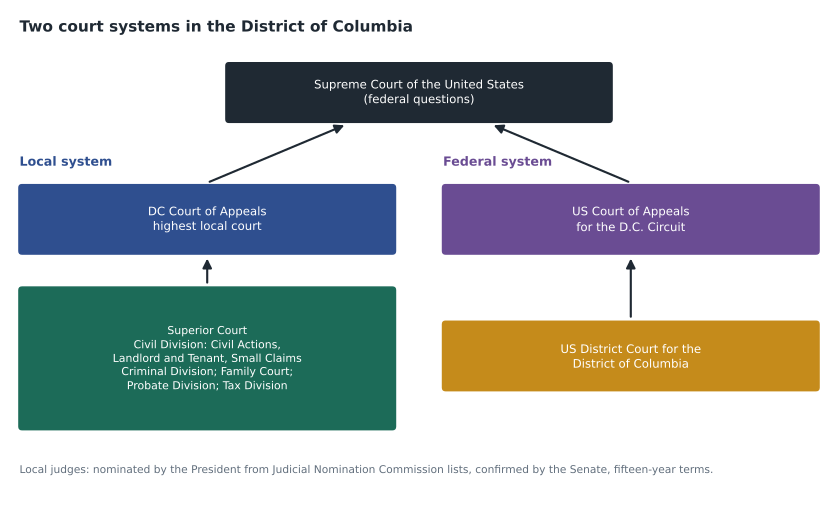
The District has two separate court systems. The first is its local court system: the Superior Court of the District of Columbia, the general trial court, and the District of Columbia Court of Appeals, the highest court. Congress created these courts in their modern form in the District of Columbia Court Reform and Criminal Procedure Act of 1970, under its constitutional power to legislate for the District. They are courts of the District, deciding cases under District law much as state courts decide cases under state law, and they hear the everyday litigation of the city: criminal cases, family matters, landlord and tenant disputes, probate, small claims and general civil cases.
The second system is federal: the United States District Court for the District of Columbia and the United States Court of Appeals for the District of Columbia Circuit. These are ordinary federal courts created under Article III of the Constitution. They hear federal cases, including the large number of cases against federal agencies that make the D.C. Circuit unusually important in administrative law, and diversity cases, subject to the usual federal jurisdiction rules. Decisions of the Supreme Court of the United States can review decisions of either system on questions of federal law.
The local courts differ from state courts in one important respect: their judges are not elected or appointed by local officials. Judges of the Superior Court and the Court of Appeals are nominated by the President of the United States from a list of candidates recommended by the District of Columbia Judicial Nomination Commission and confirmed by the United States Senate. They serve fifteen-year terms and may be reappointed after review by the District of Columbia Commission on Judicial Disabilities and Tenure. The Court of Appeals has nine judges, a chief judge and eight associate judges.
Inside the Superior Court
The Superior Court is divided into divisions. The Civil Division hears civil cases and includes the Civil Actions Branch for general civil litigation, the Landlord and Tenant Branch for eviction and related cases, and the Small Claims and Conciliation Branch, which handles claims of 10,000 dollars or less. The Criminal Division hears criminal cases. The Family Court hears divorce, custody, child support, adoption, neglect and juvenile cases. The Probate Division handles estates, guardianships and conservatorships, and the Tax Division hears tax appeals. The Domestic Violence Division handles civil protection orders and related matters.
Prosecution in the District is also unusual. The United States Attorney for the District of Columbia, a federal official, prosecutes most adult criminal cases in the Superior Court, including serious local crimes, as well as federal crimes in the federal court. The District's own Office of the Attorney General prosecutes juvenile cases and certain minor adult offenses, and it represents the District government in civil litigation. A new lawyer handling a criminal matter in the Superior Court will usually face an Assistant United States Attorney.
The District and Congress
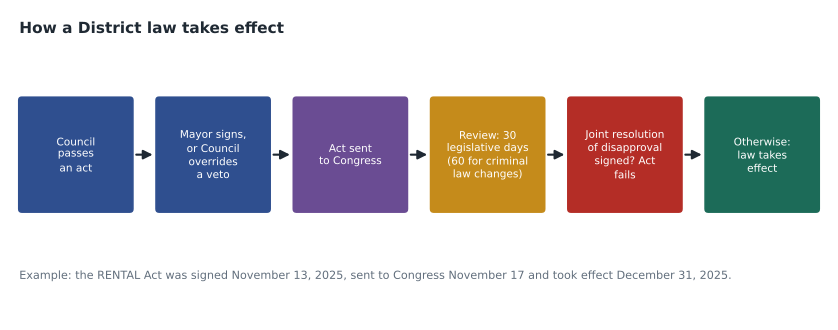
The Home Rule Act of 1973 gave the District an elected Mayor and a thirteen-member Council, but Congress kept ultimate authority. Congress can legislate for the District directly, it approves the District's budget, and it reviews the Council's legislation. When the Council passes an act and the Mayor signs it, or the Council overrides a veto, the act is sent to Congress for a review period. During that period, Congress may pass a joint resolution disapproving the act, which, if signed by the President, prevents the act from taking effect. The review period is generally thirty legislative days, and longer, sixty legislative days, for changes to the District's criminal laws. If Congress does nothing, the act becomes law at the end of the period.
Most acts pass through review without incident. The RENTAL Act, a major housing law that Lesson 9 covers, is a recent example: the Mayor signed it on November 13, 2025, it was sent to Congress on November 17, Congress took no action, and it took effect on December 31, 2025. Occasionally Congress acts. In 2023 Congress passed, and the President signed, a joint resolution disapproving the District's Revised Criminal Code Act of 2022, the first time in decades that Congress had overturned a District law through this procedure.
The Home Rule Act also contains an emergency provision that allows the President, in special conditions of an emergency nature, to direct the Mayor to provide the services of the Metropolitan Police Department for federal purposes, for a limited period unless Congress extends it. On August 11, 2025, the President declared a crime emergency in the District and invoked that power, placing the police department under federal direction. The period was limited to thirty days without congressional extension; Congress did not extend it, and the federal direction expired on September 10, 2025. The District's Attorney General sued over the administration's attempt to install an emergency police commissioner, and a court blocked that plan. The episode is a reminder that the District's government operates within limits that do not exist for any state.
Civil procedure in the Superior Court
The Superior Court Rules of Civil Procedure are modeled closely on the Federal Rules of Civil Procedure, and the District's courts often look to federal decisions interpreting a federal rule when they interpret the matching District rule. A lawyer who knows the Federal Rules will find the structure familiar: complaints and answers, motions to dismiss, discovery, summary judgment, pretrial conferences and trial. But the local rules, standing orders and practices of each branch matter, and the Landlord and Tenant Branch and Small Claims Branch have their own rules and procedures designed for high-volume dockets with many unrepresented parties.
Personal jurisdiction over nonresident defendants in District courts is governed by the District's long-arm statute and by due process. Venue questions are simpler than in a state, because the District is a single jurisdiction with a single trial court of general jurisdiction.
Limitation periods
The District's general limitation periods are in DC Code section 12-301. Most actions for personal injury, property damage and breach of a simple contract must be brought within three years after the claim accrues. Actions for libel, slander, assault, battery and false imprisonment have a shorter period of one year. Actions to recover land have a much longer period, and actions on instruments under seal have their own longer period. Other statutes set different periods for particular claims, and the District applies a discovery rule in some contexts, such as certain latent injuries. A new lawyer should always check the current text of section 12-301 and any specific statute before relying on a period.
Claims against the District: the notice requirement
A plaintiff suing the District government for unliquidated damages for injury or property damage must give written notice to the Mayor within six months after the injury, under DC Code section 12-309. The notice must state the approximate time, place, cause and circumstances of the injury. A police report prepared in the regular course of duty can sometimes satisfy the requirement. The District's courts construe the notice requirement strictly because it is a condition of waiving the District's immunity, and a missed notice can defeat an otherwise strong claim. This requirement is in addition to the three-year limitation period.
| Situation | Rule | Period |
|---|---|---|
| Most personal injury and property damage claims | DC Code 12-301 | Three years |
| Libel, slander, assault, battery, false imprisonment | DC Code 12-301 | One year |
| Simple contract claims | DC Code 12-301 | Three years |
| Unliquidated damages claims against the District | DC Code 12-309 notice to the Mayor | Six months after injury, plus the limitation period |
| Small claims | Small Claims and Conciliation Branch | Claims of 10,000 dollars or less |
Appeals
Appeals from the Superior Court go to the Court of Appeals. In most civil cases, a notice of appeal must be filed within thirty days after entry of the judgment or order appealed from, under the Court of Appeals' rules. The Court of Appeals usually hears cases in panels of three judges and may rehear cases en banc. There is no intermediate appellate court in the District's local system, so the Court of Appeals reviews the full volume of local appeals.
Worked problem
A slip on a District sidewalk
On March 3, 2026, Jasper's client, Mr. Edwards, tripped on a broken District-owned sidewalk and broke his wrist. He comes to the nonprofit in late September 2026. What deadlines matter?
Show solution
- A claim against the District for unliquidated damages requires written notice to the Mayor within six months, under DC Code 12-309.
- Six months from March 3, 2026 is early September 2026, so the notice period may already have run, unless a police report or other qualifying notice was made.
- The three-year limitation period in DC Code 12-301 would run until March 2029, but meeting it does not cure a missing 12-309 notice.
- Jasper should immediately look for any qualifying notice and refer the matter to a lawyer who handles such claims.
Answer: The six-month notice under section 12-309 is the critical deadline, and it may already have passed.
Common mistakes
MistakeThe Superior Court is a federal court.
InsteadIt is the District's local trial court, created by Congress in 1970; federal cases go to the US District Court for D.C.
MistakeDistrict judges are appointed by the Mayor.
InsteadThey are nominated by the President from Judicial Nomination Commission lists and confirmed by the Senate for fifteen-year terms.
MistakeA Council act takes effect when the Mayor signs it.
InsteadIt must first survive a congressional review period, generally 30 legislative days and 60 for criminal law changes.
MistakeFiling within three years is enough for any claim against the District.
InsteadUnliquidated damages claims also require written notice to the Mayor within six months under section 12-309.
The federal courts in the District
Alongside the District's local courts sit the federal courts: the United States District Court for the District of Columbia and the United States Court of Appeals for the District of Columbia Circuit. Because so many federal agencies are headquartered in the city, these courts hear an unusually large share of cases involving federal administrative law, and many federal statutes direct challenges to agency action to the D.C. Circuit. A District lawyer whose practice involves federal agencies will spend much of it in these courts, and admission to the federal bar in the District is a separate step from admission to the DC Bar.
New lawyers should keep the two systems distinct. A slip-and-fall case, a landlord-tenant dispute or a local criminal prosecution belongs in the Superior Court. A challenge to a federal agency's rule or a federal civil rights claim may belong in federal court. Diversity jurisdiction can bring state-law claims involving District residents into federal court, where the federal court applies District substantive law as the Court of Appeals has declared it.
The Office of Administrative Hearings
Many disputes with the District government start not in court but at the Office of Administrative Hearings, an independent agency that hears cases arising under many District laws, including some unemployment compensation, public benefits and rental housing matters. Its decisions can generally be reviewed by the DC Court of Appeals. A lawyer handling a dispute with a District agency should check early whether an administrative process must be completed before going to court, and what deadlines apply.
Practice tips for the Superior Court
The Superior Court's civil rules are modeled on the Federal Rules of Civil Procedure, so a new lawyer who knows the federal rules will find much that is familiar. Differences matter, though, and lawyers should read the Superior Court's own rules and the standing orders of the assigned judge. The court relies heavily on electronic filing, and its divisions publish their own procedures and forms.
Small claims and the Landlord and Tenant Branch
Two branches of the Civil Division handle a large share of the city's cases. The Small Claims Branch hears claims up to 10,000 dollars under simplified procedures, and many parties appear without lawyers. The Landlord and Tenant Branch hears actions for possession of rental property, and it is one of the busiest parts of the court. New lawyers often get their first courtroom experience in these branches, sometimes through pro bono programs that pair volunteer lawyers with unrepresented tenants or small claims litigants.
Summary and key terms
- The District has a local court system (Superior Court and Court of Appeals) and a federal one (D.D.C. and the D.C. Circuit).
- Local judges are presidentially nominated from Judicial Nomination Commission lists, Senate-confirmed and serve fifteen-year terms.
- Council acts go to Congress for review; Congress disapproved the Revised Criminal Code Act in 2023.
- The 2025 federal direction of the police under the Home Rule Act's emergency provision expired on September 10, 2025.
- Superior Court civil rules track the Federal Rules; limitation periods are in DC Code 12-301; claims against the District need six-month notice under 12-309.
- Superior Court
- The District of Columbia's local trial court of general jurisdiction.
- Court Reform Act of 1970
- The federal statute that created the District's modern local court system.
- Congressional review
- The period during which Congress may disapprove a District act before it takes effect.
- DC Code 12-309
- The statute requiring six-month written notice to the Mayor for unliquidated damages claims against the District.
- Landlord and Tenant Branch
- The branch of the Superior Court's Civil Division that hears eviction and related cases.
Lesson quiz · 5 questions
Score 60% or more to complete this lesson.
Create a free account to save your progress, take quizzes and earn a certificate.