
BAR-209 · Lesson 8 of 12 · 16 min
District torts: contributory negligence and its statutory exceptions
▶ Video coming soon A video version of this lesson is on the way.
A week before Thanksgiving, a woman comes to Jasper's nonprofit asking for help finding a lawyer. Her son was riding an electric scooter in a bike lane on 14th Street when a delivery van turned across his path. The insurance adjuster has told her that her son cannot recover anything because he was going a little too fast. 'Is that true?' she asks. Jasper does not know, and he takes the question to Marchetti. 'Five years ago the adjuster might have been right,' she says. 'Today the answer depends on a statute most lawyers outside DC have never heard of.'
This lesson covers the feature of District tort law that most surprises lawyers from elsewhere: the District still applies the old common law rule of contributory negligence in most negligence cases. It then explains the statute that changes that rule for pedestrians, bicyclists and other vulnerable road users, the doctrines that soften contributory negligence, and several other District rules that shape tort litigation.
Contributory negligence: the general rule
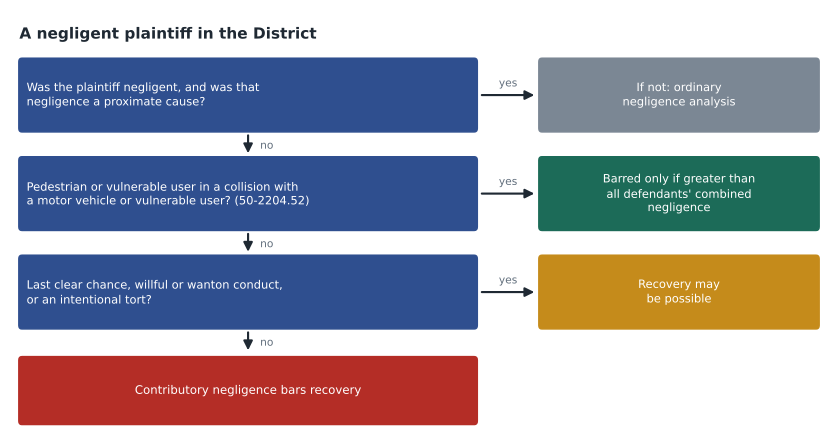
Under the traditional common law rule of contributory negligence, a plaintiff whose own negligence contributed to the injury, even slightly, recovers nothing from a negligent defendant. Most states abandoned that rule decades ago in favor of comparative negligence, under which a plaintiff's damages are reduced in proportion to the plaintiff's share of fault, either in all cases or as long as the plaintiff is not more at fault than the defendants. The District is one of only five United States jurisdictions that still apply contributory negligence as the general rule in negligence cases. The others are Alabama, Maryland, North Carolina and Virginia.
The rule is harsh, and the District's courts have long acknowledged that. But it remains the law because neither the Council nor the Court of Appeals has replaced it in general negligence cases. A lawyer who handles a negligence case in the District must therefore investigate the plaintiff's own conduct as carefully as the defendant's. A defendant who can show that the plaintiff failed to use reasonable care for his or her own safety, and that this failure was a proximate cause of the injury, can defeat the claim entirely.
This is the opposite of what the bar exam assumes. NCBE's materials tell examinees that, unless a question states otherwise, they should assume pure comparative negligence and joint and several liability. 'On the exam, comparative fault,' Marchetti says. 'In a District courtroom, contributory negligence, unless an exception applies. Never mix them up.'
Softening doctrines
Contributory negligence does not operate everywhere a plaintiff was careless. Under traditional doctrine, which the District follows, contributory negligence is a defense only to negligence claims. It is not a defense to intentional torts, such as battery, and it generally does not bar recovery when the defendant's conduct was willful, wanton or reckless rather than merely negligent.
The last clear chance doctrine is the most important softening rule. It allows a negligent plaintiff to recover if the defendant had the last clear opportunity to avoid the harm and failed to use it. The doctrine typically applies when the plaintiff was in a position of danger from which he or she could not escape, or was unaware of the danger, the defendant knew or should have known of the plaintiff's danger, and the defendant could have avoided the injury with reasonable care but did not. Last clear chance is fact-intensive, and plaintiffs in contributory negligence jurisdictions often plead it as a matter of course. The District's statute for vulnerable road users, discussed next, expressly preserves the doctrine.
Assumption of the risk is a related defense. A plaintiff who knowingly and voluntarily encountered a known danger may be barred from recovery. Assumption of the risk and contributory negligence overlap, and the distinction can matter for how a jury is instructed.
The Motor Vehicle Collision Recovery Act
In 2016 the Council changed the rule for one large group of plaintiffs. The Motor Vehicle Collision Recovery Act of 2016, which took effect on November 26, 2016 as D.C. Law 21-167, created a special rule for pedestrians and bicyclists injured in collisions with motor vehicles. In 2021 the Council expanded the rule. D.C. Law 23-183, effective March 16, 2021, extended it to a broader category of vulnerable users and to collisions between vulnerable users and with pedestrians.
The rule now appears in DC Code section 50-2204.52. It applies in two situations: when a pedestrian or a vulnerable user of a public highway or sidewalk is involved in a collision with a motor vehicle or with another vulnerable user, and when a vulnerable user is involved in a collision with a pedestrian. In those cases, the plaintiff's negligence does not bar recovery unless it is a proximate cause of the injury and is greater than the combined, or aggregated, negligence of all the defendants that proximately caused the injury. The statute states that it does not change joint and several liability, does not affect the last clear chance doctrine, and does not reduce protections under certain other statutes.
Who is a vulnerable user? The definition in section 50-2204.51 includes people using a bicycle, an electric mobility device, a motorized bicycle, a motor-driven cycle, a motorcycle, a non-motorized scooter, a personal mobility device, a skateboard, an all-terrain vehicle, a dirt bike or other similar devices, with several terms defined by cross-reference to other District law. A person riding a typical shared electric scooter will often fit within these definitions, but the exact device matters, and a lawyer should check the definitions as they stand when the collision occurred.
Notice what the statute does not say. It does not say that the plaintiff's damages are reduced by the plaintiff's share of fault. On its face, a covered plaintiff whose negligence is not greater than the defendants' combined negligence is simply not barred. That is unusual: it gives covered plaintiffs more favorable treatment than many comparative negligence states would. Lawyers on both sides should read the statute carefully and look for any Court of Appeals decisions applying it before advising a client on likely recovery.
| Plaintiff | Collision with | Rule that applies |
|---|---|---|
| Pedestrian | Motor vehicle or vulnerable user | DC Code 50-2204.52: barred only if plaintiff's negligence is a proximate cause and greater than all defendants' combined negligence |
| Bicyclist, scooter rider or other vulnerable user | Motor vehicle, vulnerable user or pedestrian | DC Code 50-2204.52 (as expanded in 2021) |
| Driver or passenger of a car | Another car | Contributory negligence, subject to last clear chance |
| Customer who slips in a store | Premises condition | Contributory negligence, subject to last clear chance |
| Victim of battery | Intentional tort | Contributory negligence is not a defense |
Applying the rule to the scooter case
Return to the woman whose son was hit by a turning van. Her son was riding an electric scooter, which likely makes him a vulnerable user under section 50-2204.51. He was in a collision with a motor vehicle. Under section 50-2204.52, his own negligence, such as riding somewhat too fast, does not bar his recovery unless it was a proximate cause of his injuries and greater than the van driver's negligence and that of any other defendant. If a jury found the van driver primarily at fault for turning across the bike lane, the son's claim would not be barred. The adjuster's statement reflects the general contributory negligence rule, which the statute displaces in this situation.
Claims against the District government
Tort claims against the District government raise additional issues. The District is immune from liability for discretionary functions but may be liable for ministerial acts, and the line between them is often litigated. As Lesson 7 explained, a plaintiff seeking unliquidated damages from the District must give written notice to the Mayor within six months under DC Code section 12-309.
The District also applies the public duty doctrine. In Warren v. District of Columbia, 444 A.2d 1 (D.C. 1981) (en banc), the Court of Appeals held that the government and its officials owe a duty to provide public services, such as police protection, to the public at large and not to particular individuals, so that a failure to provide those services does not give an individual a negligence claim unless a special relationship exists. Warren remains a leading statement of the doctrine and is widely cited.
Other features of District tort practice
Several other features matter in District tort cases. Joint and several liability remains the rule among joint tortfeasors, so a plaintiff can recover the full amount of a judgment from any one defendant liable for an indivisible injury, subject to contribution among defendants. The District does not have a broad statutory cap on compensatory damages in ordinary personal injury cases of the kind many states have adopted, so damages questions usually turn on proof rather than caps. Medical malpractice plaintiffs must give the defendant advance written notice of intent to sue before filing, under the District's medical malpractice statute, and must comply with its mediation provisions. Wrongful death and survival claims are governed by District statutes that specify who may sue and what damages are recoverable.
A new lawyer should treat each of these points as a starting place for research, not a final answer. Tort practice in the District is heavily shaped by Court of Appeals decisions, and the details matter.
Worked problem
Two plaintiffs, one intersection
At a District intersection, a driver runs a yellow light that turns red and hits two people: a pedestrian who stepped off the curb while looking at her phone, and another driver who had just started into the intersection a moment early. Both were slightly negligent. Who can recover from the first driver?
Show solution
- The pedestrian is covered by DC Code 50-2204.52 as a pedestrian in a collision with a motor vehicle.
- Her negligence bars recovery only if it was a proximate cause and greater than the defendant driver's negligence; a slight lapse likely does not bar her.
- The second driver is not covered by the statute; the general contributory negligence rule applies.
- Unless last clear chance or another exception applies, the second driver's slight negligence may bar his claim entirely.
Answer: The pedestrian likely can recover; the second driver may be barred by contributory negligence.
Common mistakes
MistakeThe District applies comparative negligence like most states.
InsteadThe District is one of five jurisdictions that keep contributory negligence as the general rule.
MistakeContributory negligence bars recovery for battery.
InsteadIt is a defense only to negligence; it does not bar intentional tort claims.
MistakeThe vulnerable user statute reduces damages by the plaintiff's share of fault.
InsteadOn its face it bars recovery only if the plaintiff's negligence is a proximate cause and greater than all defendants' combined negligence; it states no reduction.
MistakeBar exam answers should use the District's contributory negligence rule.
InsteadUnless the question says otherwise, NCBE assumes pure comparative negligence.
Assumption of the risk
Assumption of the risk is a related defense. In the District, a plaintiff who knew of a specific risk, understood it and voluntarily chose to encounter it may be barred from recovery. The defense is narrower than contributory negligence because it requires actual knowledge of the risk rather than a failure to exercise reasonable care. In practice, defendants often plead both, and the facts that support one may support the other, such as a plaintiff who walked into a clearly marked construction zone.
Building the facts
Because a plaintiff's own negligence can be decisive in the District, plaintiffs' lawyers investigate the plaintiff's conduct as carefully as the defendant's. Where was the plaintiff looking? Was she in a crosswalk? Was the light in her favor? Was she wearing headphones? Each fact may decide whether the vulnerable user statute applies, whether the plaintiff's negligence was a proximate cause, and whether it was greater than the defendants' combined negligence. Defense lawyers, for their part, look for any evidence of the plaintiff's fault, since in a case outside the statute even slight negligence may defeat the claim.
Jury instructions
Contributory negligence and last clear chance are usually questions for the jury, which decides on proper instructions whether the plaintiff was negligent and whether that negligence was a proximate cause. The District's standardized civil jury instructions, which judges and lawyers use as a starting point, include instructions on negligence, contributory negligence and last clear chance. Reading them is a quick way for a new lawyer to see how the doctrines are explained to jurors in the District's courts.
A quick comparison
On the exam, the default rule is pure comparative negligence. In a District collision covered by the vulnerable user statute, the plaintiff's negligence bars recovery only if it was a proximate cause and greater than the defendants' combined negligence. In every other District negligence case, the general rule of contributory negligence applies, softened by last clear chance. Keeping these three rules separate, and knowing which one applies, is one of the most useful things a new District litigator can do.
Summary and key terms
- The District keeps contributory negligence as the general rule, with Alabama, Maryland, North Carolina and Virginia.
- Contributory negligence does not bar intentional tort claims or claims based on willful or wanton conduct, and last clear chance can allow recovery.
- DC Code 50-2204.52, enacted in 2016 and expanded in 2021, protects pedestrians and vulnerable road users in collisions.
- Under that statute, a covered plaintiff is barred only if his or her negligence is a proximate cause and greater than all defendants' combined negligence.
- Claims against the District require section 12-309 notice and face the public duty doctrine of Warren v. District of Columbia.
- Contributory negligence
- A rule under which any negligence by the plaintiff that contributes to the injury bars recovery.
- Last clear chance
- A doctrine allowing a negligent plaintiff to recover if the defendant had the last clear opportunity to avoid the harm.
- Vulnerable user
- A person using a bicycle, scooter, motorcycle, skateboard or similar device, as defined in DC Code 50-2204.51.
- Motor Vehicle Collision Recovery Act
- The 2016 District law, expanded in 2021, limiting contributory negligence for pedestrians and vulnerable users.
- Public duty doctrine
- The rule that government duties to provide public services run to the public, not to individuals, absent a special relationship.
Lesson quiz · 5 questions
Score 60% or more to complete this lesson.
Create a free account to save your progress, take quizzes and earn a certificate.