
BAR-209 · Lesson 4 of 12 · 15 min
The DC bar exam: format, scoring and passing score
▶ Video coming soon A video version of this lesson is on the way.
Jasper has taken many exams, but none that lasted two full days and none that used a scale he did not understand. At their fourth session he asks Marchetti a question that sounds simple: 'How many questions do I need to get right?' She smiles. 'Nobody can tell you that,' she says, 'and the reason why will change how you study.'
This lesson explains the District's bar exam as it stands for the February and July 2027 administrations: what is on it, how it is scored, what the passing score of 266 means, the practical rules on exam day, and what the District's recent results show.
The exam is the UBE
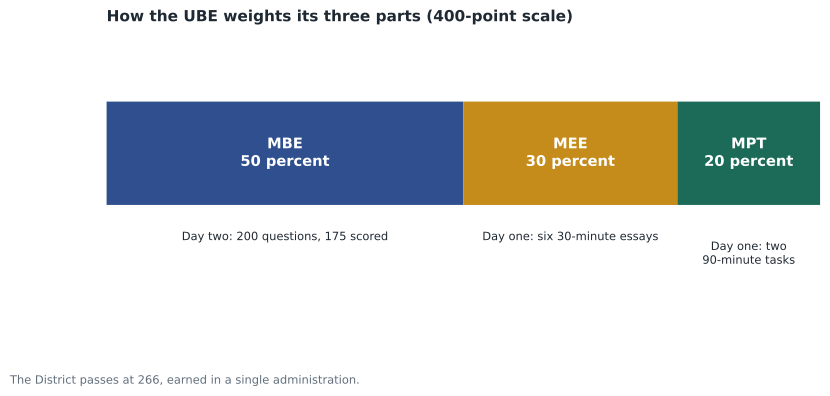
The District gives the Uniform Bar Examination, prepared by NCBE. NCBE's information shows that the District first gave the UBE in July 2016. The UBE has three parts, all written by NCBE and graded under NCBE's guidelines, with the essay and performance test answers graded by the jurisdiction's graders. The Multistate Bar Examination (MBE) is a six-hour, 200-question multiple-choice test covering civil procedure, constitutional law, contracts, criminal law and procedure, evidence, real property and torts; 175 questions are scored and 25 are unscored pretest questions. The Multistate Essay Examination (MEE) consists of six thirty-minute essay questions. The Multistate Performance Test (MPT) consists of two ninety-minute tasks in which the examinee completes a lawyering assignment, such as a memorandum or a brief, using a file of facts and a library of law supplied with the task.
The exam takes two days. On the first day, examinees take the MPT in the morning and the MEE in the afternoon. On the second day, they take the MBE in two three-hour sessions. The UBE is given on the last Tuesday and Wednesday of February and July.
Starting with the July 2026 exam, NCBE removed four subjects from the MEE: conflict of laws, family law, trusts and estates, and secured transactions. The MEE now tests the MBE subjects and business associations. Family law and trusts and estates may still appear on the MPT, where the necessary law is supplied. BAR-120 in this program covers the MEE in detail, and BAR-121 covers the MPT.
How the UBE is weighted
The three parts carry fixed weights in every UBE jurisdiction. The MBE counts for 50 percent of the total score, the MEE for 30 percent, and the MPT for 20 percent. Each examinee's MBE raw score is converted to a scaled score through equating, a statistical process that adjusts for differences in difficulty between exams so that a given scaled score represents the same level of performance from one administration to the next. The written scores, from the MEE and MPT, are then scaled to the MBE. This is why the written portions are graded on a relative basis: graders rank answers against one another, and scaling places those rankings on the same scale as the MBE.
The total UBE score is reported on a 400-point scale. A passing score of 266 means a total scaled score of 266 or more out of 400, earned in a single administration. The District's rules require all components to be taken in the same administration; an applicant cannot combine an MBE from one exam with written scores from another.
Why no one can tell you how many questions to get right
Because of equating and scaling, there is no fixed number of correct MBE answers or fixed essay grade that guarantees a pass. The scaled score that corresponds to a given number of correct answers shifts slightly from exam to exam, depending on the difficulty of the questions. Written scores depend on how an examinee's answers compare with other examinees' answers. And the UBE is compensatory: a strong MBE can make up for weaker essays, and strong written work can make up for a weaker MBE. What matters is the total.
This is what Marchetti meant when she said the answer would change how Jasper studies. 'You cannot aim for a magic number of right answers,' she says. 'You can only aim to be good at all three parts, because you do not know which part will carry you. People who neglect the MPT because it is only 20 percent lose points they could have had for almost no extra study.'
The four-attempt rule and the single-administration rule
Rule 46, as amended, provides that an applicant who has failed the exam four times may not sit again unless the applicant shows extraordinary circumstances. NCBE's information likewise lists an attempt limit of four to earn a passing UBE score. The rule makes each attempt valuable. A candidate who fails twice should seriously reconsider how he or she is preparing before trying again.
The single-administration rule means that every score that counts in the District, whether earned in the District or transferred in, must come from all components taken at the same exam. Applicants who are close to the limit should read the current text of the rule, as amended by the court's order adopting the NextGen exam, before registering again.
Exam day in the District
The Committee announces the venues for each exam. For the July 2026 exam, the standard venues were the Washington Hilton, the Andrew Mellon Auditorium and the DC Bar's own facility, with the Historic Courthouse and the George Washington University Law School used as non-standard venues for applicants with approved accommodations; all venues were in the District and subject to change. For the February 2026 exam, the standard venue was The Reach at the Kennedy Center. Venues for February 2027 were to be announced. The Committee has adopted a clear bag policy: only clear bags are permitted at all exam sites.
Examinees should read the Committee's exam-day instructions as soon as they are issued. These cover what to bring, including admission documents and identification, what is prohibited, whether laptops are used and what software must be installed in advance, and when to arrive. A laptop fee may apply for examinees who type their answers. Small failures, such as forgetting identification, failing to install the exam software or bringing a prohibited item, can cost an examinee an exam that took months to prepare for.
Results
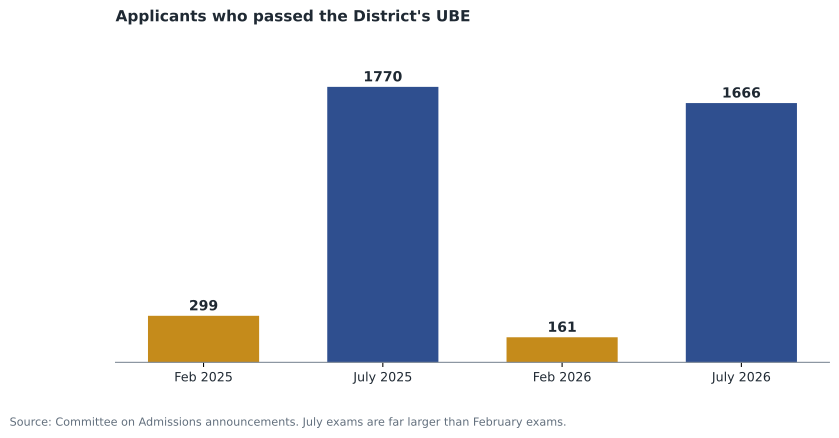
The District posts results to applicants' accounts on the admissions portal and publishes the number of applicants who passed. The Committee's announcements give the recent picture. For the July 2025 exam, results were posted on October 31, 2025, and 1,770 applicants passed. For the February 2026 exam, results were posted on April 17, 2026, and 161 applicants passed. For the July 2026 exam, results were posted by noon Eastern time on October 23, 2026, and 1,666 applicants passed. The Committee's announcement for July 2026 stated that the results are final.
The large difference between February and July counts reflects the size of each sitting. The July exam has many more seats and draws most recent graduates. The February exam is smaller and includes a higher share of repeat takers, which is true in most jurisdictions.
Results are final in the sense that the District does not offer regrading. Applicants who believe there was a problem with the administration of the exam, such as a disruption in the room, must raise it under the Committee's complaint procedure within the stated time. For the July 2025 exam, the Committee set a deadline of August 5, 2025 for complaints and stated that no further review would occur after that.
What the score means for portability
A score of 266 or more earned in the District is a passing UBE score that other jurisdictions may accept, subject to their own passing scores and time limits. Because 266 is in the middle of the range, a District score of exactly 266 will not transfer to a jurisdiction that requires 270, such as Alaska, Arizona or Colorado. A candidate who expects to move should look at the passing score of the destination and aim to clear it. Lesson 11 explains transfers in both directions.
Worked problem
Reading a District score report
Jasper's classmate, Lena, scored 271 on the July 2026 UBE in the District. She is admitted in the District and now hopes to move to Colorado in two years. Will her score help?
Show solution
- Her 271 is above the District's 266, so she passed in the District.
- Colorado requires 270 for exams from February 2023 on.
- 271 meets that standard, so she can seek to transfer it if she applies within Colorado's time limits.
- She must also meet Colorado's other requirements, including its MPRE score and character review.
Answer: Yes: her 271 meets Colorado's 270, subject to Colorado's time limits and other requirements.
Common mistakes
MistakeA set number of correct MBE answers guarantees a pass.
InsteadScores are equated and scaled; no fixed raw number guarantees a pass.
MistakeThe MEE still tests family law and trusts and estates.
InsteadThose subjects left the MEE starting July 2026, though they may appear on the MPT with law supplied.
MistakeAn applicant can combine an MBE from one exam with essays from another.
InsteadAll components must be taken in a single administration.
MistakeApplicants can request regrading of District essays.
InsteadResults are final; the Committee handles only timely complaints about exam administration.
A sample study schedule
Most candidates prepare for the UBE over ten to twelve weeks of full-time study, or longer if they are working. The weighting described above suggests how to divide that time. The MBE carries half the score, so roughly half of study time should go to the seven MBE subjects, with steady practice on timed sets of questions. The MEE and MPT together carry the other half, and the MPT alone carries twenty percent, a large share for a portion many candidates practice least.
| Weeks | Focus |
|---|---|
| 1 to 4 | Learn the MBE subjects; start one timed set of questions each day; read MEE model answers for the same subjects |
| 5 to 8 | Add the MEE-only subjects; write two or three timed essays a week; complete one MPT each week |
| 9 to 10 | Take a full timed practice exam; review weak subjects; repeat timed MPTs |
| Final days | Light review of outlines and the MPT approach; rest; confirm logistics |
Making practice count
Practice questions are useful only if candidates review them carefully. For every MBE question missed, the candidate should identify which of three things went wrong: not knowing the rule, misreading the facts, or knowing the rule but misapplying it. Each calls for a different fix. Not knowing the rule calls for review of the outline; misreading the facts calls for slowing down and reading the call of the question first; misapplying the rule calls for more practice on that subject. Keeping a simple log of missed questions by subject and by type of error shows within a few weeks where the remaining points are.
For the MEE, candidates should compare each practice answer with NCBE's released analyses, looking for issues they missed and rules they stated imprecisely, and should not worry too much about matching the length of the analysis, which is written to be comprehensive. For the MPT, the most common problem is running out of time, so practice should be timed from the start, with about half the time spent reading and organizing and half spent writing.
Scaled scores and why they are fair
Scaling can seem mysterious, but its purpose is fairness. Because one administration's MBE may be slightly harder than another's, NCBE equates MBE scores so that the same scaled score reflects the same level of performance across administrations. Written scores are then scaled to the MBE, so that a candidate's written score is placed on the same scale. A candidate who sits a harder exam is not penalized for it, and a candidate who sits an easier one gains no advantage. That is also why a raw percentage of questions answered correctly cannot be converted directly into a UBE score.
Reading the score report
After results are released, a candidate receives a score report. A passing candidate in the District usually needs it only to confirm the total and, later, to request a transfer to another UBE jurisdiction. A candidate who did not pass should read it closely. The report shows the scaled MBE score and the scaled written score, and comparing the two shows whether the multiple-choice or the written portion cost more points. A candidate whose MBE score was strong but whose written score lagged should spend more of the next study period writing timed essays and performance tests; a candidate with the opposite pattern should focus on MBE practice and the rules behind missed questions.
Candidates should also remember that a score report from one administration cannot be combined with another. The District requires the 266 to be earned in a single administration, so a strong MBE in February and a strong written score in July do not add together. Each attempt starts again from zero.
Summary and key terms
- The District gives the UBE: MBE 50 percent, MEE 30 percent and MPT 20 percent, on a 400-point scale.
- The passing score is 266, earned in a single administration; there is a four-attempt limit.
- Scores are equated and scaled, and the exam is compensatory.
- Venues and exam-day rules, including a clear bag policy, are announced for each exam.
- July 2026 results were posted on October 23, 2026, with 1,666 passers; results are final.
- UBE
- The Uniform Bar Examination, made up of the MBE, MEE and MPT.
- Equating
- A statistical adjustment that keeps scaled scores comparable across exams of different difficulty.
- Scaling
- The process of placing written scores on the same scale as the MBE.
- Compensatory scoring
- Scoring in which strength on one part can make up for weakness on another.
- Single administration
- The requirement that all parts of the exam be taken at the same sitting.
Lesson quiz · 5 questions
Score 60% or more to complete this lesson.
Create a free account to save your progress, take quizzes and earn a certificate.