
BAR-209 · Lesson 5 of 12 · 17 min
Exam changes ahead: NextGen in February 2028
▶ Video coming soon A video version of this lesson is on the way.
Jasper's younger cousin, Ifeoma, started law school in Washington in August 2026. Over a family dinner she asks him whether she will take the same bar exam he is taking. He realizes he does not know. At the next session, Marchetti brings in Marcus Bell, the group member who sat Missouri's first NextGen exam in July 2026 and passed. 'Your cousin will take a different exam,' Marcus says. 'And DC switches earlier than a lot of big jurisdictions. February 2028, not July.'
This lesson explains the District's decision to adopt the NextGen bar exam, what the new exam looks like, how the transition works in the District, what is still to be announced, and how the change affects candidates who graduate before, during and after it.
The District's decision
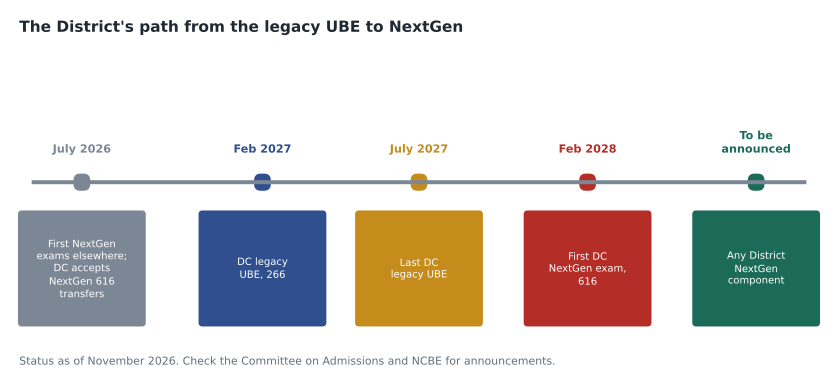
The District of Columbia Court of Appeals amended Rule 46 to adopt the NextGen Uniform Bar Examination by an order in matter M-291-25, published on the court's website in early 2026. The amended rule states the change directly: beginning in February 2028, the District's examination is the NextGen Uniform Bar Examination. Before February 2028, the examination remains the legacy UBE described in Lesson 4. NCBE's jurisdiction information lists July 2027 as the District's final legacy UBE administration and February 2028 as its first NextGen administration.
The District's timing is notable. NCBE's table of jurisdiction decisions shows a handful of jurisdictions starting in July 2026, others in 2027, and a large group, including California, Florida, New York and Texas, starting in July 2028. The District is one of a small number of jurisdictions that start in February 2028, alongside Delaware, Illinois and Montana. That means the District's last legacy UBE is July 2027, not February 2028 as in jurisdictions that switch in July 2028.
The amended rule also sets out how NextGen scores work in the District. To pass the District's NextGen exam, an examinee must attain a score at or above the NextGen passing score, which the court sets by administrative order rather than in the text of Rule 46. NCBE's information and the Committee's announcements list that passing score as 616. The rule keeps two familiar requirements in the new setting: all components must be taken in a single administration, and the four-attempt limit continues to apply.
Transferred NextGen scores, starting July 2026
The District did not wait until 2028 to accept NextGen scores. The amended Rule 46(d)(1) allows applicants to transfer NextGen scores earned in other jurisdictions during any administration in or after July 2026, provided the score is at or above the District's NextGen passing score and is not more than five years old when the transfer is requested. The Committee announced that, effective July 2026, NextGen scores can be transferred to the District with a passing score of 616, and its concurrent transfer windows for the July 2026 and February 2027 exams accepted either a legacy UBE score of 266 or a NextGen score of 616.
This matters right away for candidates like Aaliyah, Jasper's classmate who missed a February 2027 seat. A jurisdiction such as Connecticut, Maryland, Missouri, Oregon or Washington that already gives NextGen could, if it had seats and she was eligible there, give her a NextGen score that she could then transfer to the District if it reached 616. She would need to check that jurisdiction's own eligibility rules and calendar, and she would be preparing for a different exam than the District's February legacy UBE.
What the NextGen exam looks like
NextGen is a single exam taken over a day and a half: two three-hour sections on the first day and one three-hour section on the second. Each section contains three kinds of items. There are about forty standalone multiple-choice questions, some asking the examinee to select two answers rather than one. There are integrated question sets built around a common fact pattern, mixing multiple-choice questions and short written answers. And there is a performance task, a longer lawyering assignment, which in some versions involves legal research using supplied materials. NCBE's blueprint assigns approximate times of under two minutes per multiple-choice question, about twenty-four minutes per integrated set and about an hour for the performance task. Some items in every administration are unscored pretest items.
The content has two parts. Foundational concepts and principles cover eight subjects: business associations, civil procedure, constitutional law, contract law, criminal law and procedure, evidence, real property, and torts. Family law joins the tested subjects starting in July 2028, so the District's February 2028 exam will not test family law from memory, though family law and trusts and estates can appear in skills questions with the law supplied. Foundational skills cover seven areas: legal research, legal writing, issue spotting and analysis, investigation and evaluation, client counseling and advising, negotiation and dispute resolution, and client relationship and management. A short list of ABA Model Rules of Professional Conduct can be tested within the client-facing skills.
NextGen scores are reported on a scale from 500 to 750, and each jurisdiction sets its own passing score. NCBE reported that the first administration, in July 2026, had 2,630 examinees in ten jurisdictions, with an overall pass rate of 72.7 percent and a much higher rate for first-time takers than for repeaters. NCBE had recommended that jurisdictions consider passing scores in the range of 610 to 620. The District's 616 falls in the middle of that range. BAR-130 in this program covers NextGen in depth.
| Feature | Legacy UBE (DC through July 2027) | NextGen (DC from February 2028) |
|---|---|---|
| Length | Two full days | A day and a half (three three-hour sections) |
| Structure | Separate MBE, MEE and MPT | Each section mixes multiple choice, integrated sets and a performance task |
| Subjects from memory | Seven MBE subjects; MEE adds business associations | Eight subjects; family law added from July 2028 |
| Score scale | 400 points; DC passes at 266 | 500 to 750; DC passes at 616 |
| Transfers into DC | Legacy scores of 266 or more within five years | NextGen scores of 616 or more from July 2026 on, within five years |
| District component | None | To be announced |
What is still to be announced
As of November 2026, NCBE's information listed the District's NextGen jurisdiction-specific requirement as to be announced. The court could decide to add nothing, as it has for the legacy UBE, or it could add a component such as a course or test on District law or practice. Marchetti's advice is the same she gives in every transition: 'Plan on what has been announced, keep a backup for what has not, and check the Committee's announcements and NCBE's tables every few months.'
Who should sit which exam
For most current candidates the calendar decides. Jasper graduated in May 2026 and holds a seat for February 2027, a legacy UBE. If he does not pass, he can try again in July 2027, the District's last legacy UBE. After that, any retake in the District would be on NextGen.
The hard cases are candidates who graduate in December 2027 or May 2027 and later. A December 2027 graduate cannot sit a legacy UBE in the District at all, because July 2027 is the last one; her first District exam would be NextGen in February 2028. A May 2027 graduate can sit the District's July 2027 legacy exam, but if she fails, her District retake will be NextGen, which requires different preparation. Some candidates in that position will prefer to sit in a jurisdiction that still gives the legacy UBE in February 2028 and transfer the score. Others will choose to prepare once for NextGen. The right choice depends on the candidate.
Ifeoma is simpler. She expects to graduate in May 2029. Her first District exam would be NextGen, with family law by then a tested subject. Marcus suggests she take family law in law school and seek out clinics and externships that build counseling and negotiation skills, because NextGen tests them directly.
Worked problem
Mapping three candidates
Three candidates want to be admitted in the District: Jasper (graduated May 2026, seat for February 2027), Rhea (expects to graduate December 2027) and Ifeoma (expects to graduate May 2029). Which District exam will each first take?
Show solution
- Jasper: the February 2027 legacy UBE; a retake in July 2027 would still be legacy.
- Rhea: the District's last legacy UBE is July 2027, before she graduates, so her first District exam is NextGen in February 2028.
- Ifeoma: NextGen, with family law tested from memory by then.
- Each can also transfer a qualifying score from elsewhere: 266 on the legacy UBE or 616 on NextGen, within five years.
Answer: Jasper takes the legacy UBE; Rhea and Ifeoma take NextGen in the District.
Preparing during the transition
Several habits help on either exam. Learn the core subjects as rules to apply, not lists to recite. Practice close reading under time pressure, because both the MPT and the NextGen performance tasks punish examinees who skim the instructions. Practice writing short, organized answers. And build lawyering skills through clinics and externships. Marcus adds his own lesson from July 2026: 'The integrated sets felt like a day at a small firm. You read a file, answer a client question, draft a paragraph, and then the facts change. People who had only practiced questions one at a time struggled.'
Common mistakes
MistakeThe District's last legacy UBE is February 2028.
InsteadThe District switches in February 2028, so its last legacy UBE is July 2027.
MistakeThe District will not accept NextGen scores until 2028.
InsteadThe District accepts transferred NextGen scores of 616 or more from administrations in or after July 2026.
MistakeThe NextGen passing score appears in the text of Rule 46.
InsteadThe court sets the NextGen passing score by administrative order; it is listed as 616.
MistakeFamily law will be tested from memory on the District's first NextGen exam.
InsteadFamily law joins the tested subjects in July 2028, after the District's February 2028 start.
How NextGen questions differ
NCBE has said that the NextGen exam is designed to test the skills newly licensed lawyers use, such as legal research, legal writing, issue spotting, client counseling and negotiation, alongside a narrower set of foundational legal concepts. Rather than separating multiple-choice questions, essays and performance tests into different sessions, NextGen integrates them, so that a single session may include short multiple-choice questions, short written answers and longer performance tasks drawing on materials provided in the exam.
For candidates, the practical lesson is that memorizing rules will matter somewhat less and applying them under realistic conditions will matter somewhat more. NextGen provides some legal materials within the exam, as performance tests do now, and NCBE has published the list of foundational concepts and skills the exam will cover. Candidates preparing for NextGen should read NCBE's published content scope, work through NCBE's sample questions and pay attention to the integrated question sets, which present a client problem and ask several questions about it.
Using official materials
Because the exam is new, commercial preparation materials will vary in quality during the first few administrations. NCBE's own study aids, sample questions and content outlines are the most reliable guide to what the exam will test. Candidates should also watch for announcements from the Committee about the District's administration of NextGen, including whether a District law component will be added, the exam's dates and locations, and any changes to registration.
A note for candidates already studying
A candidate who started studying for the legacy UBE and now expects to sit NextGen has not wasted time. The foundational concepts on NextGen overlap heavily with the MBE and MEE subjects, and the skills tested on NextGen performance tasks are close to those on the MPT. The main adjustments are format and emphasis: practicing integrated question sets, writing shorter answers under time pressure, and becoming comfortable working from materials supplied in the exam.
Worked problem
Choosing between the last legacy exam and NextGen
Mara is a law student who will graduate in May 2027. She could sit the District's July 2027 legacy UBE or wait for NextGen in February 2028. How should she decide?
Show solution
- July 2027 is the District's last legacy UBE, so a failure there would mean retaking on NextGen.
- Sitting in July 2027 lets her be admitted months earlier and use widely available legacy preparation materials.
- Waiting for February 2028 delays admission and requires preparing for a new format with fewer proven materials.
- She should also consider where else she may want to practice, since a legacy score can be transferred only to jurisdictions that accept it and within their time limits.
Answer: For most candidates graduating in May 2027, July 2027 is the stronger choice, provided they plan for the possibility of a NextGen retake.
Candidates who expect to practice in more than one jurisdiction should also track which neighbors are adopting NextGen and when. A legacy score is portable only to jurisdictions that still accept it, and a NextGen score is portable only to jurisdictions that have adopted NextGen. Maryland and Virginia, where many District lawyers also practice, set their own timetables and passing standards, and a candidate planning to transfer a score into either should read that jurisdiction's current rules before choosing which exam to sit.
Summary and key terms
- Amended Rule 46 makes NextGen the District's exam beginning February 2028; July 2027 is the last legacy UBE.
- The District accepts transferred NextGen scores of 616 or more from July 2026 on, within five years.
- NextGen takes a day and a half, mixes multiple choice, integrated sets and performance tasks, and reports scores from 500 to 750.
- Any District-specific NextGen component was still to be announced in November 2026.
- Candidates graduating in 2027 face the hardest choices because of the early switch.
- NextGen UBE
- NCBE's new bar exam, which becomes the District's exam in February 2028.
- NextGen passing score
- The score on the 500 to 750 scale needed to pass; 616 in the District.
- Integrated question set
- A NextGen item built on a common fact pattern combining multiple choice and short answers.
- Performance task
- A longer NextGen lawyering assignment, sometimes including legal research.
- Legacy UBE
- The MBE-MEE-MPT exam, given in the District for the last time in July 2027.
Lesson quiz · 5 questions
Score 60% or more to complete this lesson.
Create a free account to save your progress, take quizzes and earn a certificate.