
BAR-209 · Lesson 10 of 12 · 17 min
The DC Rules of Professional Conduct and Rule 49
▶ Video coming soon A video version of this lesson is on the way.
Jasper's MPRE score was a comfortable 96, and he assumes that means he knows the ethics rules. Marchetti asks him a question to test the assumption. 'Can a DC law firm make its economist a partner and share profits with her?' Jasper answers confidently: no, Model Rule 5.4 forbids it. 'Correct on the MPRE,' Marchetti says. 'Wrong in DC. And the DC Court of Appeals just turned down a proposal to go even further.'
This lesson covers the professional conduct rules that apply to District lawyers, focusing on where they differ from the ABA Model Rules that the MPRE tests, and the District's rule on the unauthorized practice of law, Rule 49, which matters to every lawyer who works in the District before being admitted there.
The DC Rules of Professional Conduct
The District of Columbia Court of Appeals adopted the District of Columbia Rules of Professional Conduct, which govern every member of the DC Bar and every lawyer who practices in the District's courts. Like most states' rules, they follow the general structure and numbering of the ABA Model Rules, but they differ in a number of important respects. The DC Bar's legal ethics program publishes the rules with comments, issues ethics opinions through its Legal Ethics Committee and runs an ethics helpline that members can call for informal guidance. Discipline is handled by the Office of Disciplinary Counsel, which investigates and prosecutes complaints, hearing committees and the Board on Professional Responsibility, with the Court of Appeals deciding final sanctions.
A new District lawyer should read the District's rules themselves, not rely on what the MPRE taught. The Mandatory Course that every new admittee must complete within twelve months covers the rules, the disciplinary system and pro bono obligations, but reading the rules in full is the better foundation.
Rule 5.4: nonlawyer partners
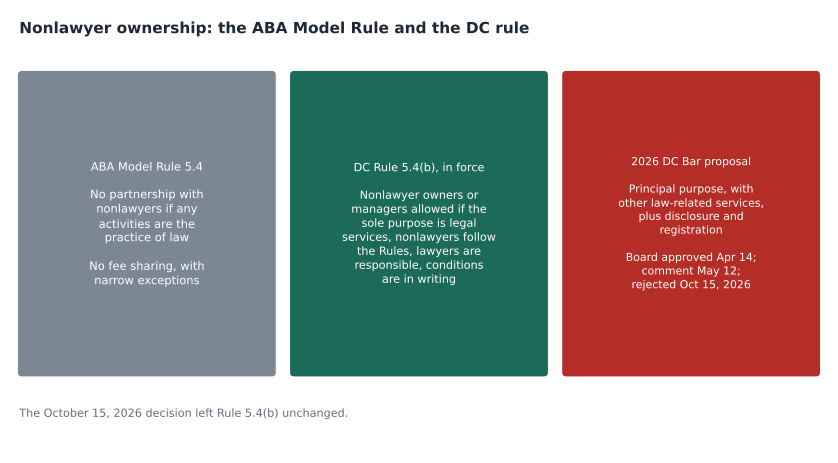
The most famous difference concerns nonlawyer ownership of law firms. ABA Model Rule 5.4 generally forbids lawyers to share legal fees with nonlawyers or to form a partnership with a nonlawyer if any of the partnership's activities consist of the practice of law. For decades, the District has taken a different approach. District Rule 5.4(b) permits a lawyer to practice law in a partnership or other organization in which a nonlawyer holds a financial interest or exercises managerial authority, under conditions. The organization's sole purpose must be providing legal services to clients. The nonlawyers must undertake to abide by the Rules of Professional Conduct. The lawyers with a financial interest or managerial authority must take responsibility for the nonlawyers as if they were lawyers under the supervision rules. And these conditions must be set out in writing. The rule allows firms to bring in economists, lobbyists, accountants or other professionals as partners, as long as the firm exists to provide legal services.
The District's rule has drawn attention as other jurisdictions consider broader changes. Arizona eliminated its version of Rule 5.4 and licenses alternative business structures, and Utah runs a regulatory sandbox. In 2026 the DC Bar asked the court to go further. Its Innovations in Legal Practice Committee recommended, and its Board of Governors unanimously approved on April 14, 2026, amendments that would have allowed firms whose principal purpose, rather than sole purpose, is providing legal services to have nonlawyer owners, as long as any other services were law-related, with supervision, disclosure and registration requirements. The court published the proposal for comment on May 12, 2026 in notice M-297-26, with comments due August 12, 2026. On October 15, 2026, the court rejected the proposed amendments to Rules 5.3, 5.4 and 5.7, stating that it was not persuaded that a strong case had been made for the changes, while noting that it could reconsider if circumstances changed. The existing Rule 5.4(b), with its sole purpose limitation, remains in force.
Rule 1.6: confidences and secrets
The District's confidentiality rule also differs from the Model Rule in its structure and terms. Model Rule 1.6 protects all information relating to the representation of a client. The District's Rule 1.6 is framed in terms of a client's confidences, meaning information protected by the attorney-client privilege, and secrets, meaning other information gained in the professional relationship that the client has asked to be kept confidential or whose disclosure would be embarrassing or likely to be detrimental to the client. The District's exceptions permitting disclosure also differ in wording and scope from the Model Rule's exceptions, including those relating to crimes and to frauds in which a lawyer's services were used. Because these differences can decide what a lawyer may or must do in a crisis, a District lawyer facing a disclosure question should read the District rule and its comments carefully and consider calling the DC Bar's ethics helpline.
Other differences worth knowing
Several other District rules depart from the Model Rules in ways a new lawyer may notice. The District has its own rule prohibiting lawyers from discriminating in employment on the basis of a list of protected characteristics, reflecting the District's broad civil rights law. The District's rules on conflicts of interest, including those involving former government lawyers, matter in a city where many lawyers move between government and private practice, and the District's rule on former government lawyers should be studied by anyone who has worked or will work for a federal agency. The District's version of the rule on pro bono service, Rule 6.1, describes an aspirational duty to provide services to people of limited means, and the DC Bar and the courts encourage it strongly; the Mandatory Course discusses how lawyers can fulfill it.
The broader point is that the District's rules, while similar to the Model Rules in structure, are a separate body of law. Marchetti puts it bluntly: 'The MPRE tested you on the Model Rules. Your clients and the Office of Disciplinary Counsel will hold you to the DC Rules.'
| Topic | ABA Model Rules (MPRE) | DC Rules of Professional Conduct |
|---|---|---|
| Nonlawyer partners | Generally prohibited (Rule 5.4) | Permitted in firms whose sole purpose is legal services, with conditions (Rule 5.4(b)) |
| 2026 proposal to broaden | Not applicable | Rejected by the Court of Appeals on October 15, 2026 |
| Confidentiality | Information relating to the representation (Rule 1.6) | Confidences and secrets, with District exceptions (Rule 1.6) |
| Discipline | Varies by state | Office of Disciplinary Counsel, hearing committees, Board on Professional Responsibility, Court of Appeals |
| Ethics guidance | ABA formal opinions | DC Bar Legal Ethics Committee opinions and ethics helpline |
Rule 49: the unauthorized practice of law
Rule 49 of the District of Columbia Court of Appeals Rules defines the practice of law in the District and prohibits anyone who is not a member of the DC Bar from practicing law in the District, unless an exception applies. The Committee on Unauthorized Practice of Law issues opinions interpreting the rule, and the Committee on Admissions has posted guidance about it for applicants. Rule 49 matters to new lawyers in two ways.
First, it affects lawyers who work in the District before they are admitted there. A recent graduate like Jasper may not practice law in the District until admitted, though he may do legal work under the supervision of a DC Bar member in ways that do not involve holding himself out as a lawyer. Rule 49 also contains exceptions for certain lawyers admitted elsewhere, including a provision that allows a lawyer who has applied for admission to the DC Bar to practice under the direct supervision of a DC Bar member for a limited period while the application is pending, if specified conditions are met, including notice to clients. Other exceptions cover practice before federal courts and agencies when authorized by their rules, and certain work by government lawyers and in-house counsel. The exceptions are detailed and conditional, and lawyers who rely on one should read the current text and guidance carefully.
Second, Rule 49 is one reason the District's route for admission without examination is so heavily used. Many lawyers who move to the District to work for law firms, nonprofits or companies are admitted elsewhere and need to become DC Bar members to practice District law or to hold themselves out as DC lawyers. Lesson 11 explains the routes.
Temporary practice for military spouses
The court's Rule 46-B allows certain attorneys who are spouses of military service members stationed in the District area to practice temporarily. In a notice issued on October 15, 2026, the court proposed amendments to bring the rule into full conformity with a federal statute, 50 U.S.C. section 4025a. The proposals would expand the rule to cover service members as well as spouses, replace the character and fitness inquiry with a criminal background check, remove the requirement of graduation from an ABA-approved school and the two-year limit on temporary practice, and clarify that temporary practitioners need not pay bar dues. Comments were due December 14, 2026. As of November 2026 the amendments were proposals, not adopted rules.
Worked problem
The economist partner
A three-partner DC firm that practices antitrust law wants to make its in-house economist, who is not a lawyer, a partner sharing in profits. The firm does nothing except provide legal services. May it do so under the DC Rules?
Show solution
- DC Rule 5.4(b) allows nonlawyer partners if the organization's sole purpose is providing legal services.
- The firm provides only legal services, so that condition is met.
- The economist must undertake to abide by the Rules of Professional Conduct, the lawyer partners must take responsibility for her, and the arrangement must be in writing.
- The 2026 proposal to allow law-related services beyond legal services was rejected, but this firm does not need it.
Answer: Yes, if the conditions of DC Rule 5.4(b) are met and set out in writing.
Common mistakes
MistakeThe MPRE rules govern DC lawyers.
InsteadDC lawyers are governed by the DC Rules of Professional Conduct, which differ from the ABA Model Rules.
MistakeDC now allows nonlawyer ownership of firms offering a mix of services.
InsteadThe court rejected the broader 2026 amendments on October 15, 2026; nonlawyer partners are allowed only where the firm's sole purpose is legal services.
MistakeA recent graduate working at a DC firm may practice DC law before admission.
InsteadRule 49 prohibits practice in the District by non-members unless an exception applies; supervised work that does not hold the person out as a lawyer is different.
MistakeThe Rule 46-B military amendments are in force.
InsteadThey were proposed on October 15, 2026, with comments due December 14, 2026.
Conflicts of interest
The DC Rules on conflicts of interest follow the general structure of the Model Rules, but District practice puts them to frequent use because of the number of lawyers who move between government service and private practice. Rule 1.11 governs former and current government lawyers, and lawyers who leave federal or District government for a firm must take care with matters in which they participated personally and substantially. Firms in the District routinely screen former government lawyers and keep records of the matters each lawyer handled while in government.
Disciplinary Counsel and the Board on Professional Responsibility
Lawyer discipline in the District is handled by the Office of Disciplinary Counsel, which investigates complaints and prosecutes disciplinary cases, and the Board on Professional Responsibility, which hears cases through hearing committees and makes recommendations to the DC Court of Appeals. The Court of Appeals decides on discipline. Its published disciplinary opinions are a practical guide to how the Rules are applied, and new lawyers can learn a great deal by reading a few of them, particularly on misuse of client funds, which the court treats with particular seriousness.
Trust accounts
Like every jurisdiction, the District requires lawyers to hold client and third-party funds separately from their own, in accounts that meet the requirements of the DC Rules. Lawyers in the District participate in an interest on lawyers' trust accounts program, which uses interest earned on pooled client funds to support legal services. A new lawyer opening a practice should set up a trust account before taking any client funds, keep careful records of every deposit and withdrawal, and never use client money, even briefly, for any other purpose.
Worked problem
A former government lawyer joins a firm
Ines spent four years at a federal agency, where she worked personally on an enforcement investigation of Delta Corp. She now joins a District firm, which is asked to represent Delta Corp. in the same matter. What issues arise?
Show solution
- Rule 1.11 generally bars her from representing Delta Corp. in a matter in which she participated personally and substantially as a government lawyer, unless the agency consents.
- The firm may be able to take the matter if she is screened from it and the agency is given notice, as the Rule provides.
- Federal ethics rules may impose separate restrictions on her.
- The firm should document the screen before the representation begins.
Answer: She is personally barred; the firm may proceed only with a proper screen and notice.
Summary and key terms
- DC lawyers follow the DC Rules of Professional Conduct, not the ABA Model Rules tested on the MPRE.
- DC Rule 5.4(b) allows nonlawyer partners in firms whose sole purpose is providing legal services, under written conditions.
- The court rejected the DC Bar's broader 2026 nonlawyer ownership proposal on October 15, 2026.
- DC Rule 1.6 protects confidences and secrets, with exceptions that differ from the Model Rule.
- Rule 49 prohibits unauthorized practice in the District, with detailed exceptions, including limited supervised practice while an admission application is pending.
- DC Rule 5.4(b)
- The District rule permitting nonlawyer partners in organizations whose sole purpose is providing legal services.
- Confidences and secrets
- The two categories of client information protected by DC Rule 1.6.
- Rule 49
- The DC Court of Appeals rule defining and prohibiting the unauthorized practice of law in the District.
- Office of Disciplinary Counsel
- The office that investigates and prosecutes complaints against DC lawyers.
- Rule 46-B
- The court rule allowing temporary practice by certain military spouse attorneys.
Lesson quiz · 5 questions
Score 60% or more to complete this lesson.
Create a free account to save your progress, take quizzes and earn a certificate.