
BAR-207 · Lesson 8 of 12 · 17 min
Connecticut torts and the Unfair Trade Practices Act
▶ Video coming soon A video version of this lesson is on the way.
Most of the cases on Graham's desk at Abernathy's firm are torts. There is a rear-end collision on Interstate 84, a slip on ice outside a New Britain apartment building, a dog bite in West Hartford, and a dispute in which a small landscaping company claims a competitor lied to its customers. 'Notice which of those has the most money in it,' Hollis Marchetti says when he lists them. Graham guesses the collision. 'Maybe,' she says. 'But the landscaping case has a statute that can add punitive damages and attorney's fees. In Connecticut, that statute shows up in more complaints than almost anything else. Let's do torts first and then CUTPA.'
This lesson covers the Connecticut tort rules a new lawyer meets most often: comparative negligence and several liability, limitation periods, product liability, a few special duties and immunities, and the Connecticut Unfair Trade Practices Act. None of these Connecticut versions is tested on NextGen, which tests general tort principles. They matter in practice from the first week.
Comparative negligence
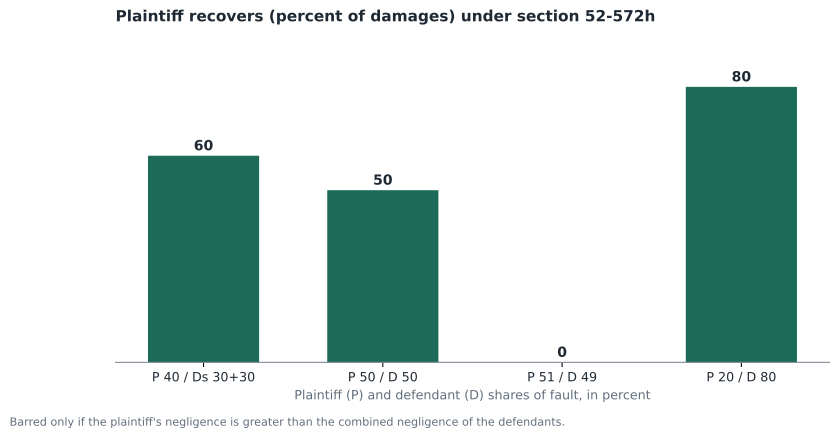
Connecticut adopted comparative negligence by statute in 1973, replacing the old common law rule that any contributory negligence barred recovery. The current rule, in General Statutes section 52-572h, is a modified comparative negligence system. A plaintiff's own negligence does not bar recovery if it was not greater than the combined negligence of the persons against whom recovery is sought. If it was not greater, the plaintiff's damages are reduced in proportion to the plaintiff's share of fault. If it was greater, the plaintiff recovers nothing.
The comparison is with the defendants together, not one at a time. A plaintiff who is 40 percent at fault, suing two defendants who are each 30 percent at fault, recovers 60 percent of the damages, even though the plaintiff was more at fault than either defendant alone. A plaintiff who is exactly 50 percent at fault against defendants who are together 50 percent at fault also recovers, because the plaintiff's negligence is not greater than theirs. Only a plaintiff whose share exceeds the defendants' combined share, 51 percent or more, is barred.
Several liability and reallocation
Section 52-572h also changed joint liability. In most negligence actions for personal injury, wrongful death or property damage, each defendant is liable only for its proportionate share of the recoverable economic and noneconomic damages. If a defendant's share turns out to be uncollectible, the statute provides a procedure for reallocating it among the other parties, including the plaintiff, according to their shares of fault, after a motion made within a set time after judgment. Combined with apportionment, which lets defendants bring in others whose negligence contributed to the harm, the rule makes the allocation of fault among all responsible persons central to Connecticut negligence litigation.
| Rule | Connecticut | Where it comes from |
|---|---|---|
| Contributory fault | Modified comparative negligence; barred only if greater than defendants' combined negligence | General Statutes section 52-572h |
| Joint liability | Generally several, with reallocation of uncollectible shares | Section 52-572h |
| Bringing in others | Apportionment complaint within 120 days of return day | Section 52-102b |
| Negligence limitation period | Two years from discovery of injury, no more than three years from the act | Section 52-584 |
| Product liability | Statutory product liability claim; three-year period and a ten-year repose rule in most cases | Sections 52-572m and following, 52-577a |
Limitation periods
Connecticut's main negligence limitation period, in section 52-584, has two parts. An action must be brought within two years from the date when the injury is first sustained or discovered, or in the exercise of reasonable care should have been discovered. And no action may be brought more than three years from the date of the act or omission complained of. The second part is a repose rule: even a plaintiff who could not have discovered the injury loses the claim three years after the negligent act. Medical malpractice claims fall under the same section, with an automatic ninety-day extension available when a plaintiff petitions for it to investigate the claim, and with a requirement under section 52-190a that the complaint include a good faith certificate and a written opinion from a similar health care provider that there appears to be evidence of negligence.
Intentional torts and many other claims have different periods; the general tort statute, section 52-577, allows three years from the act or omission. Because Connecticut measures many periods from the act and commences actions on service rather than filing, a lawyer who takes a case near the deadline must allow time for a state marshal to serve the defendant.
Product liability
Connecticut's Product Liability Act, sections 52-572m and following, provides a single statutory claim for harm caused by a product, whether the theory is strict liability, negligence, breach of warranty, misrepresentation or failure to warn. The act is the exclusive remedy against a product seller for those theories, so a complaint should plead a product liability claim rather than separate common law counts. Claims generally must be brought within three years from when the injury is or should have been discovered, and most claims are subject to a repose rule barring actions brought more than ten years after the defendant last parted with the product, with exceptions. Comparative responsibility applies to product claims as well.
Duties and immunities worth knowing
A few other Connecticut rules come up early. The dog bite statute imposes strict liability on the owner or keeper of a dog that causes damage to a person or property, subject to defenses where the injured person was committing a trespass or other tort or was teasing or abusing the dog. The dram shop act allows a person injured by an intoxicated person to recover against the seller of the alcohol, subject to statutory limits on damages and a requirement of prompt notice. Municipalities and their employees have a qualified governmental immunity, codified in section 52-557n, that generally protects discretionary acts but not ministerial acts or certain other conduct; claims based on highway defects follow a separate statute with a short written notice requirement. Connecticut recognizes bystander emotional distress claims within limits, and its courts have allowed recovery for negligent infliction of emotional distress in defined circumstances.
The Connecticut Unfair Trade Practices Act
The Connecticut Unfair Trade Practices Act, known as CUTPA, is in Chapter 735a of the General Statutes. Section 42-110b(a) states its core rule: no person shall engage in unfair methods of competition and unfair or deceptive acts or practices in the conduct of any trade or commerce. Section 42-110b(b) directs the courts to be guided by interpretations of section 5(a)(1) of the Federal Trade Commission Act. CUTPA is enforced both by the Commissioner of Consumer Protection and the Attorney General and by private parties.
Connecticut courts decide whether a practice is unfair using a test drawn from the Federal Trade Commission's 1964 statement on cigarette advertising, often called the cigarette rule. A court asks whether the practice offends public policy as established by statutes, the common law or otherwise; whether it is immoral, unethical, oppressive or unscrupulous; and whether it causes substantial injury to consumers, competitors or other businesspersons. A practice need not satisfy all three criteria; it may be unfair because of the degree to which it meets one, or because to a lesser extent it meets all three. The Connecticut Supreme Court has repeatedly applied that test, and in Ulbrich v. Groth, decided in 2013, it addressed CUTPA's relationship to other remedies and the availability of punitive damages.
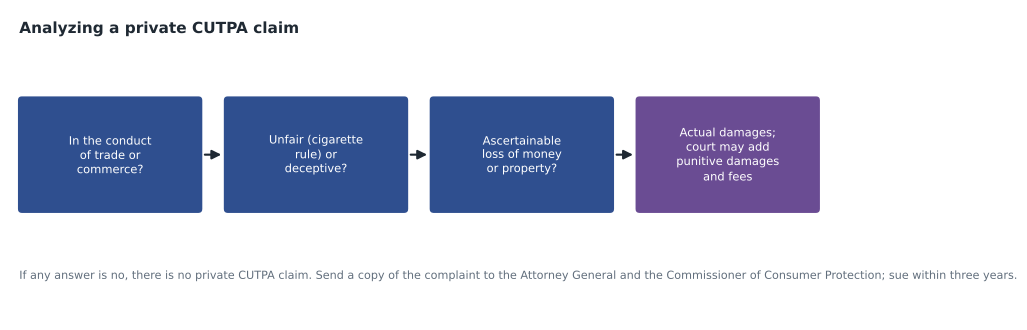
CUTPA's private remedy is in section 42-110g. Any person who suffers an ascertainable loss of money or property as a result of a prohibited practice may sue to recover actual damages. The court may, in its discretion, award punitive damages and may award reasonable attorney's fees and costs. Class actions are permitted. Actions must generally be brought within three years after the occurrence of the violation, and the plaintiff must send a copy of the complaint to the Attorney General and the Commissioner of Consumer Protection. CUTPA is not limited to consumer transactions: businesses sue competitors under it, which is why the landscaping company on Graham's desk pleaded a CUTPA count alongside its claims for interference with business relations. It also has limits: courts have held, for example, that a simple breach of contract without aggravating circumstances is usually not enough, and that some professional conduct falls outside its reach.
Worked problem
Pleading the landscaping case
Elmwood Landscaping alleges that a competitor told Elmwood's customers, falsely, that Elmwood's owner had been arrested for fraud, and that several customers canceled contracts worth about 40,000 dollars.
Show solution
- The statements were made in trade or commerce, to customers in the competitor's business.
- False statements to steal customers offend public policy and are unscrupulous, and they caused substantial injury to a competitor.
- Canceled contracts are an ascertainable loss of money.
- Elmwood can seek actual damages, and the court may add punitive damages and attorney's fees.
Answer: Elmwood should plead a CUTPA count along with defamation and tortious interference, and send a copy of the complaint to the Attorney General and the Commissioner of Consumer Protection.
Marchetti closes with a warning Graham writes in his notebook. 'On the exam, torts means general principles: whatever system of comparative fault the question gives you, joint and several liability unless it says otherwise, and no CUTPA. At work, Connecticut means section 52-572h, two years from discovery capped at three, and a CUTPA count whenever a business behaved badly. Keep the two worlds apart and you will be right in both.'
Common mistakes
MistakeA plaintiff more at fault than any single defendant is barred.
InsteadThe comparison is with the defendants' combined negligence.
MistakeDefendants in Connecticut negligence cases are jointly liable.
InsteadLiability is generally several, with reallocation of uncollectible shares.
MistakeThe negligence limitation period runs only from discovery.
InsteadSection 52-584 also bars claims more than three years after the act.
MistakeCUTPA protects only consumers.
InsteadBusinesses may sue competitors; any person with an ascertainable loss may sue.
Damages
Connecticut allows recovery of the usual categories of compensatory damages in tort: economic damages such as medical expenses, lost earnings and property loss, and noneconomic damages such as pain and suffering and loss of enjoyment of life. Connecticut does not cap noneconomic damages in ordinary negligence or medical malpractice cases. Common law punitive damages in Connecticut are distinctive and limited: they are measured by the plaintiff's litigation expenses, including attorney's fees, less taxable costs, rather than by a separate amount designed to punish. That is one reason the punitive damages available under CUTPA and certain other statutes matter so much; statutory punitive damages are not subject to the common law measure and can be substantially larger.
Collateral source payments, such as health insurance benefits, generally reduce a damages award after the verdict under a statutory procedure, subject to adjustments for amounts the plaintiff paid to obtain the benefits and for rights of subrogation. Prejudgment interest in tort cases is mainly available through the offer of compromise statute discussed in lesson 7, not as a matter of course.
Wrongful death and loss of consortium
Connecticut's wrongful death statute allows the executor or administrator of a decedent's estate to recover just damages, including the value of the decedent's lost earning capacity and the destruction of the capacity to carry on and enjoy life's activities, along with medical and funeral expenses. The action is brought by the estate, not by family members directly. The limitation period for wrongful death runs from the date of death, within a statutory outer limit measured from the act or omission. Spouses may claim loss of consortium, and Connecticut's Supreme Court has also recognized a minor child's claim for loss of parental consortium in certain cases.
Negligence per se and statutes
Connecticut courts may treat violation of a statute or regulation designed to protect a class of persons from a particular harm as negligence per se, if the plaintiff is within the protected class and the injury is of the type the statute was meant to prevent. Traffic statutes are a common source. A related Connecticut statute allows enhanced damages, up to double or triple damages, against a defendant who deliberately or with reckless disregard violated certain motor vehicle statutes, such as speeding or driving while intoxicated, if the violation was a substantial factor in causing injury. Personal injury lawyers in Connecticut plead that statute whenever the facts allow.
Premises liability
Connecticut premises liability turns on the status of the visitor. An invitee is owed a duty of reasonable care to keep the premises reasonably safe and to warn of or remedy dangers the owner knew of or should have discovered. A licensee is owed a lesser duty, chiefly to warn of known dangers the licensee is unlikely to discover. A trespasser is generally owed only a duty to refrain from willful or wanton injury, with exceptions for known trespassers and for children under the attractive nuisance doctrine. A plaintiff in a slip-and-fall case must usually prove that the defendant had actual or constructive notice of the specific defect. Graham's New Britain ice case turns on that question: whether the landlord knew or should have known about the ice in time to treat it.
CUTPA in practice
CUTPA claims are pleaded so often in Connecticut business litigation that judges and lawyers have developed a rich body of decisions on its limits. Three are worth knowing early. First, a simple breach of contract, even an intentional one, is usually not a CUTPA violation without substantial aggravating circumstances, such as deception. Second, CUTPA applies to the entrepreneurial aspects of a professional's practice, such as billing and advertising, but generally not to claims about the quality of professional services, which are malpractice claims. Third, CUTPA does not reach conduct outside trade or commerce, such as purely private sales or many employment relationships. A lawyer who adds a CUTPA count by reflex invites a motion to strike; one who pleads the aggravating facts carefully can recover punitive damages and fees that the underlying common law claims would not support.
Graham's landscaping case fits comfortably within CUTPA: false statements to a competitor's customers are deceptive conduct in trade or commerce, aimed at diverting business. His slip-and-fall and dog bite cases do not involve CUTPA at all. 'Ask two questions,' Marchetti says. 'Was there trade or commerce, and was there something unfair beyond an ordinary dispute? If both answers are yes, plead it.'
Summary and key terms
- Section 52-572h: recovery reduced by the plaintiff's share; barred only if greater than the defendants' combined negligence.
- Liability is generally several, with reallocation of uncollectible shares; apportionment brings in others.
- Negligence: two years from discovery, no more than three years from the act; medical malpractice needs a good faith certificate and opinion letter.
- The Product Liability Act is the exclusive product claim against sellers.
- CUTPA uses the cigarette rule; private plaintiffs need an ascertainable loss and may get punitive damages and fees.
- Modified comparative negligence
- A system that reduces recovery by the plaintiff's share of fault and bars recovery above a threshold.
- Several liability
- Each defendant pays only its own share of damages.
- Cigarette rule
- The three-part test Connecticut courts use to decide whether a practice is unfair under CUTPA.
- Ascertainable loss
- A measurable loss of money or property required for a private CUTPA claim.
- Repose
- A fixed outer limit that bars a claim regardless of discovery.
Lesson quiz · 5 questions
Score 60% or more to complete this lesson.
Create a free account to save your progress, take quizzes and earn a certificate.