
BAR-207 · Lesson 12 of 12 · 17 min
Capstone: Connecticut practice questions and an exam-day plan
▶ Video coming soon A video version of this lesson is on the way.
On the Sunday before Thanksgiving, Hollis Marchetti sends Graham a capstone packet: ten original questions on Connecticut admission and Connecticut law, one short essay, and a template for his exam-week plan. 'Two things in here,' her email says. 'The questions check that you have the Connecticut picture straight, so nothing about admission or local practice surprises you. The plan is for February, when the only thing that should be in your head is the exam.' This lesson works through the packet. None of the questions is a real bar exam question; all were written for this course.
Part one: ten questions
Answer each question before reading the explanation. The explanations cite the lesson where each rule is covered.
Question 1. A graduate of a law school accredited only by a state agency, not by the American Bar Association, and not approved by the committee, wants to sit the February 2027 Connecticut exam. She has never been admitted anywhere. Can she sit? Answer: No. Connecticut requires a degree from an ABA-approved or committee-approved school; the exception for experienced lawyers requires ten years of admission and five of the last seven years in practice (lesson 2).
Question 2. An applicant who has failed the Connecticut exam four times wants to file for July 2027. What does the 2026 rule provide? Answer: After four unsuccessful attempts, an applicant may file only for a February administration, so the applicant must wait for February 2028 (lessons 1 and 2).
Question 3. An applicant downloads her MPRE score report from her NCBE account and uploads it with her application. Is her MPRE requirement satisfied? Answer: Not yet. Connecticut requires NCBE to send the score directly to the committee; an applicant-submitted report is not accepted (lesson 3).
Question 4. A candidate earns a scaled NextGen score of 618 in Connecticut in February 2027. Did the candidate pass? Answer: Yes, if the passing score is still 616, as it was in November 2026. The committee has agreed to revisit the passing score, so candidates should check the current notice (lesson 4).
Question 5. A lawyer earned a legacy UBE score of 270 in Massachusetts in July 2022 and wants to transfer it to Connecticut in January 2027. Is the score eligible? Answer: Yes. It exceeds Connecticut's 266 minimum, and the application falls within five years of the exam (lesson 11).
Question 6. A plaintiff in a Connecticut negligence action is found 50 percent at fault; the single defendant is 50 percent at fault. Damages are 80,000 dollars. What does the plaintiff recover? Answer: 40,000 dollars. The plaintiff's negligence is not greater than the defendant's, so recovery is reduced by half under section 52-572h (lesson 8).
Question 7. A process server delivers a writ, summons and complaint to a defendant on March 4. The return day is a Tuesday, March 16. Is service timely? Answer: Yes, barely. Service must be made at least twelve days before the return day; March 4 is twelve days before March 16. The papers must then be returned to court at least six days before the return day, by March 10 (lesson 7).
Question 8. A client's late father, domiciled in Connecticut, left a handwritten, signed and dated will executed at home in Connecticut with no witnesses. Is it valid? Answer: No. A will executed in Connecticut requires two subscribing witnesses; Connecticut does not recognize holographic wills executed here (lesson 9).
Question 9. During a meeting, a client tells a Connecticut lawyer he plans to burn down a rival's occupied building tonight. What must the lawyer do? Answer: Rule 1.6(b) requires the lawyer to reveal information to the extent reasonably necessary to prevent a criminal act likely to cause death or substantial bodily harm. Disclosure is mandatory in Connecticut, not merely permitted (lesson 10).
Question 10. A Connecticut lawyer admitted in April 2027 asks how many continuing education hours she must complete in 2027. Answer: None. Attorneys are exempt for the calendar year in which they are admitted; the twelve-hour requirement, with two hours in ethics, begins in 2028 (lesson 11).
| Question | Topic | Lesson |
|---|---|---|
| 1 | Education requirement | 2 |
| 2 | Attempt limit | 1, 2 |
| 3 | MPRE reporting | 3 |
| 4 | Passing score | 4 |
| 5 | Score transfer | 11 |
| 6 | Comparative negligence | 8 |
| 7 | Service and return | 7 |
| 8 | Wills | 9 |
| 9 | Confidentiality | 10 |
| 10 | Continuing education | 11 |
Graham gets nine of ten. He misses question 7, thinking service had to be made more than twelve days before the return day. Marchetti tells him to read the statute's wording at work on Monday and add the answer to his notebook in his own words.
Part two: an essay
Marchetti's essay is written in the style of an integrated question set, but on Connecticut law, so it is practice for local work rather than for the exam. Graham has thirty minutes.
The facts: Coastline Pools, a Connecticut installer, sold and installed an in-ground pool for the Ferreira family in Glastonbury for 60,000 dollars. Coastline's salesperson told the Ferreiras the pool had a lifetime structural warranty; the written contract gave only a one-year warranty, and Coastline's manager admitted in an email that salespeople were told to say lifetime because it closes deals. Eighteen months later the pool shell cracked. Coastline refused to repair it. A neighbor's child, visiting, slipped on the cracked deck and broke an arm. The Ferreiras want to know what claims they have and what risks they face.
A strong answer covers four points. First, the Ferreiras have a CUTPA claim. Telling customers about a lifetime warranty while the contract gives one year, as a deliberate sales practice, is deceptive and offends public policy under the cigarette rule. The repair cost is an ascertainable loss. They may recover actual damages, and the court may award punitive damages and attorney's fees. They must send a copy of the complaint to the Attorney General and the Commissioner of Consumer Protection, and they must sue within three years of the violation. Second, they have contract and warranty claims, but the written one-year warranty and any merger clause may limit them, which is one reason the CUTPA claim matters. Third, the injured child may have a negligence claim against the Ferreiras as owners of the premises, and possibly against Coastline; if the child's claim is brought, the Ferreiras may file an apportionment complaint against Coastline within 120 days of the return day, and liability will be several under section 52-572h. Fourth, deadlines: negligence claims must be brought within two years of the injury and no more than three years after the act, and Connecticut actions are commenced by service, so the firm should allow time for a state marshal.
Worked problem
Self-grading the essay
Graham's answer identifies the CUTPA claim and the remedies, the contract issue, and the child's negligence claim, but does not mention apportionment or the notice to the Attorney General.
Show solution
- CUTPA claim with the cigarette rule and ascertainable loss: 3 of 3 points.
- Remedies, including punitive damages and fees: 2 of 2 points.
- Contract and warranty limits: 1 of 1 point.
- Child's claim, apportionment and several liability: 1 of 2 points; missed apportionment.
- Procedure and deadlines, including notice to the Attorney General: 0 of 1 point.
Answer: Graham scores 7 of 9. The misses are procedural, which is exactly the kind of Connecticut detail his notebook is for.
Part three: the exam-week plan
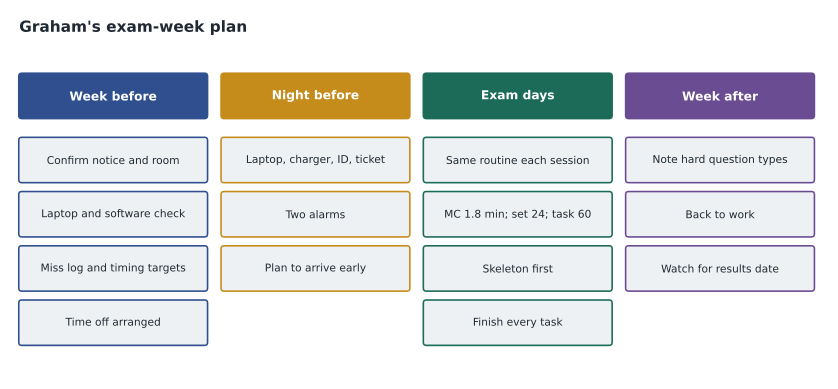
The last part of the packet is the plan. Marchetti's template has four sections: the week before, the night before, the two exam days, and the week after.
The week before: confirm the location, reporting times and permitted items in the committee's notice; confirm the laptop is registered and the exam software is updated, with a final practice run on the same machine; stop new studying two days before and review only the miss log, the performance task checklist and a one-page list of timing targets: about 1.8 minutes per multiple-choice question, about 24 minutes per integrated set, about 60 minutes per performance task, with ten minutes saved for the end of each task. Arrange time off work for both exam days and the day after.
The night before: pack the laptop, charger, government photo identification and the admission ticket; set two alarms; plan to arrive early, because late arrivals are not admitted after the instructions begin and missing a session means withdrawal with no result.
The exam days: follow the same routine in each session. Glance at the session's components, start the multiple-choice questions, keep track of time against the targets, write the performance task in a skeleton first so that every required part gets something, and never leave a task unfinished. Eat lunch away from other candidates if their talk about the morning is unsettling. On the second morning, remember that the room will be smaller and the session shorter, and treat it as fresh.
The week after: write down every question type that felt hard, while it is fresh, and file it with the plan; it will be useful whatever the result. Then return to work and the notebook. Results for the February 2027 exam are expected in the spring; the committee announces the date. If Graham passes, his file is current, his MPRE is on record, and he can expect a ceremony about a month later. If he does not, the July window opens on March 1, and his notes from the week after will be the start of his next plan.
Closing the course
Graham's last session with Marchetti is short. He has a plan, a notebook with forty Connecticut rules in it, and a clear idea of what the February exam will ask of him. 'You know what changed since July?' she asks. He thinks for a moment. 'I know where the points are,' he says, 'and I know which rules belong to the exam and which belong to the office.' Marchetti nods. 'That is the whole course,' she says. 'Go finish your tasks.'
Common mistakes
MistakeService must be made more than twelve days before the return day.
InsteadService is timely if made at least twelve days before the return day.
MistakeA CUTPA plaintiff needs only to show the defendant acted unfairly.
InsteadA private plaintiff must also show an ascertainable loss and send the complaint to the Attorney General and the Commissioner.
MistakeAn unfinished performance task costs only the unwritten paragraph.
InsteadEvery required part left unanswered loses points; write a skeleton first.
MistakeExam week is for learning new material.
InsteadStop new studying two days before and review the miss log and timing targets.
Reviewing the misses
Marchetti asks Graham to write a short note on each question he missed or hesitated over, using a format she gives every candidate: the question, the answer he chose, the right answer, the rule, and the reason he went wrong. For question 7, his note reads: 'Thought service had to be more than twelve days before the return day. Rule: at least twelve days, so the twelfth day counts. Why I missed it: I read the rule loosely and second-guessed a simple count.' The note is short, but writing it fixes the rule in memory far better than reading the explanation again.
He also writes notes for two questions he got right but hesitated on: question 6, where he briefly wondered whether a plaintiff at exactly 50 percent is barred, and question 9, where his first instinct was the Model Rule's 'may'. Both hesitations come from the same source, mixing up the national rule and the Connecticut rule, and both go into his notebook as reminders.
Applying the same method to the exam
The capstone's questions are about Connecticut, but the review method is the one Graham will use for every NextGen practice session between now and February. After each timed session, he logs every missed multiple-choice question with the rule and the reason, compares each integrated set answer with the model answer for length and content, and scores each performance task against its point sheet, noting where time ran out. Every Sunday he reads the week's notes and picks two habits to fix the next week. Marchetti asks him to email her the Sunday list each week until the exam.
The last month
For the four weeks before the exam, Marchetti gives Graham a schedule that tapers. Weeks one and two: two full simulated sessions each week, one performance task and four integrated sets on the other days, multiple-choice drills daily. Week three: one full simulated day and a half, run on the Tuesday and Wednesday at the same times as the real exam, to rehearse the rhythm. Week four: light practice only, the miss log, the timing targets and the logistics. Work drops to part-time in the last three weeks and stops entirely for the last two days before the exam, by arrangement with Abernathy.
When things go wrong on the day
Marchetti prepares Graham for the problems that can happen in the room. If the laptop fails, raise a hand at once and follow the proctors' instructions; the exam software and the committee have procedures for technical failures, and panicking costs more time than the failure. If he finishes a session early, he should check the multiple-choice questions he flagged and reread the performance task's headings against the task memo, not sit idle. If a question seems to test something he has never seen, he should answer it from first principles and move on; with unscored pretest items in every session, the strange question may not count at all. And if one session goes badly, he should treat the next as a fresh start, because the score is a single total across all three sessions, and a strong later session can make up for a weak earlier one.
The result, either way
Graham asks the question every candidate asks: what if he fails again? Marchetti answers practically. A second failure would not change his eligibility: it would be his second unsuccessful attempt, leaving two more before the February-only rule applies. The July 2027 filing window opens on March 1, and his week-after notes and Sunday lists would show him what to change. She also reminds him that his firm has already said it will keep him on as a clerk whatever happens. 'The plan works for both outcomes,' she says. 'That is what makes it a plan and not a hope.'
If he passes, the steps are simple: confirm his file is complete, watch for the ceremony date, get his juris number, register for e-filing, and start the first-year practice plan. Abernathy has already promised to sign his first appearance with him.
What the course covered
Over twelve lessons, the course has followed one candidate from a failed first attempt to a complete plan for his second. It has covered the bodies that control admission in Connecticut and the steps every applicant takes; eligibility, filing windows and fees; character and fitness and the MPRE; the NextGen exam as Connecticut gives it and the 2026 change from the legacy UBE; how Connecticut law appears, and does not appear, on a national exam; Connecticut courts and procedure, torts and CUTPA, family law, property and probate, and the Rules of Professional Conduct; and the routes to admission without the exam and the duties that follow admission. Every rule was checked against official sources as of November 2026, and every rule can change. The habit worth keeping is the one Graham learned: check the current notice, read the question, and keep the exam's world and the office's world apart.
Summary and key terms
- The capstone tests Connecticut admission rules, procedure, torts, wills, ethics and continuing education.
- The essay combines CUTPA, warranty limits, apportionment and deadlines.
- Timing targets: about 1.8 minutes per multiple-choice question, 24 per integrated set, 60 per performance task.
- Arrive early: late arrivals are not admitted, and missing a session means withdrawal.
- After the exam, record hard question types and watch for the results date.
- Capstone
- A final set of original questions and an essay reviewing the course.
- Miss log
- A record of missed practice questions and the rules behind them.
- Timing targets
- Planned minutes per component to keep pace on exam day.
- Skeleton answer
- An outline of every required part of a task, written before filling in detail.
- Withdrawal
- The status of an applicant who misses a session and receives no result.
Lesson quiz · 5 questions
Score 60% or more to complete this lesson.
Create a free account to save your progress, take quizzes and earn a certificate.