
BAR-207 · Lesson 2 of 12 · 16 min
Eligibility, education, filing windows and fees
▶ Video coming soon A video version of this lesson is on the way.
Graham's second session with Hollis Marchetti is about paperwork. He has filed for the February 2027 exam already, in the first days of the October window, but he wants to understand the rules well enough to answer the questions his classmates keep asking him. One friend graduated from a law school that is not approved by the American Bar Association. Another earned an LL.M. in the United States after a law degree abroad. A third wants to know why her fee was higher than his. 'Good,' Marchetti says. 'If you can explain these rules to them, you will never be caught by them yourself.'
This lesson covers who may sit the Connecticut exam, how and when to file, what it costs, and the deadlines that follow filing. All of it comes from Article II and related articles of the Connecticut Bar Examining Committee's regulations, as revised effective January 26, 2026, and from the committee's published notices for the 2026 and 2027 exams.
The education requirement
The basic rule is simple. To sit the Connecticut exam, an applicant must hold a Juris Doctor or equivalent degree from an approved law school, conferred before the exam. Under the 2026 regulations, a law school counts as approved if it was approved or provisionally approved by the American Bar Association when the degree was conferred, or if the committee itself has approved it. A school the committee approves must offer courses in all the subject areas the exam tests.
The committee has used that power. Its published guidance lists the Massachusetts School of Law as an approved school and, for graduates from 2024 onward, Purdue Global Law School. Graduates of other law schools that are not ABA-approved, including most online and state-accredited schools, do not qualify on the strength of the degree alone. A candidate who attended one of those schools should not assume that admission elsewhere opens the door to Connecticut; the education rules are applied to every applicant.
There is one route around the education requirement for experienced lawyers. An applicant who has been admitted in another jurisdiction for at least ten years and has practiced there for five of the last seven years may sit the Connecticut exam without meeting the ordinary education rules. That route is for senior practitioners, not recent graduates.
Foreign-educated applicants
Connecticut is open to foreign-trained lawyers, but on its own terms. NCBE's jurisdiction information lists Connecticut as accepting foreign law graduates, and Article II-3 of the committee's regulations sets the conditions. In general, a foreign-educated applicant must show a legal education that the committee finds equivalent and must complete additional study in American law at an ABA-approved law school. The committee's guidance is blunt about one point: a non-approved law degree or an LL.M. by itself does not qualify. What counts is the combination the regulation requires.
In 2026 the committee updated how that additional study may be done. At its January 30, 2026 meeting it approved online LL.M. courses for purposes of Article II-3(B), and at its April 24, 2026 meeting it accepted, by an eleven-to-three vote, amendments to Article II-3 to carry that decision into the regulation. A foreign-trained candidate planning an online LL.M. should read the current text of Article II-3 carefully and confirm with the administrative office that a particular program and course list will satisfy it before enrolling.
| Applicant | Can sit the Connecticut exam? | What to check |
|---|---|---|
| JD from an ABA-approved school | Yes | Proof of degree at least seven days before the exam |
| JD from Massachusetts School of Law, or Purdue Global (2024 or later) | Yes | Committee approval applies to the year of the degree |
| JD from another non-ABA school | Generally no | Unless admitted ten years and practicing five of the last seven |
| Foreign law degree plus approved US study | Possibly | Article II-3, including the 2026 online LL.M. changes |
| LL.M. alone | No | An LL.M. by itself does not qualify |
Age, attempts and other conditions
Two other eligibility rules changed in 2026. First, applicants may now sit the exam before they turn eighteen, but they may not be admitted until they reach that age. Second, the committee limited how often repeat takers may sit. Under Article III-1(D), after four unsuccessful attempts on the Connecticut bar examination, an applicant may file only for a February administration. A fifth or later attempt is still possible, but not in July. Older guidance on the committee's website still describes unlimited attempts; the current regulation controls.
Applicants must also meet the MPRE and character requirements covered in lesson 3. Connecticut does not impose a residency requirement for admission, and the Practice Book rule on admission without examination requires only that an applicant be a United States citizen or lawfully residing in the United States, including someone authorized to work here. Applicants with questions about immigration status should raise them with the administrative office early.
Filing windows
Connecticut gives the exam twice a year. Under the 2026 regulations it is held on the last two consecutive Tuesdays and Wednesdays of February and July, over a day and a half: two sessions on the first day and one on the second. Each exam has a single filing window. For a July exam, applications are filed from March 1 to April 30. For a February exam, they are filed from October 1 to November 30. The regulations divide each window into tiers, and the fee rises as the window goes on.
For the July 2026 exam, the first NextGen exam, the committee added two further rules. It accepted no more than 600 applications, first-come, first-served, and it gave priority to first-time takers. From March 1 to 15, only applicants taking a bar exam for the first time in any United States jurisdiction could file. From March 16 to 31, those first-timers plus applicants who had failed the July 2025 exam in Connecticut could file. From April 1 to 30, all eligible applicants could file, until the cap was reached. Applicants who failed the February 2026 exam had a separate window from April 24 to May 15, opening on the day February results were released.
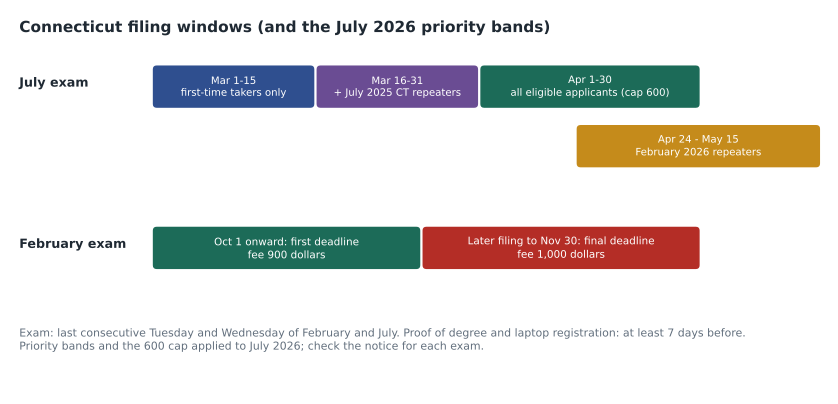
Whether those caps and priority bands will be used again is a decision the committee makes exam by exam, so candidates should read the filing notice for their administration rather than assume. The committee's July 10, 2026 minutes show 474 applications filed for July 2026, well under the cap, but no one could have known that in March. Marchetti's advice is the same for every exam: file early in the window.
Fees
The committee's 2026 regulation changes raised several fees. The exam application fee became 900 dollars at the first deadline and 1,000 dollars at the final deadline. The fee for a UBE score transfer application rose to 850 dollars, and registration as authorized house counsel rose to 1,200 dollars. The fee for admission without examination stayed at 1,800 dollars. For July 2026, the committee's filing notice set a single fee of 900 dollars for all applicants. Applicants also pay NCBE separately for the MPRE and for any score report sent from another jurisdiction.
| Item | Fee (2026 regulations) |
|---|---|
| Exam application, first deadline | 900 dollars |
| Exam application, final deadline | 1,000 dollars |
| UBE score transfer application | 850 dollars |
| Admission without examination | 1,800 dollars |
| Authorized house counsel registration | 1,200 dollars |
Deadlines after filing
Filing is not the last deadline. Two more fall shortly before the exam. First, the applicant must register the laptop that will run the exam software at least seven days before the exam. Second, the law degree and proof that it has been conferred, or for foreign-educated applicants the official transcript of the qualifying American study, must reach the committee at least seven days before the exam. A candidate who graduates in May and sits in July has very little slack; one who graduates in December and sits in February has even less. Law schools usually send degree confirmations in batches, and it is the applicant's job to make sure it arrives.
Worked problem
Can Solene sit in February?
Solene graduates in December 2026 from an ABA-approved law school. She files on November 20, 2026, pays the final-deadline fee, and her school confirms the degree on February 10, 2027. The February 2027 exam is on the last Tuesday and Wednesday of the month.
Show solution
- Her school is ABA-approved, so the education rule is met once the degree is conferred.
- She filed within the October 1 to November 30 window, at the higher final-deadline fee.
- Proof of degree must arrive at least seven days before the exam; February 10 is about two weeks before it.
- She must also register her laptop at least seven days before the exam.
Answer: Yes, provided the confirmation actually reaches the committee by the deadline and her MPRE score and character file are in order.
Graham's checklist
Graham already meets the education rule: his JD is from an ABA-approved school, and his proof of degree is on file from July. His February application was filed on October 2, in the first tier. That leaves two items before the exam: laptop registration, which he schedules for the first week of February, and a final look at his application to make sure nothing has changed. Marchetti adds a third. 'Write down the date the February results come out the moment the committee announces it,' she says, 'and then plan for both outcomes, because the July window opens on March 1 and your next decision may come fast.'
Common mistakes
MistakeAn LL.M. lets a foreign lawyer sit in Connecticut.
InsteadAn LL.M. by itself does not qualify; Article II-3 requires an approved foreign education plus qualifying American study.
MistakeRepeat takers can sit any exam, any number of times.
InsteadAfter four unsuccessful attempts, an applicant may file only for February.
MistakeThe fee is the same whenever you file.
InsteadThe fee rises across the window: 900 dollars at the first deadline, 1,000 at the final.
MistakeThe degree can arrive on exam day.
InsteadProof of degree must arrive at least seven days before the exam.
Answering the classmates
Graham uses the session to work through his three classmates' questions. The first friend graduated from a law school that is not approved by the American Bar Association or by the committee. Unless she has been admitted somewhere for ten years and has practiced for five of the last seven, she cannot sit in Connecticut on that degree. Marchetti suggests she look at jurisdictions that do admit graduates of her school, practice there, and consider Connecticut again later through a different route. 'The rule is not a judgment about her ability,' Marchetti says. 'It is a line the committee draws, and it draws it the same way for everyone.'
The second friend earned a law degree in Brazil and then an LL.M. in the United States. Whether she qualifies depends on the details of Article II-3: whether the committee finds her Brazilian education equivalent, and whether her American study meets the course and credit requirements in the regulation, including the 2026 changes for online courses. Marchetti's advice is to write to the administrative office with her transcripts before filing, not after, because a rejected application costs a filing window as well as a fee.
The third friend's question is the easiest. She filed on November 20, after the first deadline, and so paid the final-deadline fee of 1,000 dollars instead of the 900 dollars Graham paid on October 2. The committee's tiers reward early filing, and the money is the smaller part of the benefit. Early filers also start their character review sooner and have more time to fix problems the staff find.
Accommodations and special arrangements
Applicants who need testing accommodations because of a disability must request them through the committee, with supporting documentation, as part of the application. Common accommodations include extra time, separate rooms, breaks and assistive technology. The committee's July 2026 minutes show forty-two applicants receiving non-standard accommodations for the first NextGen exam, with some testing on a third day. Requests take time to review, and documentation from a qualified professional is usually required, so candidates who need accommodations should file early in the window and respond quickly to any request for more information. Applicants with temporary conditions, such as an injury or a pregnancy near the exam date, should contact the office as soon as the need arises.
Changing your mind
Life sometimes intervenes between filing and the exam. An applicant who cannot sit should read the committee's current rules on withdrawal and deferral before doing anything, because the rules on refunds and on carrying an application forward to the next exam are specific and change from time to time. The general lesson is simple: never just fail to appear. An applicant who misses a session is deemed to have withdrawn and receives no result, and an unexplained absence can complicate the next application.
Graham has no plans to withdraw, but he writes the office's phone number and email address in his planner anyway. 'The candidates who handle surprises well,' Marchetti says, 'are the ones who know exactly whom to call before anything goes wrong.'
A note on sources
Connecticut's committee publishes its rules in several places, and they do not always agree. Its regulations, as amended effective January 26, 2026, are the controlling text. Its filing notices give the details for a particular exam. Its frequently asked questions page is helpful but sometimes lags behind: in November 2026 it still described the legacy UBE, its 266 passing score and unlimited attempts, all of which the 2026 regulations changed. When sources conflict, rely on the regulations and the notice for the exam you are taking, and ask the office if anything remains unclear.
Marchetti adds one more practical point: keep a copy of every form, receipt and email confirmation from the filing, in one folder. If a question arises months later about when a fee was paid or which version of a form was submitted, the folder answers it in minutes.
Summary and key terms
- Applicants need a JD from an ABA-approved or committee-approved school, or ten years of admission with five of the last seven in practice.
- Foreign-educated applicants qualify only under Article II-3, updated in 2026 for online LL.M. courses.
- Filing windows: March 1 to April 30 for July, October 1 to November 30 for February; July 2026 was capped at 600 with first-timer priority.
- Fees rose in 2026: 900 dollars at the first deadline, 1,000 at the final.
- Laptop registration and proof of degree are due at least seven days before the exam.
- Approved law school
- An ABA-approved school, or one approved by the CBEC.
- Article II-3
- The CBEC regulation on foreign-educated applicants.
- Filing window
- The period during which applications for a given exam are accepted.
- Article III-1(D)
- The rule limiting applicants with four failed attempts to February exams.
- Proof of degree
- Confirmation from the law school that the degree has been conferred.
Lesson quiz · 5 questions
Score 60% or more to complete this lesson.
Create a free account to save your progress, take quizzes and earn a certificate.